
 321-236-2899
Answer Engine Optimization (AEO): How to Get Your Brand Cited by AI in 2026
What Is Answer Engine Optimization (AEO)?
Answer engine optimization (AEO) is the practice of structuring your content so AI-powered answer engines like ChatGPT, Perplexity, and Google AI Overviews can extract it, trust it, and cite it as the direct answer to a user’s question. Where classic search rewards the page that ranks, AEO rewards the source that gets quoted.
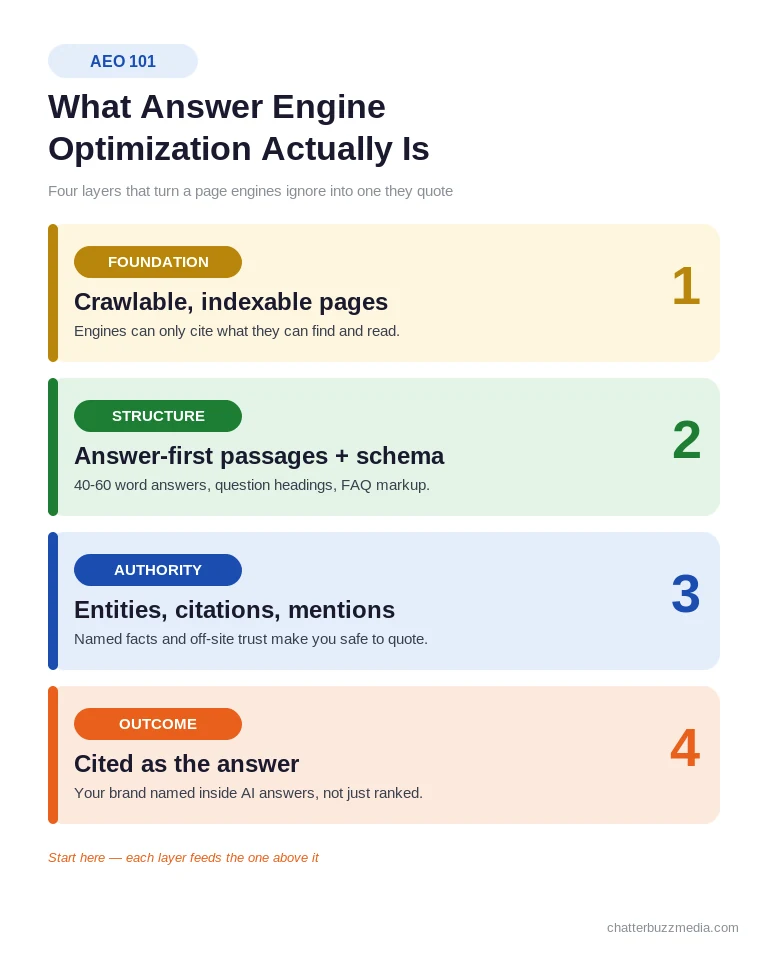
The shift is subtle but total. A blue link earns a click; a citation earns a mention inside the answer itself, often before the user ever sees a list of results.
That mention is now where discovery happens. When someone asks an AI assistant “who does credit union marketing” or “what is the best PPC structure,” the brands named in the response win the consideration set before a single website loads.
It also helps to untangle the alphabet soup. AEO is the umbrella term for optimizing to become the answer, while GEO (generative engine optimization) and SGE-era tactics are narrower labels for the same core idea aimed at generative results.
The vocabulary keeps shifting, but the discipline does not. Make your best answers easy to find, easy to parse, and easy to trust, and you will surface no matter which acronym wins the marketing cycle.
Key Takeaways
- AEO earns citations, not just clicks. The goal is to be the quoted source inside an AI answer, not only a ranked link.
- Structure beats length. Direct-answer blocks of 40-60 words, question-shaped headings, and clean schema get pulled far more often than dense prose.
- Bottom-funnel content wins. Comparisons, pricing logic, and specific how-tos generate the highest AI referral traffic.
- Entities and authority still decide trust. Named-entity density, citations, and off-site mentions tell engines your content is safe to surface.
- New metrics matter. Track citation frequency, share of voice, and AI referral traffic instead of rankings alone.
Who should care about AEO? Any business whose buyers research before they buy — which is nearly all of them. Service firms, B2B brands, healthcare and financial providers, and multi-location businesses all lose ground the moment a competitor becomes the default AI answer in their category.
The good news is that AEO is not a rip-and-replace of your current marketing. It is a structural upgrade to content you likely already have, aimed at making your best pages quotable instead of merely rankable.
This guide breaks AEO down into a repeatable system: how it differs from SEO, why it matters now, how engines choose sources, the seven-part framework to get cited, the tools worth using, per-platform tactics, and how to measure whether any of it is working. By the end, you will know exactly what to change on your highest-value pages this quarter.
AEO vs SEO: What Actually Changes
AEO and SEO share the same foundation but chase different outcomes: SEO optimizes a page to rank and earn a click, while AEO optimizes a passage to be retrieved and cited inside an AI-generated answer. One competes for position; the other competes for attribution.
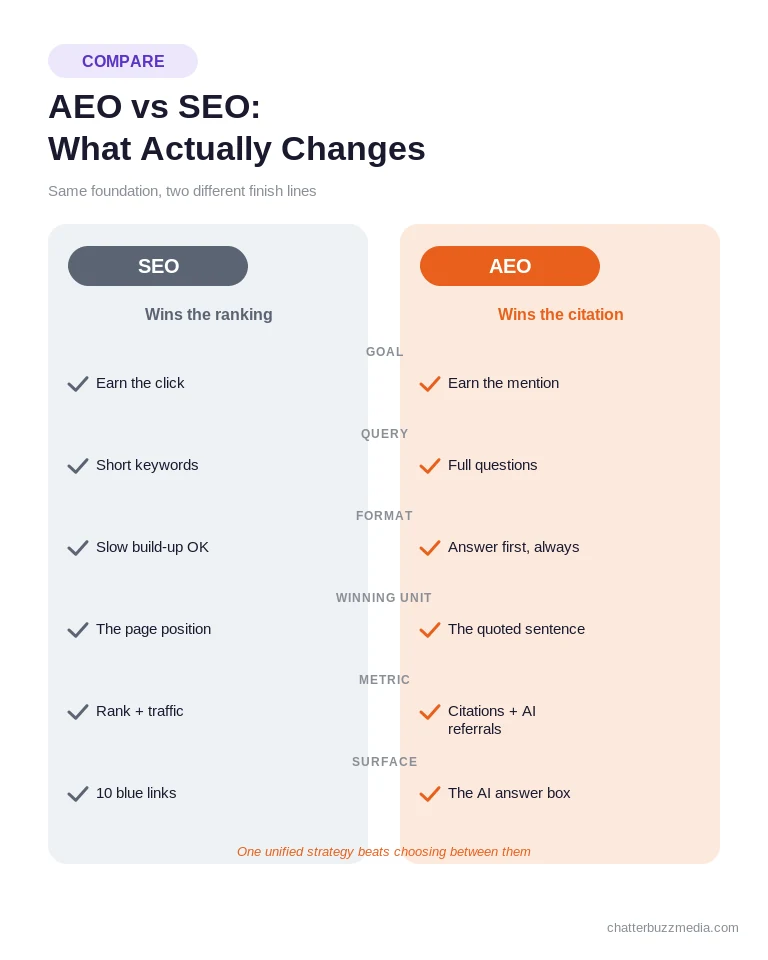
They are not rivals. A strong SEO base — crawlable, authoritative, well-structured pages — is a prerequisite for AEO, because engines still pull from content they can find and trust.
Think of SEO as earning the right to be considered and AEO as earning the right to be quoted. You cannot be cited from a page an engine never indexed, so the foundation has to come first.
The practical difference shows up in format and intent. SEO tolerates a 200-word warm-up before the payoff; AEO punishes it, because engines lift the passage that answers the question fastest and most cleanly.
Intent shifts too. SEO often chases a keyword; AEO chases a question, and that reframing changes how you title sections, structure answers, and decide what belongs at the very top of a page.
Here is where the two diverge in day-to-day execution:
- Query shape: SEO targets short keywords; AEO targets full, conversational questions the way people actually ask them.
- Content structure: SEO allows a slow build; AEO front-loads a crisp answer, then adds depth beneath it.
- Winning unit: SEO wins the page ranking; AEO wins the sentence that gets quoted.
- Success metric: SEO counts clicks and positions; AEO counts citations, mentions, and referral traffic from AI tools.
Consider a real example. A page titled “SEO vs PPC” might rank on page one for years, but if its opening paragraph meanders before defining either term, an answer engine will skip it and quote a competitor who defined both in the first two sentences.
The fix is not to abandon depth. It is to lead with the answer and keep the depth underneath, so the same page satisfies a skimming engine and a serious reader at once, a balance we explore in our SEO vs PPC comparison.
Treat AEO as an extension of SEO, not a replacement. The teams that win in 2026 run one unified strategy where the same page ranks organically and feeds the answer, covered in our breakdown of SEO practices for 2026 and the fundamentals in this glossary of core SEO terms.
Once you accept that citations are the new currency, the next question is why this shift is accelerating so quickly.
Why AEO Matters Now: Inside the Zero-Click Shift
AEO matters now because search behavior has crossed a tipping point: the majority of searches end without a click, and hundreds of millions of people get answers straight from AI tools instead of websites. If your content is not the cited source, you are invisible to a growing share of your market.
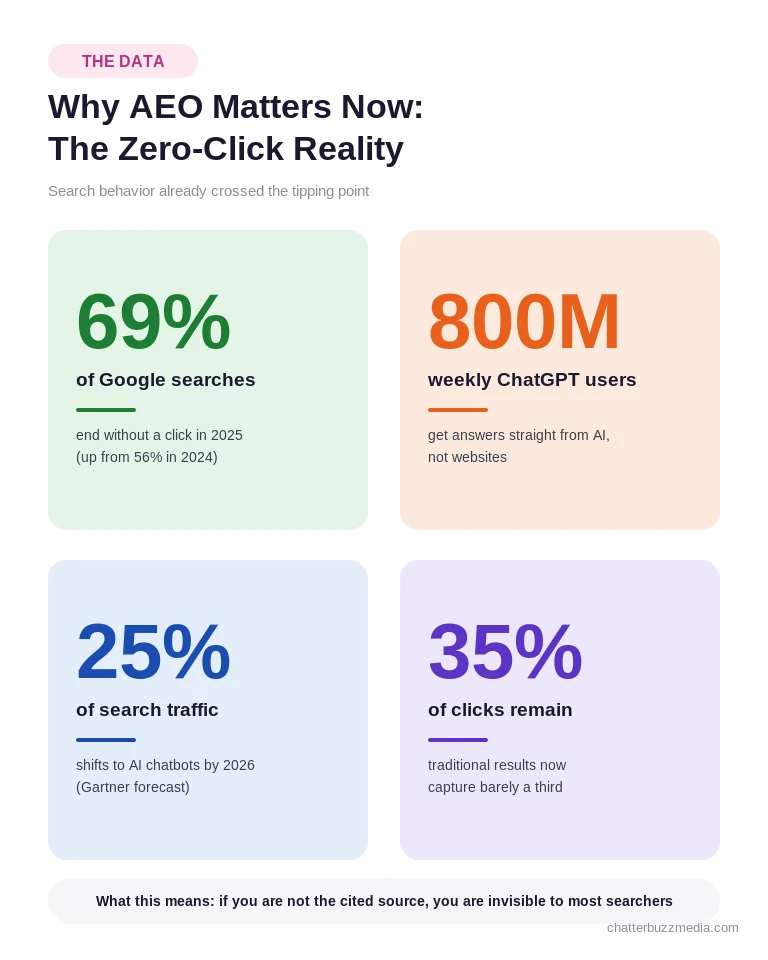
The numbers are stark. Zero-click Google searches climbed from 56% in 2024 to roughly 69% in 2025, meaning most queries are answered on the results page itself.
Read that shift slowly, because it rewrites the deal you thought you had with search. For most of the last two decades, ranking meant traffic; now ranking can mean an appearance in an answer you never get credited for unless you optimize for the citation.
At the same time, ChatGPT reached 800 million weekly active users, and a growing slice of research now starts in an assistant rather than a search bar. Discovery is moving to surfaces where there are no ten blue links at all.
Analysts see the trend continuing. Gartner projected that 25% of organic search traffic will shift to AI chatbots and virtual agents by 2026, pulling volume away from traditional listings.
Fewer clicks does not have to mean less business. Brands that stay in the answer keep winning mindshare, and the winners increasingly separate reach from raw traffic:
- Traffic can fall while revenue rises when your brand is still cited and remembered at the moment of decision.
- Impressions shift to answers, so being named in an AI response builds recognition even without a visit.
- Zero-click does not mean zero-value; it means value moves upstream to the citation.
There is a second-order effect worth naming. As Google surfaces AI Overviews above the organic results, even the clicks that remain get pushed further down the page, so the cost of not being in the answer keeps rising.
For local and regional businesses, the stakes are just as high. When a buyer asks an assistant for the best provider in Orlando or Tampa, being the cited name shapes the shortlist, which is why optimizing your Google Business Profile now feeds AEO as much as it feeds maps.
The takeaway is simple: the audience did not disappear, it relocated. To follow it, you need to understand how answer engines actually pick their sources.
How Answer Engines Decide What to Cite
Answer engines cite content that is easy to retrieve, easy to parse, and safe to trust — clear passages that directly answer the query, backed by structured data and recognizable authority signals. They are not ranking ten links; they are assembling one answer and choosing which sources to name.
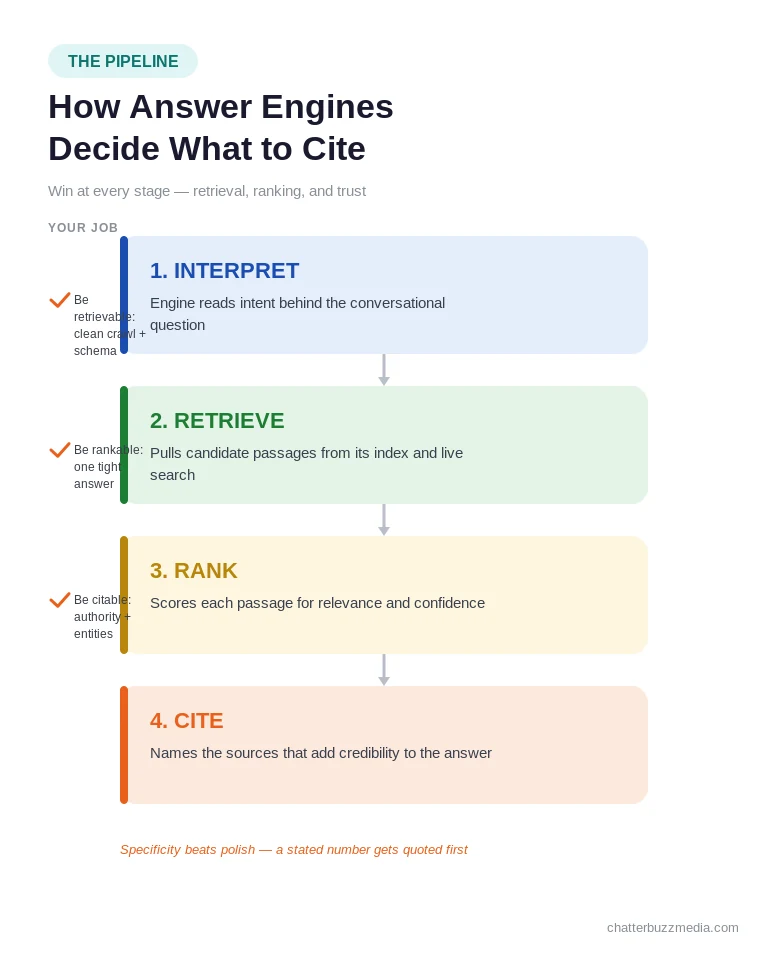
Under the hood, large language models and retrieval systems break your page into passages and score each one for relevance to the question. The passage that answers most cleanly, in the fewest words, tends to win the citation.
This is why a 4,000-word page can lose to a single well-formed paragraph. Engines do not cite word count; they cite the chunk that resolves the question, so your job is to make that chunk impossible to miss.
Three technical layers drive that decision. First is natural-language understanding, where engines interpret intent behind conversational questions rather than matching exact keywords.
Second is structured data. Schema markup — FAQPage, HowTo, Article — and a clean knowledge-graph presence help engines label what your content is and lift it with confidence, which is why technical SEO fundamentals matter more than ever.
Third is authority and entities. Named-entity density, citations to primary sources, reviews, and off-site mentions all signal that your brand is a credible thing to quote, not a risk.
Authority is where many sites quietly lose. An engine will happily paraphrase a topic it understands, and it only bothers to name a source when that source adds credibility the model cannot manufacture on its own.
There is also a trust dimension engines cannot ignore: experience. First-hand results, original data, named case outcomes, and specific examples are exactly the E-E-A-T signals that separate a quotable source from generic filler an AI can already generate on its own.
This is the one advantage AI cannot copy from you. Write what only you know — real numbers, real outcomes, real lessons — and you give engines a reason to cite you instead of paraphrasing the crowd.
To earn citations, give engines what they reward:
- Answer first, elaborate second so the retrievable passage is unmistakable.
- Mark up your content with the right schema types for questions, steps, and articles.
- Name entities precisely — products, places, people, and specifics engines can verify.
- Build off-site trust through authoritative links, listings, and mentions.
It helps to picture the pipeline. An engine interprets the question, retrieves candidate passages from its index or live search, ranks them for relevance and confidence, and then generates an answer that names the sources it leaned on most.
Your job is to win at every stage of that pipeline. Be retrievable through clean crawling and schema, be rankable through a tight answer, and be citable through authority signals that make quoting you the safe choice.
One nuance surprises most teams: engines reward specificity over polish. A plain sentence that states “the average B2B landing page converts at 2.35%” is more quotable than a beautifully written paragraph that never commits to a number.
Understanding the selection logic is half the battle. The other half is a repeatable framework you can apply to every page.
The 7-Part AEO Framework to Get Cited
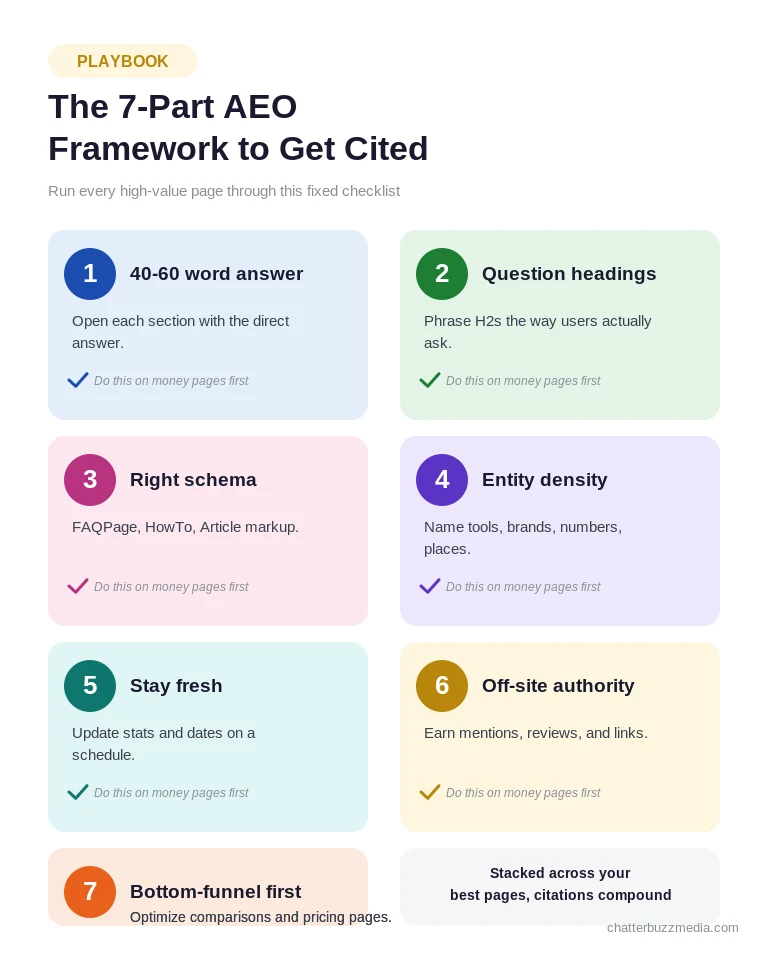
The fastest way to get cited is to run every high-value page through a fixed checklist: answer-first structure, question-shaped headings, schema, entities, freshness, authority, and measurement. Treat AEO as a system, not a one-time edit, and citations compound.
Before the list, one mindset shift. Stop writing for a reader who scrolls patiently and start writing for a machine that scans for the cleanest answer, then a reader who wants the depth below it.
Serve both audiences and you win both. The framework below is simply the repeatable way to do that on every page.
Below is the seven-part framework. Apply it to your money pages first — comparisons, service pages, and high-intent guides — because those generate the most AI referral traffic.
- 1. Lead with a 40-60 word answer. Open every major section with a direct, self-contained answer to the implied question, then expand beneath it.
- 2. Write question-shaped headings. Phrase H2s and H3s the way users ask, so engines can match heading to query instantly.
- 3. Add the right schema. Implement FAQPage, HowTo, and Article markup so engines can classify and safely surface your content.
- 4. Raise entity density. Name specific tools, brands, numbers, and places instead of vague phrasing, giving engines verifiable facts to cite.
- 5. Keep content fresh. Update stats, dates, and examples regularly, because engines favor current, maintained sources.
- 6. Build off-site authority. Earn mentions, reviews, and links from trusted sites so your brand reads as a credible source, supported by high-authority link building.
- 7. Prioritize bottom-funnel pages. Optimize comparisons, pricing, and specs first, since these earn disproportionate citations and buyers.
A quick note on the answer block, because it does the heaviest lifting. The strongest ones restate the question’s core noun, deliver a complete answer in one or two sentences, and avoid pronouns that only make sense in context — because engines often lift the passage on its own.
Entity density is the second underrated move. Replace “a popular analytics tool” with “Google Analytics 4,” and “some studies” with the named source and figure, so the passage carries facts an engine can verify and attribute.
Freshness deserves a system, not a whim. Put a recurring review on your top pages, refresh the statistics and the year in the title, and log the update date, because a page that clearly reflects the current year earns more trust than a stale one.
Each move is small on its own. Stacked across your best pages, they turn a site engines ignore into one they quote, and they pair naturally with strong featured-snippet optimization and a well-mapped content-to-journey plan.
With the framework in place, the next lever is tooling — knowing which platforms help you find questions, structure answers, and track citations.
Answer Engine Optimization Tools and How to Use Them
The best answer engine optimization tools fall into four jobs: finding the questions people ask, structuring content for extraction, validating schema, and tracking whether AI engines actually cite you. No single tool does all four, so most teams assemble a small stack.
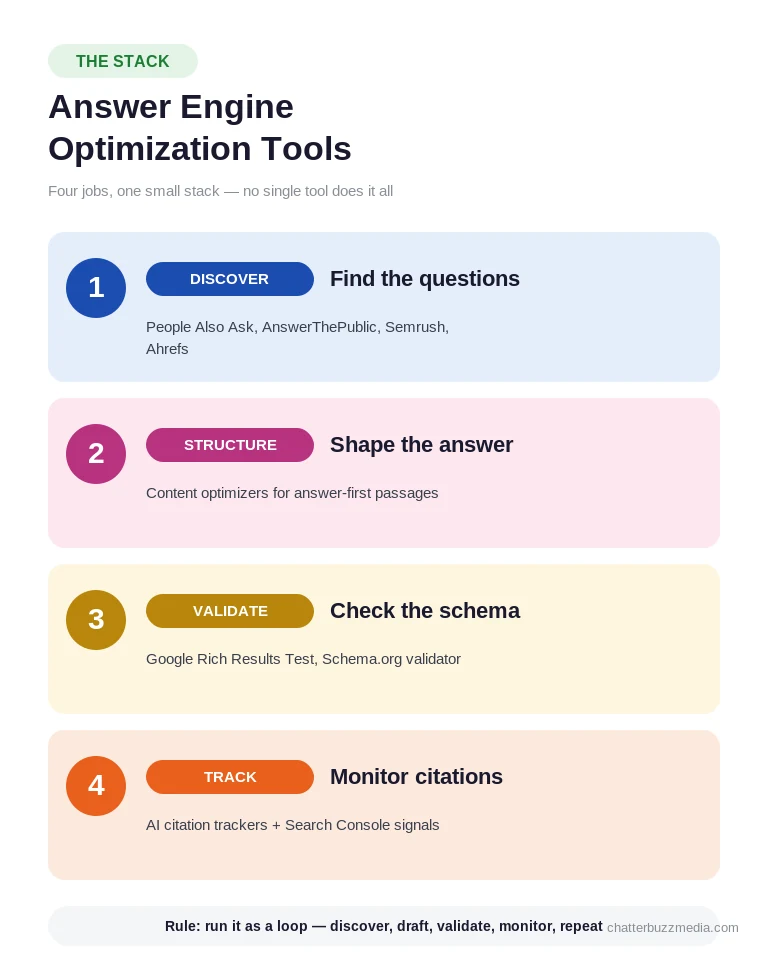
Start with question discovery. People Also Ask boxes, AnswerThePublic, and topic-research features inside Semrush or Ahrefs surface the exact conversational queries to build answers around.
Next comes structure and schema. Content optimization tools help you shape answer-first passages, and Google’s Rich Results Test plus the Schema.org validator confirm your markup is valid before it ships.
Then add citation tracking, the newest category. Emerging AEO tools monitor how often ChatGPT, Perplexity, and AI Overviews mention your brand, giving you a citation-frequency baseline that keyword tools never captured.
Do not overlook the analytics you already own. Google Search Console and your analytics platform reveal question-style queries and AI referral sources, which is often enough to spot early wins before you invest in specialized software.
Use the stack in a loop, not a vacuum:
- Discover the highest-intent questions in your category.
- Draft answer-first content mapped to those questions.
- Validate schema and structure before publishing.
- Monitor citations and iterate on what gets pulled.
A word of caution on the shiny new category. Citation-tracking tools vary widely in accuracy because AI answers are personalized and non-deterministic, so treat their numbers as directional trends rather than precise counts.
You can also run a zero-cost version of every job. Manually prompt ChatGPT, Perplexity, and Google AI Mode with your priority questions, record who gets cited, and you have a rough share-of-voice baseline before you spend a dollar on software.
Match the tool to the maturity of your program. Early on, People Also Ask and a spreadsheet are plenty; as you scale, dedicated discovery and tracking platforms pay for themselves by showing exactly where you are winning and losing.
Tools accelerate the work, but they do not replace judgment about which pages deserve attention first. For a broader view of how AI is reshaping discovery, see our take on AI search and leveraging AI in marketing.
That brings us to the question every leader asks next: how do you prove AEO is working?
How to Measure AEO Success
You measure AEO with three metrics that rankings never captured: citation frequency (how often engines quote you), share of voice (how often you appear versus competitors), and AI referral traffic (visits arriving from ChatGPT, Perplexity, and similar tools). Together they replace position-obsessed reporting with attribution-based reporting.
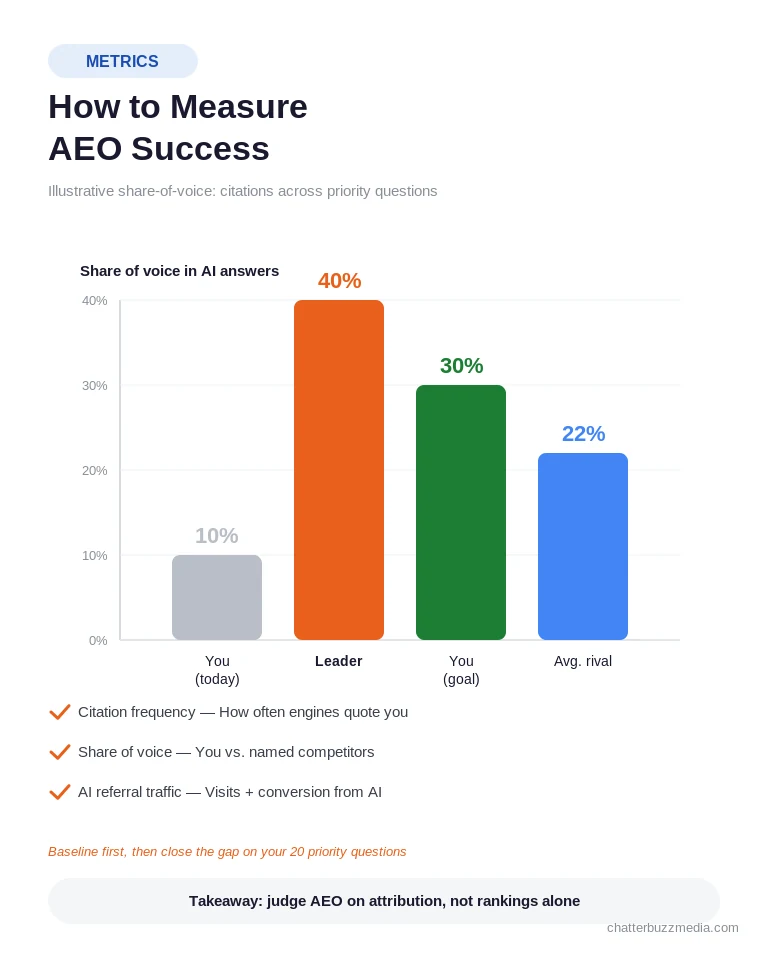
The reason the old scorecard fails is simple. In a zero-click world, a page can influence thousands of decisions while its traffic line stays flat, so a rankings-only report will make winning content look like it is losing.
Citation frequency is the new ranking position. It answers a blunt question: for the queries that matter, how often does your brand show up inside the answer?
Share of voice adds context. If a competitor is cited on 40% of category questions and you are on 10%, you have a clear, measurable gap to close.
It also turns a vague goal into a concrete target. Instead of “get more AI visibility,” you can commit to raising share of voice on your twenty priority questions by a specific percentage this quarter.
AI referral traffic closes the loop on revenue. Analytics segments for AI sources reveal that these visitors often arrive later in the buying journey and convert at strong rates, which is why clear reporting and data visualization matters for proving impact.
That last point reframes the whole exercise. A smaller number of AI-referred visitors who already trust your brand can outperform a larger pool of cold organic clicks, so judge these channels on quality, not just volume.
Build your AEO scorecard around signals, not vanity:
- Citation frequency across your priority questions and platforms.
- Share of voice versus named competitors in AI answers.
- AI referral traffic and its conversion rate, tracked separately from organic.
- Impression-to-citation trend on question queries in Search Console as an early snippet signal.
Set the baseline before you optimize, or you will never prove the lift. Capture citation counts and AI referral traffic for your priority pages today, so the changes you make next quarter have a clear before-and-after.
Watch for the leading indicator hiding in Search Console. When a page shows rising impressions but flat clicks on question-style queries, that gap often signals your content is being surfaced as an answer even before dedicated tools confirm it.
Measured this way, AEO stops being a buzzword and becomes a line you can defend in a budget meeting. Before the FAQs, it helps to see how the tactics shift across the specific platforms your buyers actually use.
AEO Platform Playbook: ChatGPT, Perplexity, Google and Gemini
Each answer engine sources content differently, so a smart AEO program tunes for the platforms that matter most: ChatGPT and Gemini lean on trained knowledge plus live retrieval, Perplexity is citation-heavy and link-forward, and Google AI Overviews blends its index with generative answers. The fundamentals are shared, but the emphasis shifts.
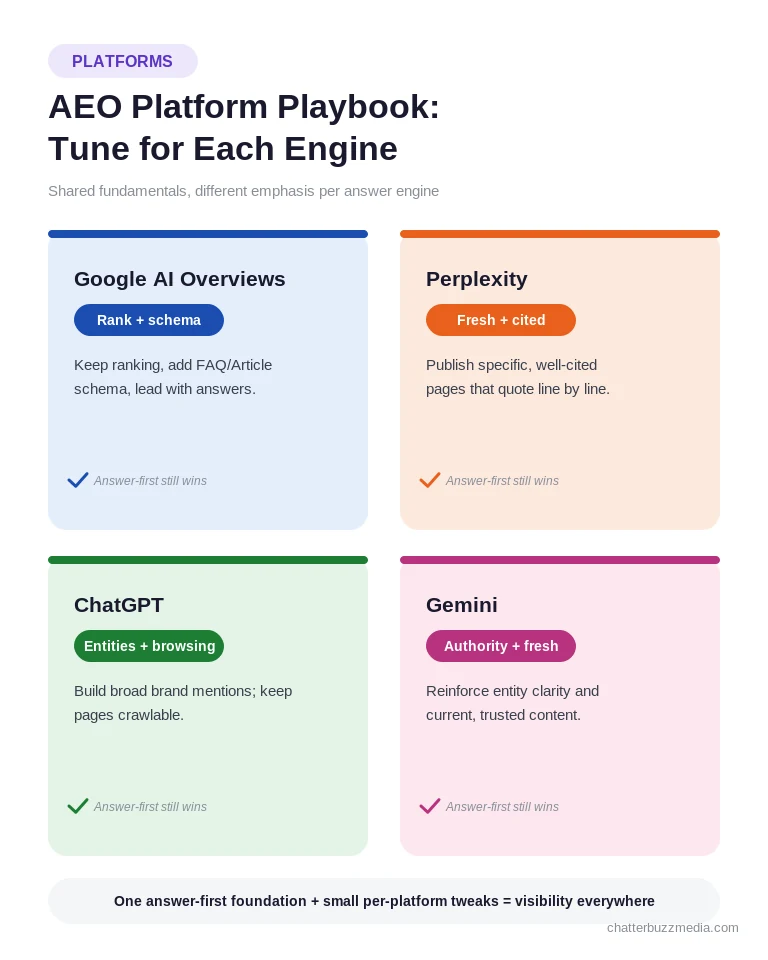
Google AI Overviews reward the same signals as classic search, amplified. Strong rankings, FAQ and Article schema, and crisp answer blocks all raise your odds of being pulled into the overview at the top of the page.
Perplexity is the most transparent about sourcing, listing citations beside every answer. It favors fresh, well-structured pages with clear claims, which makes it the best place to see quick wins from answer-first formatting.
Use Perplexity as your live testing ground. Because it shows exactly which pages it cites, you can watch a formatting change move you into the source list within days, then apply the same pattern everywhere else.
ChatGPT and Gemini combine model knowledge with live browsing, so both entity authority and current, crawlable content matter. Being widely mentioned across trusted sites raises the odds the model already knows and trusts your brand.
This is why off-site presence quietly powers on-platform results. A brand that shows up in reputable roundups, directories, and industry press becomes a familiar name the model reaches for first when a relevant question appears.
Translate that into platform-aware priorities:
- For Google AI Overviews: keep ranking, add schema, and lead every section with a direct answer.
- For Perplexity: publish fresh, specific, well-cited pages that are easy to quote line by line.
- For ChatGPT and Gemini: build broad brand mentions and keep authoritative pages crawlable and current.
- Across all four: reinforce entity clarity so every engine can tell exactly who you are and what you do.
You do not need a separate strategy per platform. You need one strong, answer-first foundation with small adjustments for where your audience spends its time, an approach that mirrors how we help brands prepare for the future of search.
With the playbook set, here are the questions teams ask most about putting AEO into practice.
Frequently Asked Questions About AEO
1. 🔍 What is answer engine optimization in simple terms?
Answer engine optimization is the practice of structuring content so AI tools and search features can lift it as the direct answer to a question. Instead of only chasing rankings, you optimize to be the cited source inside an AI-generated response.
2. 📊 What is the difference between SEO and AEO?
SEO optimizes a page to rank and earn a click, while AEO optimizes a passage to be retrieved and cited inside an answer. SEO wins position; AEO wins attribution, and the two work best as a single unified strategy.
3. ⚡ How do I get my content cited by ChatGPT and Perplexity?
Lead each section with a concise 40-60 word answer, use question-shaped headings, add FAQ and structured data markup, and name specific entities and sources. Clear, verifiable, well-structured passages are far easier for engines to quote.
4. 🏦 Does AEO replace traditional SEO?
No — AEO is an extension of SEO, and it depends on the same crawlable, authoritative foundation. The strongest approach ranks in organic search and gets cited in AI answers at the same time.
5. 🤝 What are the best answer engine optimization tools?
Effective stacks combine question discovery (People Also Ask, AnswerThePublic, Semrush, Ahrefs), schema validation (Rich Results Test, Schema.org validator), and AI citation tracking tools. No single tool covers every job, so most teams assemble a few.
6. 💰 How do you measure AEO success?
Track citation frequency, share of voice in AI answers, and AI referral traffic and its conversion rate. These attribution-based metrics matter more than keyword rankings alone in a zero-click world.
7. 🚀 What content gets cited most by AI answer engines?
Bottom-funnel content — comparisons, pricing logic, service specifics, and step-by-step answers — earns the most AI citations. It provides the clear, decision-ready facts engines prefer to surface.
8. 📈 How long does AEO take to show results?
Structural changes like answer blocks and schema can influence citations within weeks, while authority and entity signals compound over months. Treat AEO as an ongoing system, not a one-time project.
Conclusion: Your AEO Action Plan
The move from rankings to citations is not a trend to watch; it is the current reality of how people find answers. The brands that adapt now will own their category’s AI answers while competitors still count clicks.
Start with a focused, four-step plan:
- 1. Audit your money pages. Identify the comparisons, service pages, and high-intent guides that should be cited and rank them by value.
- 2. Restructure for extraction. Add 40-60 word answer blocks, question-shaped headings, and the right schema to each one.
- 3. Strengthen authority and entities. Name specifics, cite sources, and build off-site mentions that make your brand safe to quote.
- 4. Measure and iterate. Baseline citation frequency and AI referral traffic, then refine the pages that are close to breaking through.
The mistake to avoid is waiting for the shift to feel finished before you act. AEO is not a switch that flips on a launch date; it is a slow reallocation of attention that is already underway, and early movers accumulate citations that get harder to displace over time.
You also do not need to boil the ocean. Pick your ten most valuable pages, apply the framework, baseline your metrics, and expand from there — a focused start beats a perfect plan that never ships.
Do those four things consistently and AEO becomes a compounding advantage rather than a scramble. For a deeper foundation, explore our marketing resource library, the fundamentals in preparing for the future of SEO, review how AI is changing discovery in our look at multi-location and local SEO, and align it all inside a broader marketing strategy and planning approach.
Need help with SEO? Explore our SEO agency services.

Victoria Wallace
Victoria Wallace is a senior content strategist and marketing writer with 30+ years of experience helping more than 200 brands translate complex business goals into clear, conversion-focused content. Her background spans paid media, marketing strategy, go-to-market planning, brand positioning, and full-funnel campaign development, giving her a deep understanding of how SEO content connects to real business growth.