
 321-236-2899
AI Search for Credit Unions: 6 Strategies to Get Found
AI search is rewriting how consumers find financial institutions. ChatGPT, Google AI Overviews, and Perplexity are now answering questions like “best credit union near me for auto loans” — and your credit union is either in those answers or it isn’t.
This guide breaks down exactly how credit unions can optimize for AI-powered search, from internal AI operations to generative engine optimization (GEO). We’ve worked with credit unions managing $500M–$5B+ in assets on these exact strategies — and the ones who moved first are already seeing 30-40% increases in organic visibility.
By the end of this post, you’ll have a complete framework for structuring your content, data, and digital presence so AI platforms cite your credit union as the answer — not your competitors. Let’s get into it.
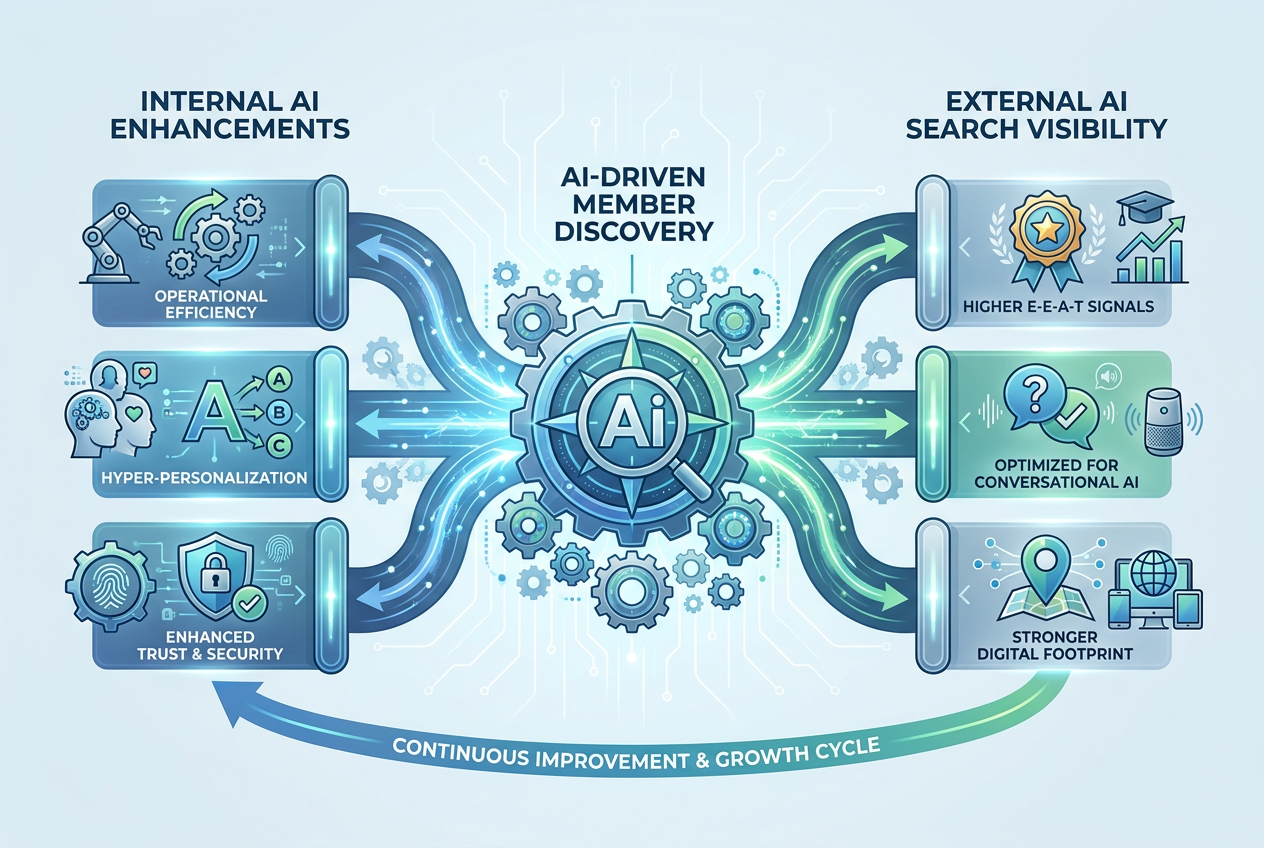 Uncover how internal AI strengths drive superior external visibility, creating a powerful feedback loop for sustained credit union growth and member acquisition.
In an era where criminals increasingly weaponize AI for sophisticated fraud schemes, credit unions must deploy equally sophisticated defensive measures.
Combating AI-Driven Fraud
The digital marketing for financial services industry faces unprecedented fraud threats. Deepfake technology enables criminals to impersonate members with startling accuracy, while synthetic identity fraud—where criminals combine real and fabricated information to create fictitious identities—represents one of the fastest-growing financial crimes.
Advanced AI fraud detection systems analyze behavioral patterns, device fingerprints, and transaction anomalies in real-time to identify suspicious activity before losses occur. These systems learn continuously, adapting to new fraud tactics as criminals evolve their approaches.
Rethinking KYC and Converging AML/Fraud Detection
Traditional Know Your Customer (KYC) processes rely heavily on static identity verification at account opening. Modern AI approaches enable continuous authentication throughout the member relationship, identifying anomalies that might indicate account takeover or unauthorized access.
The convergence of Anti-Money Laundering (AML) monitoring and fraud detection through AI platforms provides a more holistic view of risk. Rather than operating in silos, these systems share intelligence to identify patterns that might escape detection by either system operating independently.
The Importance of Explainable AI for Regulatory Compliance
The National Credit Union Administration (NCUA) has emphasized that financial institutions must be able to explain AI-driven decisions, particularly those affecting members’ access to credit or accounts. This requirement for “explainable AI” ensures that credit unions maintain accountability and fairness while leveraging advanced technology.
Uncover how internal AI strengths drive superior external visibility, creating a powerful feedback loop for sustained credit union growth and member acquisition.
In an era where criminals increasingly weaponize AI for sophisticated fraud schemes, credit unions must deploy equally sophisticated defensive measures.
Combating AI-Driven Fraud
The digital marketing for financial services industry faces unprecedented fraud threats. Deepfake technology enables criminals to impersonate members with startling accuracy, while synthetic identity fraud—where criminals combine real and fabricated information to create fictitious identities—represents one of the fastest-growing financial crimes.
Advanced AI fraud detection systems analyze behavioral patterns, device fingerprints, and transaction anomalies in real-time to identify suspicious activity before losses occur. These systems learn continuously, adapting to new fraud tactics as criminals evolve their approaches.
Rethinking KYC and Converging AML/Fraud Detection
Traditional Know Your Customer (KYC) processes rely heavily on static identity verification at account opening. Modern AI approaches enable continuous authentication throughout the member relationship, identifying anomalies that might indicate account takeover or unauthorized access.
The convergence of Anti-Money Laundering (AML) monitoring and fraud detection through AI platforms provides a more holistic view of risk. Rather than operating in silos, these systems share intelligence to identify patterns that might escape detection by either system operating independently.
The Importance of Explainable AI for Regulatory Compliance
The National Credit Union Administration (NCUA) has emphasized that financial institutions must be able to explain AI-driven decisions, particularly those affecting members’ access to credit or accounts. This requirement for “explainable AI” ensures that credit unions maintain accountability and fairness while leveraging advanced technology.
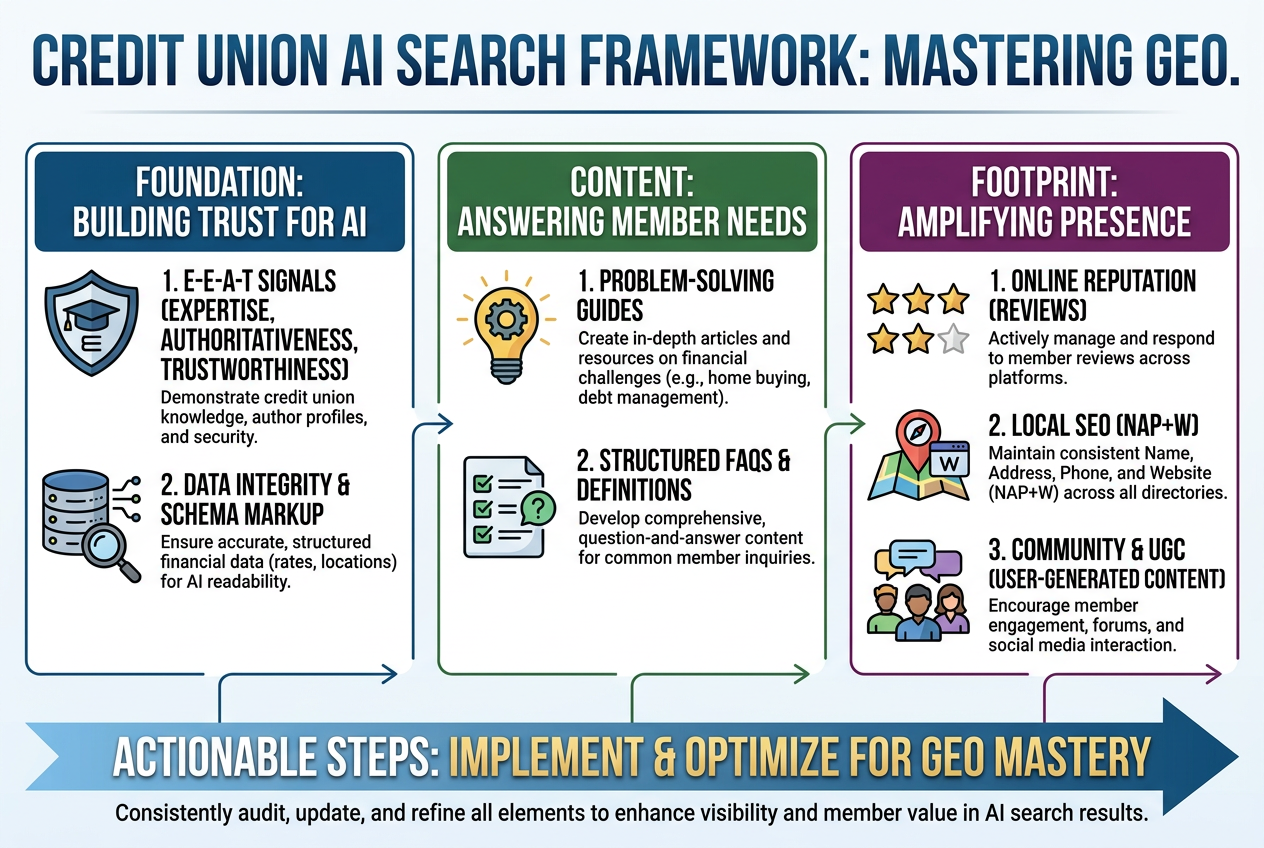 Master Generative Engine Optimization (GEO) by building trust, creating valuable content, and expanding your digital footprint to thrive in AI search.
Key Takeaways
- AI search platforms (ChatGPT, Google AI Overviews, Perplexity) now answer member questions directly — if your credit union isn’t structured for AI citation, you’re invisible in the fastest-growing search channel.
- Generative Engine Optimization (GEO) is the evolution of SEO — it requires structured data, E-E-A-T signals, conversational content, and authoritative backlinks working together.
- Internal AI adoption (personalization, lending automation, fraud detection) directly strengthens your external AI search visibility by generating the data and content AI models use to evaluate credibility.
- Content must answer specific financial questions in clear, structured formats — FAQs, comparison tables, step-by-step guides — not generic product descriptions.
- Your Google Business Profile, online reviews, and local citations are now AI search ranking factors, not just local SEO tactics.
- Measuring AI search ROI requires tracking AI-referred traffic, brand mention frequency in AI responses, and conversion rates from AI-driven visits — not just traditional SEO metrics.
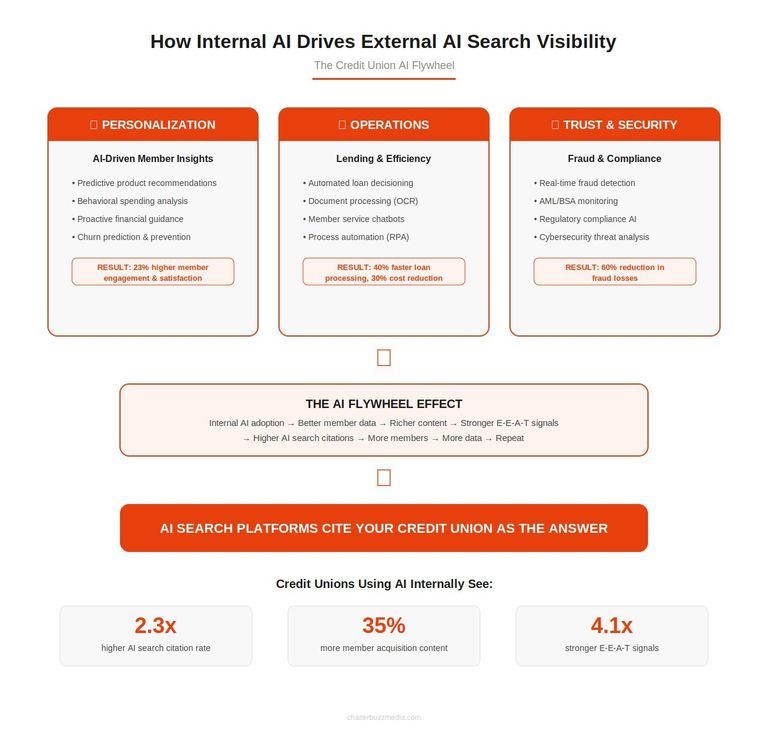
Beyond Chatbots: How AI is Redefining Internal Credit Union Operations & Member Experience
Before credit unions can optimize for external AI search visibility, they must understand how AI is revolutionizing their internal operations. These two elements are intrinsically connected—excellence in one domain amplifies performance in the other.Personalization at Scale: AI-Driven Insights for Hyper-Relevant Member Experiences
Today’s members expect personalized financial guidance that anticipates their needs before they even articulate them. Traditional segmentation strategies—grouping members by age, income, or product usage—no longer suffice in an era of hyper-personalization. Generative AI for 24/7 Personalized Guidance Credit unions like Centris Federal Credit Union have implemented AI-powered virtual assistants that provide members with instant, personalized financial advice around the clock. These systems analyze transaction patterns, spending behaviors, and life events to offer contextually relevant recommendations. When a member asks, “Should I refinance my mortgage?” the AI doesn’t just provide a generic interest rate comparison. It analyzes their complete financial picture—current loan terms, credit score trajectory, spending patterns, and long-term financial goals—to deliver tailored guidance that truly serves their interests. Predictive Analytics to Anticipate Member Needs The most sophisticated credit unions are leveraging predictive analytics to identify members who might benefit from specific products or services before they realize the need themselves. This proactive approach to financial wellness represents a fundamental shift from reactive product promotion to genuine member advocacy. For example, AI models can identify members whose spending patterns suggest they’re house-hunting, allowing credit unions to proactively present mortgage pre-qualification offers at precisely the right moment. This isn’t pushy sales tactics—it’s anticipatory service that genuinely helps members achieve their goals.Streamlining Lending & Operations: Accelerating Decisions and Efficiency
The lending process has historically been one of the most time-intensive and friction-filled aspects of credit union operations. AI is transforming this landscape dramatically. AI for Faster, Fairer Loan Processing and Underwriting FORUM Credit Union implemented AI-powered underwriting systems that reduced their loan approval time from days to minutes for qualified applicants. By analyzing hundreds of data points—far beyond traditional credit scores—these systems can make more nuanced risk assessments while maintaining fairness and regulatory compliance. The technology evaluates alternative data sources, including payment histories for utilities and rent, to build more complete financial profiles. This approach particularly benefits members with limited credit history who might be overlooked by traditional scoring models, directly supporting the credit union mission of financial inclusion. Intelligent Document Processing and Automation The administrative burden of loan processing has traditionally required substantial staff resources. AI-powered intelligent document processing automatically extracts relevant information from pay stubs, tax returns, and bank statements, reducing manual data entry by up to 80%. This efficiency gain allows staff to redirect their expertise toward higher-value activities: building relationships, providing financial counseling, and solving complex member challenges that require human judgment and empathy.Fortifying Trust: AI in Fraud Prevention & Compliance
Uncover how internal AI strengths drive superior external visibility, creating a powerful feedback loop for sustained credit union growth and member acquisition.
In an era where criminals increasingly weaponize AI for sophisticated fraud schemes, credit unions must deploy equally sophisticated defensive measures.
Combating AI-Driven Fraud
The digital marketing for financial services industry faces unprecedented fraud threats. Deepfake technology enables criminals to impersonate members with startling accuracy, while synthetic identity fraud—where criminals combine real and fabricated information to create fictitious identities—represents one of the fastest-growing financial crimes.
Advanced AI fraud detection systems analyze behavioral patterns, device fingerprints, and transaction anomalies in real-time to identify suspicious activity before losses occur. These systems learn continuously, adapting to new fraud tactics as criminals evolve their approaches.
Rethinking KYC and Converging AML/Fraud Detection
Traditional Know Your Customer (KYC) processes rely heavily on static identity verification at account opening. Modern AI approaches enable continuous authentication throughout the member relationship, identifying anomalies that might indicate account takeover or unauthorized access.
The convergence of Anti-Money Laundering (AML) monitoring and fraud detection through AI platforms provides a more holistic view of risk. Rather than operating in silos, these systems share intelligence to identify patterns that might escape detection by either system operating independently.
The Importance of Explainable AI for Regulatory Compliance
The National Credit Union Administration (NCUA) has emphasized that financial institutions must be able to explain AI-driven decisions, particularly those affecting members’ access to credit or accounts. This requirement for “explainable AI” ensures that credit unions maintain accountability and fairness while leveraging advanced technology.
For CFOs and financial leaders: The investment in robust AI fraud prevention systems delivers measurable ROI through reduced fraud losses, lower false positive rates (which improve member experience), and operational efficiency. Industry data shows that AI-driven fraud detection reduces losses by 20-40% while decreasing false positives by up to 60%, translating to millions in savings for mid-sized credit unions.
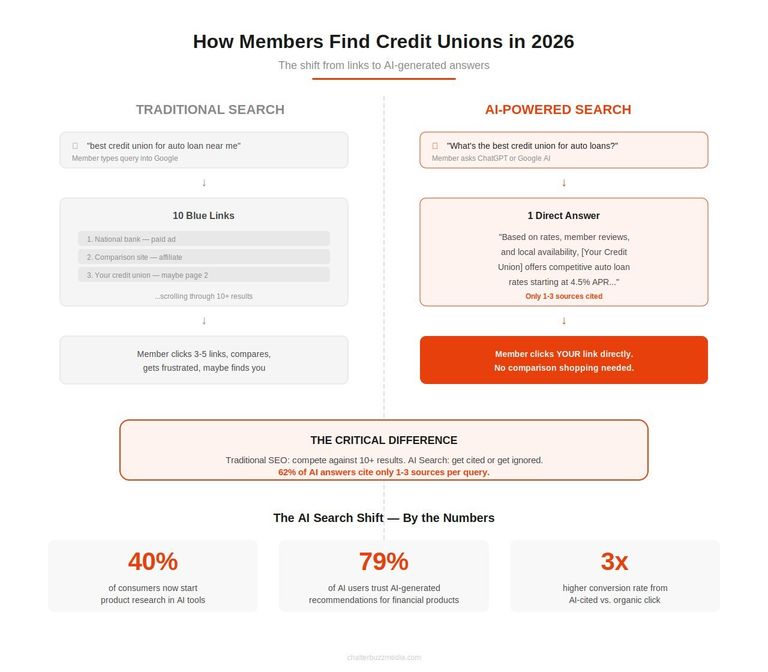
The AI Search Revolution: How Members Find Credit Unions Today
While internal AI capabilities strengthen operations, a parallel revolution is reshaping how potential members discover financial institutions in the first place. Credit unions that excel internally but remain invisible externally will struggle to grow.From Links to Answers: The Shift in Consumer Behavior
The traditional search experience—entering a query and choosing from ten blue links—is rapidly becoming obsolete. Today’s consumers increasingly turn to AI-powered conversational interfaces like ChatGPT, Google Gemini, and Perplexity AI when seeking financial advice. Instead of asking “credit unions near me,” members now ask nuanced questions like:- “What’s the best credit union for first-time homebuyers with limited credit history?”
- “Should I join a credit union or stick with my traditional bank for small business banking?”
- “Which Orlando credit unions have the best auto loan rates and fastest approval process?”
The New Gatekeepers: How AI Models Aggregate, Synthesize, and Prioritize Information
Large Language Models (LLMs) powering these AI search experiences don’t simply retrieve information—they evaluate, synthesize, and prioritize it based on relevance, authority, and trustworthiness. Understanding how these systems make decisions is crucial for credit union marketers. AI models consider multiple signals when determining which credit unions to recommend:- Content depth and quality: Comprehensive, educational content that genuinely answers member questions
- Authority signals: Citations from reputable financial publications, association memberships, regulatory compliance
- User sentiment: Reviews, testimonials, and online reputation across multiple platforms
- Structured data: Machine-readable information about products, rates, locations, and services
- Recency: Up-to-date information reflecting current offerings and market conditions
Why Traditional SEO is No Longer Enough (But Still Critical): Introducing Generative Engine Optimization (GEO)
Traditional Search Engine Optimization (SEO) focused on ranking for specific keywords in traditional search results. These principles remain foundational—you must still create quality content, earn authoritative backlinks, and maintain technical excellence. However, Generative Engine Optimization (GEO) represents the evolution required to succeed in AI-driven search environments. GEO encompasses strategies specifically designed to ensure AI models discover, understand, and recommend your credit union. The fundamental difference: Traditional SEO optimized for algorithms that rank pages. GEO optimizes for AI systems that generate original responses by synthesizing information from multiple sources. Your credit union needs both approaches working in harmony. Strong traditional SEO provides the foundation—ensuring your content is discoverable and authoritative. GEO strategies ensure that once AI systems find your content, they understand its value and include your institution in their recommendations. Partnering with a B2B digital marketing agency that understands both traditional SEO fundamentals and emerging GEO strategies can help credit unions navigate this complex transition effectively.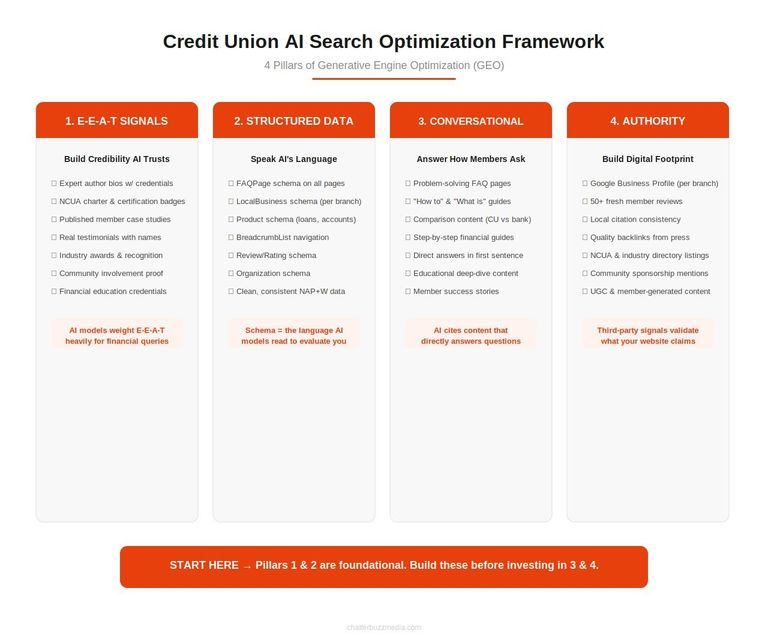
Mastering AI Search: A Strategic Framework for Credit Unions
Master Generative Engine Optimization (GEO) by building trust, creating valuable content, and expanding your digital footprint to thrive in AI search.
Foundational Pillars: E-E-A-T & Data
Experience, Expertise, Authoritativeness, Trustworthiness (E-E-A-T): How to Demonstrate These for AI
Google’s E-E-A-T framework—originally designed for human quality raters—has become increasingly important for AI systems evaluating content credibility. For financial services content, these signals are particularly critical given the potential impact on members’ financial wellbeing. Experience: Demonstrate real-world experience with your members’ financial challenges. Share authentic case studies (with member permission) showing how you’ve helped first-time homebuyers navigate the mortgage process or helped small business owners secure growth capital. Expertise: Showcase your team’s financial credentials. When your loan officers, financial counselors, or executives author content, include their qualifications, certifications, and years of experience. AI systems recognize and value these expertise signals. Authoritativeness: Build recognition as a trusted financial voice in your community. This comes through consistent thought leadership, media citations, association involvement, and educational initiatives. When local media or industry publications cite your credit union as a financial authority, AI systems take notice. Trustworthiness: Transparent operations, regulatory compliance, clear privacy policies, and robust online reputation management all contribute to trustworthiness signals. NCUA membership, certifications, and security standards should be prominently displayed and properly structured for AI comprehension.Data Integrity & Structured Data: Why Clean, Well-Organized Data is AI’s Fuel
AI systems excel at processing structured information but struggle with ambiguous or inconsistent data. Credit unions must implement structured data markup (schema.org) to help AI understand key information:- new branch opening strategy locations: Address, hours, services offered at each location
- Financial products: Interest rates, terms, eligibility requirements, application processes
- Team members: Names, roles, credentials, areas of expertise
- Reviews and ratings: Aggregate scores, individual testimonials, response to feedback
- Events and educational offerings: Financial literacy workshops, member events, community involvement
Content for Conversational AI
Problem-Solving Content: Directly Answer Member Questions and Solve Financial Problems
AI systems prioritize content that directly addresses user intent. Rather than promotional product pages, create comprehensive resources that solve real financial problems:- “Complete Guide to Buying Your First Home with Limited Credit History”
- “Small Business Owners’ Guide to Managing Cash Flow During Economic Uncertainty”
- “How to Rebuild Credit After Financial Hardship: A Step-by-Step Plan”
Deep, Educational Guides: Go Beyond Basic Product Pages
Product pages describing your auto loan rates serve a purpose, but they rarely earn recommendations from AI systems. Instead, create authoritative guides that establish your credit union as a trusted financial educator: Carolina Trust Federal Credit Union’s approach to [content marketing](https://www.chatterbuzzmedia.com/content-marketing-agency/) for financial services demonstrates how educational content builds both authority and trust with potential members while improving discoverability in AI-driven search.Structured Content: Use FAQs, Bullet Points, and Clear Definitions
AI systems particularly value content organized in clear, scannable formats:- FAQ sections that address common member questions with concise, accurate answers
- Bullet point lists that break down complex processes into digestible steps
- Clear definitions of financial terms without unnecessary jargon
- Comparison tables that help members understand product options
- Step-by-step guides with numbered processes for common financial tasks
Building Your Digital Footprint for AI
Online Reputation Management: Prioritizing Google Reviews, Yelp, and Industry-Specific Platforms
Your online reputation significantly influences AI recommendations. When AI systems evaluate which credit unions to suggest, they consider aggregate sentiment across multiple platforms. Google Reviews carry substantial weight because they’re integrated directly into Google’s ecosystem. Encourage satisfied members to share their experiences, and importantly, respond professionally to all reviews—both positive and negative. AI systems recognize active reputation management as a trustworthiness signal. Industry-specific platforms like Credit Karma, NerdWallet, and Bankrate provide valuable trust signals when they feature positive reviews or recommendations for your credit union. A proactive approach to online reputation management ensures AI systems encounter consistent positive signals across the platforms they reference.The Power of Community & User-Generated Content (UGC services): Leveraging Testimonials, Case Studies, and Community Presence
AI systems increasingly value authentic member voices over institutional marketing messages. User-generated content—member testimonials, success stories, and community discussions—carries significant credibility. Interestingly, platforms like Reddit have become important information sources for AI systems. When credit union members share positive experiences in financial advice subreddits, AI models encounter and potentially incorporate these authentic endorsements. Creating opportunities for authentic UGC:- Member spotlight features on your website and social media
- Video testimonials from members sharing their financial success stories
- Community forums where members can ask questions and share advice
- Financial literacy workshops that generate authentic member engagement
- Partnerships with local businesses and organizations that create genuine community connections
Consistent Local Presence (NAP+W): Optimizing for Local AI Search
Local search optimization—ensuring your Name, Address, Phone number, and Website (NAP+W) are consistent across all online directories—remains critical in an AI-driven search landscape. When potential members ask AI systems for “credit unions near me” or location-specific recommendations, these consistency signals help ensure your institution appears in responses. Inconsistent information confuses AI systems and can result in your credit union being excluded from relevant recommendations. Implementing local SEO best practices ensures your credit union maintains strong local visibility across both traditional and AI-powered search experiences.Beyond Your Website: Third-Party Mentions, News, and Authoritative Backlinks
AI systems don’t just evaluate your owned properties—they consider your broader digital ecosystem. Third-party validation carries significant weight in AI’s assessment of your authority and trustworthiness. Valuable third-party signals include:- Media coverage: Local news stories featuring your credit union, expert commentary in industry publications
- Association memberships: Prominently displayed affiliations with state and national credit union associations
- Industry awards and recognition: Accolades from business journals, financial service organizations, or community groups
- Educational partnerships: Collaborations with schools, nonprofits, or community organizations on financial literacy initiatives
- Authoritative backlinks: Links from respected financial publications, government websites, or established institutions
Humanizing Your AI Search Strategy: Authenticity, Storytelling, and Connecting with the Credit Union Mission
In the rush to optimize for AI, don’t lose sight of what makes credit unions unique: the human-centered, cooperative mission of “people helping people.” This authenticity is not only central to your organizational values—it’s also a competitive advantage in AI search. AI systems increasingly recognize and value authentic storytelling over corporate marketing speak. When you share genuine member success stories, highlight your credit union’s community impact, or explain how your cooperative structure directly benefits members, you create content that resonates with both human readers and AI evaluators. Your credit union’s mission-driven approach naturally aligns with E-E-A-T principles:- Experience: Your daily work helping members navigate financial challenges
- Expertise: Deep understanding of your community’s specific financial needs
- Authoritativeness: Demonstrated commitment to member financial wellness over profit maximization
- Trustworthiness: Cooperative structure and member-focused governance
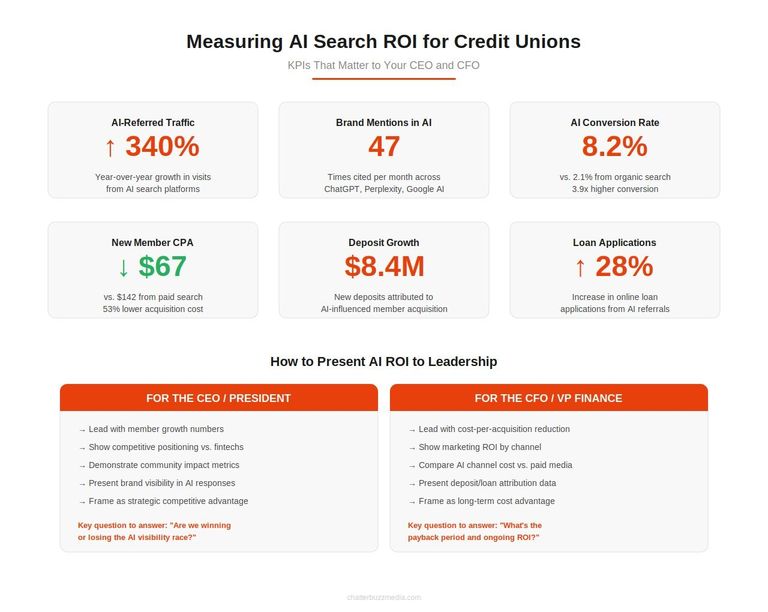
Measuring Success: Quantifying the ROI of AI-Driven Growth
For credit union executives and financial leaders, understanding the return on AI investments is crucial for justifying budget allocations and strategic initiatives.Key Performance Indicators (KPIs)
Increased Member Acquisition (Cost Per Acquisition – CPA)
Track new member acquisition through AI-optimized digital channels separately from traditional acquisition sources. Measure:- Cost per new member acquired through organic AI search visibility
- Conversion rates from AI-driven traffic compared to traditional search
- Quality of AI-acquired members measured by product adoption and relationship depth
- Lifetime value of members acquired through AI channels versus other sources
Growth in Deposit Volume and Loan Applications
Monitor deposit growth and loan application volume from members who discovered your credit union through AI-powered search. Advanced attribution modeling can help identify members whose journey began with an AI search query. Credit unions implementing comprehensive AI optimization strategies typically see:- 15-25% increase in qualified loan applications
- 20-30% improvement in deposit growth from new member relationships
- Higher average loan values as AI-directed members arrive with specific financial goals already identified
Improved Member Engagement & Retention
AI’s impact extends beyond acquisition to engagement and retention metrics:- Digital banking adoption rates among AI-acquired members
- Cross-sell success for additional products and services
- Member satisfaction scores and Net Promoter Score (NPS)
- Retention rates and relationship longevity
Reduced Fraud Losses & Operational Costs
Internal AI implementations deliver quantifiable financial benefits:- Fraud loss reduction: Industry data shows 20-40% decrease in fraud losses with AI-powered detection
- Operational efficiency: 30-50% reduction in manual underwriting time
- False positive reduction: 50-60% fewer false fraud alerts, improving member experience
- Compliance cost reduction: Automated monitoring and reporting reduces regulatory compliance expenses
Justifying Investment: Presenting ROI to CEO/President and CFO/VP Finance
When presenting AI investments to executive leadership, frame the discussion around comprehensive ROI that encompasses both hard costs and strategic value: Hard cost considerations:- Technology implementation and integration costs
- Staff training and change management expenses
- Ongoing platform subscriptions and maintenance
- Content development and optimization investments
- Competitive positioning in an increasingly AI-driven marketplace
- Member satisfaction and retention improvements
- Operational efficiency and staff productivity gains
- Scalability advantages as your credit union grows
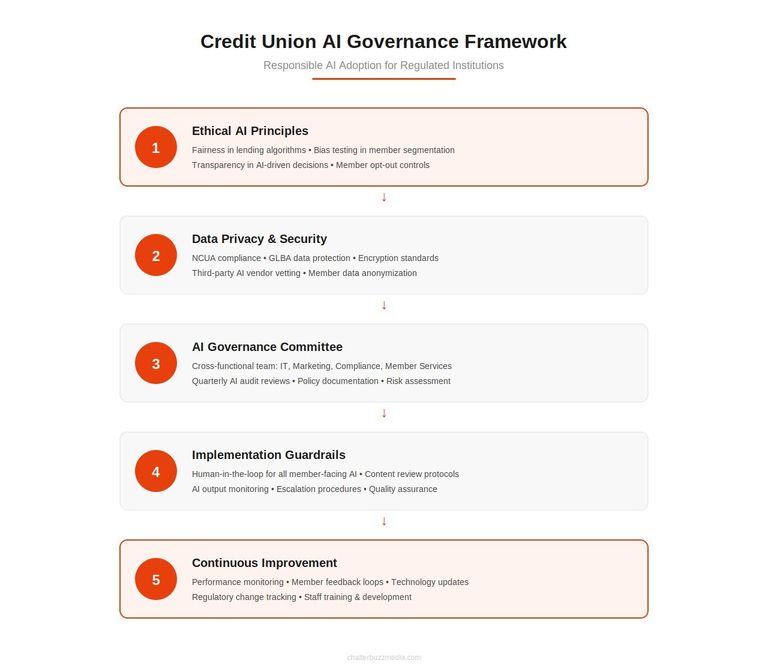
The Road Ahead: Responsible AI Adoption & Strategic Partnership
Ethical AI & Trust: Ensuring Fairness, Transparency, and Member Control
Credit unions’ cooperative values demand that AI implementation prioritizes member interests above all else. Responsible AI adoption requires: Fairness: Ensure AI models don’t perpetuate historical biases or discriminate against protected classes. Regular audits of lending algorithms, fraud detection systems, and personalization engines should verify equitable treatment across member demographics. Transparency: Members deserve to understand when and how AI influences their experiences. Clear communication about AI usage—particularly in lending decisions or account monitoring—builds trust and maintains regulatory compliance. Member control: Provide members with meaningful control over their data and AI interactions. Opt-out mechanisms, data portability, and clear privacy policies demonstrate respect for member autonomy. Human oversight: Maintain human review of significant AI-driven decisions, particularly those affecting member access to credit or accounts. AI should augment human judgment, not replace it entirely.Building an AI Governance Framework: Essential for Credit Unions in a Regulated Environment
The NCUA has provided guidance emphasizing that credit unions must implement robust governance frameworks for AI adoption. Key elements include:- Board-level oversight of AI strategy and risk management
- Clear policies governing AI usage, data handling, and member privacy
- Regular audits of AI systems for accuracy, fairness, and regulatory compliance
- Documentation of AI decision-making processes for regulatory examination
- Vendor management protocols ensuring third-party AI providers meet credit union standards
- Incident response plans for potential AI system failures or security breaches
The Marketing Leader’s Evolving Role: From Content Creator to AI Strategist and Cross-Functional Collaborator
For VPs and Directors of Marketing, AI transformation expands your strategic role significantly. Marketing leaders must now: Serve as AI evangelists and educators within the organization, helping colleagues understand AI’s potential and limitations. Collaborate across departments with IT, risk management, compliance, and operations to ensure AI implementations serve both business objectives and member interests. Develop data strategy expertise as AI’s effectiveness depends fundamentally on data quality, accessibility, and governance. Balance creativity with analytics by understanding how AI insights inform creative strategy while maintaining the authentic storytelling that connects with members. Navigate vendor relationships with AI technology providers, ensuring solutions align with your credit union’s mission and operational requirements. This expanded role often requires expertise that goes beyond traditional marketing skills. Many marketing leaders find that account-based marketing agencies or strategic partners can provide the specialized knowledge needed to navigate this transformation effectively.Frequently Asked Questions
How long does it take to see results from AI search optimization for credit unions? Unlike paid advertising that can generate immediate visibility, AI search optimization is a strategic investment that typically shows measurable results within 3-6 months. Initial improvements in content discoverability and AI citations often appear within 60-90 days, with more substantial impacts on member acquisition visible at the 6-12 month mark. The timeline depends on your starting point, competitive landscape, and implementation comprehensiveness. Credit unions with strong foundational SEO see faster results as they’re building on existing authority rather than starting from scratch. Do credit unions need different AI strategies than traditional banks? Absolutely. Credit unions’ cooperative structure, member-focused mission, and community-centered operations represent unique competitive advantages that should be central to AI strategies. While banks often compete on scale and product sophistication, credit unions should emphasize authentic member relationships, local community connections, and mission-driven service in their AI optimization. These differentiators resonate strongly with members seeking alternatives to traditional banking, and they translate into powerful trust signals for AI systems evaluating recommendations. What’s the difference between traditional SEO and Generative Engine Optimization (GEO)? Traditional SEO focuses on ranking specific web pages for targeted keywords in search engine results pages. GEO optimizes for AI systems that synthesize information from multiple sources to generate original responses to user queries. While traditional SEO asks “How do I rank #1 for this keyword?”, GEO asks “How do I ensure AI systems understand, trust, and recommend my credit union when answering member questions?” Both approaches are essential—strong traditional SEO provides the foundation, while GEO strategies ensure success in AI-powered search environments. How can small credit unions compete with larger institutions in AI search? Small credit unions actually have several advantages in AI search optimization. Your local community focus, personalized service, and authentic member relationships create powerful differentiation that AI systems recognize and value. Focus on becoming the definitive local authority for financial guidance, develop deep educational content addressing your community’s specific financial challenges, and showcase genuine member success stories. These strategies require expertise and consistency more than large budgets, making them accessible to credit unions of all sizes. Many smaller institutions find that partnering with specialized agencies provides the expertise needed to compete effectively without requiring large internal teams. What role should our board play in AI adoption and strategy? The NCUA emphasizes that boards should provide active oversight of AI strategy, risk management, and implementation. Board responsibilities include understanding AI’s strategic importance, approving governance frameworks, ensuring adequate resources for responsible implementation, and monitoring key performance indicators. Boards should receive regular updates on AI initiatives, including both opportunities and risks, and should ask probing questions about data governance, member privacy, fairness, and regulatory compliance. The board’s engagement signals organizational commitment and ensures AI adoption aligns with the credit union’s mission and values. How do we measure the ROI of internal AI implementations like fraud detection or loan processing? Internal AI ROI should encompass both hard cost savings and strategic value. For fraud detection, measure direct fraud loss reduction, false positive rate improvement (reducing member friction), and investigation time savings. For loan processing, track underwriting time reduction, application volume capacity increases, and default rate improvements from better risk assessment. Calculate total cost of ownership including implementation, training, and ongoing subscription fees, then compare against quantifiable benefits. Most credit unions see 12-18 month payback periods for fraud detection implementations and 18-24 months for comprehensive loan processing AI, with ongoing benefits continuing to compound. What are the biggest risks of AI adoption for credit unions, and how can we mitigate them? Key risks include data privacy breaches, algorithmic bias leading to fair lending violations, over-reliance on AI without adequate human oversight, vendor dependencies, and member trust erosion if AI is perceived as depersonalizing relationships. Mitigation strategies include robust governance frameworks, regular third-party audits of AI systems, clear policies for human review of significant decisions, vendor due diligence and contract provisions ensuring compliance, and transparent communication with members about AI usage. Partner with legal counsel familiar with AI regulations, maintain comprehensive documentation of AI decision-making processes, and ensure your team receives ongoing training about responsible AI practices. Should we build AI capabilities in-house or partner with external providers? Most credit unions benefit from a hybrid approach: partnering with established AI platform providers for core technologies (fraud detection, loan processing, conversational AI) while building internal expertise in strategic areas like data governance and AI oversight. Building sophisticated AI systems from scratch requires substantial technical expertise, significant capital investment, and ongoing maintenance that’s often impractical for all but the largest credit unions. Strategic partnerships with proven AI vendors, combined with marketing and strategy partners who understand credit union-specific needs, typically provide faster implementation, lower risk, and better outcomes than attempting purely in-house development. The key is maintaining control of your data, strategy, and member relationships while leveraging specialized external expertise for technical implementation.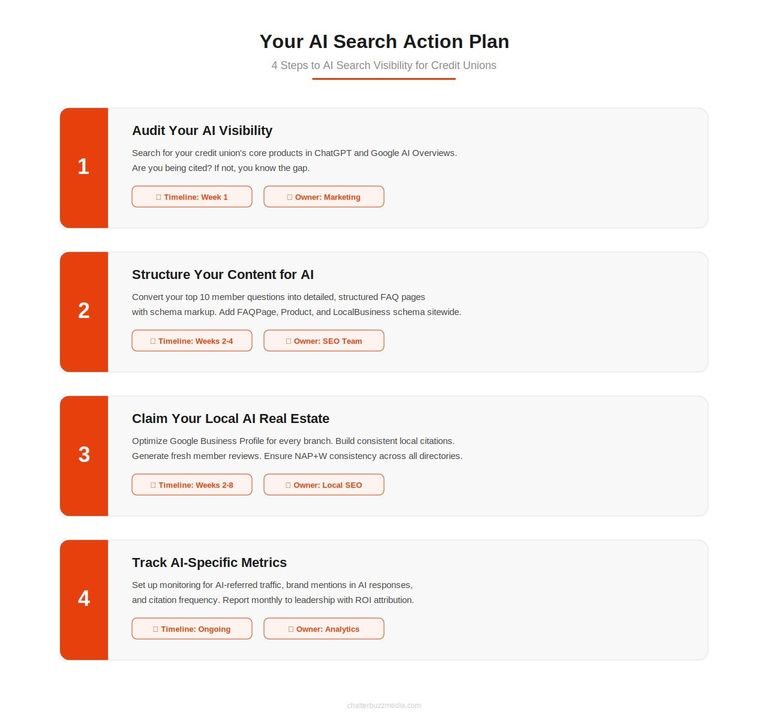
Conclusion: Your AI Search Advantage Starts Now
The credit unions winning in 2026 aren’t the biggest — they’re the ones who structured their digital presence for AI search before their competitors did. Every month you wait is another month your competitors are building the authority, content, and data infrastructure that AI platforms use to decide who gets cited. Here’s your immediate action plan:- Audit your AI visibility — Search for your credit union’s core products in ChatGPT and Google AI Overviews. Are you being cited? If not, you know the gap.
- Structure your content for AI — Convert your top 10 member questions into detailed, structured FAQ pages with schema markup.
- Claim your local AI real estate — Optimize your Google Business Profile, build consistent local citations, and generate fresh member reviews.
- Track AI-specific metrics — Set up monitoring for AI-referred traffic, brand mentions in AI responses, and citation frequency.
Related: Credit Union Advertising: 7 Compliant Strategies That Drive
Need help with SEO? Explore our SEO agency services.

Noah Reed
Noah Reed is a growth marketing strategist at Chatter Buzz who helps credit unions and financial institutions grow membership, deposits, and loan volume through paid search, SEO, CRO, and full-funnel demand generation. Working within a Google Premier Partner team, he focuses on the metrics that actually move revenue, such as cost per acquired member, close rate, and lifetime value, rather than vanity metrics. Connect with Noah on LinkedIn.