
 321-236-2899
Google Ads for Financial Services: 7 Steps to Drive Qualified Leads
Running Google Ads for financial services demands a playbook most industries never need. Between strict compliance requirements, $50–$150 cost-per-click keywords, and Google’s evolving AI features, banks, credit unions, and fintech companies face a PPC landscape that punishes guesswork and rewards precision.
Here’s the upside: financial services averages a 5.9% conversion rate on paid search — well above the cross-industry benchmark. Smart campaigns turn expensive clicks into a durable competitive advantage that compounds over time.
This guide walks through seven steps to build, launch, and optimize Google Ads campaigns for financial institutions. Step 3 covers the compliance framework that prevents account suspensions before they happen. Start here, and you’ll stop burning budget on unqualified clicks.
Key Takeaways
- Measure PPC by customer lifetime value, not cost-per-lead. A checking account customer with an 89.4% retention rate becomes a mortgage, investment, and insurance customer over time.
- Build compliance into your keyword strategy from day one. Google’s financial services ad policies require advertiser verification, geographic restrictions, and mandatory disclosures on both ads and landing pages.
- Long-tail keywords reduce cost and improve compliance. Start with $1–2K/month, 2–3 campaigns, and 5–8 keywords per ad group to generate data before scaling.
- Enhanced Conversions and first-party data pipelines are non-negotiable. First-party data generates 2.9x revenue improvement — the foundation of smart-bidding performance in a cookieless landscape.
- AI Overviews now appear on 79% of financial queries with 9+ words. Structure landing pages and ad copy to win citations in AI-generated answers, not just traditional search results.
- Custom landing pages per ad group drive Quality Score up and CPC down. Mobile-first design matters — 56.4% of financial services traffic comes from mobile devices.
Step 1: Define Campaign Goals Around Customer Lifetime Value
Customer lifetime value (CLV) — not cost-per-lead — determines whether your Google Ads investment pays off. Financial institutions that optimize for CLV consistently outperform competitors who fixate on lead acquisition cost alone.
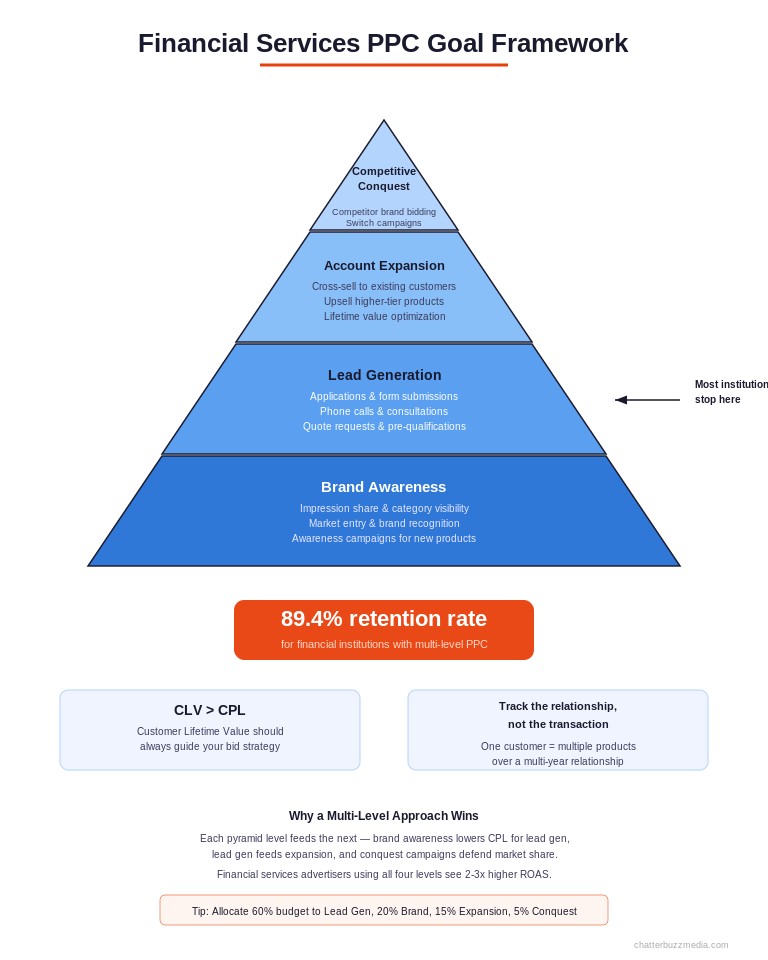
Most banks and credit unions track marketing KPIs like cost-per-click and cost-per-lead. Those metrics matter, but they miss the bigger picture: a single checking account customer retained at the industry’s 89.4% retention rate becomes a mortgage applicant, investment client, and insurance buyer over a 10–15 year relationship.
A $200 lead that converts into a $50,000 mortgage origination reframes every PPC cost calculation. Measure the relationship, not the transaction.
Before launching any campaign, categorize your goals into one of four buckets:
- Brand awareness: Capture impression share on branded and category keywords so prospects see your institution first. Ideal for community banks and credit unions entering new markets.
- Lead generation: Drive applications for checking accounts, savings accounts, personal loans, or business banking. This is where most digital marketing lead generation strategies start.
- Account expansion: Target existing customers with cross-sell offers — home equity lines, investment products, or premium credit cards.
- Competitive conquest: Bid on competitor brand names and “switch from” keywords to capture dissatisfied customers actively comparing alternatives.
Each goal requires different bidding strategies, keyword sets, and conversion actions. A brand awareness campaign measured by lead volume will always look like a failure — and a lead gen campaign judged by impressions will always look like a success that delivers nothing.
Map each campaign to a specific CLV outcome before you write a single ad. That decision shapes everything downstream.
Step 2: Build a Compliance-First Keyword Strategy
Your keyword strategy must satisfy Google’s financial services ad policies before it satisfies your marketing goals. Keywords that trigger policy violations waste budget, risk account suspension, and create compliance headaches that take weeks to resolve.
Google updated its financial services advertising requirements in late 2023, tightening advertiser verification and geographic restrictions. Every institution running PPC for financial services now needs verified advertiser status, geographic targeting aligned with licensing, and disclosures that match the product being advertised.
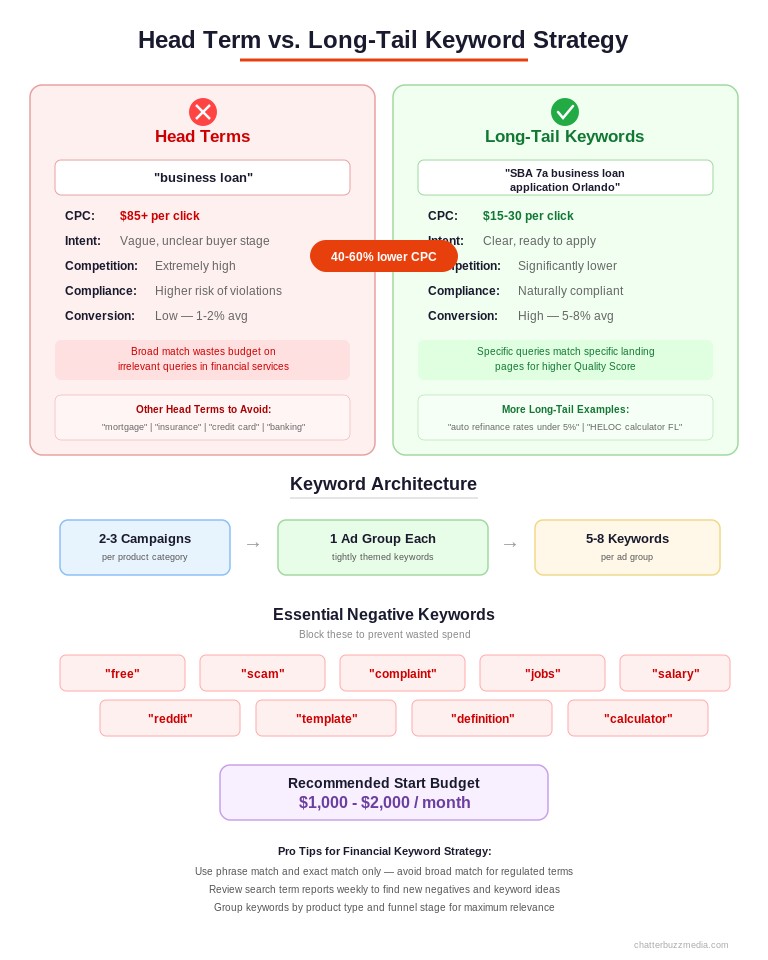
Long-tail keywords solve two problems simultaneously. They cost less per click — often 40–60% below head terms — and they naturally align with compliant ad copy because they describe specific products and services rather than broad financial categories.
Compare these approaches:
- Head term: “business loan” — $85+ CPC, vague intent, high competition, compliance risk from broad matching.
- Long-tail: “SBA 7a business loan application Orlando” — $15–30 CPC, clear intent, lower competition, naturally compliant because it references a specific product and geography.
Structure your keyword strategy around these principles:
- 5–8 keywords per ad group. Tight grouping ensures ad copy matches search intent precisely, which improves Quality Score and reduces CPC.
- Negative keywords are your primary cost-control lever. Block terms like “free,” “scam,” “complaint,” “jobs,” and competitor employee names. With AI Max campaigns expanding match types automatically, negative keyword lists become your most important control mechanism.
- Geographic modifiers in keywords and targeting. Banks and credit unions operate within specific service areas. Add city, county, and state modifiers to keywords and restrict geographic targeting to licensed territories through local targeting.
- Match types matter less than intent alignment. Phrase match and exact match give you tighter control. Broad match with Smart Bidding works only after you’ve accumulated enough conversion data — typically 30–50 conversions per campaign.
Budget starting point: begin with $1,000–$2,000 per month across 2–3 campaigns. This generates enough data to identify winning keywords and negative keyword gaps without overcommitting. Scale only after you’ve established baseline conversion rates and cost-per-acquisition numbers.
Keyword research for financial services Google Ads isn’t a one-time task. Review search term reports weekly to catch irrelevant queries before they drain budget, and add converting long-tail terms as exact match keywords to lock in performance.
Step 3: Navigate Google’s Financial Services Ad Policies
Google restricts financial services advertising more heavily than almost any other vertical. Understanding the policy framework prevents account suspensions that can freeze your pipeline for weeks and cost your institution qualified leads you can’t recover.
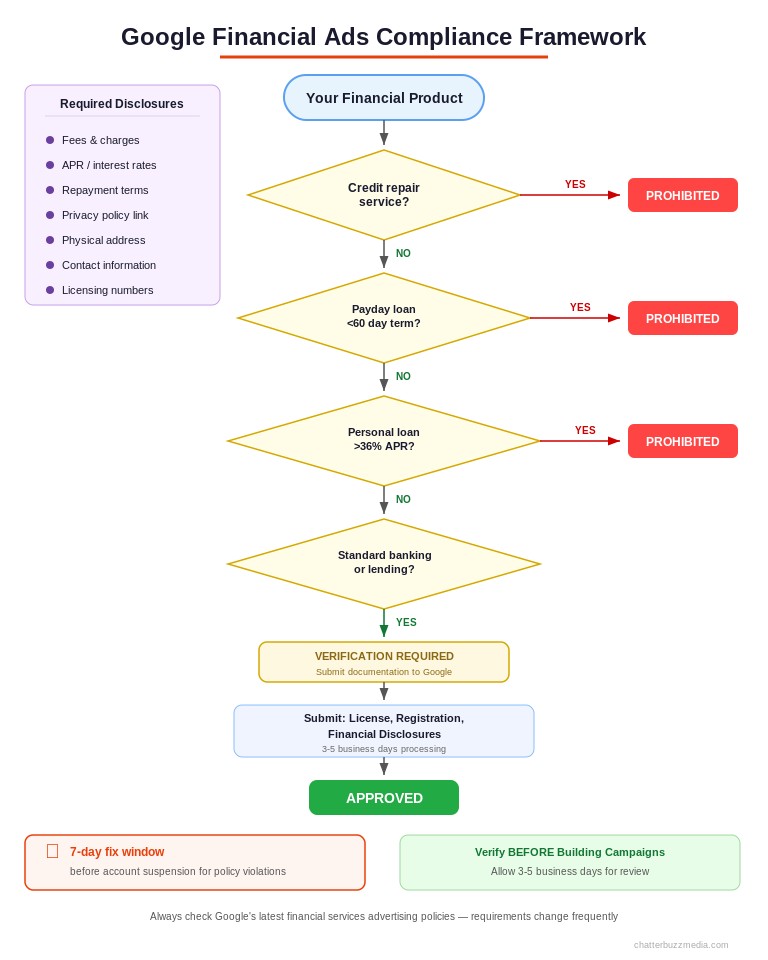
The certification and verification process varies by product type. Personal loans, mortgages, and credit products each carry separate requirements. Start the verification process before you build campaigns — Google’s approval timeline runs 3–5 business days under ideal conditions and longer during peak review periods.
Here’s what Google prohibits outright in financial services advertising:
- Credit repair services. No ads promoting credit score improvement or debt settlement through third parties.
- High-APR personal loans. Loans with APRs exceeding 36% in the US cannot be advertised. Google enforces this globally with country-specific thresholds.
- Misleading financial claims. Guarantees of specific returns, “risk-free” investment language, or promises of loan approval.
- Payday loans with repayment terms under 60 days. These are banned entirely in the US, Canada, and several other markets.
For permitted products, Google requires specific disclosures on both your ads and landing pages:
- Fees and charges must appear clearly — account maintenance fees, origination fees, and penalty fee structures.
- APR and interest rate information needs to be visible on the landing page, not buried in fine print or behind a click.
- Terms and conditions for any promoted offer must appear on the landing page that the ad links to. Redirects to a generic homepage violate this requirement.
Google’s strike system gives you exactly 7 days to fix a violation before suspension. First strikes result in a warning. Three strikes within 90 days trigger account suspension. The appeal process takes 2–4 weeks, during which your campaigns sit dark and competitors capture your traffic.
Two recent policy developments matter for 2026 planning. Google updated its prediction markets advertising policy in January 2026, creating new restrictions around event-based financial products. And ChatGPT Ads launched in February 2026 with its own compliance framework separate from Google’s — financial institutions advertising across both platforms need parallel compliance workflows.
Build a compliance checklist that your team reviews before every campaign launch and every ad copy update. The cost of prevention is a 20-minute review. The cost of a suspension is weeks of lost leads and revenue.
Step 4: Craft High-Converting Ad Copy That Passes Compliance
Effective ad creative for financial services balances persuasion with compliance in extremely tight character limits. Headlines cap at 30 characters and descriptions at 90 characters — every word carries weight.
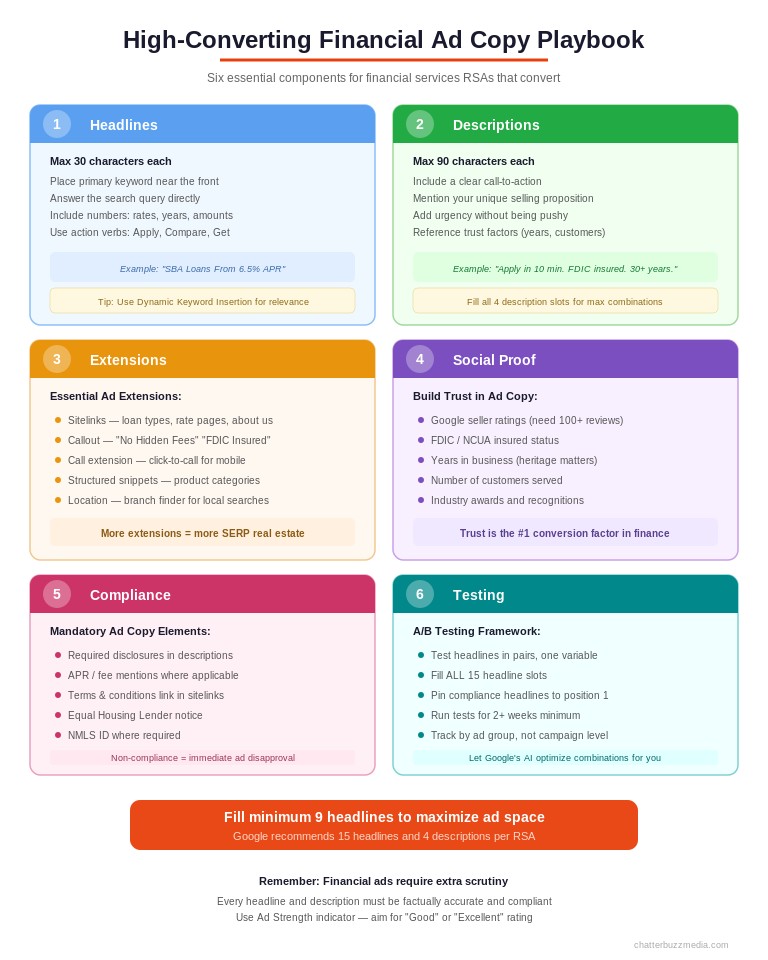
Google Responsive Search Ads (RSAs) now dominate bank Google Ads campaigns. You provide multiple headlines and descriptions, and Google’s machine learning tests combinations to find top performers. Fill all available slots — a minimum of 9 headlines and 4 descriptions — to give the algorithm enough material to optimize.
Structure your headlines around these categories:
- USP headlines: “No Monthly Fees” | “4.5% APY Savings” | “Same-Day Loan Decisions” — lead with your competitive differentiator.
- Social proof headlines: “Trusted Since 1952” | “50,000+ Members Strong” | “$2B in Loans Funded” — build credibility immediately.
- Action headlines: “Apply in 5 Minutes” | “Open Your Account Today” | “Get Pre-Approved Now” — drive the next step.
- Keyword-rich headlines: Use dynamic keyword insertion (DKI) to automatically insert the user’s search query, ensuring relevance. DKI works particularly well for credit union campaigns with localized product offerings.
Descriptions should expand on headlines with specific details. “Apply online in under 5 minutes with no impact to your credit score. FDIC insured, no minimum balance required.” That’s 88 characters of clear value and embedded compliance language.
Maximize ad extensions to dominate more SERP real estate:
- Sitelinks: Link to specific product pages — checking, savings, auto loans, mortgage. Each sitelink gets its own headline and two description lines.
- Callout extensions: “FDIC Insured” | “NCUA Member” | “24/7 Online Banking” | “Free Mobile App” — add trust signals without using character space in your main ad.
- Call extensions: Display your phone number directly. Financial services prospects often prefer speaking with someone before committing to an application.
- Structured snippets: Use “Types” to list product categories: Checking, Savings, CDs, Money Market, Auto Loans. This pre-qualifies clicks.
Every ad must include required disclosures without making the copy feel like a legal document. Lead with brand messaging and value, then incorporate compliance language naturally. “4.5% APY on savings. Terms apply. FDIC insured.” reads better than burying APY disclosures in fine print.
Step 5: Design Landing Pages That Convert and Comply
Your landing page must match your ad’s messaging exactly — both to satisfy Google’s policy requirements and to convert the visitor who just clicked a $100 keyword. Sending paid traffic to your homepage is the most expensive mistake in financial services marketing.
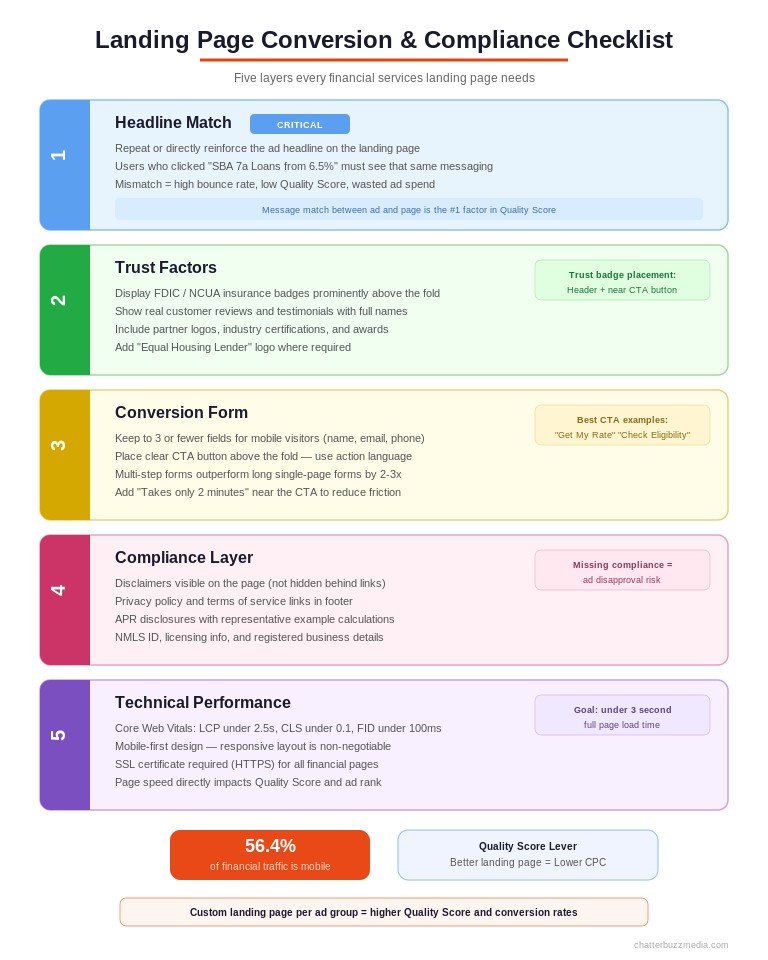
Google’s Quality Score algorithm evaluates landing page experience as one of three core components (alongside expected CTR and ad relevance). Higher landing page quality directly lowers your cost-per-click — a Quality Score improvement from 5 to 7 can reduce CPC by 28% on identical keywords.
Every landing page needs these elements:
- Headline matching the ad. If your ad says “4.5% APY Business Savings,” the landing page headline should reference that same offer. Mismatches kill conversion rates and lower Quality Score.
- Expanded copy that addresses objections and adds detail the ad couldn’t fit. Cover fees, minimums, eligibility requirements, and the application timeline.
- Trust factors above the fold: FDIC/NCUA badges, security certifications, customer count, years in business. Financial prospects make trust decisions in seconds.
- Single, clear CTA. “Open Your Account” or “Get Pre-Approved” — one action per page. Multiple CTAs dilute landing page purpose and reduce conversion rates.
- Short-form lead capture. Name, email, phone — three fields maximum on mobile. Every additional field drops conversion rates by 10–15%.
Compliance requirements extend to your landing page. Fee disclosures, APR information, terms and conditions, and privacy policy links must appear on the page. Missing these triggers ad disapprovals and can escalate to account-level policy violations.
56.4% of financial services web traffic comes from mobile devices. Design mobile-first, not mobile-adapted. That means tap-friendly buttons (minimum 44×44 pixels), forms that auto-advance between fields, and page load times under 3 seconds.
Create custom landing pages for each ad group — not each campaign, each ad group. A “business checking” ad group and a “business savings” ad group need separate landing pages with tailored messaging, even if both fall under the same campaign. This level of specificity is what separates landing pages that convert from pages that waste expensive clicks.
Test relentlessly. A/B test headlines, CTA button copy, form length, and page layout. Conversion rate optimization in financial services has outsized ROI because even small improvements compound across high-value keywords.
Step 6: Set Up Conversion Tracking and First-Party Data Pipelines
Enhanced Conversions are now the primary lever for maintaining smart-bidding performance in financial services PPC. Without robust conversion tracking and first-party data, Google’s bidding algorithms operate blind — and blind algorithms waste money on unqualified clicks.
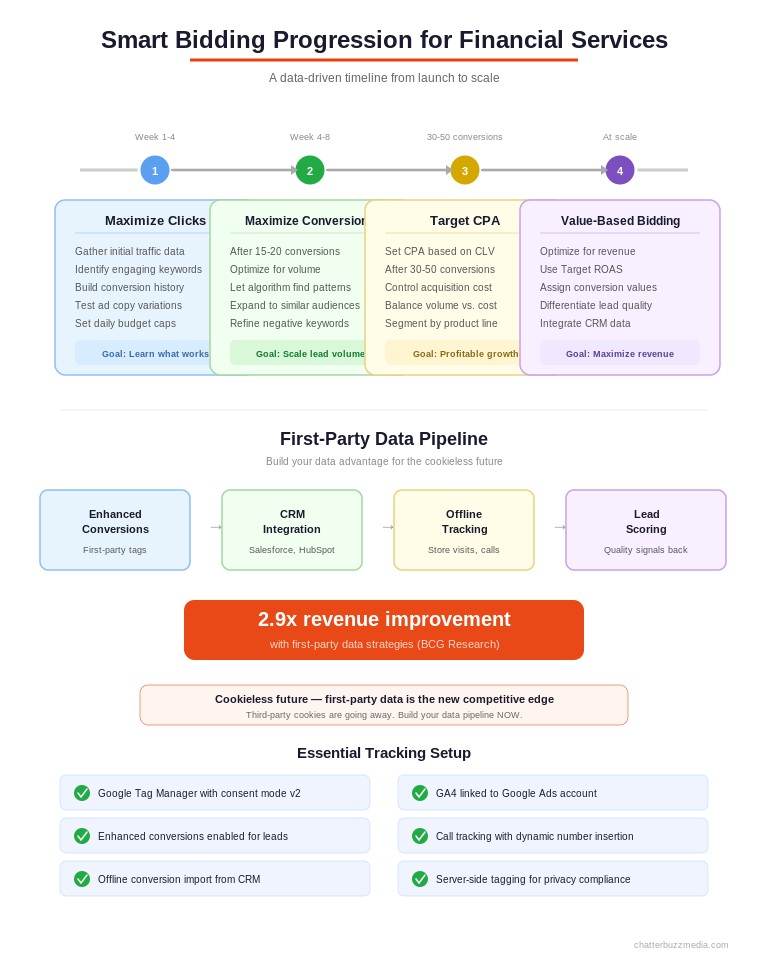
The deprecation of third-party cookies has made first-party data the foundation of effective fintech PPC strategy and bank advertising alike. BCG research shows that first-party data generates 2.9x revenue improvement compared to campaigns relying on third-party signals.
Set up your tracking infrastructure in this order:
- Google Ads conversion tracking on every form submission, phone call, and chat initiation. Tag each conversion action with a value tied to the product’s estimated CLV.
- Enhanced Conversions using hashed first-party data (email, phone, name) to improve attribution accuracy. This is no longer optional — it’s the mechanism that keeps Smart Bidding calibrated.
- Server-side tagging with GA4. Move tracking from the browser to your server to maintain data quality as privacy regulations tighten. Server-side tagging also improves page load speed, which benefits Quality Score.
- CRM integration for offline conversion tracking. When a lead from Google Ads walks into a branch and opens an account, feed that conversion data back to Google. This trains the algorithm to find more prospects who convert offline — critical for financial services where many transactions close in person.
- Lead quality scoring. Not all conversions are equal. A mortgage pre-qualification from a 750-credit-score borrower has different value than a basic checking account inquiry. Score leads and pass that data back to optimize bidding.
Follow this bidding progression as your campaigns mature:
- Week 1–4: Maximize Clicks. Gather initial traffic data and identify which keywords generate engagement.
- Week 4–8: Maximize Conversions. Once you have 15–20 conversions, switch to let Google optimize for conversion volume.
- After 30–50 conversions: Target CPA. Set a target cost-per-acquisition based on your CLV calculations from Step 1. Let the algorithm find leads at or below your target.
- At scale: Value-Based Bidding with Target ROAS. Assign different conversion values to different products and let Google optimize for revenue, not just lead volume. This is where performance marketing reaches full maturity.
Connect your reporting and data visualization tools to create dashboards that show the full funnel — from click to closed account. CRM platforms like HubSpot integrate natively with Google Ads, making offline conversion tracking and lead scoring significantly easier to implement.
Step 7: Optimize for AI Search and Answer Engines
AI Overviews now appear on 79% of financial queries containing 9 or more words, reshaping how paid search campaigns perform in financial services. Ignoring AI search means ceding visibility to competitors on precisely the high-intent, long-tail queries that drive qualified leads.
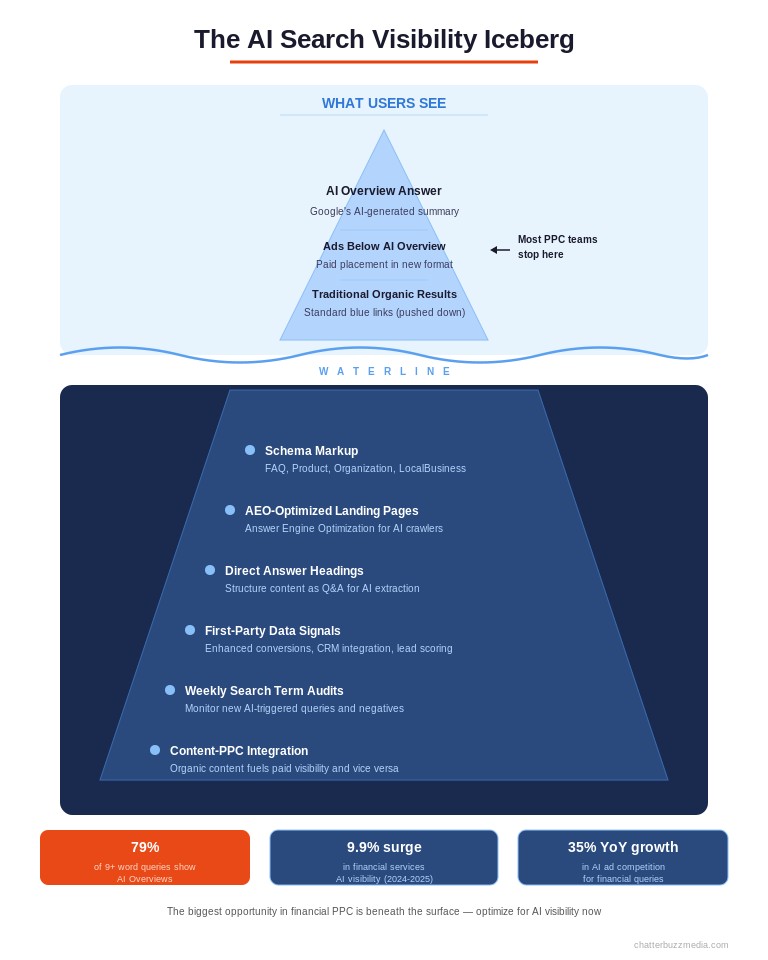
The numbers demand attention. Financial services leads all sectors with a 9.9% surge in AI Overview visibility, and AI ad auction competition has grown 35% year-over-year. This isn’t a future trend — it’s the current competitive landscape for google ads for financial services.
Adapt your campaigns with these strategies:
- Structure landing page content for AI citability. Use descriptive H2 and H3 headings with direct answers in the first sentence below each heading. AI Overviews pull from content that answers questions concisely, then expands with supporting detail — the same format that improves both SEO and PPC performance.
- Implement schema markup. FAQ schema, product schema, and organization schema help AI systems understand and cite your content. Financial products benefit from technical SEO elements like schema more than most verticals because product specifications (rates, terms, fees) map cleanly to structured data.
- Answer Engine Optimization (AEO) for landing pages. Write landing page copy that directly answers the questions your target audience asks. “What is the minimum credit score for an SBA loan?” answered clearly on your landing page positions you for both AI Overview citations and paid click-throughs.
- Weekly search-term report audits for AI Max campaigns. Google’s AI Max feature expands keyword matching aggressively. Review reports every week to catch irrelevant queries that AI matching introduces, and add negatives immediately.
Retargeting becomes more important as AI search fragments the buyer journey. Prospects who see your brand cited in an AI Overview, then click a paid ad, then leave without converting need to see your ads again across display, YouTube, and social media platforms.
Build retargeting audiences segmented by product interest and funnel stage. A visitor who viewed your mortgage rates page gets different remarketing creative than someone who browsed business checking. Layer these audiences with marketing automation sequences that nurture leads across channels.
The institutions winning in AI search treat content marketing and PPC as a unified system. Your organic content feeds AI Overviews, your paid campaigns capture the clicks AI Overviews generate, and your retargeting keeps prospects engaged until they convert. Siloed teams miss this compounding effect entirely.
Frequently Asked Questions About Google Ads for Financial Services
1. 🔍 How much do Google Ads cost for financial services?
Financial services keywords typically cost $50–$150 per click, making them among the most expensive in Google Ads. Competitive terms like “business loan” or “mortgage rates” sit at the top of that range, while long-tail product-specific keywords can drop to $15–30 per click.
Your actual cost depends on Quality Score, bidding strategy, and geographic targeting. Institutions with strong Quality Scores (7+) can reduce CPC by 20–30% compared to competitors bidding on the same keywords.
2. 📊 What is the average conversion rate for financial services PPC?
The financial services industry averages a 5.9% conversion rate on paid search — significantly above the cross-industry average of approximately 3.75%. This high conversion rate helps offset the elevated cost-per-click in the vertical.
Top-performing campaigns with optimized landing pages and precise keyword targeting regularly achieve 8–12% conversion rates. The gap between average and top performance represents substantial revenue opportunity.
3. ⚡ What financial products can’t be advertised on Google?
Google prohibits advertising for credit repair services, payday loans with repayment under 60 days, and personal loans with APRs exceeding 36%. Cryptocurrency exchanges face additional restrictions including geographic limitations and certification requirements.
Binary options, initial coin offerings, and certain speculative financial instruments are also banned globally. Review Google’s financial services policy page before launching any campaign to confirm your product category is eligible.
4. 🏦 How do I get Google Ads certified for financial services?
Apply through Google’s advertiser verification program by submitting your institution’s licensing documentation, business registration, and product disclosures. The process typically takes 3–5 business days for standard banking products and longer for investment or lending products.
You’ll need to verify your business identity, confirm geographic operating licenses, and demonstrate that your landing pages include all required disclosures. Complete this process before building campaigns — retroactive applications delay launch timelines.
5. 🤝 Is PPC worth it for credit unions with small budgets?
Yes — credit unions can run effective Google Ads campaigns starting at $1,000–$2,000 per month. The key is geographic precision and product focus. A credit union serving three counties doesn’t need national reach; it needs dominant visibility within its field of membership.
Target long-tail keywords with local modifiers, focus on 1–2 high-value products, and build tight ad groups with custom landing pages. Small budgets win when they concentrate spend rather than spreading it thin. A demand generation approach tailored to your specific market outperforms broad campaigns every time.
6. 💰 How do I reduce wasted ad spend in financial services PPC?
Negative keyword management is the single most effective lever for reducing waste. Review search term reports weekly and block irrelevant queries before they accumulate clicks. Common waste sources include informational queries (“what is APR”), job searches (“bank teller jobs”), and complaint-related terms.
Beyond negatives, tighten geographic targeting to your licensed service area, use ad scheduling to run campaigns during business hours when call conversions are possible, and implement lead qualification questions on your forms to filter unqualified prospects before they become leads your team has to process.
7. 🚀 How does AI search change Google Ads strategy for banks?
AI Overviews are reshaping paid search by answering complex financial questions directly in search results. Financial services has seen a 9.9% surge in AI Overview visibility, meaning more of your potential clicks now happen alongside or below AI-generated answers.
Adapt by structuring landing page content for AI citation (direct answers under descriptive headings), implementing schema markup, and auditing search term reports weekly to catch AI Max’s expanded matching. Financial services marketing now requires integrated SEO and PPC strategies that feed both traditional and AI-driven search experiences.
Driving Qualified Leads With Google Ads in Financial Services
Running Google Ads for financial services profitably requires a system, not a series of isolated tactics. CLV-driven goal setting, compliance-first keyword strategies, policy-compliant ad copy, converting landing pages, robust tracking, and AI search optimization work together — each step strengthening the others.
The financial institutions winning in paid search right now share one trait: they treat compliance as a competitive advantage rather than an obstacle. While competitors scramble to fix policy violations and recover suspended accounts, compliant advertisers capture uncontested impressions.
Start with these four actions this week:
- Calculate CLV for your top three products and set target CPA goals based on those values — not on what feels like a reasonable cost-per-lead.
- Audit your current campaigns against Google’s financial services policy and fix any disclosure gaps on ads and landing pages before they trigger strikes.
- Build a negative keyword list of at least 50 terms and apply it to every campaign. Review search term reports weekly to expand it.
- Implement Enhanced Conversions and connect your CRM to feed offline conversion data back to Google’s bidding algorithms.
The 5.9% conversion rate benchmark proves that financial services PPC works. The question is whether your campaigns capture that performance or leave it on the table. For a deeper dive into building your institution’s full digital presence, explore the financial services marketing guide or the credit union marketing guide for institution-specific strategies.

Noah Reed
Noah Reed is a growth marketing strategist at Chatter Buzz who helps credit unions and financial institutions grow membership, deposits, and loan volume through paid search, SEO, CRO, and full-funnel demand generation. Working within a Google Premier Partner team, he focuses on the metrics that actually move revenue, such as cost per acquired member, close rate, and lifetime value, rather than vanity metrics. Connect with Noah on LinkedIn.