
 321-341-2327
Credit Union Advertising: 7 Compliant Strategies That Drive Member Growth
Credit unions can no longer rely on branch loyalty and word-of-mouth to hit growth targets. This guide covers how to run Google Ads, Meta campaigns, YouTube pre-rolls, and LinkedIn ads for credit unions — all while staying inside NCUA and CFPB compliance lines.
The stakes are real. Membership growth dropped to just 1.88% by mid-2025, the lowest rate since 2011, according to Callahan & Associates. Credit unions are now competing directly against fintechs and national banks that outspend them on digital acquisition, which makes paid media a growth necessity, not a nice-to-have for any financial services marketing program.
You’ll also learn how to structure product-specific campaigns that cut cost per funded account by segmenting auto loans, HELOCs, and checking into separate campaigns instead of one blended effort. That single change alone can reshape your acquisition economics.
Let’s start with why paid advertising has become essential to credit union growth strategy.
Key Takeaways
- Membership growth has stalled to 1.88%, the slowest pace since 2011, making paid acquisition essential for credit unions that want to grow.
- Search outperforms Performance Max 84% of the time for lead generation campaigns, so credit unions should prioritize dedicated Search campaigns over automated blends.
- Meta’s Special Ad Category rules (mandatory since January 2025) restrict age, ZIP code, and income-based targeting for all credit union ads.
- Every loan and deposit ad requires specific disclosures under Regulation Z, Truth in Savings, and NCUA Section 740.5 — compliance can’t be an afterthought.
- Landing pages convert far better than homepages for paid traffic, with top-performing financial services pages hitting 26.1% conversion rates.
- Attribution must connect ad clicks to funded accounts, not just form fills, for paid media to earn credibility with the board.
Why Credit Unions Need Paid Advertising in 2026
Credit unions need paid advertising because organic growth alone can no longer offset the industry’s membership slowdown. The math has gotten harder every year since 2020, and 2026 is not the year that trend reverses on its own.
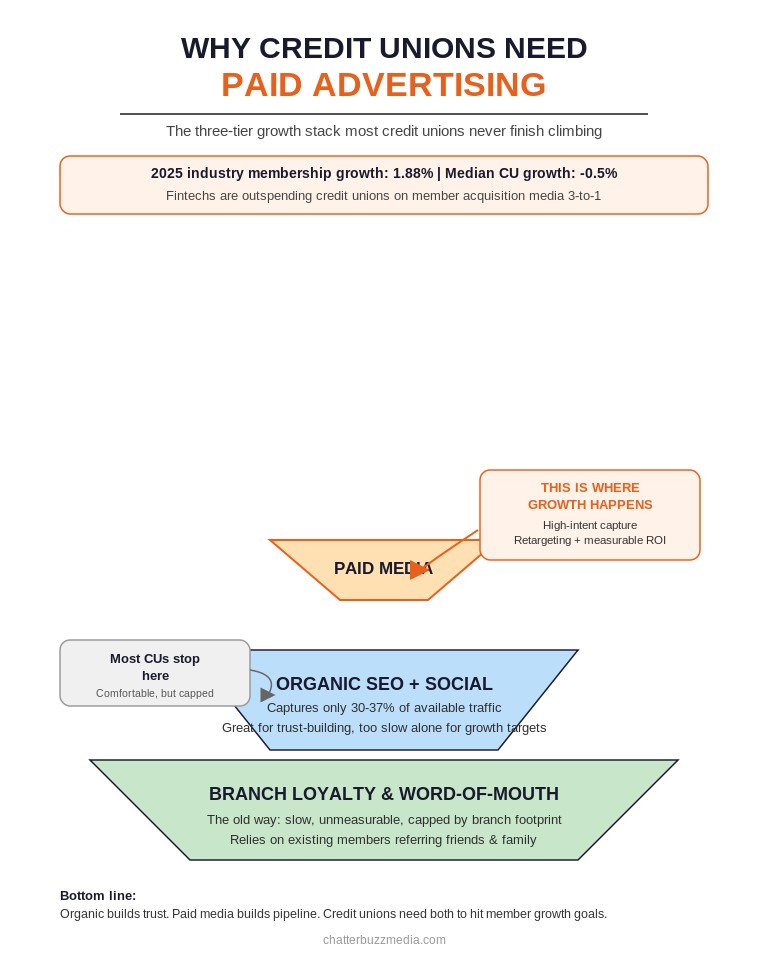
The numbers tell the story clearly. Callahan & Associates reported that membership growth fell to 1.88% by mid-2025, with the median credit union actually posting negative 0.5% growth. Half the industry is shrinking, not growing.
Meanwhile, credit union marketing teams that rely purely on organic channels are capturing only a fraction of available demand. Organic search and social typically capture just 30-37% of total addressable traffic for a given product category, leaving the remaining majority to competitors who are willing to pay for visibility.
That gap matters because fintechs and national banks are not holding back. Digital-only lenders and megabanks pour enormous budgets into geofenced advertising, Google Ads, Meta, and connected TV to capture auto loan shoppers and HELOC applicants at the exact moment they’re searching. Credit unions that skip paid media are effectively ceding those high-intent moments to better-funded competitors.
Paid advertising fills three specific gaps that organic strategy cannot close on its own:
- High-intent capture: Search ads put your credit union in front of someone actively comparing auto loan rates or refinance options right now.
- Retargeting: Display and social remarketing bring back visitors who explored a product page but didn’t apply.
- Measurable ROI: Unlike branch signage or radio spots, paid digital campaigns produce hard data on cost per lead and cost per funded account.
A well-built digital marketing strategy for credit unions treats paid media as the engine that converts organic awareness into funded accounts. The next sections break down exactly how to build that engine across each major platform.
Google Ads Strategy for Credit Unions
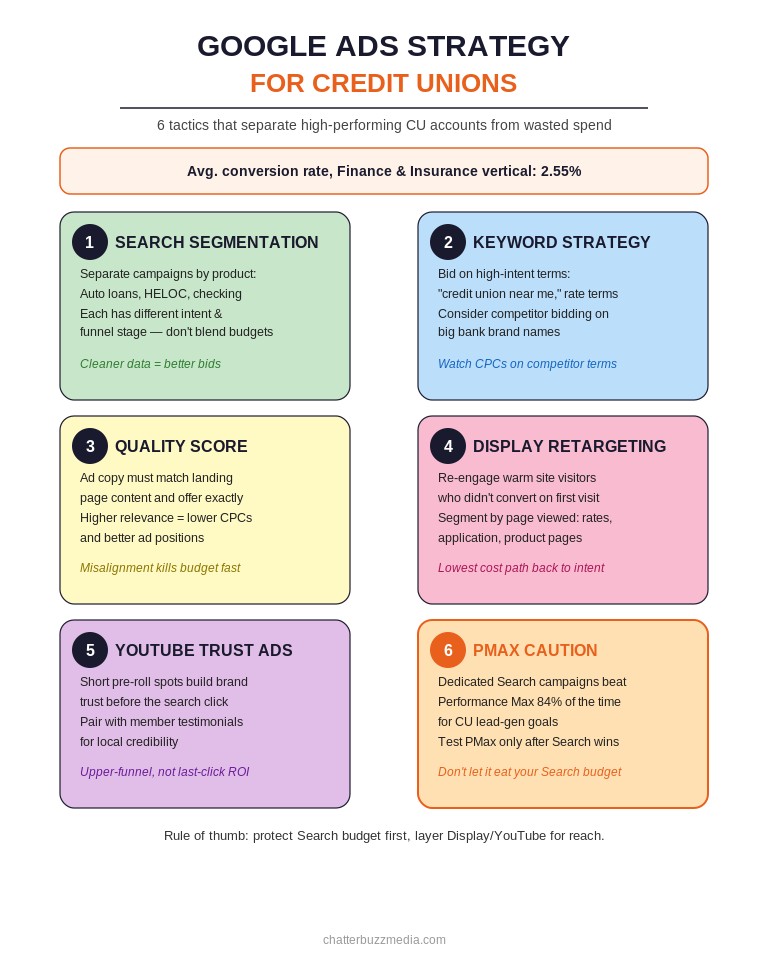
The right Google Ads strategy for credit unions is built on product-specific Search campaigns, not a single blended account chasing every keyword at once. Segmentation is what separates credit unions with a healthy cost per funded account from those burning budget on generic clicks.
Search Campaigns: Segment by Product
Auto loans, HELOCs, and checking accounts attract completely different searchers with different intent signals and different conversion paths. Running them in one campaign forces a single bidding strategy and a single set of ad copy onto audiences that behave nothing alike.
Instead, build separate credit union google ads campaigns for each core product line. This lets you set product-specific budgets, bid strategies, and negative keyword lists that actually reflect how each audience shops.
- Auto loan campaigns should target refinance and purchase-intent terms like “auto loan rates” or “refinance my car loan.”
- HELOC campaigns should isolate home equity terms separately from general mortgage keywords, since HELOC shoppers convert on different messaging.
- Checking account campaigns should emphasize local intent and switching incentives, since these searchers are often comparing your credit union to a specific competing bank branch nearby.
Keyword Strategy and Quality Score
High-intent, bottom-funnel keywords outperform broad awareness terms for paid search budgets. Bidding on competitor brand terms can also work well for credit unions, since someone searching a national bank’s name while comparing rates is a strong conversion candidate.
Quality Score directly controls your cost per click, and it rewards tight alignment between keyword, ad copy, and landing page content. A dedicated landing page built for that specific keyword will outperform a generic product page every time on Quality Score and conversion rate alike.
Display, YouTube, and Performance Max
Display campaigns work best as a retargeting layer, not a cold-audience acquisition tool, bringing back visitors who researched a loan product but left before applying. YouTube pre-roll ads build trust at a stage before someone is ready to search, which makes it a strong fit for brand and member-story content.
Performance Max deserves caution rather than blind adoption. Adalysis found that Search campaigns outperform Performance Max 84% of the time for lead generation, largely because PMax’s automated targeting can cannibalize the high-intent traffic your dedicated Search campaigns already capture efficiently.
For benchmarking, the Finance & Insurance vertical converts at 2.55% on average according to WordStream’s 2025 Google Ads benchmarks. Use that figure as a baseline when evaluating whether your PPC management is performing at, above, or below industry standard.
Search delivers the highest-intent traffic in your funnel, but Meta plays a different and equally important role in reaching members who aren’t actively searching yet.
Meta Advertising for Credit Unions
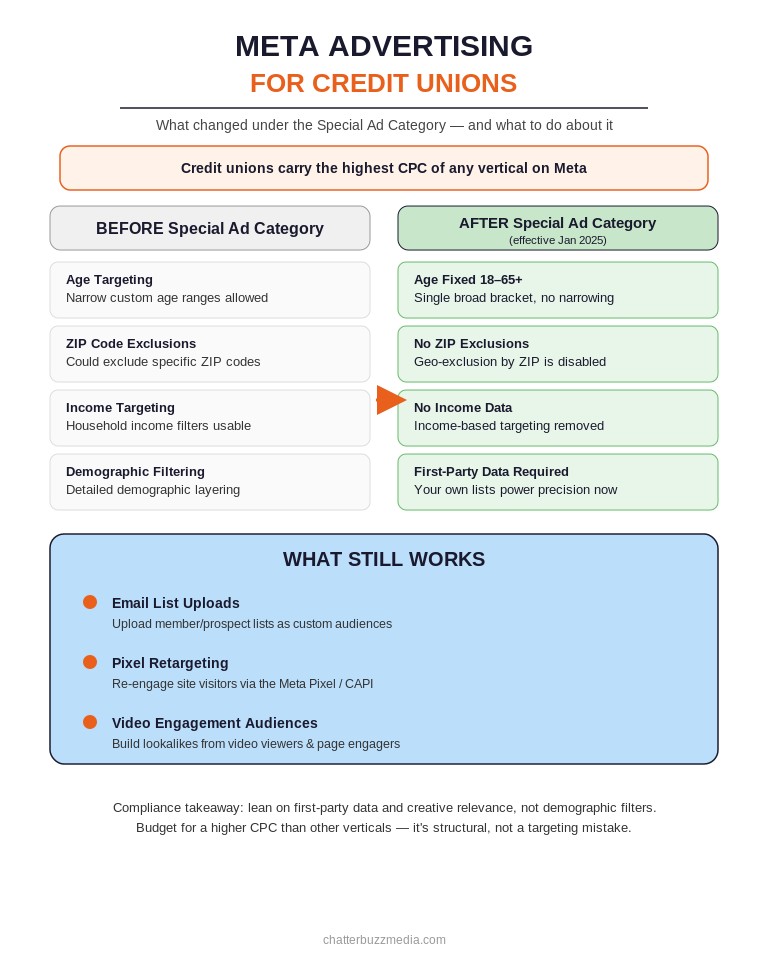
Meta advertising for credit unions requires operating inside Special Ad Category rules, which have restricted financial services targeting since Facebook settled a 2019 fair-housing and fair-lending complaint. As of January 2025, these restrictions are mandatory for every credit union running ads on Facebook or Instagram.
Special Ad Category Requirements
Any credit union promoting credit, employment, or housing-related products must declare the campaign under the Special Ad Category. Doing so removes access to several targeting options that marketers in other industries use freely.
- Age targeting is locked to a fixed range of 18-65+, eliminating the ability to narrow by specific age brackets.
- ZIP code exclusions are prohibited, preventing marketers from carving out specific neighborhoods from a campaign.
- Income-based targeting is unavailable, along with several other demographic and lifestyle categories Meta considers sensitive for credit products.
These restrictions exist to prevent digital redlining, and credit unions should treat them as a floor, not a workaround to engineer around. Attempting to replicate excluded targeting through creative workarounds risks both platform bans and regulatory scrutiny.
First-Party Data Becomes Your Primary Targeting Asset
With demographic targeting constrained, first-party data becomes the most valuable lever available to credit union marketers on Meta. Three assets do the heavy lifting.
- Email list uploads let you build lookalike audiences from your existing member base or a segment of qualified leads.
- Pixel-based retargeting re-engages website visitors who viewed a loan or checking product page without applying.
- Video engagement audiences capture people who watched a significant portion of your YouTube or Reels content, signaling real interest.
Facebook vs. Instagram Placement Strategy
Facebook and Instagram reach genuinely different member segments within the same campaign. Facebook tends to perform better for older members researching HELOCs and retirement-adjacent products, while Instagram and Reels placements typically reach younger prospects considering their first auto loan or checking account.
Creative strategy has to work within the Special Ad Category’s compliance constraints while still standing out in the feed. Testimonial-style video, clear rate callouts, and local community imagery consistently outperform generic stock photography in social media advertising for financial brands. Measuring creative performance across variants helps identify which messaging resonates.
It’s worth budgeting accordingly: Finance & Insurance carries the highest average cost per click of any vertical on Meta, so campaigns need realistic budget expectations from the outset. None of this targeting or creative work matters, though, if the compliance foundation underneath it is shaky — which is where NCUA rules come in.
NCUA Compliance for Credit Union Digital Ads
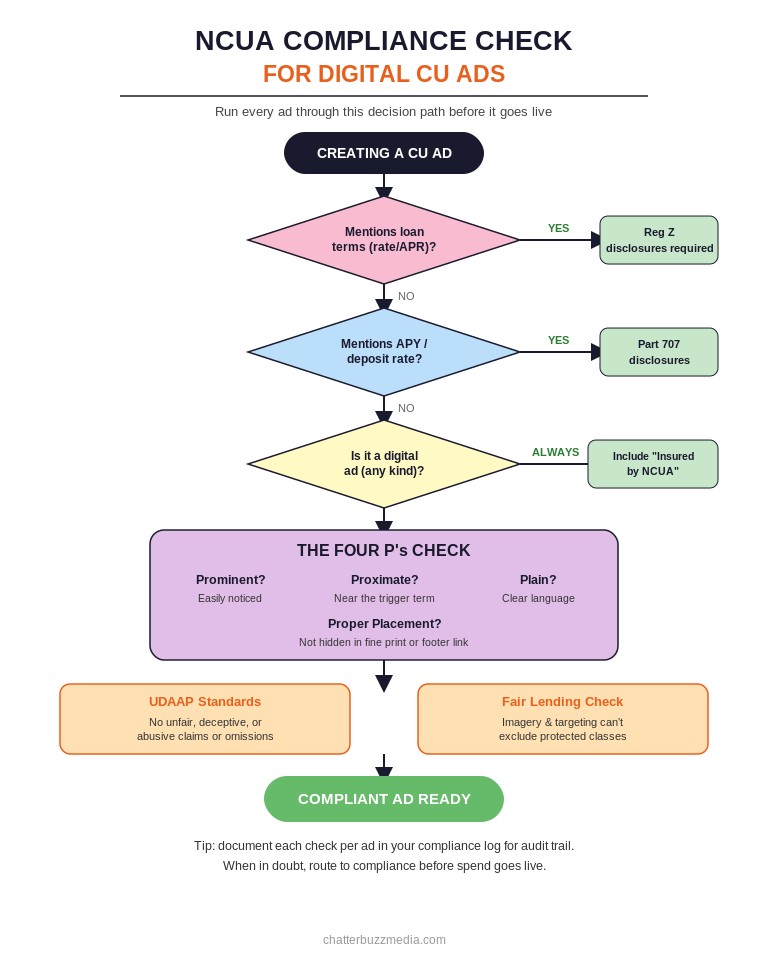
NCUA compliance for digital ads means every campaign has to satisfy the official advertising statement requirement, Regulation Z, Truth in Savings, and UDAAP standards before it ever goes live. Skipping this step isn’t a shortcut — it’s a liability waiting to surface during an exam.
The Official Advertising Statement
Under NCUA Section 740.5, most credit union advertisements must include the official statement “Insured by NCUA” or an approved variation. Digital ads with limited character counts — like Google Search ads — require careful handling to include this statement or qualify for an exemption.
Regulation Z and Truth in Savings
Any ad mentioning loan terms triggers Regulation Z disclosure requirements. Mentioning a specific APR, payment amount, or loan term in an ad obligates you to disclose the full set of associated terms, so vague rate teasers are often safer than specific numbers unless your compliance team has pre-approved the full disclosure block.
Deposit product advertising falls under Truth in Savings, Part 707, which governs how you can advertise APY, minimum balance requirements, and fees on checking or savings products. The rules are stricter than most marketers expect, and they apply equally to a 15-second Instagram Story and a full-page print ad.
UDAAP and the Four P’s of Disclosure
Unfair, Deceptive, or Abusive Acts and Practices (UDAAP) standards require every ad to be honest not just in its claims but in its overall impression. A common internal framework for reviewing ads is the four P’s: is the claim Prominent, Proximate to the relevant offer, in Plain language, and does it hold up in every Placement the ad might appear?
Fair Lending and Digital Redlining Risk
Fair lending laws extend directly into digital ad targeting, and regulators have made clear that algorithmic targeting choices can constitute digital redlining even without explicit intent. This is precisely why Meta’s Special Ad Category restrictions exist, and credit unions should apply the same scrutiny to Google’s audience targeting and Performance Max asset groups.
A Compliant-by-Design Workflow
The safest approach builds compliance into the campaign process from the start rather than treating it as a final checkpoint. A reliable workflow looks like this:
- Plan: Define the product, offer, and target audience before any creative work begins.
- Draft with disclosures: Write ad copy and landing page content with required disclosures built in from the first draft.
- Compliance review: Route every asset through your compliance team before launch, not after.
- Publish: Launch only after written sign-off, with a record of that approval retained.
- Monitor: Review live ads periodically, since platform auto-generated variations can sometimes drift from approved copy.
Getting the compliance layer right protects the credit union, but it only pays off if the landing page after the click actually converts. That’s the next piece of the puzzle.
Landing Page Optimization for Paid Traffic
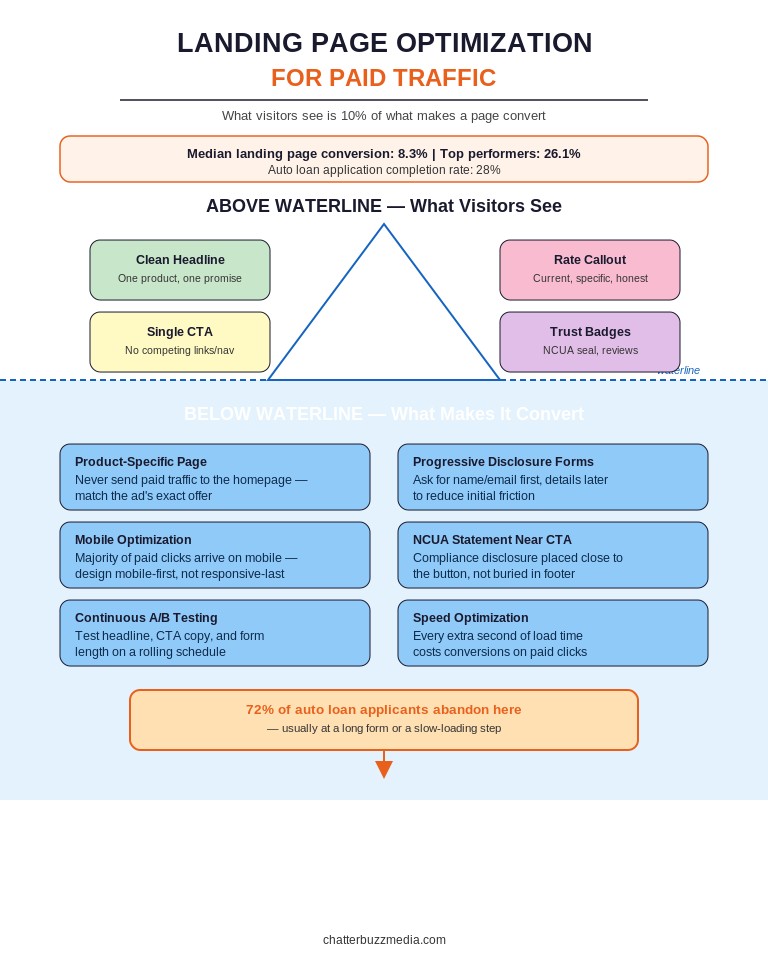
Landing page optimization for paid traffic means sending every ad click to a dedicated, product-specific page rather than your homepage. Homepages are built for browsing; landing pages are built for converting a single, specific intent.
Why Product-Specific Pages Win
A visitor who clicked an auto loan ad wants to see auto loan rates and an application, not a navigation menu with twelve other products competing for attention. Unbounce’s 2024 Conversion Benchmark Report found that financial services landing pages convert at a median of 8.3%, while top performers reach 26.1% — a gap almost entirely explained by page focus and design quality.
Building landing pages that convert isn’t guesswork; it follows a consistent set of principles around clarity, focus, and friction reduction.
Application Completion Is the Real Bottleneck
Getting a click to your landing page is only half the battle. Geear.io found that the average auto loan application completion rate is just 28%, meaning most people who start a loan application abandon it before finishing.
Two tactics consistently move that number:
- Progressive disclosure breaks a long application into short, sequential steps instead of one overwhelming form, which reduces the perceived effort at each stage.
- Shorter initial forms collect only the essential fields upfront — name, email, phone, loan amount — and defer sensitive financial details to a secure follow-up step.
Mobile Optimization Is Not Optional
Most paid ad clicks now arrive on a phone, and financial services pages convert 27.8% better on mobile when the page is properly optimized, per Unbounce’s data. That means large tap targets, minimal typing, and autofill-friendly form fields designed specifically for a small screen rather than a shrunk-down desktop layout.
Trust Signals Near the CTA
Placing trust indicators close to your call-to-action reduces last-second hesitation. The elements that matter most for credit unions include:
- The NCUA official statement, reinforcing deposit insurance right where someone is deciding to apply.
- Member testimonials or star ratings, which build social proof for a financial decision that feels personal.
- Security badges, signaling that sensitive financial information will be handled safely.
A well-designed conversion rate optimization process treats the landing page as a living asset, testing headlines, form length, and trust placement continuously rather than launching once and leaving it alone. Even the best landing page, though, is worthless to your board if you can’t prove it’s actually driving funded accounts — which brings us to attribution.
Attribution and ROI Measurement
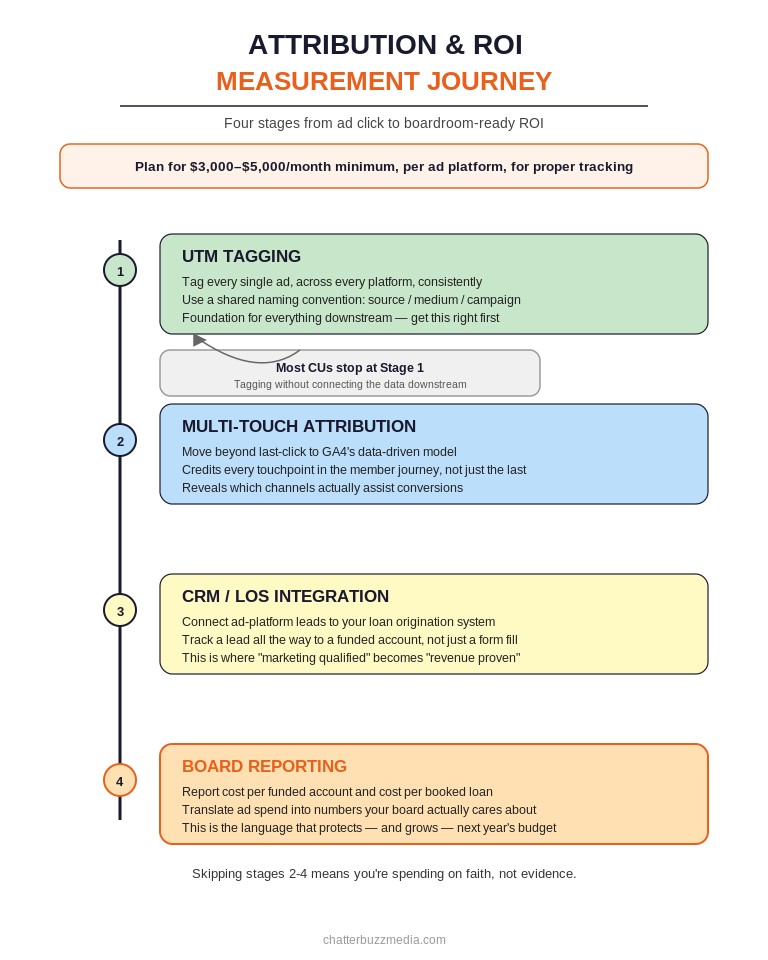
Attribution and ROI measurement for credit union advertising means connecting every ad click to a funded account, not just a form submission. Marketing teams that stop measurement at “lead generated” leave the board with an incomplete, and often unconvincing, picture of paid media performance.
Build the Tracking Foundation First
UTM tagging on every single ad is the non-negotiable starting point, since it’s the only way to separate performance by platform, campaign, and even individual ad creative later. Without consistent UTM structure, your reporting and data visualization will always have gaps that undermine trust in the numbers.
Move Beyond Last-Click Attribution
Last-click attribution gives all credit to the final touchpoint before conversion, which badly undervalues channels like YouTube and display that build awareness earlier in the journey. Multi-touch attribution models spread credit across every meaningful touchpoint, giving a far more accurate view of which channels actually influence a member’s decision to apply.
GA4’s data-driven attribution model uses machine learning to weight each touchpoint based on its actual contribution to conversion, and it’s available by default in most GA4 properties today. This is a meaningful upgrade over the simple last-click model many credit unions still default to.
Close the Loop with Your LOS and CRM
Digital conversion data alone doesn’t prove business impact — you need to connect it to your loan origination system (LOS) and CRM to see which digital leads actually became funded accounts. This closed-loop reporting is what separates marketing teams that get budget increases from those that get budget cuts.
For board-level reporting, two metrics matter more than clicks or impressions:
- Cost per funded account, which shows the true acquisition cost after accounting for application drop-off and underwriting.
- Cost per booked loan by channel, which lets the board see exactly which platforms are delivering the best return.
Budget Benchmarks
As a starting point, most credit unions need a minimum of $3,000-$5,000 per month per platform to generate enough data volume for meaningful optimization. Budgets below that threshold often produce too little conversion data to distinguish genuine performance trends from statistical noise.
Solid attribution turns paid media from a cost center into a defensible, budget-justifying growth channel. With Search, Meta, and measurement covered, one more channel deserves specific attention for credit unions with employer-based membership: LinkedIn.
LinkedIn Ads for Credit Union SEG Outreach
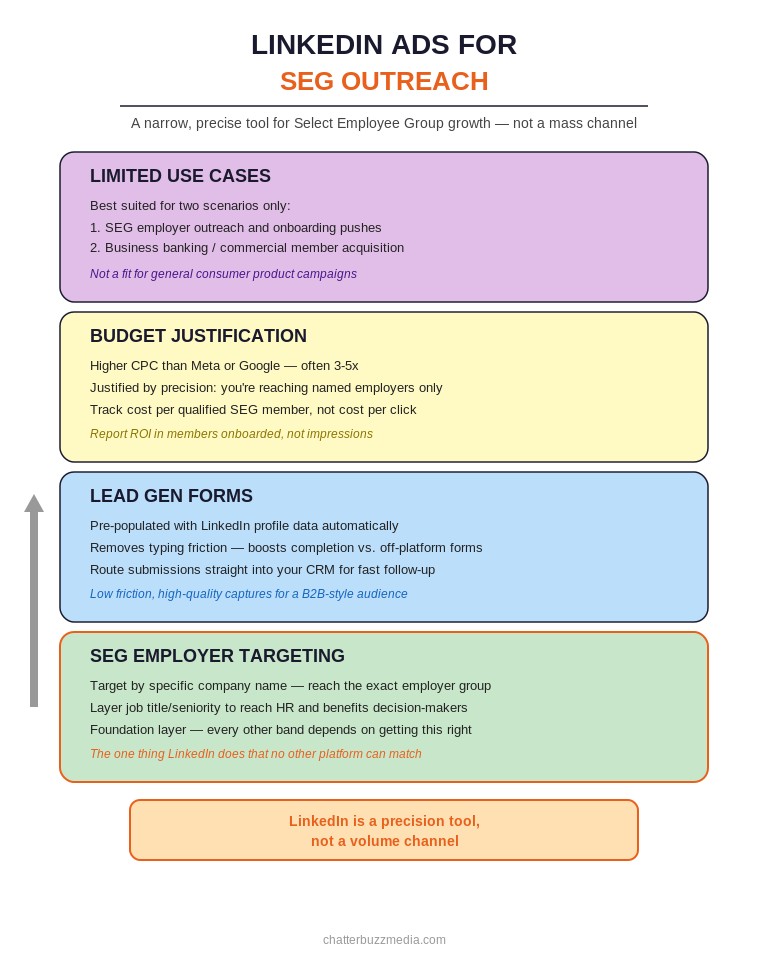
LinkedIn ads earn their place in a credit union’s media mix primarily through Select Employee Group (SEG) outreach, not broad consumer acquisition. It’s a precision tool for a specific job, not a general-purpose acquisition channel.
Targeting by Employer Name
LinkedIn’s targeting lets credit unions build campaigns aimed at employees of specific companies within their SEG charter. This is a targeting capability essentially unavailable anywhere else, since Google and Meta have no reliable way to isolate employees of a named employer.
Lead Gen Forms for Direct Capture
LinkedIn Lead Gen Forms pre-populate with a user’s profile data, dramatically reducing friction for capturing contact information from employees at a target SEG company. This works especially well paired with an offer around workplace financial wellness or group benefits enrollment.
Higher CPC, Justified by Precision
LinkedIn’s cost per click runs notably higher than Google or Meta, and that’s a fair trade given the specificity of the audience it reaches. Paying a premium to reach exactly the employees of a target SEG is far more efficient than broad consumer advertising aimed at reaching the same small group indirectly.
Where LinkedIn Falls Short
Outside SEG outreach, LinkedIn has limited utility for credit union consumer acquisition, since its audience skews toward professional context rather than personal financial decision-making. It performs best for two specific use cases: SEG employer outreach and business banking or commercial lending campaigns targeting small business owners and finance decision-makers by job title.
Used narrowly and intentionally, LinkedIn rounds out a paid media strategy that already covers Search, Meta, and measurement. Together, these seven strategies form a complete, compliant approach to credit union paid growth.
Frequently Asked Questions
1. 🔍 How much should credit unions budget for digital advertising?
Most credit unions should plan for a minimum of $3,000-$5,000 per month per platform to generate enough conversion volume for meaningful optimization. Credit unions running Google Ads, Meta, and LinkedIn simultaneously should budget accordingly across each channel rather than splitting a single small budget too thin.
2. 📊 What is the average cost per acquisition for credit union paid ads?
Cost per acquisition varies significantly by product, with checking accounts typically costing far less to acquire than auto loans or HELOCs. The Finance & Insurance vertical converts at 2.55% on average per WordStream’s 2025 benchmarks, and cost per acquisition should be calculated against cost per funded account, not just cost per lead, to get an accurate picture.
3. ⚡ Do credit unions need separate campaigns for each product line?
Yes — segmenting campaigns by product is one of the highest-impact changes a credit union can make to its paid strategy. Auto loans, HELOCs, and checking accounts attract different searchers with different intent, and blending them into one campaign forces a compromised bidding and messaging strategy that underperforms for all three.
4. 🏦 How does Meta’s Special Ad Category affect credit union targeting?
Since January 2025, every credit union ad on Meta must comply with Special Ad Category rules, which fix age targeting at 18-65+ and prohibit ZIP code exclusions and income-based targeting. This makes first-party data — email lists, pixel retargeting, and video engagement audiences — the primary lever for precise targeting instead of demographic filters.
5. 🤝 What NCUA advertising requirements apply to digital ads?
Digital ads must include the official advertising statement under NCUA Section 740.5, comply with Regulation Z disclosure rules for any loan ad mentioning specific terms, and follow Truth in Savings requirements under Part 707 for deposit product advertising. UDAAP standards apply on top of these, requiring every claim to be prominent, proximate, plain, and consistent across every placement.
6. 💰 How long does it take to see results from credit union paid advertising?
Search campaigns can generate qualified leads within the first few weeks, but meaningful optimization typically requires 60-90 days of consistent spend to gather enough conversion data. Campaigns tied to SEO or content-supported strategies, like a broader SEO vs. PPC approach, often show compounding results over a longer horizon.
7. 🚀 What landing page conversion rate should credit unions target?
The median financial services landing page converts at 8.3%, while top performers reach 26.1%, according to Unbounce’s 2024 benchmark data. Credit unions should treat 8.3% as a baseline to beat, not a ceiling, especially after implementing progressive disclosure and mobile-first design.
8. 📈 How do credit unions measure paid advertising ROI for board reporting?
Board-ready reporting connects digital conversions all the way through to funded accounts using CRM and loan origination system data, not just ad platform dashboards. The two metrics that matter most are cost per funded account and cost per booked loan by channel, both of which require multi-touch attribution rather than last-click models to calculate accurately.
For additional context on how content marketing ROI fits alongside paid acquisition, combining organic and paid channels gives credit unions a more complete growth strategy. When HubSpot or a similar CRM sits at the center, tracking touchpoints across both channels becomes significantly easier.
Building a Compliant, Growth-Focused Advertising Program
Credit union advertising in 2026 rewards teams that combine disciplined segmentation, strict compliance, and closed-loop attribution. Membership growth won’t recover on its own, and paid media is the lever that fills the gap organic channels can’t close alone.
Four steps summarize the path forward:
- Segment every Google Ads campaign by product — auto loans, HELOCs, and checking each need their own budget, keywords, and landing page.
- Build Meta targeting around first-party data since Special Ad Category rules limit demographic options.
- Bake compliance into the creative process with a plan-draft-review-publish-monitor workflow instead of a last-minute check.
- Connect every ad click to a funded account through UTM tagging, multi-touch attribution, and CRM integration before reporting results to the board.
Strong messaging underneath all of this matters just as much as channel tactics — a credit union’s brand messaging has to be consistent across every ad, landing page, and disclosure for the strategy to hold together. For a deeper look at building this out across your full marketing stack, explore the Chatter Buzz resource library and the financial services marketing agency guide for additional guidance on compliant growth strategy.
Related: AI Search for Credit Unions: 6 Strategies to Get Found

Noah Reed
Noah Reed is a growth marketing strategist at Chatter Buzz who helps credit unions and financial institutions grow membership, deposits, and loan volume through paid search, SEO, CRO, and full-funnel demand generation. Working within a Google Premier Partner team, he focuses on the metrics that actually move revenue, such as cost per acquired member, close rate, and lifetime value, rather than vanity metrics. Connect with Noah on LinkedIn.