
 321-236-2899
Multi-Location SEO for Credit Unions: Rank Every Branch

Your credit union has 12 branches. But when a potential member searches “credit union near me” from the parking lot of your newest location, your competitor’s single branch opening marketing shows up first. Sound familiar?
Multi-location SEO for credit unions isn’t just about optimizing one website — it’s about making every single branch visible, relevant, and authoritative in its specific market. We’ve helped credit unions with 5 to 50+ branches dominate local search in every market they serve, and the ones who get this right consistently outperform on new member acquisition.
By the end of this guide, you’ll have the complete playbook for building location-specific SEO authority across every branch — from Google Business Profile optimization to hyper-local content strategies that AI search platforms can’t ignore.
Key Takeaways
- Each branch needs its own SEO identity — a unique Google Business Profile, location-specific landing page, and localized content strategy. Cookie-cutter approaches kill multi-location SEO.
- Local search intent drives 60%+ of new credit union memberships. Members search “credit union near me,” “best auto loan [city],” and “[neighborhood] checking account” — your branches must appear for all of these.
- Google Business Profile optimization is the highest-ROI activity for multi-location credit unions — it directly impacts AI Overviews, Maps, and local pack rankings.
- Content localization means more than swapping city names. Each branch needs content that references local employers, neighborhoods, community events, and financial services marketing needs specific to that market.
- AI search platforms (ChatGPT, Google AI Overviews) now pull from local signals — reviews, citations, and GBP data — making traditional local SEO even more critical for future visibility.
- Centralized brand control + localized execution is the operating model. Your brand stays consistent; your local presence adapts to each market.
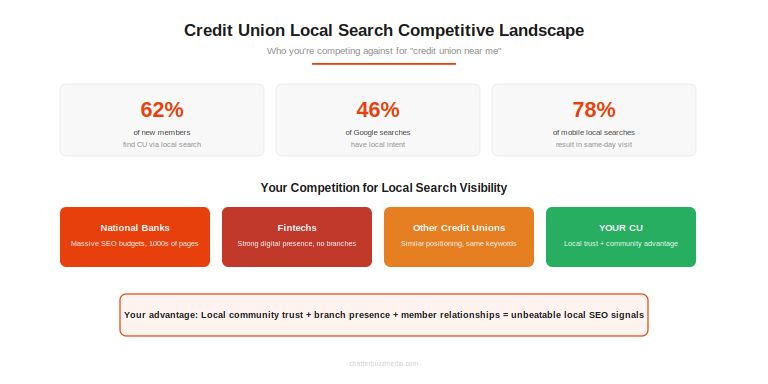
The Unique Competitive Landscape: Why Multi-Location SEO is Your Growth Engine
Credit unions face a dual challenge that banks and fintechs don’t: you must compete nationally in digital channels while maintaining authentic local connections across diverse communities. The Big Bank Problem: Large national banks leverage massive marketing budgets and sophisticated digital infrastructure. They dominate branded searches and national keywords, making it nearly impossible for credit unions to compete head-to-head on broad terms. The Fintech Disruption: Digital-first fintechs offer frictionless online experiences optimized for mobile-native consumers. They’ve mastered conversion rate optimization and user experience, setting new expectations for digital banking. Your Credit Union Advantage: Unlike banks focused on shareholders or fintechs lacking physical presence, credit unions combine member-first values with genuine community engagement. You sponsor local Little League teams. Your branch managers serve on chamber boards. Your members aren’t customers—they’re neighbors. Multi-location SEO amplifies this inherent advantage. When someone searches for “auto loans in Portland” or “business checking near downtown Boise,” you’re not competing against Chase’s $2 billion ad budget—you’re competing for relevance in that specific community. That’s a battle credit unions can win.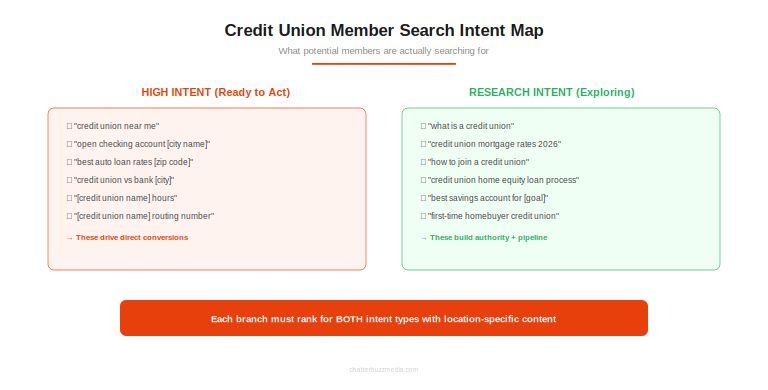
Decoding Search Intent: What Your Future Members Are Really Searching For
Understanding how potential members search for financial services transforms your entire local SEO strategy. Member search behavior falls into three distinct intent patterns:“Near Me” & Geo-Specific Searches: Capturing High-Intent Local Queries
These searches indicate immediate intent: “credit union near me,” “ATM locations near downtown,” “branches open Saturday Phoenix.” Searchers want to visit physically or need immediate access to services. Strategic Opportunity: These queries convert at extraordinarily high rates because intent is crystal clear. Optimizing for “near me” searches requires robust Google Business Profile management, accurate NAP (Name, Address, Phone) consistency, and location-specific schema markup.Product & Service-Specific Local Searches: Beyond Generic Financial Terms
More sophisticated searchers combine service needs with geographic intent: “first-time homebuyer programs Austin,” “small business loans Spokane,” “high-yield savings accounts credit union Oregon.” These searches reveal both what members need and where they need it. They’re researching options, comparing rates, and evaluating institutions. This is your opportunity to demonstrate expertise while establishing local authority. Strategic Opportunity: Create branch-specific content addressing local market conditions. For example, “Understanding Portland’s First-Time Homebuyer Landscape: How [Credit Union] Supports Local Families” combines service-specific information with geographic relevance.The Rise of AI Search: How Conversational AI Reshapes Local Discovery
Search behavior is evolving rapidly. AI-powered tools like ChatGPT, Google’s AI Overviews, and Perplexity are changing how people discover financial services. Instead of keyword searches, members ask conversational questions: “Which credit union has the best rates for refinancing my mortgage in Denver?” or “Show me community banks near Boulder with excellent member service.” These AI systems pull information from structured data, reviews, and authoritative content to formulate responses. Unlike traditional SEO where the top 3 results captured most clicks, AI search synthesizes information across multiple sources. Strategic Opportunity: Position your credit union as the “source of truth” for AI systems by implementing comprehensive structured data, maintaining exceptional review ratings, and creating authoritative content that answers specific financial questions for your local markets. We’ll explore this deeper in Section IV.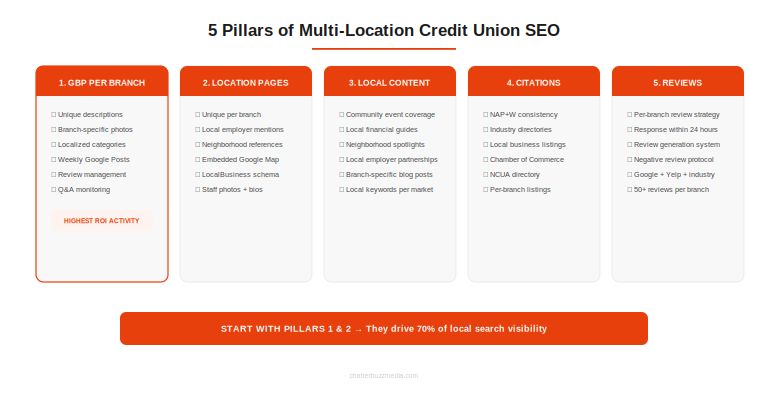
Core Pillars of Multi-Location SEO: The Strategic Framework
Successful multi-location SEO isn’t about random tactics—it’s about systematic execution across seven interconnected pillars. Each reinforces the others, creating compound growth in local visibility.Pillar A: Google Business Profile (GBP) Optimization—Your #1 Local Asset
Your Google Business Profile is the single most influential ranking factor for local search. It’s also completely free. Yet most credit unions treat GBP as an afterthought, missing enormous opportunities. Claiming & Verifying Every Branch: The Foundation Start by claiming and verifying every single branch location, including: – Main branches – Express branches – Shared branching locations (where applicable) – ATM-only locations (if strategically valuable) Use Google’s bulk verification process when managing 10+ locations to accelerate deployment. NAP Consistency: Exact Matching Across All Data Points NAP consistency—ensuring your Name, Address, and Phone number appear identically everywhere online—directly impacts local rankings. Even minor variations confuse search engines:- ❌ “Main Street Credit Union” vs. “Main St. CU”
- ❌ “Suite 100” vs. “#100”
- ❌ “(555) 123-4567” vs. “555.123.4567”
- Mortgage lender
- Auto loan provider
- Investment service
- ATM
- Exterior shots showing clear signage and parking
- Interior photos of member service areas
- Team photos (with permission) showing friendly staff
- Community involvement images (local event sponsorships)
Pillar B: Branch-Specific Website Pages—The Hyperlocal Landing Zones
Many credit unions use a single “Locations” page listing all branches. This approach fundamentally undermines local SEO potential. Every branch needs its own dedicated landing page CRO optimized for that specific community. Dedicated Pages for Each Location: Why One Page Isn’t Enough Individual branch pages allow you to: – Target location-specific keywords (“credit union Bethesda MD”) – Implement location-specific schema markup – Capture local backlinks to that specific branch – Provide relevant content for that community – Track branch-specific analytics A dedicated URL structure (e.g., creditunion.com/locations/bethesda/) tells search engines this page focuses exclusively on that location. Unique, Locally-Relevant Content for Each Branch: Beyond Boilerplate Here’s where most credit unions fail: they create “template” pages changing only the address and phone number. Google recognizes duplicate content and won’t rank multiple pages saying essentially the same thing. Instead, each branch page should include unique elements:- Community-specific introduction: “Serving the Bethesda community since 1987, our downtown branch provides convenient access to members across Montgomery County.”
- Local market insights: “Our team specializes in helping Bethesda families navigate the area’s competitive housing market, with specialized programs for first-time buyers in this high-cost region.”
- Branch-specific services: “This location features a dedicated Business Banking Center for Montgomery County entrepreneurs, plus Saturday hours for busy professionals.”
- Local team highlights: Feature branch managers and key staff with brief bios emphasizing community involvement: “Branch Manager Sarah Johnson serves on the Bethesda Chamber of Commerce and volunteers with the local Rotary Club.”
- Credit union name
- Branch address
- Phone number
- Hours of operation
- Accepted payment methods
- Price range (if applicable)
- Geo-coordinates (latitude/longitude)
- Staff photos and bios: “Meet the team serving your community”
- Member testimonials: Focus on testimonials from members in that specific area (with appropriate compliance review)
- Community involvement: Photos and descriptions of local sponsorships, financial literacy workshops, or community partnerships
Pillar C: Local Citations & Directory Management—Building Trust & Consistency
Local citations—mentions of your credit union’s NAP information on other websites—function as trust signals for search engines. The more consistent citations you have across authoritative directories, the more confident Google becomes in your legitimacy. What Are Local Citations & Why They Matter for Credit Unions Citations come in two forms: Structured Citations: Listings in business directories like Yelp, YellowPages, Apple Maps, and industry-specific directories. These follow a consistent format with specific fields for business information. Unstructured Citations: Mentions in blog posts, news articles, event listings, or sponsorship pages that mention your NAP information but don’t follow a specific format. For multi-location credit unions, citation management is exponentially more complex because you need separate citations for each branch location—not just your headquarters. Top Directories for Financial Institutions Prioritize these high-authority directories: General Business Directories: – Google Business Profile (already covered) – Bing Places – Apple Maps – Yelp – YellowPages – MapQuest Financial Institution Directories: – Credit Union National Association (CUNA) locator – MyCreditUnion.gov (NCUA) – BankRate – NerdWallet – Zillow (for mortgage services) Local & Community Directories: – Chamber of Commerce listings – Better Business Bureau – Local business associations – Community calendar sites – Local news outlet business directories Auditing & Cleaning Up Inconsistent/Duplicate Listings Citation errors multiply across multi-branch operations. Common problems include:- Duplicate listings for the same branch
- Old addresses from previous locations
- Inconsistent phone numbers
- Closed branches still appearing in directories
- Missing branches in major directories
Pillar D: Online Reviews & Reputation Management—Your Community’s Voice
Reviews impact local rankings significantly—Google considers review quantity, velocity, diversity, and sentiment. But beyond rankings, reviews directly influence conversion: 93% of consumers say online reviews impact their purchasing decisions. For credit unions, reviews carry extra weight because financial decisions involve high trust. A pattern of negative reviews about customer service or loan processing can devastate branch-level growth. The Power of Member Reviews: Ranking Factor & Trust Signal Google’s local pack algorithm heavily weights: – Review volume: Total number of reviews across all locations – Review recency: Fresh reviews signal active business – Review velocity: Steady flow indicates healthy member engagement – Review sentiment: Star ratings and positive/negative language in review text – Review responses: Active engagement demonstrates you value member feedback For multi-location credit unions, reviews create compound effects. Strong reviews at one branch can improve perception system-wide, while negative patterns at underperforming branches drag down your entire brand. Ethical Strategies for Generating Positive Reviews from Loyal Members The key word is “ethical.” Financial services face strict regulations around testimonials and endorsements. Never offer incentives for reviews—this violates both Google’s terms of service and potentially FTC guidelines. Compliant Review Generation Tactics:- Ask at peak satisfaction moments: After a successful loan closing, when a member thanks your staff, or following exceptional service, staff can simply say: “We’re so glad we could help. If you have a moment, we’d appreciate if you’d share your experience on Google.”
- Email follow-up campaigns: Send automated emails after major milestones (loan funding, account opening) with a polite request: “Your feedback helps us serve our members better. Would you mind sharing your experience?” Include direct links to your Google Business Profile.
- Branch signage: Tasteful lobby signage or table tents that say “Love your experience? Share it on Google” with a QR code linking directly to your review page.
- Staff training: Ensure frontline staff understand the importance of reviews and feel comfortable making asks naturally—without scripts that feel forced.
Pillar E: Localized Content Strategy—Connecting with Your Community
Generic financial content—”10 Ways to Save Money” or “Understanding APR”—doesn’t move the needle for local SEO. Localized content demonstrates authentic community connection while targeting geo-specific keywords. Beyond Generic Blog Posts: Hyperlocal Content That Resonates The most effective local content combines financial expertise with genuine community knowledge: Local Housing Market Insights: “What Portland’s Median Home Price Increase Means for First-Time Buyers” positions your credit union as both mortgage expert and local market authority. Community Event Recaps: “Supporting Youth Financial Literacy: [Credit Union] Partners with Lincoln High School’s Economics Program” showcases community involvement while earning potential backlinks from school websites and local news. Member Success Stories: “How We Helped the Martinez Family Buy Their First Home in Albuquerque’s Competitive Northeast Heights Neighborhood” (with permission) demonstrates specific local expertise. Neighborhood Guides: “Banking in the Pearl District: Your Guide to [Credit Union]’s Downtown Portland Branch” targets neighborhood-specific searches while providing value to prospective members exploring the area. Local Economic Updates: “How [City]’s Job Market Growth Impacts Home Lending: What Local Families Should Know” positions your team as economic commentators for your community. Blog Ideas That Drive Local Engagement:- “5 Things to Know Before Applying for a Mortgage in [High-Cost Market]”
- “Small Business Spotlight: How [Credit Union] Supports [City] Entrepreneurs”
- “Financial Literacy Month: Free Workshops at Our [City] Branches”
- “Year in Review: [Credit Union]’s 2024 Community Impact in [Region]”
- Event pages on your website: Create dedicated pages for each major event: “Annual 5K Run for Financial Literacy” with date, location, registration info, and photo gallery. This provides content opportunities and potential backlink targets.
- Partnership announcements: “Proud Partner of [Local Non-Profit]” blog posts that explain the partnership and link to partner websites (often reciprocated).
- Photo galleries and recaps: Post-event content documenting your involvement with names, photos, and community impact metrics.
Pillar F: Local Link Building—Earning Authority in Your Service Area
Backlinks remain a critical ranking factor, but for local SEO, link quality matters more than quantity. A single link from your city’s official website or local newspaper carries more weight than dozens from irrelevant national directories. Strategic Partnerships with Local Businesses & Non-Profits Credit unions possess natural partnership opportunities many businesses lack. Leverage your community involvement for link building: Non-Profit Partnerships: Many credit unions support local food banks, youth organizations, and community foundations. These organizations often maintain “Partners” or “Supporters” pages linking to sponsors. Chamber of Commerce Memberships: Active chamber participation typically includes member directory listings with backlinks. Business Improvement Districts: Downtown business associations often feature member businesses on their websites. Local University Partnerships: Financial literacy programs for students can earn backlinks from university financial aid pages or student resource centers. Sponsorships & Mentions: Securing High-Quality Local Backlinks Thoughtful sponsorships yield link-building opportunities:- Youth sports leagues (team sponsor pages)
- Local festivals and events (sponsor recognition pages)
- Community theater or arts organizations (season sponsor listings)
- Charity races and fundraisers (participant/sponsor pages)
- Local housing market trends
- Economic outlook for your region
- Consumer financial literacy issues
- Credit union industry news and impacts
Pillar G: Technical SEO for Multi-Branch Networks—The Unseen Foundation
Technical SEO ensures search engines can properly crawl, understand, and index your multi-location structure. While less visible than content or reviews, technical issues silently devastate local rankings. Mobile-First & Page Speed: Essential for Local Searchers “Near me” and local searches happen overwhelmingly on mobile devices—people searching while driving or walking. If your branch pages load slowly or display poorly on mobile, you’ve lost them. Critical Mobile Optimizations:- Responsive design: Pages automatically adapt to any screen size
- Click-to-call functionality: Phone numbers become clickable links on mobile
- Tap-friendly buttons: “Get Directions” and “Visit Website” buttons are large enough to tap easily
- Fast load times: Target under 3 seconds on 4G connections
- Include every branch-specific landing page
- Be organized logically (e.g., all location pages in a dedicated sitemap section)
- Be submitted directly to Google Search Console and Bing Webmaster Tools
- Update automatically when you add/remove branches
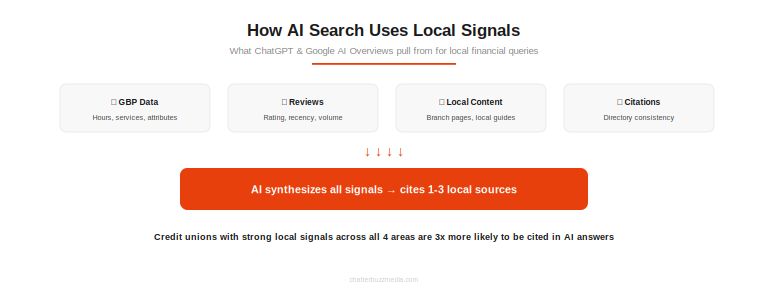
Mastering AI Search for Credit Unions: The Future of Local Visibility
Traditional search—typing keywords into Google and clicking blue links—is evolving rapidly. AI-powered search experiences are fundamentally changing how people discover financial services, and credit unions must adapt now.Prepare for the future of local search. This visual demonstrates how optimizing for AI Overviews, structured data, and E-E-A-T boosts your credit union’s visibility.
How AI Models Source Local Financial Information When someone asks ChatGPT, Perplexity, or Google’s AI “Which credit union should I choose for a mortgage in Boise?” these systems don’t rank websites traditionally. Instead, they synthesize answers from multiple sources:- Structured data from websites
- Review platforms (Google, Yelp, Trustpilot)
- Financial comparison sites (NerdWallet, Bankrate)
- Local directories and citations
- Your own website content
- Write how people speak: Use natural language and conversational tone.
- Answer specific questions directly: Structure content to explicitly answer questions, ideally in the first paragraph.
- Use question-based headings: “What Documents Do I Need for a Mortgage?” as an H2 heading tells both humans and AI exactly what that section covers.
- Provide complete, authoritative answers: AI systems favor thorough responses over superficial overviews.
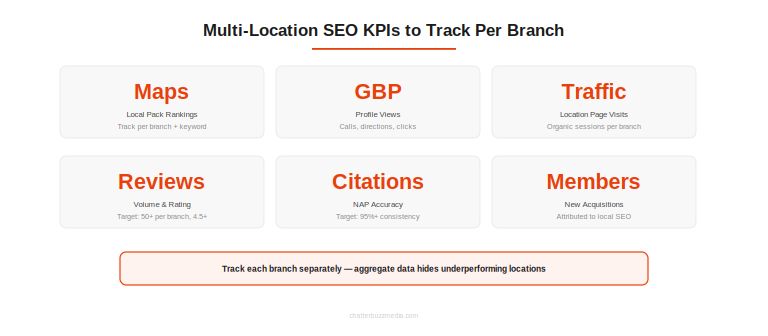
Measuring Success: Tracking ROI for Multi-Location Credit Union SEO
SEO without measurement is guesswork. For multi-location credit unions, proving ROI to CEOs and CFOs requires connecting local visibility to business outcomes: new member acquisition, loan volume, and deposit growth. See the tangible impact. Strategic multi-location SEO directly boosts key credit union metrics like new member acquisition, loan applications, and overall deposit growth.Key Performance Indicators (KPIs) for Branch-Level SEO
Track these metrics at both the system-wide and individual branch levels: Google Business Profile Insights: – Search impressions: How often your GBP appears in search results – Search vs. Discovery: Are people finding you through direct searches (branded) or discovery (non-branded)? – Actions taken: Direction requests, phone calls, website clicks – Photo views: Engagement with your visual content Monitor these metrics monthly for each branch. Sudden drops indicate issues requiring investigation (incorrect hours, negative reviews, technical problems). Website Analytics (Google Analytics 4): – Organic traffic to location pages: Measure visits to each branch landing page from organic search – Keyword rankings: Track positions for target local keywords (“credit union [city],” “mortgage lender [neighborhood]”) – Engagement metrics: Time on page, bounce rate, pages per session for location pages – Goal completions: Application starts, appointment bookings, contact form submissions originating from branch pages Local Pack Rankings: – Track your position in Google’s local 3-pack for key terms – Monitor competitors’ positions in your markets – Measure ranking consistency across different neighborhoods Review Metrics: – Total reviews per location – Average star rating – Review velocity (new reviews per month) – Response rate and response time – Review sentiment analysis Citation Metrics: – Total citations per branch location – NAP consistency score – Presence in top-tier directories – Citation accuracy (correct vs. incorrect listings)Connecting SEO to Business Outcomes
Raw traffic and rankings don’t impress CFOs—business results do. Build attribution models connecting local SEO to: New Member Acquisition: – Track application source (referral, direct, organic search, Google My Business) – Calculate member acquisition cost by channel – Monitor which branches drive highest-value new members Loan Application Volume: – Tag applications by origination source – Measure loan approval and funding rates by traffic source – Calculate loan portfolio growth attributable to organic search Deposit Growth: – Track account openings by discovery channel – Measure average deposit size by traffic source – Monitor deposit retention rates for organically-acquired members Digital Banking Adoption: – Track mobile app downloads originating from local search – Measure online banking registration by acquisition source – Monitor digital engagement for members acquired via local SEO Sample Attribution Framework: Create UTM parameters for all digital campaigns, including organic: – Source: google-organic, google-mybusiness, bing-organic – Medium: organic, local – Campaign: branch-[city], service-[loantype] This enables precise tracking of which local SEO efforts drive specific business outcomes at which branches.Reporting & Analytics: Proving Value to the CEO & CFO
Executive reporting should focus on business impact, not technical metrics. Structure quarterly reports around: Executive Summary: – New members acquired through local search – Loan applications and funded loan volume from organic traffic – Deposit growth attributable to local SEO – ROI calculation: Revenue generated vs. SEO investment Branch-Level Performance: – Top performing locations by organic traffic and conversions – Underperforming branches requiring attention – Success stories (specific member acquisitions or loan fundings) Competitive Position: – Market share of local search visibility – Ranking improvements vs. key competitors – Review profile comparison against competitor credit unions and banks Strategic Recommendations: – Investment priorities for next quarter – Branch-specific opportunities – Emerging trends or competitive threats Action: Implement a consistent reporting dashboard (Google Data Studio, Tableau, or your preferred platform) that automatically updates branch-level metrics. Schedule quarterly reviews with leadership showing clear business impact. For deeper insights into tracking and optimizing your marketing performance, explore our reporting and data visualization services.Frequently Asked Questions
How long does it take to see results from multi-location SEO for credit unions? Multi-location SEO follows a 3-6 month maturity curve before significant results emerge. Initial improvements in Google Business Profile visibility and rankings for low-competition terms often appear within 4-6 weeks. However, meaningful business impact—increased organic traffic driving member applications and loan inquiries—typically takes 3-6 months as Google validates your optimization efforts and local authority builds. Sustained, systematic execution yields compound returns: credit unions committed to ongoing optimization see accelerating results over 12-24 months as domain authority, review profiles, and content libraries mature. What’s the biggest mistake credit unions make with local SEO? The most costly mistake is treating local SEO as a one-time project rather than an ongoing operational discipline. Credit unions often launch with enthusiasm—claiming Google Business Profiles, creating location pages, building initial citations—then neglect ongoing management. Local SEO requires continuous attention: responding to reviews, updating business information, refreshing content, monitoring rankings, and adapting to algorithm changes. This “set it and forget it” approach allows competitors to overtake you, duplicate listings to proliferate, and once-strong rankings to erode. Successful credit unions treat local SEO like facilities maintenance—systematic, scheduled, and never truly “finished.” Do we need separate Google Business Profiles for each branch location? Absolutely yes. Each physical branch location must have its own verified Google Business Profile. This isn’t optional for multi-location SEO success. Google’s guidelines explicitly require separate profiles for each location where you provide in-person services. Attempting to represent multiple branches through a single profile violates Google’s terms and eliminates your ability to appear in local search results for each community. Even small express branches or locations with limited hours need individual GBPs. The only exception: purely administrative offices with no member interaction don’t require profiles. Every member-facing branch does. How do we handle reviews for credit unions with multiple branches? Reviews should be solicited and managed at the branch level, not system-wide. When requesting reviews, direct members to the specific branch profile where they received service. This geo-targets review equity to the most relevant location and prevents review “pooling” that dilutes local relevance. Implement branch-level review response protocols: each location’s manager or designated staff should respond personally to reviews for their branch, signing responses with their name and title. This personalization demonstrates genuine local engagement. For system-wide reputation monitoring, aggregate metrics across all locations while maintaining branch-specific management. Tools like BrightLocal or Birdeye help manage multi-location review workflows efficiently. What’s the ROI timeline for investing in multi-location SEO? Most credit unions begin seeing positive ROI within 6-9 months of systematic multi-location SEO implementation. Initial months involve foundational work—optimizing GBPs, building citations, creating location pages—that sets the stage but doesn’t immediately drive revenue. Months 3-6 typically show traffic growth and initial conversion upticks. Months 6-12 demonstrate clear business impact as rankings improve, organic traffic compounds, and member acquisition attributable to local search becomes substantial. Credit unions consistently executing multi-location SEO typically see 15-25% of new member acquisitions originating from organic local search within 12-18 months, with that percentage growing steadily thereafter. Calculate ROI by multiplying new members acquired via organic search by lifetime member value, then comparing against your SEO investment. Can we optimize for local SEO while maintaining compliance with financial services regulations? Absolutely, and we strongly recommend working with agencies or specialists familiar with financial services compliance. Key compliance considerations: review solicitations must never offer incentives or suggest outcomes (violates FTC guidelines), testimonials displayed on websites require appropriate disclosures, rate claims must be accurate and include required disclosures, and content must avoid misleading statements about deposit insurance or investment returns. The good news: compliance-aware local SEO is entirely achievable. Focus on soliciting genuine member feedback without compensation, feature testimonials with proper disclaimers, ensure all financial information is current and accurate, and have your compliance team review content before publication. Successful credit unions integrate compliance review into SEO workflows rather than treating them as opposing forces. Should we optimize location pages for products (like auto loans) or keep them general? The most effective approach combines both: create comprehensive branch landing pages covering all services, then develop product-specific location pages for high-value offerings. Your primary branch page should showcase all services available at that location, local team members, hours, and community involvement. However, for your most important products—mortgages, auto loans, business banking—create dedicated pages optimizing for product + location combinations: “[Credit Union] Auto Loans in Tampa,” “[Credit Union] Mortgages for Portland First-Time Buyers.” This allows you to rank for both general location searches (“credit union near me”) and product-specific local queries (“business checking downtown Seattle”), capturing different search intents at various buyer journey stages. What’s the difference between local SEO and traditional SEO for credit unions? Traditional SEO targets broad, often national keywords (“best savings account rates,” “credit union membership benefits”) competing against every financial institution nationwide. Local SEO targets geo-specific intent (“credit union Bethesda MD,” “mortgage lender near me”), competing primarily within specific geographic markets. For multi-location credit unions, local SEO offers dramatically better ROI because you’re not competing against Bank of America’s billion-dollar marketing budget—you’re competing for relevance in specific communities where your branch presence, local relationships, and community involvement create natural advantages. Traditional SEO remains valuable for building overall domain authority and capturing informational queries, but local SEO directly drives branch traffic and member acquisition at significantly lower cost per acquisition. The most successful credit unions integrate both: strong traditional SEO builds brand awareness and authority, while local SEO converts that awareness into members at specific branch locations.Conclusion: Make Every Branch Your Strongest Local Competitor
Multi-location SEO isn’t a project — it’s an operating system. The credit unions winning local search in 2026 treat every branch as its own micro-market with its own SEO strategy, content, and community presence. Here’s your priority order:- Audit every Google Business Profile — ensure each branch has complete, accurate, unique information with fresh photos and active review management.
- Build location-specific landing pages — one per branch, with unique content referencing local employers, neighborhoods, and community needs.
- Create a localized content calendar — each branch gets 2-4 pieces of hyper-local content per quarter targeting local search intent.
- Monitor branch-level rankings — track each location’s visibility in Maps, local pack, and AI Overviews separately.
Related: Med Spa SEO: The Complete Guide to Ranking Every Location in
Need help with SEO? Explore our SEO agency services.

Noah Reed
Noah Reed is a growth marketing strategist at Chatter Buzz who helps credit unions and financial institutions grow membership, deposits, and loan volume through paid search, SEO, CRO, and full-funnel demand generation. Working within a Google Premier Partner team, he focuses on the metrics that actually move revenue, such as cost per acquired member, close rate, and lifetime value, rather than vanity metrics. Connect with Noah on LinkedIn.