
 321-236-2899
Med Spa SEO: The Complete Guide to Ranking Every Location in 2026
➤ Not Ranking Where Your Patients Are Searching? Most multi-location med spas are invisible in the markets that matter most. Our SEO Quick-Win Package identifies the exact gaps costing you booked appointments — across every location. — Request Your Med Spa SEO Audit
Why Med Spa SEO Is Different from General Healthcare SEO
Med spas sit in a unique position. You’re not a hospital system with built-in brand authority, and you’re not a solo practitioner competing for a handful of keywords. You’re a consumer-facing medical business where patients compare providers the way they compare restaurants – fast, on their phones, with Google Maps open. That creates three SEO dynamics that general healthcare SEO strategies miss entirely.First, search intent is hyper-local and high-intent.
When someone searches “Botox near me” or “best med spa in [city],” they’re not researching. They’re comparing two or three providers before they book. The practice that shows up first in the Map Pack gets the call.Second, multi-location groups cannibalize themselves.
When your Orlando location and your Tampa location target the same generic “med spa” keywords with the same content, Google doesn’t know which one to rank. Neither wins. Your competitors do.Third, compliance adds complexity.
Before-and-after photos are considered protected health information under HIPAA. Every image on your site, every gallery, every patient story needs proper consent, secure storage, and compliant publication. That’s not optional; it’s a regulatory requirement that shapes your entire content strategy.How to Optimize Your Google Business Profile for Med Spas
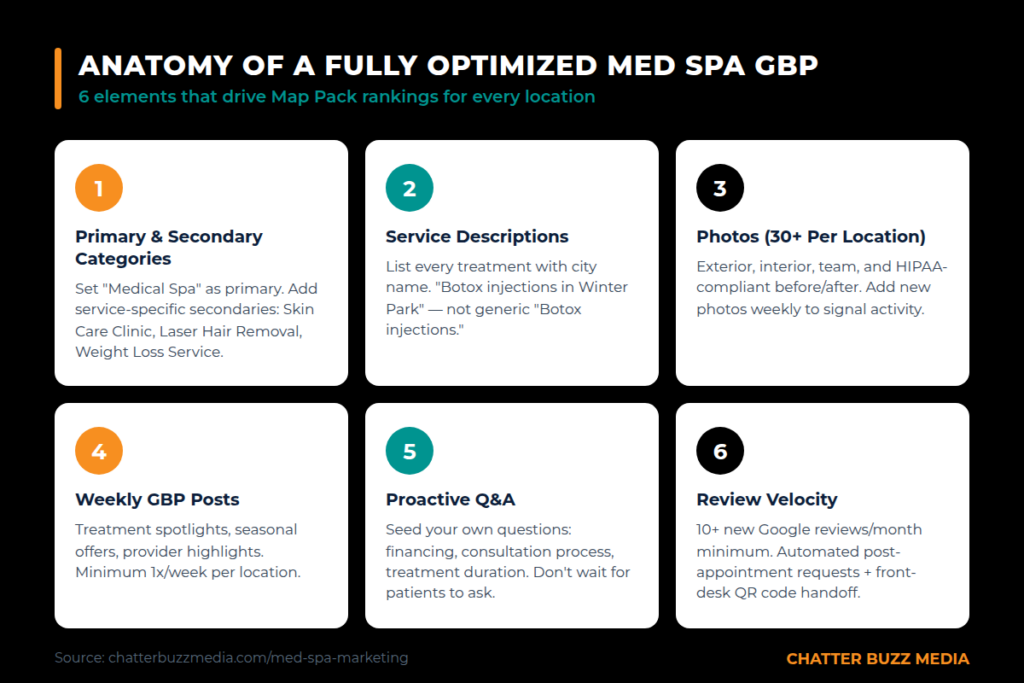
Your Google Business Profile is the single most important ranking factor for local med spa searches. It controls whether you appear in the Map Pack, the three-pack of local results that sits above organic listings and captures the highest click volume. For multi-location groups, this means every location needs its own fully optimized GBP. Not a copy-paste job. Not a template with the city name swapped out. Each profile needs to reflect the specific location’s team, services, and market.Categories and Services
Set your primary category to “Medical Spa.” Then layer in secondary categories that match your highest-revenue services, “Skin Care Clinic,” “Laser Hair Removal Service,” “Weight Loss Service,” or “Day Spa,” depending on your service mix. Each location can carry different secondary categories if its service menus differ. In the Services section, list every treatment you offer at that specific location with a description that includes the treatment name and the city. “Botox injections in Winter Park” is more useful to Google than “Botox injections” alone.Photos, Posts, and Q&A
Upload 30+ high-quality photos per location. Include exterior shots (helps Google verify your address), interior shots, team photos, and HIPAA-compliant before-and-after images with proper written consent. Google rewards active profiles that add new photos weekly. Post to your GBP at least once per week per location. Treatment spotlights, seasonal offers, and provider highlights all work. These posts signal to Google that the business is active and engaged. Populate Q&A proactively. Don’t wait for patients to ask. Add your own questions and answers covering common objections:- “How long does Botox last?”
- “Do you offer financing?”
- “What should I expect during a consultation?”
Per-Location Local SEO Strategy for Multi-Location Med Spa Groups
This is where most multi-location med spa groups get it wrong. They build one website, create one set of service pages, and expect Google to figure out which location to rank for which market. Google doesn’t figure it out. Google skips you entirely. Every location in your group needs its own local SEO infrastructure.Dedicated Location Pages
Each location needs a standalone page on your website. Not a contact page with a list of addresses. A fully built location page with unique content, including the location’s address, phone number, hours, embedded Google Map, team bios for that location’s providers, the specific services offered there, and patient reviews from that location. The URL structure should be clean and hierarchical: yourdomain.com/locations/city-name/. If that location has unique treatment pages, nest them: yourdomain.com/locations/city-name/botox/.Location-Specific Treatment Pages
A single “Botox” page that serves five cities won’t rank in any of them. Each location should have its own version of your core treatment pages, with content tailored to that specific market. That doesn’t mean spinning the same copy with a different city name. It means writing content that references local landmarks, local competitors’ positioning, and the specific patient demographics in that market. A Botox page for your Scottsdale location should read differently from one for your Brooklyn location.NAP Consistency and Citation Building
NAP — name, address, phone number — consistency across every directory, listing, and citation is foundational. For multi-location groups, this is a coordination challenge. Every location needs identical NAP data across Google, Yelp, Healthgrades, Vitals, RealSelf, and the dozens of local and medical directories that feed Google’s local algorithm. One mismatched phone number on a stale Yelp listing can suppress a location’s Map Pack visibility. Audit citations quarterly using a tool like BrightLocal or Moz Local, and correct discrepancies immediately.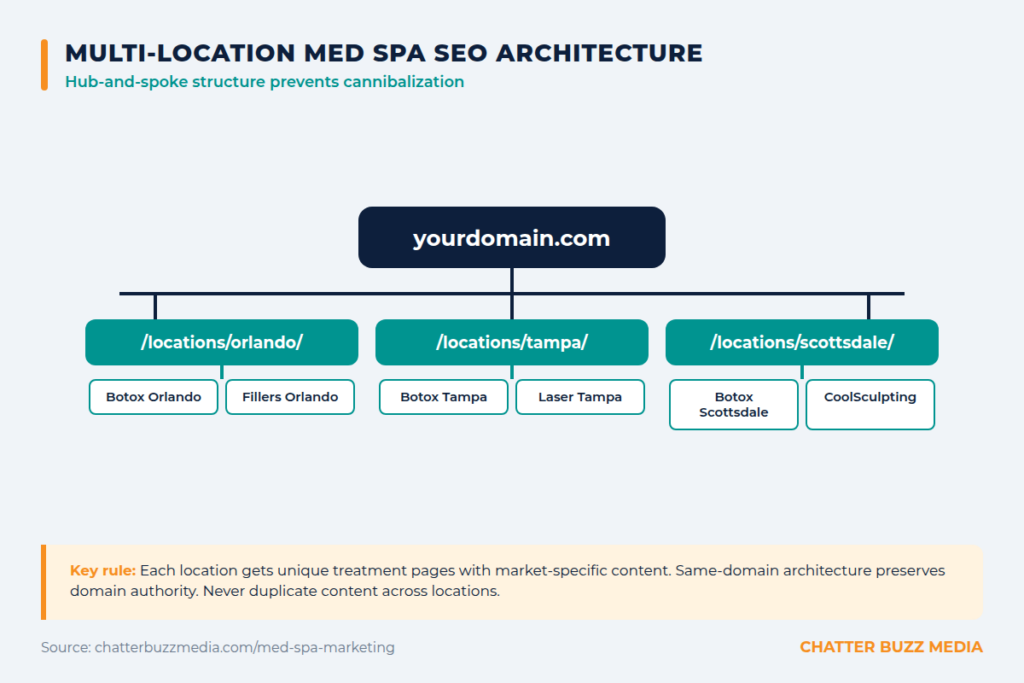
➤ Running SEO for 3+ Med Spa Locations? Per-location SEO requires a system, not a checklist. Our team manages $300K+/mo in aesthetics ad spend and builds per-location SEO strategies that prevent cannibalization and maximize Map Pack visibility. — Talk to a Med Spa SEO Strategist
Schema Markup for Medical Aesthetics: What to Implement and Why
Schema markup is structured data you add to your website’s code that tells search engines exactly what your business is, what services you offer, and where you’re located. For med spas, this is a significant competitive advantage because most practices don’t implement it or implement it incorrectly. Research from Nestlé R&D found that pages with schema markup driving rich results saw an 82% higher click-through rate compared to pages without it. In a category where a handful of positions in the Map Pack determine who gets the call, that margin matters.MedicalBusiness and LocalBusiness Schema
Every location page should carry MedicalBusiness schema (a subtype of LocalBusiness designed specifically for healthcare). This includes your business name, address, phone, opening hours, accepted payment methods, and medical specialties. MedicalBusiness is more specific than generic LocalBusiness and tells Google you’re a healthcare provider, not a retail store. For multi-location groups, implement a separate MedicalBusiness schema on each location page with that location’s specific data. Never use a single schema block pointing to your headquarters for all locations.MedicalProcedure and Offer Schema
Each treatment page should include a MedicalProcedure schema that describes the procedure name, body location, preparation, how it’s performed, and follow-up care. Pair this with the Offer schema if you’re listing pricing; search engines can display price ranges directly in results.FAQPage Schema
FAQ schema remains one of the highest-impact structured data types for healthcare websites. Google still surfaces FAQ rich results for authoritative medical and health sites, while most other verticals have lost this feature. Every treatment page and location page should include 3–5 FAQ items implemented with FAQPage schema.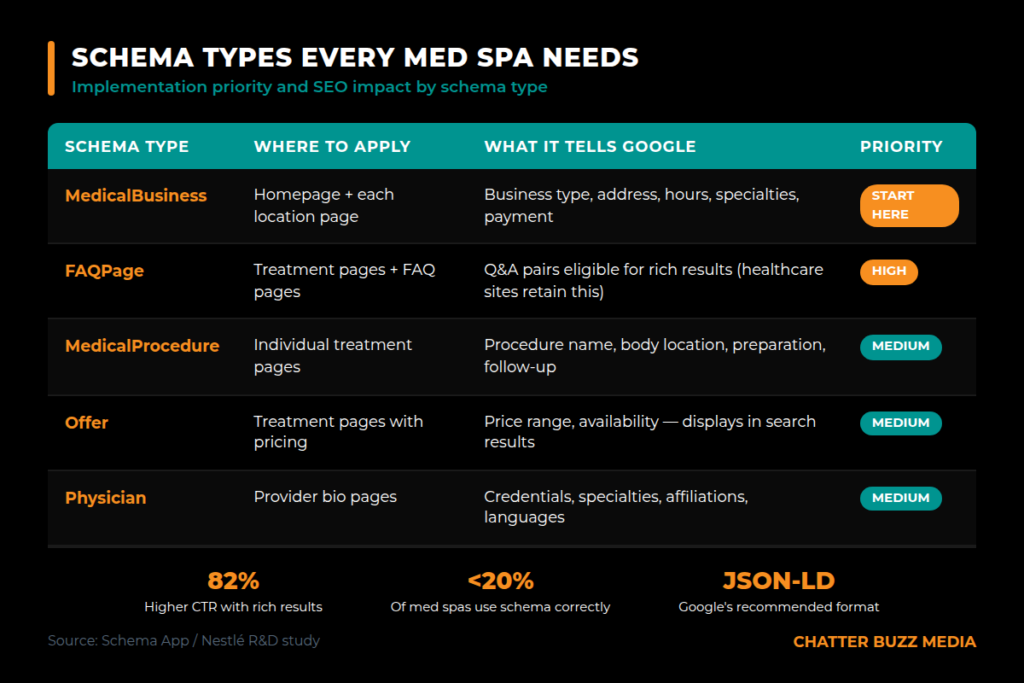
Content Strategy: Treatment Pages, FAQ Pages, and Location-Specific Landing Pages
Content is the engine that powers every other piece of your med spa SEO strategy. Without the right pages, there’s nothing for Google to rank, nothing for schema to describe, and nothing for patients to find.Individual Treatment Pages
Every treatment you offer needs its own dedicated page, not a section on a “Services” page. A single “Our Services” page listing Botox, fillers, laser hair removal, CoolSculpting, and chemical peels will rank for none of those terms. Individual pages rank for individual terms. Each treatment page should include what the treatment is and who it’s for, how the procedure works, expected results and timeline, pre- and post-treatment instructions, pricing transparency (at minimum, a starting range), HIPAA-compliant before-and-after photos, a clear CTA to book a consultation, and FAQ schema with 3–5 questions patients actually ask.FAQ Pages by Service
Beyond the FAQ schema on treatment pages, build standalone FAQ pages for your highest-volume services. A dedicated “Botox FAQ” page targeting long-tail queries like “how long does Botox last” and “what age should you start Botox” captures search traffic that your treatment page alone won’t. Structure these pages with clear H2/H3 question headers and direct answers in the first sentence of each response. This AEO (Answer Engine Optimization) structure is what AI search engines and Google’s featured snippets pull from.Location-Specific Landing Pages
We covered this in the per-location strategy section, but it bears repeating: each location needs content that’s genuinely unique to that market. Reference local demographics, local events, nearby landmarks, and the specific competitive landscape. Google’s algorithms have been trained to detect and suppress thin location pages that are just template swaps with a different city name.Review Management Strategy: How to Build Reviews Across Multiple Locations
Reviews are the second most important local ranking factor behind your Google Business Profile, and they’re the single biggest conversion factor once a patient lands on your listing. Seventy-two percent of patients check Google reviews before booking with a med spa. Your review strategy needs to be as location-specific as your SEO strategy.Volume and Velocity by Location
Google’s algorithm doesn’t just count total reviews; it weighs recency. A location with 200 reviews that hasn’t received a new one in three months signals a stagnant business. A location with 80 reviews that gets 5+ new reviews per month signals momentum. Set a target: every location should generate a minimum of 10 new Google reviews per month. For high-volume locations, aim for 20+. Build a system to automate post-appointment SMS or email review requests, but the highest conversion comes from a front desk handoff with a QR code at checkout.Responding to Every Review
Respond to every review, positive and negative, within 24 hours. Responses should be personalized, professional, and never disclose treatment details (that’s a HIPAA violation). A response like “We’re glad you had a great experience” is safe. “We’re glad your Botox results exceeded expectations” is not.Diversifying Review Platforms
Google is priority one, but don’t neglect RealSelf, Yelp, and Healthgrades. These platforms carry authority with both patients and search engines, and they often rank for treatment-specific queries in your local market. A strong RealSelf presence for a multi-location group can generate organic patient inquiries independent of your own website.HIPAA-Compliant Before-and-After Galleries and Their SEO Impact
Before-and-after photos are the most persuasive content on any med spa website. They’re also protected health information under HIPAA when they can be linked to an identifiable individual. Getting this right is non-negotiable; the consequences of getting it wrong include fines up to $2 million per violation category.What Compliance Requires
Every patient must sign a written consent form that specifies exactly how and where their images will be used: website, social media, print, email marketing. Consent for “website use” does not automatically cover Instagram. Each use case needs explicit authorization. Store all images on HIPAA-compliant, encrypted systems. Personal phones and unencrypted cloud storage are violations. Use a purpose-built medical photo platform that stores images inside the patient’s record and follows the same security protocols as your EMR.SEO Benefits of a Strong Gallery
Compliant before-and-after galleries serve double duty. They convert visitors into booked appointments (patients want to see proof), and they generate SEO value through image search, enriched page content, and increased time on page. Optimize every image: keyword-rich alt text (“Botox before and after results at [City] Med Spa”), compressed file sizes for fast loading, descriptive filenames (not “IMG_4523.jpg”), and structured image data. These galleries often rank in Google Image Search for treatment-specific queries and drive qualified traffic.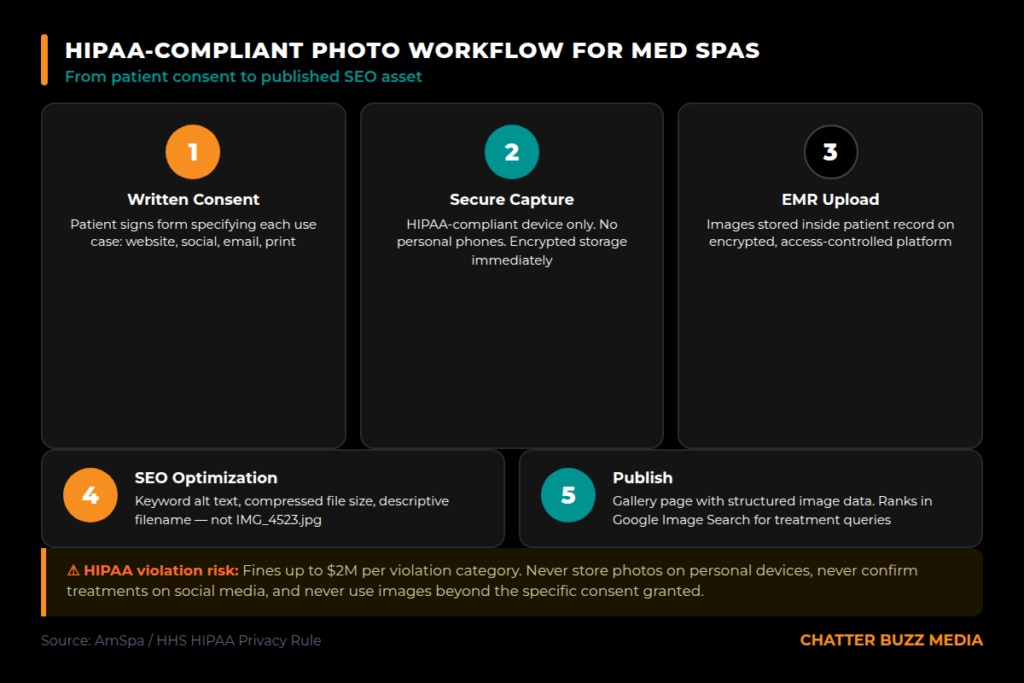
Competitor Analysis Framework for Med Spa Local SEO
You can’t build an effective med spa SEO strategy without knowing who you’re actually competing against in each local market. And here’s the critical point: your competitors are different in every market. Your Orlando location competes against a different set of practices than your Tampa or Scottsdale location.How to Run a Per-Location Competitive Audit
Map Pack Audit
Search your top 5 treatment keywords + city name. Document who ranks in positions 1–3 of the Map Pack for each. These are your true local competitors, not necessarily the biggest names in the industry.Review Gap Analysis
Compare your review count and average rating against each Map Pack competitor. If the top-ranking practice has 340 reviews at 4.8 stars and your location has 45 at 4.6, you’ve identified a gap that directly impacts ranking.Content Depth Comparison
Audit the top 3 organic competitors’ websites. How many treatment pages do they have? Do they have location-specific content? Are they running FAQ pages? Blog content? The practices outranking you are doing something you’re not.Backlink Profile
Use Ahrefs or Semrush to check domain authority and referring domains. If competitors have editorial backlinks from health publications, lifestyle sites, and local media, and you don’t, that’s a signal that content and digital PR need to be part of your strategy.Schema and Technical Audit
Check whether competitors are implementing structured data. A 2026 audit of 5,000 websites found that while 71% deploy some form of schema, only 22% implement it correctly enough to pass Google’s Rich Results Test — and adoption in healthcare verticals like med spas skews even lower. This is a fast, defensible advantage. Run this audit for each location every quarter. Markets shift, new competitors open, and existing competitors invest in SEO. What worked six months ago may not hold today.What to Do Next: Building Your Med Spa SEO Roadmap
Med spa SEO is not an overnight project. Most practices that implement the fundamentals properly see meaningful Map Pack movement within 60–90 days, with organic ranking improvements for competitive keywords at the 4–6-month mark. The sequence matters. Start with your Google Business Profiles, one per location, fully optimized. Build your location-specific website architecture with unique treatment pages per market. Implement schema markup across every page. Launch a systematic review generation program. Then layer in content, FAQ pages, blog posts, and before-and-after galleries to build topical authority and capture long-tail search traffic. If you’re running 3+ locations, this isn’t work that scales with a single in-house coordinator and a template. It requires a system: a per-location strategy, proprietary AI tools to accelerate content production, and a senior team that’s managed this at scale before. That’s exactly what our team does. We manage $300K+/month in aesthetics advertising and build per-location SEO strategies for multi-location med spa groups. Our Fractional CMO + execution model means you get strategic leadership and the team that executes it, not one without the other.➤ Ready to Rank Every Location? Your 5th location shouldn’t cannibalize your 3rd. Our Med Spa SEO Quick-Win Package gives you the competitive audit, technical fixes, and content roadmap to start showing up where your patients are searching. — Get Your $3K-$5K Med Spa SEO Audit
Frequently Asked Questions About Med Spa SEO
How long does it take for med spa SEO to show results?
Most med spas see meaningful movement in local Map Pack rankings within 60–90 days of implementing GBP optimization, citation cleanup, and review generation. Organic rankings for competitive treatment keywords typically take 4–6 months of consistent effort. Multi-location groups may see faster results on individual locations that start with stronger baseline authority.Does each med spa location need its own website?
No. A single domain with dedicated location pages and location-specific treatment pages is the strongest architecture for multi-location SEO. Separate websites dilute domain authority and make content management exponentially harder. Use a hub-and-spoke structure where each location has its own section within one authoritative domain.Are before-and-after photos worth the HIPAA compliance effort for SEO?
Yes. Before-and-after galleries are the highest-converting content type on med spa websites, and they generate meaningful SEO value through Google Image Search, increased time on page, and enriched content signals. The compliance requirements are manageable with the right systems, HIPAA-compliant photo platforms, proper consent forms, and encrypted storage.What schema markup should a med spa implement first?
Start with MedicalBusiness schema on your homepage and every location page. Then add FAQPage schema to your treatment and FAQ pages. Finally, implement MedicalProcedure schema on individual treatment pages. This sequence delivers the fastest impact with the least technical lift.How many Google reviews does a med spa need to rank in the Map Pack?
There’s no universal number; it depends on your market. In competitive metros like Miami, Los Angeles, or New York, top Map Pack positions often require 200+ reviews. In mid-size markets, 50–100 reviews with a strong recent velocity (5–10 new reviews per month) can be enough to compete. The key is consistent volume and recency, not just a total count.Need help with SEO? Explore our SEO agency services.
Sydney Linton
Sydney Linton is a Content Marketing Specialist at Chatter Buzz. She loves creating content that motivates readers to take action. Sydney combines her passion for storytelling with her love for problem-solving to create strategic content.