
 321-236-2899
Credit Union Landing Page CRO: Convert More Loans & Members
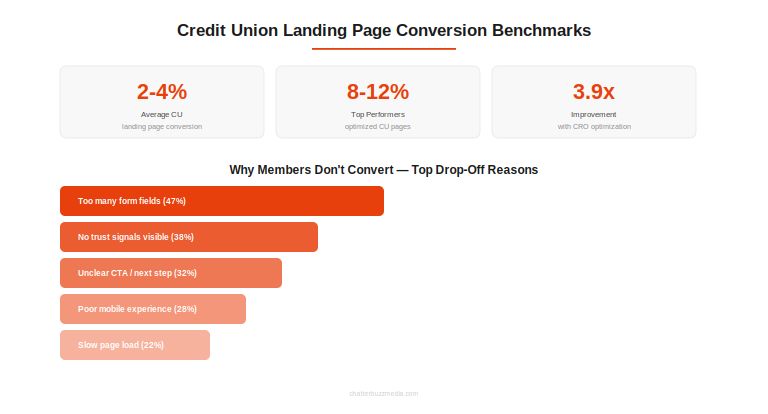
Your credit union’s landing pages are getting traffic. But the conversion rate? Probably sitting somewhere between 2-4% — which means 96 out of every 100 visitors leave without applying for a loan, opening an account, or requesting a consultation.
We’ve optimized landing pages for credit unions managing $500M–$5B+ in assets, and the difference between a 3% and an 8% conversion rate on a high-traffic auto loan page can mean millions in new loan originations per year. The fixes are rarely complicated — they’re just specific to how credit union members make financial decisions.
This guide walks you through exactly how to audit, restructure, and optimize your credit union’s landing pages for maximum conversion — from the psychology of financial decision-making to the specific CTA structures that move members from browsing to applying.
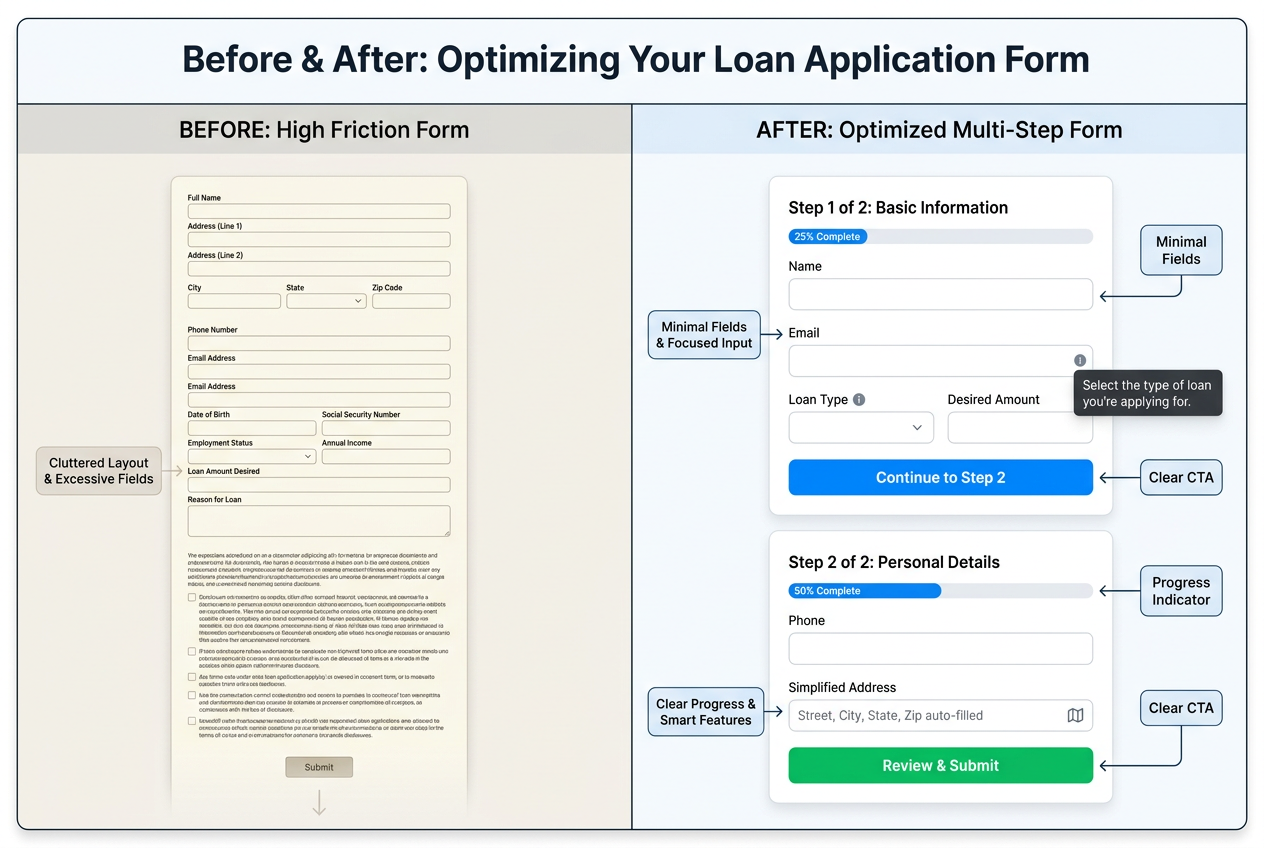 Multi-Step Forms with Progress Indicators
Break complex applications into logical steps: Personal Information → Financial Details → Loan Preferences → Review & Submit. Clear progress bars show visitors exactly where they are and how much remains.
Multi-step forms with 3-4 stages typically outperform single-page forms for applications requiring substantial information. They reduce cognitive load and increase completion rates despite requiring more clicks.
In-Progress Save Options
Life happens. Phones ring, kids need attention, and visitors navigate away before finishing. Offering “Save & Continue Later” functionality via email dramatically reduces abandonment. Send a reminder email after 24 hours if the application remains incomplete.
Smart Field Design
Multi-Step Forms with Progress Indicators
Break complex applications into logical steps: Personal Information → Financial Details → Loan Preferences → Review & Submit. Clear progress bars show visitors exactly where they are and how much remains.
Multi-step forms with 3-4 stages typically outperform single-page forms for applications requiring substantial information. They reduce cognitive load and increase completion rates despite requiring more clicks.
In-Progress Save Options
Life happens. Phones ring, kids need attention, and visitors navigate away before finishing. Offering “Save & Continue Later” functionality via email dramatically reduces abandonment. Send a reminder email after 24 hours if the application remains incomplete.
Smart Field Design
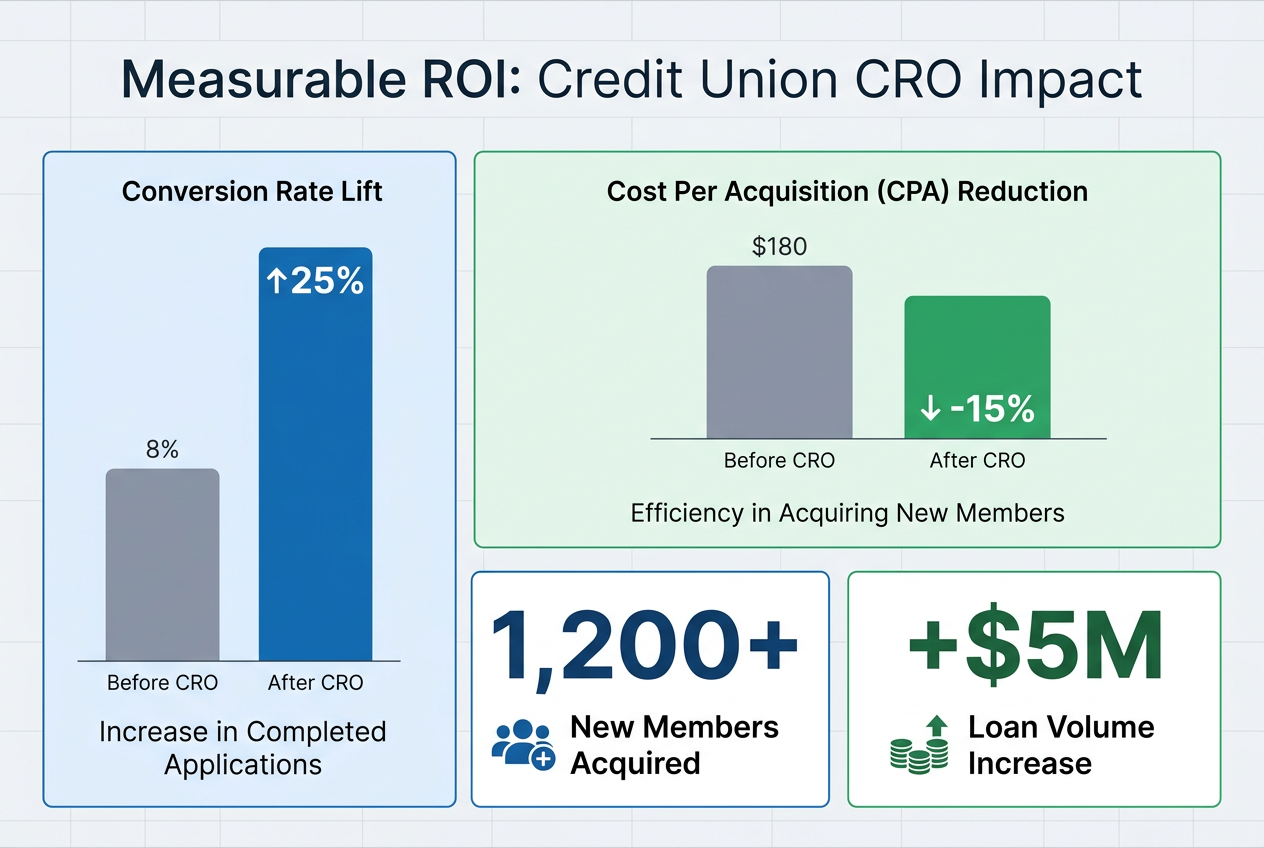 ROI Calculation Framework: Demonstrating Financial Impact to the CFO
Here’s how to present CRO value in terms executives understand:
ROI Calculation Framework: Demonstrating Financial Impact to the CFO
Here’s how to present CRO value in terms executives understand:
Key Takeaways
- Most credit union landing pages fail because they’re built for information, not conversion. Members don’t need another rate table — they need a clear, low-friction path to action.
- Trust signals are non-negotiable for financial landing pages — NCUA insurance badges, member testimonials, security certifications, and transparent fee disclosures must be visible above the fold.
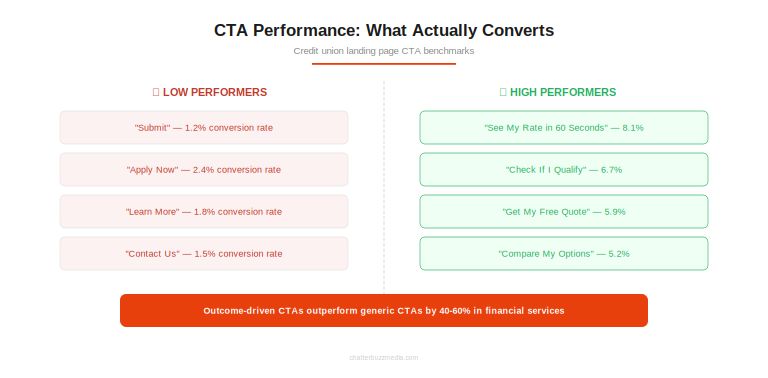
- The highest-converting credit union CTAs are specific and outcome-driven: “See My Rate in 60 Seconds” outperforms “Apply Now” by 40-60% in financial services.
- Mobile optimization isn’t optional — 65%+ of credit union landing page traffic is mobile. If your form has more than 3 fields on mobile, you’re losing conversions.
- A/B testing one element at a time (headline, CTA, form length, hero image) compounds over time. A 1% monthly improvement = 12.7% annual conversion lift.
- Landing page CRO and paid media work together — optimizing the page after the click is where most credit unions leave the biggest ROI gains on the table.
1. Understanding the Credit Union Conversion Landscape (Intent & Psychology)
The Modern Member Journey: From Search to Application
Today’s credit union members are sophisticated shoppers. They research extensively before making financial decisions, comparing rates across multiple institutions and reading reviews. Understanding this journey is the first step to optimization. Decoding “Rate Shopper” Behavior Rate shoppers aren’t just price-sensitive—they’re risk-averse. They want the best deal, but they also want security, convenience, and confidence that they’re making the right choice. When they land on your page, they’re evaluating several factors simultaneously:- Trust signals: Is this institution legitimate and secure?
- Rate competitiveness: How does this rate compare to what I’ve seen elsewhere?
- Process clarity: Will this application be straightforward or painful?
- Value beyond rates: What else do I get by choosing this credit union?
Beyond Clicks: Defining Credit Union Conversion Goals (Loans, Accounts, CDs)
Not all conversions are created equal. A successful landing page strategy requires defining clear, measurable goals for each product type: For Loans (Auto, Personal, Mortgage): – Application starts – Completed applications – Rate quote requests – Loan approvals – Average loan amount For Checking and Savings Accounts: – Account opening completions – Initial deposit amounts – Mobile banking registrations – Debit card activations For Certificates of Deposit (CDs): – Rate comparison tool engagement – CD calculator usage – Application submissions – Funded CD accounts – Average deposit size Understanding these micro and macro conversions allows you to optimize each step of the funnel, not just the final outcome. A visitor who uses your auto loan calculator but doesn’t apply immediately is still valuable—they’ve shown intent and can be nurtured through email marketing or remarketing campaigns.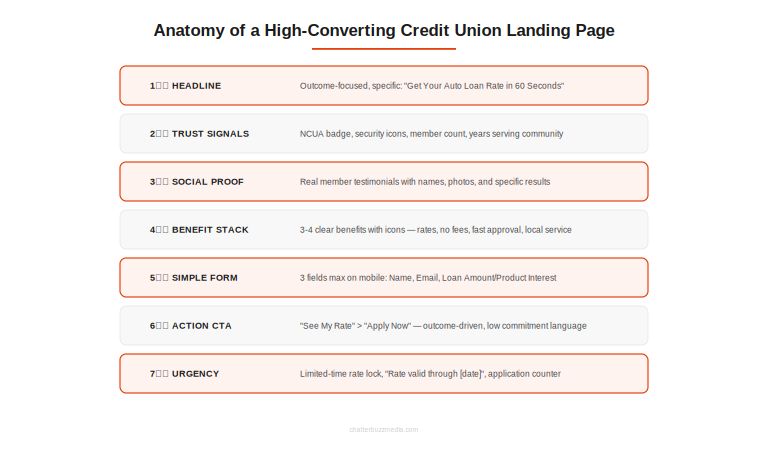
2. The Foundational Elements of a High-Converting Credit Union Landing Page
A. Compelling Headlines & Value Propositions (Stand Out from the Crowd)
Your headline is the first—and sometimes only—element visitors read. It must immediately communicate value while differentiating you from banks and fintechs. Weak headline: “Auto Loans Available” Strong headline: “Drive Home with Rates as Low as 3.99% APR—Plus $200 Back to Local Schools” The strong headline does three things: it leads with a competitive rate, includes a tangible benefit, and reinforces community values. It speaks directly to rate shoppers while highlighting what makes credit unions special. Crafting Benefit-Driven Headlines Focus on outcomes, not features. Instead of “Flexible Terms Available,” try “Choose Your Perfect Payment—12 to 84 Month Terms.” Instead of “Online Account Opening,” use “Open Your Account in 5 Minutes—No Branch Visit Needed.” Avoid financial jargon. Terms like “APY,” “compounding,” and “amortization” may be second nature to you, but they create cognitive friction for many members. Use plain language or immediately explain technical terms. Integrating Local Relevance Geographic specificity builds trust and improves local SEO performance. Headlines like “Serving Orlando Families Since 1952” or “Trusted by 50,000+ Tampa Bay Members” immediately communicate legitimacy and community roots.B. Clear & Trust-Building Visual Hierarchy
Visual hierarchy guides visitors’ eyes to the most important elements: your value proposition, call-to-action, and trust signals. A cluttered page with no clear focal point causes decision paralysis. Strategic Use of Community Imagery Show real members (with permission) rather than stock photos. Images of local families, businesses, or community events build authenticity. Avoid generic handshake photos or corporate imagery that could appear on any financial institution’s website. Placement of NCUA/FDIC Logos and Security Badges Trust symbols should be visible but not dominant. Place NCUA insurance logos in the footer or sidebar where visitors expect to find them. Modern SSL certificates and security badges near form fields reassure visitors that their information is protected. Consider adding brief explainer text: “Your deposits are federally insured up to $250,000 by the NCUA” is more reassuring than just displaying a logo.C. Irresistible Calls-to-Action (CTAs) for Every Stage
Effective CTAs use action-oriented language that removes friction and creates urgency without being pushy. Primary vs. Secondary CTAs Your primary CTA should be bold and specific: “Apply for Your Auto Loan Now” outperforms “Submit” or “Learn More.” Use contrasting colors that stand out from your page design but align with your brand palette. Secondary CTAs serve visitors not ready to commit. Options like “Estimate My Rate,” “Calculate My Payment,” or “Get Pre-Qualified” allow engagement without full application commitment. These lower-friction alternatives keep visitors in your funnel rather than bouncing to competitors. Mobile-Optimized CTA Placement On mobile devices, implement sticky CTAs that remain visible as users scroll. Thumb-friendly button sizes (minimum 44×44 pixels) ensure easy tapping. Test your CTAs on actual mobile devices, not just responsive browser views. Multiple Strategic CTA Placements Place CTAs at natural decision points: after explaining key benefits, following rate tables, and at the end of the page. Research shows that strategic repetition increases conversion rates without annoying visitors—as long as each placement makes contextual sense.D. Optimized Forms: Reducing Friction for Loans, Accounts & CDs
Forms are where most credit union landing pages fail. Every additional field represents a barrier to completion. Minimal Essential Fields Only Ask only for information you absolutely need at this stage. Full applications can be completed later—the goal is to get visitors into your pipeline. For initial rate quotes, name, email, and loan amount may be sufficient. Consider progressive disclosure: show 3-4 fields initially, then reveal additional fields only after the first set is completed. This psychological technique makes long forms feel more manageable.
Multi-Step Forms with Progress Indicators
Break complex applications into logical steps: Personal Information → Financial Details → Loan Preferences → Review & Submit. Clear progress bars show visitors exactly where they are and how much remains.
Multi-step forms with 3-4 stages typically outperform single-page forms for applications requiring substantial information. They reduce cognitive load and increase completion rates despite requiring more clicks.
In-Progress Save Options
Life happens. Phones ring, kids need attention, and visitors navigate away before finishing. Offering “Save & Continue Later” functionality via email dramatically reduces abandonment. Send a reminder email after 24 hours if the application remains incomplete.
Smart Field Design
- Auto-formatting: Phone numbers should automatically format as (555) 123-4567
- Input masking: SSN fields should display as XXX-XX-1234 for security
- Inline validation: Show checkmarks or error messages as fields are completed, not just on submission
- Contextual help: Provide tooltips for potentially confusing fields like “Member Since” or “Share Account Number”
3. Advanced CRO Strategies for Credit Union Success
A. Mobile-First Design & Speed: Capturing On-the-Go Members
With nearly 80% of credit union website traffic coming from mobile devices, mobile optimization isn’t optional—it’s essential. Thumb-Friendly Navigation Mobile users operate primarily with their thumbs. Place important elements within the natural thumb zone (bottom third of the screen on most phones). Hamburger menus should be easily accessible, and buttons should be large enough to tap accurately. Compressed Media & Lightning-Fast Load Times Every second of load time costs you conversions. Research consistently shows that pages loading in under 2 seconds convert significantly better than those taking 3+ seconds. Compress images using modern formats like WebP. Implement lazy loading so below-the-fold images don’t delay initial page rendering. Consider a content delivery network (CDN) to serve assets from geographically distributed servers. Our managed cloud hosting includes performance optimization that can dramatically improve load speeds. Mobile-Specific Features- Click-to-call buttons: Allow immediate phone contact without typing
- Tap-to-text options: Enable quick questions via SMS
- Native mobile features: Use device capabilities like camera access for document upload
- Simplified navigation: Reduce menu complexity for smaller screens
B. Building Unshakeable Trust & Social Proof (E-E-A-T for Financial Services)
Google’s E-E-A-T framework (Experience, Expertise, Authoritativeness, Trustworthiness) is particularly important for financial institutions. Landing pages must demonstrate all four elements. Leveraging Member Testimonials Effectively Generic testimonials like “Great service!” mean little. Powerful testimonials tell specific stories: “After the big banks rejected my business loan application, [Credit Union Name] took time to understand my situation. They approved my $50,000 loan in 48 hours, and my bakery has doubled revenue since then. Thank you for believing in local businesses!” – Maria S., Orlando Include photos and full names (with permission). Video testimonials are even more effective, creating emotional connection and authenticity that text alone cannot achieve. Displaying Awards and Community Partnerships Showcase recognition from legitimate organizations: “Best Credit Union 2026” from industry publications, Five-Star ratings from BauerFinancial, or community service awards from local chambers of commerce. These third-party validations build credibility. Highlight partnerships with local schools, nonprofits, or businesses. “Proud sponsor of [Local School District]” or “Official Financial Partner of [Community Event]” demonstrate commitment beyond profit. Managing Online Reviews Google Business Profile reviews significantly impact local SEO and member trust. Actively encourage satisfied members to leave reviews. Respond professionally to all reviews—both positive and negative—showing that you value member feedback. Address negative reviews constructively: acknowledge the concern, apologize if appropriate, offer to resolve the issue offline, and follow through. Potential members judge you on how you handle problems, not whether problems ever occur.C. Local SEO Integration: Attracting Members “Near Me”
Local search intent is powerful for credit unions. When someone searches “auto loans near me” or “best CD rates in Tampa,” you want to appear prominently. Optimizing Google Business Profile Your GBP is often the first impression potential members have. Ensure every location has: – Complete, accurate NAP (Name, Address, Phone) information – Current business hours, including holidays – High-quality photos of branches, staff, and community involvement – Detailed business description incorporating local keywords – Regular posts about rates, promotions, and community events – Prompt responses to questions and reviews Creating Dedicated Location-Based Landing Pages For multi-branch credit unions, generic pages don’t serve local search intent well. Create specific pages for each location and product combination:- “Auto Loans in Orlando, FL”
- “Mortgage Rates in Tampa Bay”
- “Checking Accounts in Winter Park”
D. Addressing Compliance: CRO Within Regulatory Frameworks
Financial services operate within strict regulatory frameworks. NCUA, OCC, and FTC requirements aren’t obstacles to optimization—they’re guardrails that protect both you and your members. Balancing Persuasion with Legal Requirements Prominent disclosure of APR, fees, and terms is legally required, but it doesn’t have to kill conversions. Use clear, plain-language explanations rather than burying members in legal jargon. Place mandatory disclosures where expected (near rate tables, adjacent to CTAs) using clear labels like “Important Rate Information” or “What You Need to Know.” Make them accessible without disrupting the primary conversion path. Equal Housing and Lending Compliance Equal Housing Opportunity logos and fair lending statements must appear on mortgage and loan pages. Position them appropriately without making them the visual focus. Compliance demonstrates professionalism and builds trust when handled correctly. Privacy and Data Security Messaging Members are rightfully concerned about data security. Brief, clear statements near forms reassure visitors: “Your information is encrypted and secure. We will never sell your personal data.” Link to your complete privacy policy for members who want full details, but don’t force everyone to read pages of legal text before applying. Working with Compliance Teams Involve your compliance department early in the landing page design process. Explain your conversion goals and ask for their input on regulatory requirements. Collaborative approaches produce better results than adversarial “marketing vs. compliance” dynamics.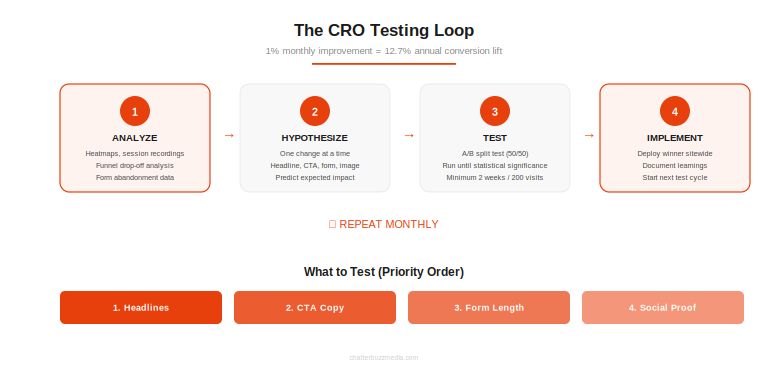
4. The Iterative Loop: Testing, Measuring & Optimizing for Exponential Growth
CRO isn’t a one-time project—it’s an ongoing process of hypothesis, testing, learning, and refinement.A. A/B Testing Your Credit Union Landing Pages: What, When, & How
A/B testing (split testing) compares two versions of a page element to determine which performs better. When done systematically, it produces continuous improvement. Hypothesis Formulation for Credit Union Elements Don’t test randomly. Form specific hypotheses based on data, user feedback, or best practices:- “Hypothesis: Changing our CTA from ‘Apply Now’ to ‘Get My Rate’ will increase clicks by 15% because it reduces commitment anxiety.”
- “Hypothesis: Adding member video testimonials above the fold will increase application starts by 10% by building trust earlier in the journey.”
- “Hypothesis: Reducing our loan application form from 12 fields to 6 will increase completion rate by 25% by minimizing friction.”
- Headlines and value propositions
- Primary CTA copy and design
- Form length and field order
- Hero images and visual hierarchy
- Trust signals and social proof placement
- Page length and information architecture
- Urgency messaging: Test “Limited-Time Rate” vs. “Current Rate” for loan offers
- Social proof variations: Member testimonials vs. statistical proof (“Chosen by 50,000+ members”)
- Rate presentation: Table format vs. calculator widget for CD rates
- Pre-qualification language: “Check My Rate” vs. “Get Pre-Approved”
- Local vs. benefit focus: “Serving Orlando Since 1952” vs. “Up to $500 Cash Back Bonus”
B. Essential KPIs for Credit Union Marketers (From VP to CFO)
Tracking the right metrics ensures you can demonstrate value to leadership while identifying optimization opportunities. Conversion Rate Metrics- Overall landing page conversion rate: Visitors who complete desired action ÷ total visitors
- Product-specific conversion rates: Separate tracking for loans, accounts, CDs
- Micro-conversion rates: Calculator usage, rate quote requests, document downloads
- Application abandonment rate: Started applications ÷ completed applications
- Bounce rate: Single-page sessions indicate relevance problems
- Average time on page: Longer engagement typically correlates with higher conversion
- Pages per session: Multi-page visitors show higher intent
- Traffic source performance: Compare conversion rates across channels (organic, paid, social, direct)
ROI Calculation Framework: Demonstrating Financial Impact to the CFO
Here’s how to present CRO value in terms executives understand:
- Current State: 10,000 monthly landing page visitors, 2% conversion rate = 200 new applications
- After Optimization: 10,000 monthly visitors, 3% conversion rate = 300 new applications
- Incremental Gain: 100 additional applications monthly = 1,200 annually
C. Member Onboarding Optimization: Continuing the Experience Post-Conversion
The member journey doesn’t end when the application is submitted. Strategic onboarding increases activation rates, reduces early attrition, and maximizes lifetime value. Immediate Confirmation and Next Steps The thank-you page should clearly communicate what happens next: – Expected approval timeline – Required documentation – Contact information for questions – What to expect via email/phone Don’t waste this high-engagement moment. Consider offering immediate value: “While we review your application, explore our financial wellness resources” with links to calculators, budget tools, or educational content. Personalized Welcome Email Series Automate a welcome sequence that nurtures new members through their first 90 days:- Day 0: Confirmation and next steps
- Day 1: Introduction to online/mobile banking
- Day 3: Highlight unique member benefits (lower fees, better rates, community impact)
- Day 7: Encourage account funding or loan acceptance
- Day 14: Introduce additional products they might need
- Day 30: Request feedback and offer personalized assistance
- Day 90: Celebrate their membership milestone
Frequently Asked Questions About Credit Union Landing Page Optimization
1. How long does it take to see results from landing page optimization? You can see initial results from basic CRO improvements (clearer CTAs, reduced form fields, improved mobile experience) within 2-4 weeks. However, comprehensive optimization with systematic A/B testing typically shows substantial impact over 3-6 months. Remember, CRO is an ongoing process, not a one-time project. Continuous improvement compounds over time, with mature optimization programs delivering exponentially better results year over year. 2. What’s the average conversion rate for credit union landing pages? Average conversion rates vary significantly by product type and traffic source. Typical benchmarks include: – Auto loan landing pages: 3-8% conversion rate – Mortgage pre-qualification pages: 5-12% conversion rate – Checking account opening pages: 2-5% conversion rate – CD rate pages: 1-4% conversion rate However, these are broad averages. Your specific conversion rate depends on factors like traffic quality, local competition, rate competitiveness, and page optimization. Don’t obsess over industry averages—focus on improving your own baseline metrics. 3. How do we balance compliance requirements with conversion optimization? Compliance and conversion aren’t inherently opposed. The key is strategic integration: – Place required disclosures prominently but not disruptively – Use clear, plain language rather than dense legal jargon where possible – Make compliance elements accessible without blocking the conversion path – Work collaboratively with your compliance team during the design phase Many credit unions assume members must read every disclosure before taking action, but regulations typically require availability, not forced consumption. A well-designed page makes compliance information accessible to those who want it while maintaining clear conversion paths. 4. Should we create separate landing pages for each product or use general pages? Dedicated product-specific landing pages almost always outperform generic pages. Here’s why: – Message match: Visitors clicking “auto loan” ads expect auto loan content, not general banking information – Relevant CTAs: Product-specific CTAs (“Apply for Auto Loan”) convert better than generic ones (“Learn More”) – Targeted optimization: You can optimize messaging for each product’s unique value proposition – Better SEO: Focused pages rank better for specific search queries Create distinct landing pages for major product categories (auto loans, mortgages, checking, savings, CDs) and consider sub-pages for specific variations (first-time homebuyer mortgages, student checking, etc.) as traffic volume justifies. 5. How important are landing page load speeds for credit union conversions? Extremely important. Research consistently shows that: – 53% of mobile visitors abandon pages that take longer than 3 seconds to load – Each additional second of load time can decrease conversions by 7-10% – Pages loading in under 2 seconds convert significantly better than slower pages For credit unions, where visitors are often comparing multiple institutions, speed creates a critical competitive advantage. If your page loads slowly while a competitor’s loads instantly, you’ve lost the member before they even see your rates. Invest in quality hosting, optimize images, and regularly test your page speed on actual mobile networks. 6. What’s the ROI of professional CRO services compared to doing it in-house? The ROI calculation depends on your current traffic volume and conversion rates, but here’s a typical scenario: In-house approach: – Full-time CRO specialist: $75,000 + $20,000 benefits = $95,000 annually – Software tools (testing, analytics, heat mapping): $5,000-$10,000 annually – Total first-year cost: $100,000-$105,000 – Challenge: Finding experienced CRO talent willing to work for a single credit union Agency partnership: – Comprehensive CRO services: $3,000-$7,000 monthly = $36,000-$84,000 annually – Software tools typically included in service – Access to senior specialists across disciplines (CRO, UX design, copywriting, development, analytics) – Benefit of cross-industry insights from multiple client engagements For most credit unions with 1-5 person marketing teams, agency partnership delivers better results at lower cost, with faster implementation and fewer internal resource demands. 7. How do we handle visitors who aren’t ready to apply but want to learn more? Not every visitor is ready to complete an application on their first visit. Provide multiple engagement pathways: Primary CTA: “Apply Now” for high-intent visitors Secondary CTAs: – “Calculate My Payment” (loan products) – “Compare CD Rates” (investment products) – “Estimate My Rate” (qualification without full application) – “Download Rate Sheet” (captures email for follow-up) – “Schedule a Call” (personal assistance option) – “Join Our Newsletter” (long-term nurturing) These secondary options keep visitors engaged and in your marketing funnel, allowing you to nurture them toward application through email campaigns, remarketing, and valuable content. Many credit union members research for weeks or months before making final decisions—staying connected during that journey is crucial. 8. What are the biggest landing page mistakes credit unions make? Based on hundreds of audits, the most common landing page mistakes include:- Rate-only focus: Leading exclusively with rates without communicating member benefits or community value
- Too many options: Overwhelming visitors with multiple products, CTAs, and paths rather than focused conversion goals
- Mobile neglect: Designing primarily for desktop while 80% of traffic comes from mobile
- Generic testimonials: Using vague praise instead of specific member success stories
- Friction-filled forms: Asking for unnecessary information upfront or using poorly designed form fields
- Weak trust signals: Failing to prominently display NCUA insurance, security features, and social proof
- No clear next steps: Leaving visitors uncertain about what happens after submission
- Ignoring local SEO: Missing opportunities to capture “near me” searches and location-based traffic
Conclusion: Stop Paying for Clicks That Don’t Convert
Every dollar you spend on paid media, SEO, and content marketing is wasted if the landing page doesn’t convert. The credit unions seeing the highest marketing ROI in 2026 aren’t spending more — they’re converting more of the traffic they already have. Start here:- Audit your top 5 landing pages — check conversion rates, bounce rates, and form completion rates. Identify the biggest drop-off points.
- Fix trust signals first — add NCUA badge, security icons, and member testimonials above the fold on every financial product page.
- Simplify your forms — cut fields to the minimum needed for a first interaction. You can collect more data after they convert.
- Test one element per month — headline, CTA, hero image, form placement. Track everything and compound the gains.
Need help with SEO? Explore our SEO agency services.

Noah Reed
Noah Reed is a growth marketing strategist at Chatter Buzz who helps credit unions and financial institutions grow membership, deposits, and loan volume through paid search, SEO, CRO, and full-funnel demand generation. Working within a Google Premier Partner team, he focuses on the metrics that actually move revenue, such as cost per acquired member, close rate, and lifetime value, rather than vanity metrics. Connect with Noah on LinkedIn.