
 321-236-2899
SEO Content Strategy: Build a Plan That Drives Revenue

Most SEO content strategies are built to win rankings. The best ones are built to win revenue.
This guide walks through the exact framework a fractional CMO uses to turn content into pipeline, not just pageviews. You will see how to reverse-engineer content from revenue goals, build topic clusters around buyer intent, and measure what actually moves the number your CEO cares about.
The approach here has been used to build content engines that compound for years, where a single well-mapped page keeps producing qualified leads long after it publishes. By the end, you will know how to build a plan a finance team would sign off on, and one specific way to prioritize topics so you never waste a quarter on content that ranks but never converts.
Let’s start with what an SEO content strategy actually is when revenue is the goal.
Key Takeaways
- Rankings are a means, not the goal. A revenue-first SEO content strategy maps every page to a business outcome before a single word is written.
- Reverse-engineer from the number. Start with your revenue target and customer economics, then work backward to the topics and search demand that can realistically get you there.
- Intent beats volume. A 200-search bottom-funnel term can outperform a 20,000-search informational term when you score topics by revenue potential, not traffic.
- AI search changed the rules. Answer engines now absorb top-of-funnel clicks, so depth, original data, and answer-ready formatting are how you stay visible.
- Measure pipeline, not pageviews. Attribution to leads, opportunities, and closed revenue is what separates a content strategy from a content calendar.
What Is an SEO Content Strategy (and Why Revenue Changes It)?
An SEO content strategy is a documented plan for creating, structuring, and optimizing content so it ranks in search, earns qualified traffic, and converts that traffic into revenue. The revenue clause is what most definitions leave out, and it is the difference between a strategy and a publishing schedule.
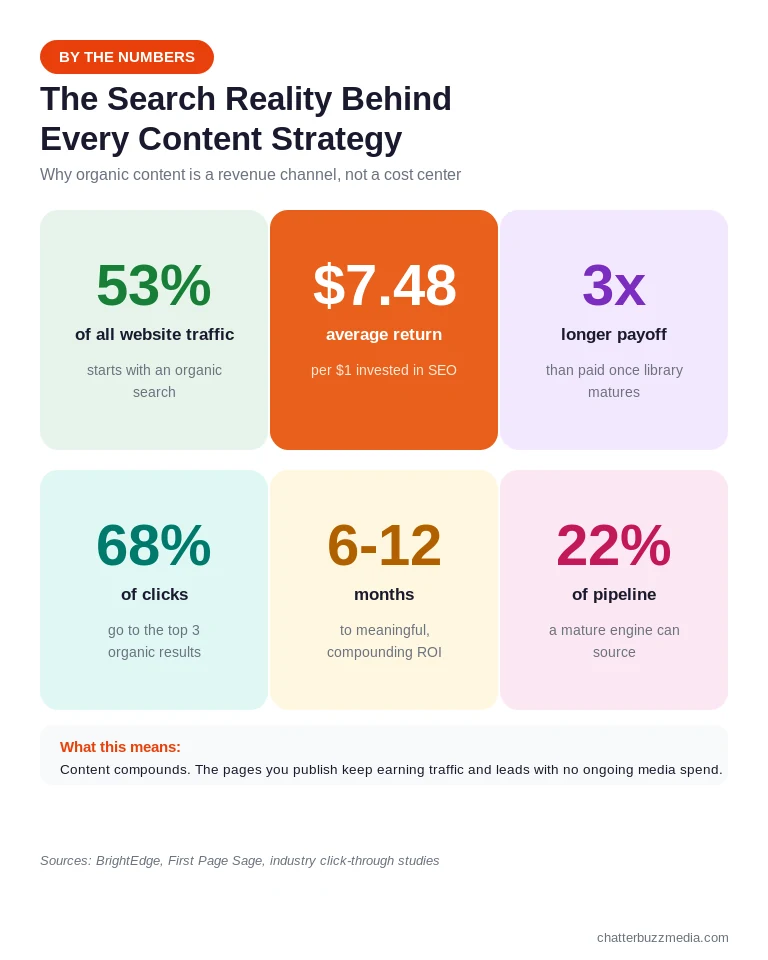
This matters because the economics are real. Organic search drives more than half of all trackable website traffic, according to BrightEdge channel research, and it does so without paying per click.
Yet most teams still measure the wrong thing. They report sessions and keyword counts to leadership, which tells you nothing about whether the content produced a single sales conversation.
The documentation gap is part of the problem. The Content Marketing Institute finds that most B2B marketers do content marketing, but far fewer have an actual documented strategy guiding it.
A revenue-oriented content marketing program flips the reporting. Instead of “we grew traffic 40%,” the sentence becomes “content sourced 22% of new pipeline this quarter.”
The shift changes every downstream decision. It changes which keywords you chase, how deep each page goes, and which pages get the internal links and refresh budget.
A good strategy answers three questions in writing. Who are we trying to reach, what will we publish to reach them, and how will we prove it produced revenue?
Here is the practical definition to work from: your SEO content strategy is the system that decides what to publish, for whom, in what order, and how you will prove it paid off.
Strategy vs. Content Calendar: The Difference That Matters
A content calendar tells you what publishes on Tuesday. A strategy tells you why that piece exists, who it is for, and what business outcome it is expected to drive.
Most teams have a calendar and call it a strategy. The gap shows up in a few predictable ways:
- A calendar lists topics; a strategy ranks them by value. One fills slots, the other decides which slots are worth filling.
- A calendar tracks output; a strategy tracks outcomes. Publishing on schedule is not the same as producing pipeline.
- A calendar reacts; a strategy compounds. Disconnected posts fade, while a planned cluster builds authority that lifts every page in it.
You need both, but the calendar should be the output of the strategy, not a substitute for it. With that lens, let’s look at why so many strategies stall.
Traffic vs. Revenue: Why Most SEO Content Strategies Stall
Most SEO content strategies stall because they optimize for traffic that never had a chance to convert. High-volume, top-of-funnel keywords feel like progress on a dashboard, but they attract researchers, students, and competitors far more often than buyers.
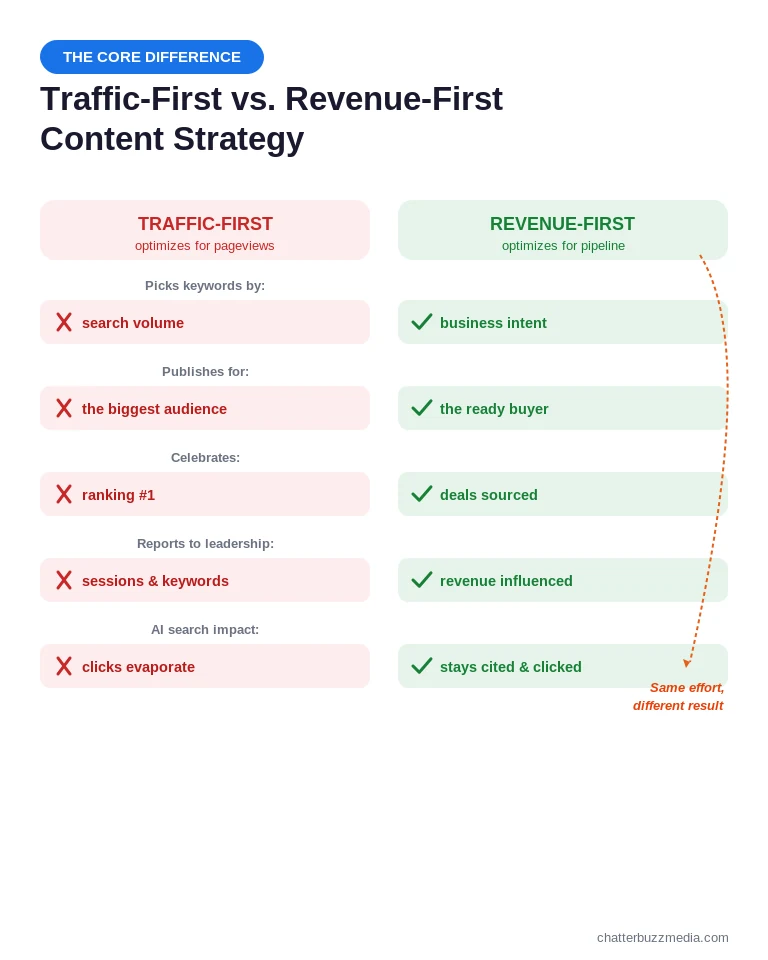
The traffic-first team picks keywords by search volume. The revenue-first team picks keywords by how close the searcher is to a buying decision.
Consider two terms. “What is marketing automation” might pull 20,000 monthly searches, while “marketing automation implementation cost” pulls 300.
The first term wins the traffic report. The second term is read almost exclusively by people with budget and a live project, which is why it wins the revenue report.
The traffic-first approach also creates a hidden tax. Every top-of-funnel post you publish needs updating, internal linking, and refreshing, so a library stuffed with low-intent content quietly drains the resources your money pages need.
This gap widened when AI answer engines arrived. Broad informational queries increasingly get answered directly in an AI Overview or a chatbot, so the click never reaches your page, a shift explored in current SEO best practices for 2026.
Bottom-funnel and mid-funnel content is more insulated. Someone comparing vendors or checking pricing still clicks through, because they need specifics an AI summary cannot safely invent.
None of this means traffic is useless. It means traffic is a leading indicator, valuable only when it reliably converts into the pipeline your business runs on.
The fix is not to abandon top-of-funnel content. It is to weight your calendar toward the intent that produces revenue and to treat informational content as a supporting layer, not the main event. That weighting starts with reverse-engineering the plan from your revenue goal.
Step 1: Reverse-Engineer Content From Your Revenue Goal
Build the strategy backward from the revenue number, not forward from a keyword list. Start with the pipeline you need, then translate that into the traffic, conversion rate, and content volume required to produce it.
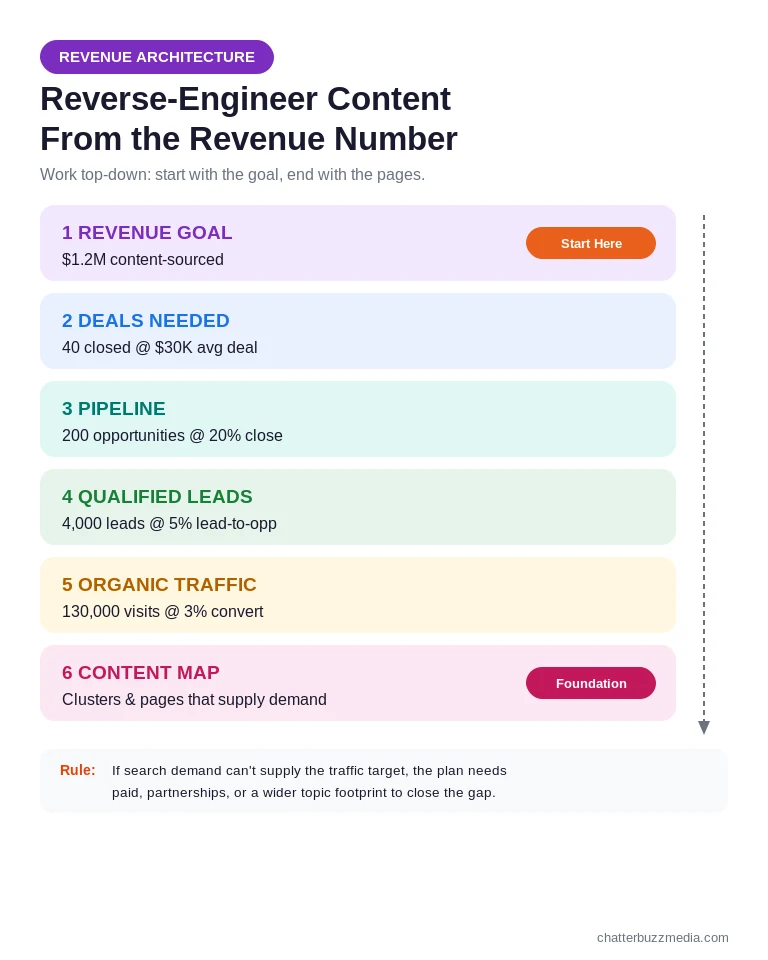
The math is simpler than it looks. If you need $1.2M in content-sourced revenue and your average deal is $30,000, you need 40 closed deals from content.
Work the funnel backward from there. At a 20% opportunity-to-close rate you need 200 opportunities, and at a 5% lead-to-opportunity rate you need roughly 4,000 qualified leads.
Now the traffic target becomes concrete. If bottom-funnel content converts visitors to leads at 3%, you need about 130,000 targeted organic visits, and you can see immediately whether your topic list can realistically supply that demand.
This is the same logic behind mapping a go-to-market strategy by revenue stage. Content is a growth channel, so it should be modeled like one.
The model also right-sizes your investment. If each closed deal is worth $30,000 and content needs to source 40 of them, you can defend a real budget for writers, design, and promotion instead of begging for scraps.
The exercise exposes fantasy plans early, too. If the available search demand in your niche caps out at 40,000 monthly visits, no amount of publishing will hit a 130,000-visit target, and you will need paid, partnerships, or a wider topic footprint to close the gap.
Anchor everything in your real customer economics. Knowing your customer acquisition cost tells you how much content investment a topic can justify before it stops making financial sense.
The Inputs Your Content Revenue Model Needs
You only need a handful of numbers to build this model, and most of them already live in your CRM. Pull these before you touch a keyword tool:
- Average deal size. The revenue a typical closed customer generates, which sets how many deals content must produce.
- Close rate. The percentage of opportunities that become customers, so you can size the opportunity target.
- Lead-to-opportunity rate. How many qualified leads it takes to create one real opportunity.
- Visitor-to-lead rate. The conversion rate of your decision-stage pages, which translates leads into a traffic target.
- Available search demand. The total realistic organic traffic your target topics can supply, which is your reality check.
Run the numbers once and the plan almost writes itself. The model tells you whether your goal is achievable through content alone, or whether it needs a bigger topic footprint or a paid assist.
With a defensible target in hand, you can decide which topics deserve a place on the map. That decision runs through topic clusters.
Step 2: Build Topic Clusters Around Buyer Intent
Organize content into topic clusters, not standalone posts, so each page reinforces the authority of the others. A cluster is one comprehensive pillar page on a broad topic, surrounded by focused articles that answer specific questions and link back to the pillar.
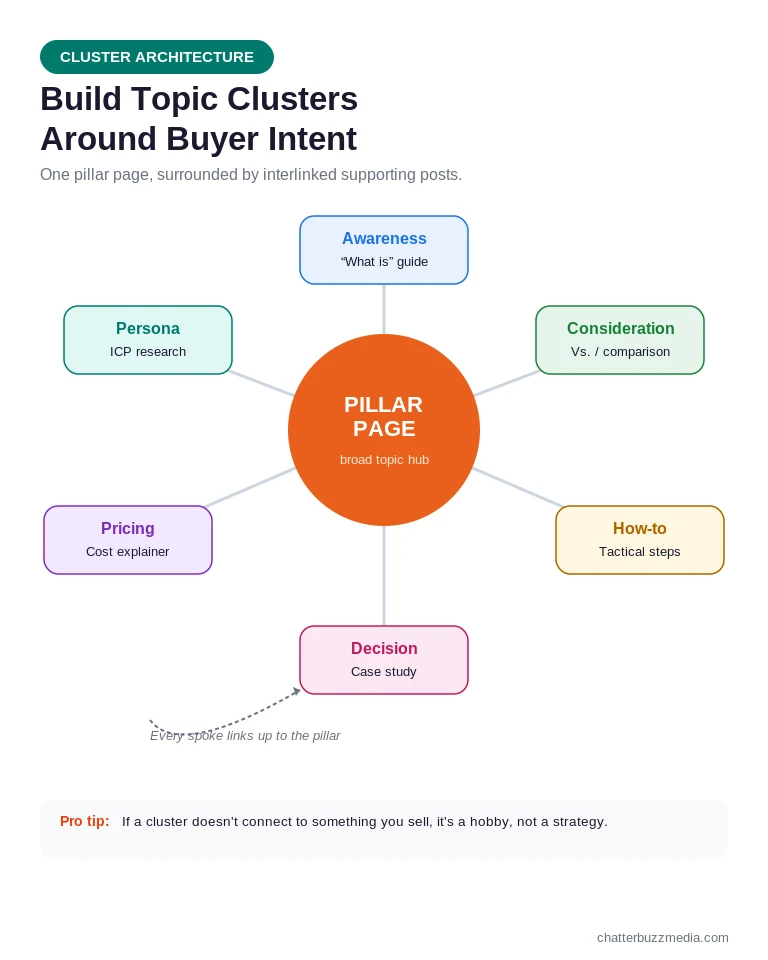
This structure does two jobs at once. It signals subject-matter depth to search engines, and it gives buyers a logical path from a broad question to a decision-stage answer.
Start by choosing pillars that map to what you sell. If you offer demand generation services, “B2B demand generation” is a pillar, and your demand generation guide becomes the hub that supporting posts feed.
Then build the spokes from real questions. Cluster content should answer the specific things buyers ask on the way to a decision, from demand generation versus lead generation to tactical how-tos and comparisons.
Interlink deliberately. Every spoke links up to the pillar, the pillar links down to its most important spokes, and related spokes cross-link so authority and readers flow through the cluster rather than leaking out.
Pick pillars around margin, not just volume. A cluster serving a high-value vertical like credit unions or manufacturing can be worth more than a broad consumer topic with ten times the searches.
Ground the whole cluster in audience research. Clusters built around a defined B2B buyer persona and a sharp ideal customer profile pull qualified readers instead of a random audience.
What Makes a Pillar Page Worth Building
A pillar page is only as strong as its ability to anchor a cluster and convert the readers it earns. Before you commit a pillar to the calendar, make sure it clears a few bars:
- It maps to revenue. The topic connects directly to something you sell, so rankings translate into pipeline rather than applause.
- It has real search demand. Enough people search the broad topic and its sub-questions to justify a hub-and-spoke build.
- You can go deeper than the competition. You hold firsthand experience, data, or examples that let the page outclass the current top results.
- It supports at least five spokes. The topic branches into enough specific questions to form a genuine cluster, not a lonely long post.
A useful test: if a cluster does not connect to a product, service, or revenue motion, it is a hobby, not a strategy. Once your clusters are mapped, the next job is aligning each page to the buyer’s stage.
Step 3: Map Every Page to Search Intent and Funnel Stage
Match each page to a single search intent and a single funnel stage, because content that tries to serve everyone converts no one. Search intent tells you what the reader wants, and funnel stage tells you what business action is realistic next.
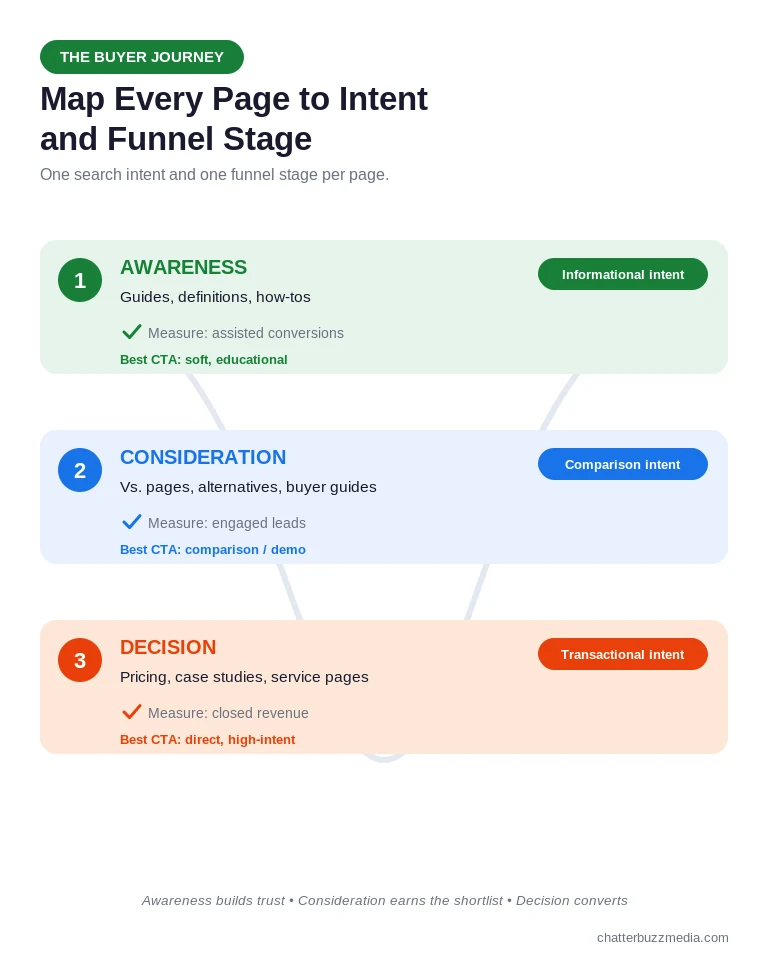
There are three core intents to design around. Informational searchers want to learn, navigational searchers want a specific destination, and transactional searchers are ready to act.
Awareness-stage content serves informational intent. Guides, definitions, and how-tos build trust and feed the top of your cluster, and they are best measured by assisted conversions rather than direct ones.
Consideration-stage content serves comparison intent. Versus pages, alternatives posts, and buyer’s guides catch people evaluating options, and this middle layer is where AI search has punished lazy content but rewarded genuinely useful comparisons.
Decision-stage content serves transactional intent. Pricing explainers, case studies, and service pages convert, so these deserve your strongest calls to action and your best internal links, a principle that also drives high-converting landing pages.
To make this concrete, here is what each stage typically looks like in a real content plan:
- Awareness: “what is” guides, trend explainers, and educational how-tos that answer a broad question and introduce your point of view.
- Consideration: comparison posts, alternatives lists, buyer’s guides, and framework articles that help a researcher narrow their options.
- Decision: pricing pages, case studies, ROI calculators, and service pages that give a ready buyer the proof and path to act.
Match the format to the stage as well as the intent. An awareness reader wants a scannable explainer, while a decision reader wants proof, specifics, and an obvious next step, so the same topic can call for very different page designs.
The discipline is one intent per page. When you try to rank a single post for both “what is content marketing” and “content marketing pricing,” you dilute both, because Google can see the page does not fully satisfy either intent, a mismatch covered in mapping content to the customer journey.
When a topic genuinely spans two intents, split it into two pages and link them. That gives each intent a page built to win it, and it gives the reader a clean path from learning to buying.
With intent and stage assigned, you can finally rank topics by what they are worth. That requires a scoring model.
Step 4: Prioritize Topics With a Revenue-First Scoring Model
Score every candidate topic on revenue potential, not search volume, so your calendar reflects business value instead of vanity. A simple weighted model turns a messy topic list into a defensible publishing order.
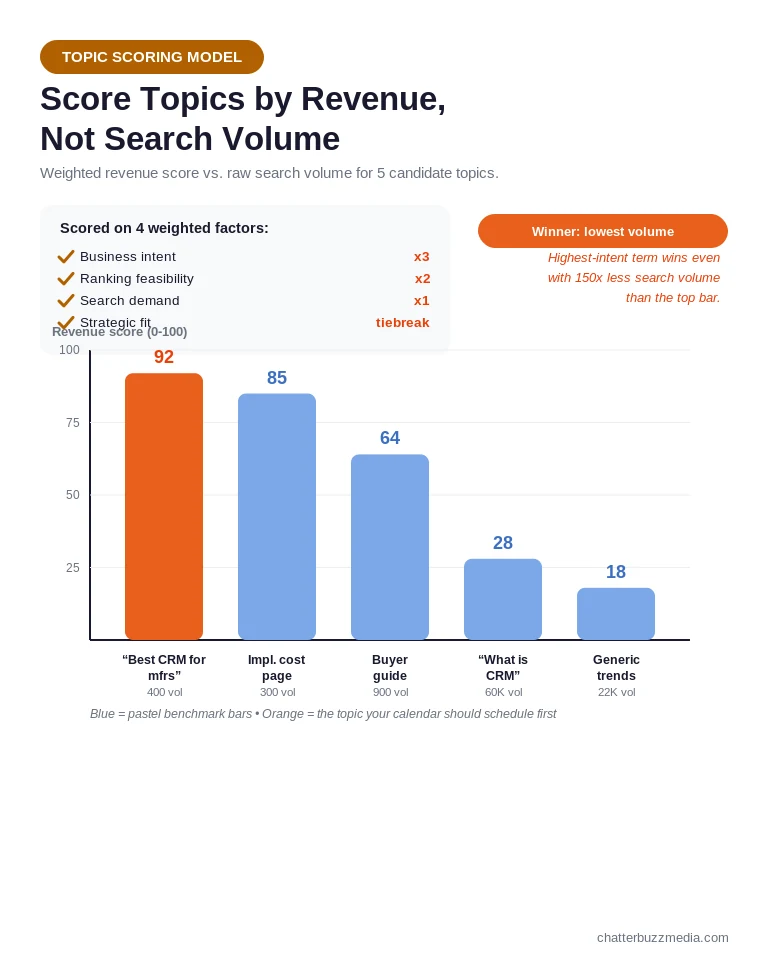
Use four factors and weight them toward revenue. Score each topic from 1 to 5 on business intent, ranking feasibility, search demand, and strategic fit, then weight business intent and feasibility most heavily.
Business intent is the highest-weighted factor. A term read by active buyers scores a 5 even if its volume is modest, while a broad informational term scores a 2 no matter how large the audience.
Ranking feasibility keeps you honest. A low-difficulty keyword where your site can realistically compete beats a high-difficulty term where a domain ten times your authority owns every result, the tradeoff at the heart of choosing between SEO and PPC.
Search demand still counts, just less. Volume becomes a multiplier on value rather than the headline metric, so a mid-volume buyer term can outrank a huge researcher term.
Strategic fit is the tiebreaker. A topic that reinforces a priority service line or a target vertical, such as content marketing for manufacturing, earns extra points because a ranking there compounds beyond a single page.
Here is the model in action. A “best CRM for small manufacturers” term with 400 searches, a 5 for intent, and a 4 for feasibility beats a “what is CRM” term with 60,000 searches, a 2 for intent, and a 1 for feasibility once the weights are applied.
Re-score on a cadence, not just once. Rankings shift, new competitors enter, and your own authority grows, so a quarterly rescore keeps the backlog honest and surfaces newly winnable terms.
The output is a ranked backlog your whole team can trust. When a stakeholder asks why one topic is scheduled before another, the score answers for you, which is the same clarity a strong marketing plan provides. Before you publish against that backlog, make sure each page is built to survive AI search.
Step 5: Optimize Content for AI Answer Engines (AEO)
Answer engine optimization means structuring content so AI systems can extract, trust, and cite it, and it is now a core part of any SEO content strategy. As AI Overviews and chatbots answer more queries directly, being the source they pull from is how you stay visible.
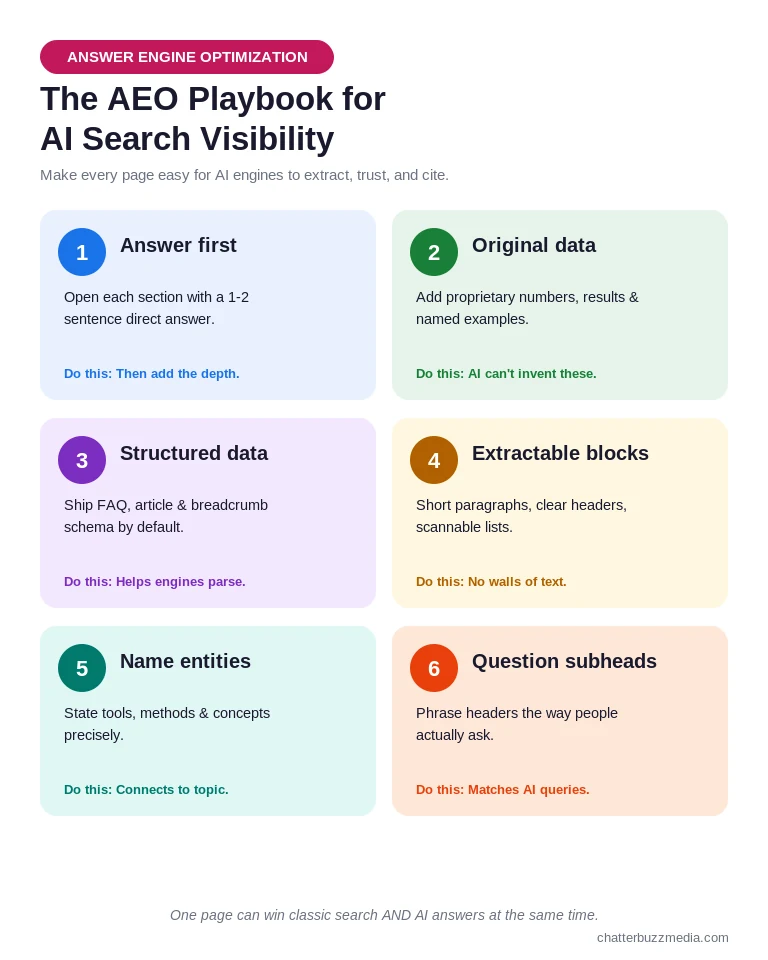
The tactics reward clarity and credibility. AI systems favor content that answers the question immediately and backs claims with evidence, and the following moves make your pages extraction-ready:
- Open every section with a direct answer. Lead with a one or two sentence answer to the implied question, then add depth, which is exactly how answer engines lift a passage into a citation.
- Publish original data and firsthand experience. Proprietary numbers, real results, and named examples give AI something it cannot generate on its own, satisfying Google’s helpful content and E-E-A-T guidance.
- Add structured data. FAQ, article, and breadcrumb schema help engines parse your page and understand its role in a topic cluster.
- Write in clean, extractable blocks. Short paragraphs, clear headers, and scannable lists make it easy for a model to pull the exact answer without ambiguity.
- Be explicit about entities. Name the tools, methods, and concepts precisely so an engine can connect your content to the right topic and audience.
The deeper strategy is to own questions AI cannot answer well. First-person results, specific case data, and expert judgment are defensible, and they are the reason a full answer engine optimization approach now sits alongside classic SEO.
Being cited also builds a compounding advantage. When answer engines repeatedly pull your brand as the source, you earn awareness and trust even from users who never click, which seeds demand that shows up later as branded search.
How AEO Fits Your Existing SEO Content Strategy
AEO is not a second workstream that competes with SEO for budget. It is a layer you apply to the same revenue-mapped pages you were already going to publish.
The overlap is almost total, and a few habits cover most of it:
- Answer-first headers. Lead each section with the answer so both a human skimmer and an AI parser get value in the first line.
- Evidence over adjectives. Replace vague claims with numbers, examples, and named methods that engines can trust and cite.
- Question-shaped subheads. Phrase headers the way people actually ask, which matches the conversational queries AI systems receive.
- Schema on every page. Ship FAQ and article structured data by default so engines can reliably interpret your content.
Do this consistently and one page earns visibility in classic search and AI answers at the same time. That efficiency is exactly why revenue-first teams fold AEO into their standard content brief.
Treat AEO as a formatting and evidence discipline, not a separate content type. Every page you publish should be built this way by default. Once content is live and structured, the real work becomes measurement.
Step 6: Measure What Drives Revenue, Then Optimize
Measure your SEO content strategy on pipeline and revenue, using traffic and rankings only as leading indicators. The goal of reporting is to prove business impact and to decide where the next hour of effort should go.
The reason most content programs get cut is not poor performance. It is poor measurement, where the team could never connect content to a dollar figure leadership recognized.
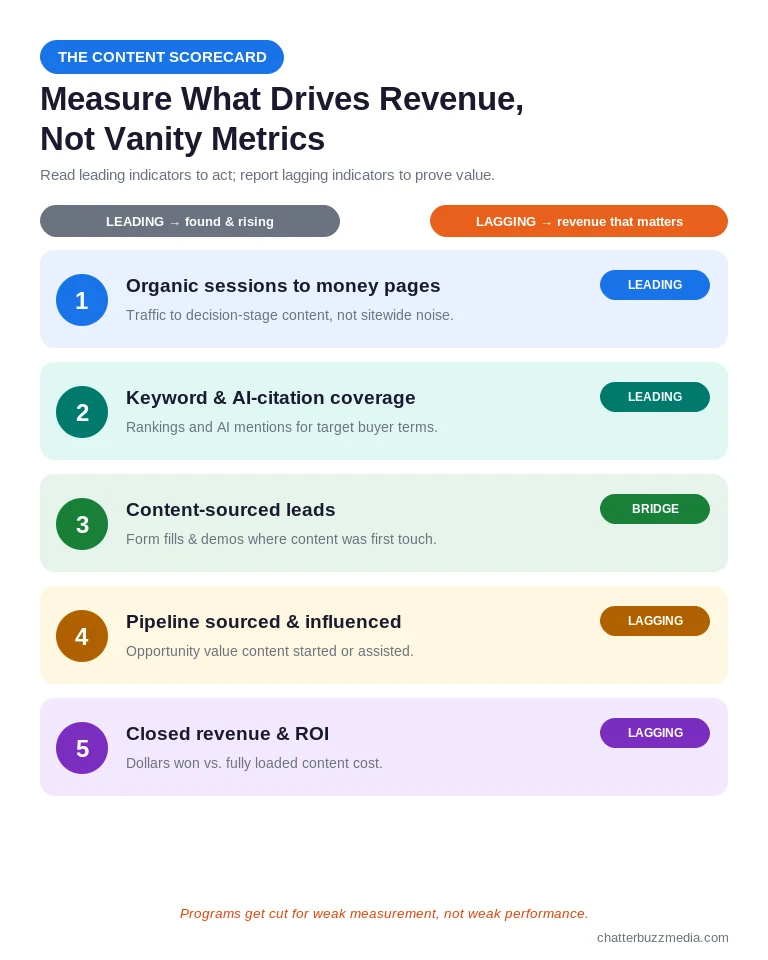
Build reporting in two layers. Leading indicators like impressions, rankings, and organic sessions tell you if content is being found, while lagging indicators like leads, opportunities, and closed revenue tell you if it matters.
Track a short, honest scorecard rather than a wall of metrics. The numbers that actually earn a place in a leadership report are:
- Organic sessions to money pages. Traffic to your decision-stage content, not sitewide sessions inflated by one viral post.
- Content-sourced leads. Form fills, demo requests, and sign-ups where content was the first meaningful touch.
- Pipeline sourced and influenced. Opportunity value that content started or assisted along the way.
- Closed revenue and ROI. Dollars won against the fully loaded cost of the content program.
Connect content to the CRM, not just analytics. First-touch and multi-touch attribution show which pages start and assist deals, and that is the data that justifies the program to a CFO, an approach detailed in measuring content marketing ROI.
Set expectations on time. SEO compounds rather than spikes, and most programs see meaningful returns in six to twelve months, a reality worth explaining upfront and echoed in how long SEO takes to work.
Then run a disciplined optimization loop. Refresh pages that are slipping, expand pages ranking on the edge of page one, and merge or retire content that has never earned traffic or leads.
Longer term, the compounding is the point. First Page Sage’s ROI research consistently shows content-driven SEO outperforming paid channels once the library matures, because published pages keep working without ongoing media spend.
The Monthly Content Optimization Loop
Your best returns often come from content you have already published, not the next new post. A simple monthly loop keeps the whole library climbing instead of decaying:
- Refresh decliners. Find pages losing rankings or traffic, update the stats and examples, and tighten the answer to match current intent.
- Push page-two contenders. Identify terms ranking in positions 8 to 15, then add depth and internal links to move them onto page one where the clicks live.
- Add internal links. Point fresh, relevant links from strong pages to newer ones so authority flows to the content you want to rank.
- Improve conversion paths. Add or sharpen calls to action on pages that get traffic but generate few leads.
- Prune the dead weight. Merge thin overlapping posts and retire pages that have never earned traffic or leads, which strengthens the pages that remain.
Run this loop every month and the compounding accelerates. A mature library that is actively maintained will out-earn a bigger library left to rot.
Common SEO Content Strategy Mistakes to Avoid
Most failed strategies share a short list of avoidable mistakes. Knowing them in advance saves quarters of wasted effort and budget.
- Chasing volume over intent. Publishing for the biggest keywords instead of the most valuable ones fills your traffic report and empties your pipeline.
- Publishing orphans. Standalone posts with no cluster, no internal links, and no pillar rarely rank and never compound.
- Ignoring existing content. Teams write new posts while proven pages decay, when a refresh often beats a net-new piece for a fraction of the effort.
- One page, many intents. Trying to serve researchers and buyers on the same URL satisfies neither and confuses search engines.
- Reporting vanity metrics. Presenting sessions and keyword counts to leadership hides whether content actually produced revenue.
- Quitting too early. Killing a strategy at month four abandons it right before compounding begins.
Each mistake traces back to the same root cause, which is optimizing for the metric that is easy to move instead of the one that matters. Clean measurement also makes the case for resourcing, whether you build the function in-house or lean on a fractional CMO to run it. Here are the questions buyers and teams ask most often.
Frequently Asked Questions About SEO Content Strategy
1. 🔍 What is an SEO content strategy?
An SEO content strategy is a documented plan for creating and optimizing content so it ranks in search, attracts qualified visitors, and converts them into revenue. It defines what to publish, for which audience, in what priority order, and how you will measure business impact rather than just traffic.
2. 📊 How is an SEO content strategy different from content marketing?
Content marketing is the broad practice of creating valuable content across channels, while an SEO content strategy focuses that practice on winning organic and AI search. The two overlap heavily, but the SEO layer adds keyword research, search intent mapping, technical structure, and ranking measurement to the content marketing foundation.
3. ⚡ How long does an SEO content strategy take to show results?
Most programs see meaningful movement in six to twelve months, with momentum compounding well beyond that. New sites and competitive niches take longer, while established domains publishing intent-matched content can see wins in a few months.
4. 🏦 How many pieces of content do I need to publish?
The right volume comes from your revenue math, not a fixed number. Once you know the traffic and conversion rates needed to hit your pipeline target, the required content volume falls out of that model, and consistency matters more than raw output.
5. 🤝 Should I focus on top-of-funnel or bottom-of-funnel content?
Weight your plan toward bottom and middle-funnel content, since those pages attract buyers and survive AI search, then layer in top-of-funnel content to build authority. A healthy strategy is a portfolio, but the revenue-producing layer should get first priority.
6. 💰 How do I measure the ROI of my content?
Connect content to your CRM and track first-touch and multi-touch attribution to leads, opportunities, and closed revenue. Traffic and rankings are useful leading indicators, but pipeline sourced and influenced by content is the number that proves ROI.
7. 🚀 What is AEO and does it replace SEO?
Answer engine optimization structures content so AI systems can extract and cite it, and it complements rather than replaces SEO. The same pages should rank in traditional search and feed AI answers, achieved through direct answers, original data, and structured formatting.
8. 📈 Do I need topic clusters or are individual blog posts enough?
Topic clusters consistently outperform isolated posts because they build topical authority and guide readers toward decisions. A pillar page supported by interlinked cluster content ranks better and converts better than the same posts published as disconnected one-offs.
Conclusion: Build a Content Strategy Your CFO Would Approve
A great SEO content strategy is not measured by how much traffic it produces. It is measured by how much revenue it can defend, and that changes everything about how you plan, prioritize, and report.
The teams that win treat content like the growth channel it is. They start from the number, build clusters that map to what they sell, and refuse to celebrate rankings that never convert.
This mindset also changes who should own the strategy. It belongs to someone accountable for revenue, not just publishing volume, because every real decision here is a business decision dressed up as an SEO one.
None of this requires a bigger team or a bigger budget. It requires the discipline to point the same effort at the topics, formats, and metrics that actually move money.
Here is your four-step action plan to put this framework to work:
- Set the revenue target and work backward. Translate your pipeline goal into the traffic, conversion, and content volume required to hit it.
- Map clusters and intent. Group topics into pillar-and-spoke clusters, then assign one search intent and funnel stage to every page.
- Score and sequence. Rank your backlog by revenue potential using a weighted model, and publish in that order.
- Measure pipeline and optimize. Connect content to your CRM, report on sourced revenue, and run a monthly refresh-and-retire loop.
When you are ready to go deeper on the strategy layer, the Chatter Buzz resource library and the fractional CMO guide break down how revenue-first marketing programs are built and run. Start with your number, and let the content follow it.
Need help with SEO? Explore our SEO agency services.

Victoria Wallace
Victoria Wallace is a senior content strategist and marketing writer with 30+ years of experience helping more than 200 brands translate complex business goals into clear, conversion-focused content. Her background spans paid media, marketing strategy, go-to-market planning, brand positioning, and full-funnel campaign development, giving her a deep understanding of how SEO content connects to real business growth.