
 321-236-2899
LinkedIn Advertising Strategy: The B2B Playbook for Mid-Market Companies
Most mid-market companies treat LinkedIn advertising like a more expensive version of Facebook, then quietly kill the campaign after two months of $60 clicks and zero pipeline. The platform isn’t the problem. The LinkedIn advertising strategy behind the campaign is.
Over hundreds of B2B campaigns across manufacturing, financial services, and professional services, one pattern holds: the accounts that win treat LinkedIn as an account-based pipeline engine, not a lead-volume machine. They match ad formats to funnel stage, feed target-account lists into the platform, and measure closed revenue instead of form fills.
This playbook walks through the exact system, step by step. You’ll learn how to qualify whether LinkedIn even fits your economics, how to structure targeting so you’re not paying to reach interns, and how to tie every dollar to your CRM. Let’s start with why the premium is worth paying.
Key Takeaways
- LinkedIn’s premium CPCs ($5.50–$8.50 on average) buy verified access to decision-makers no other platform surfaces at scale.
- Match ad format to funnel stage: thought-leadership and video for awareness, document and single-image for consideration, lead-gen forms for conversion.
- Matched Audiences plus a target-account list turns LinkedIn into an ABM channel instead of a broad-reach guessing game.
- Mid-market programs need a realistic floor of $5,000–$10,000/month to gather enough signal for the algorithm to optimize.
- Measure cost per opportunity and pipeline influenced, not cost per lead—LinkedIn’s 7-day attribution window hides most of the value.
- Manufacturing and financial-services advertisers win by narrowing targeting to job function and seniority, not broad industry buckets.
Why LinkedIn Advertising Works for B2B
LinkedIn advertising works for B2B because it targets people by who they are professionally—company, title, seniority, and function—instead of guessing from browsing behavior. That precision is why it commands higher costs and delivers higher-intent audiences than any other paid channel.
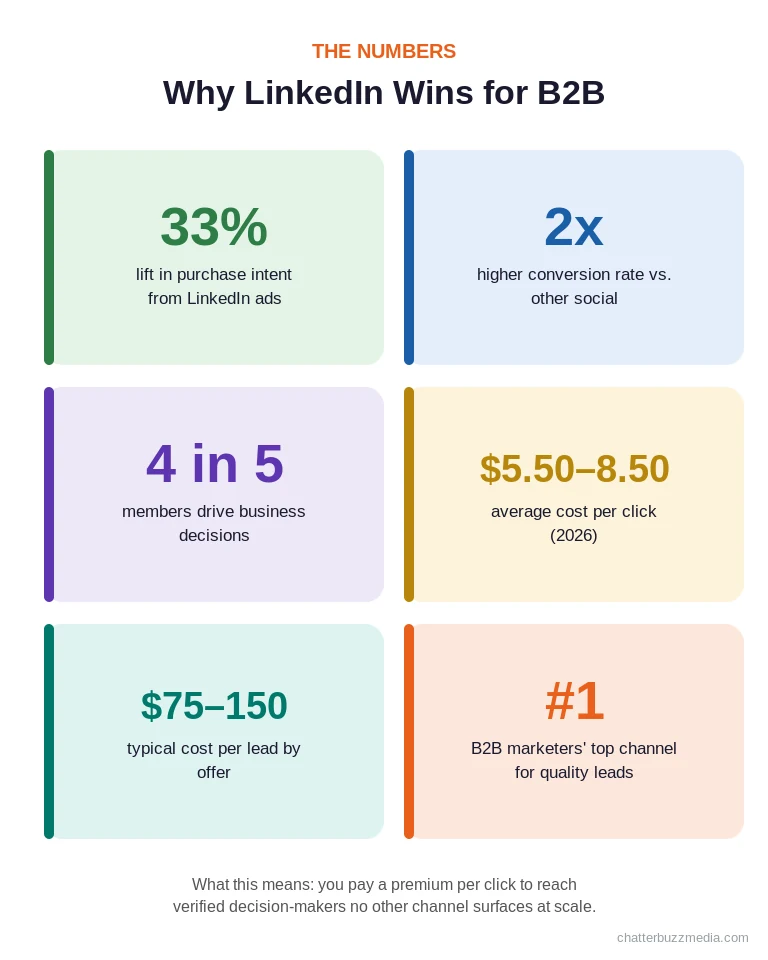
The numbers back it up. LinkedIn ads lift purchase intent by 33% and drive roughly 2x the conversion rate of other social platforms, according to LinkedIn engagement data compiled by Sprout Social. Four in five LinkedIn members drive business decisions at their organizations.
That matters most when your buyer is hard to reach. A plant manager, a VP of finance, or a credit-union CMO rarely raises a hand on Google until they’re deep in a purchase. LinkedIn lets you reach them earlier, on a platform where their job title is verified and current.
This is exactly why LinkedIn anchors so many B2B account-based programs. When your total addressable market is a few thousand named companies, a channel that can reach the right roles inside those exact accounts is worth far more than one built for mass consumer reach.
The trade-off is cost. Average CPCs run $5.50 to $8.50 and cost per lead lands between $75 and $150 depending on your offer, per 2026 LinkedIn ad benchmark data. You’re paying a premium, so your strategy has to earn it back through deal size, not lead volume. This is the same logic that governs any high-intent channel—something we cover in our breakdown of SEO versus PPC economics.
There’s a second, quieter advantage: data quality. Because members update their titles, employers, and skills to advance their own careers, LinkedIn’s targeting inputs stay current in a way behavioral cookies never do.
That reliability compounds over time. Every campaign you run teaches the platform more about which verified professionals convert, so your audiences sharpen instead of decaying the way third-party audiences do elsewhere.
Is LinkedIn Advertising Right for Your Business?
LinkedIn advertising is right for your business if your average deal size exceeds roughly $10,000 and your buyers hold identifiable professional titles. If you sell low-ticket products to broad consumer audiences, the CPCs will bury you before you see return.
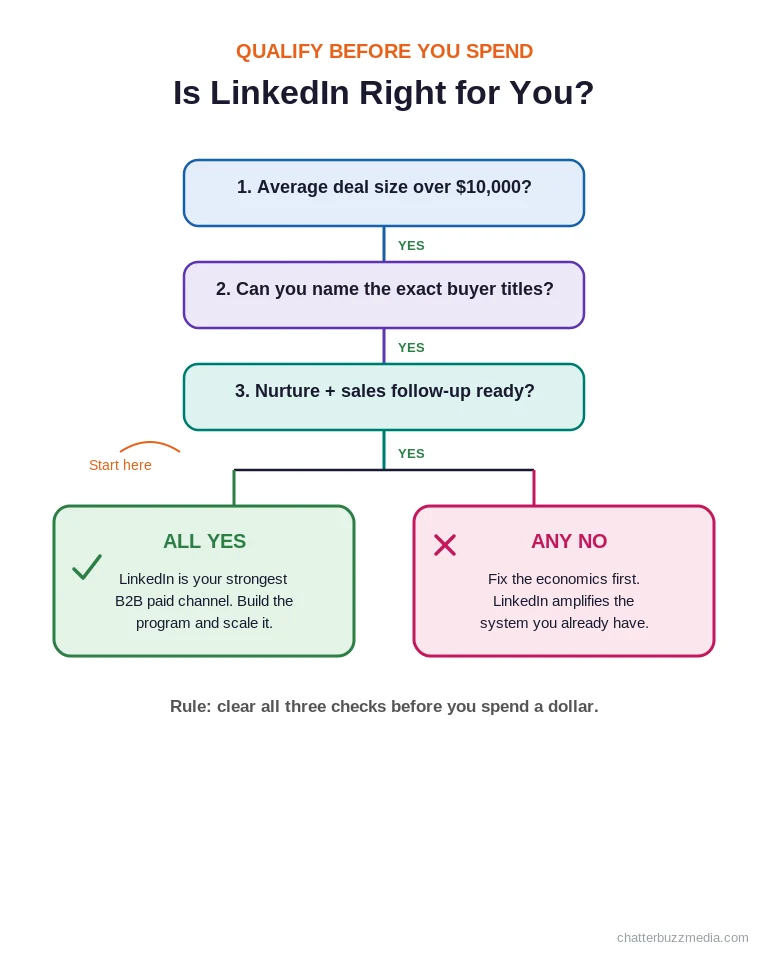
Run three quick qualification checks before you spend a dollar. First, does your customer lifetime value support a $100-plus cost per lead and a multi-touch sales cycle? Second, can you name the exact titles and industries that buy from you?
Third, do you have the sales infrastructure to follow up? LinkedIn leads are colder than search leads because you interrupted the buyer rather than answering a query. Without a nurture sequence and a responsive sales team, even great targeting leaks pipeline—which is why we pair every paid program with a documented lead-nurturing strategy.
If you clear those three bars, LinkedIn is likely your strongest B2B paid channel. If you fail even one, fix the economics first. The platform amplifies whatever system you already have—good or broken. For a fuller view of how paid fits the broader funnel, our B2B demand generation guide maps the whole engine.
Be honest about your sales cycle, too. If deals take six to nine months to close, you need patience and budget to match, because LinkedIn’s return shows up in pipeline long before it shows up in revenue.
Companies that expect week-one ROI from a long-cycle product almost always quit too early. Set the expectation internally that the first quarter builds the funnel, and the payback arrives as those influenced accounts mature into opportunities.
Step 1: Choose the Right LinkedIn Ad Format
Choose your LinkedIn ad format based on funnel stage, not novelty. Awareness objectives call for video and thought-leader ads; consideration calls for single-image and document ads; conversion calls for lead-gen forms and conversation ads.
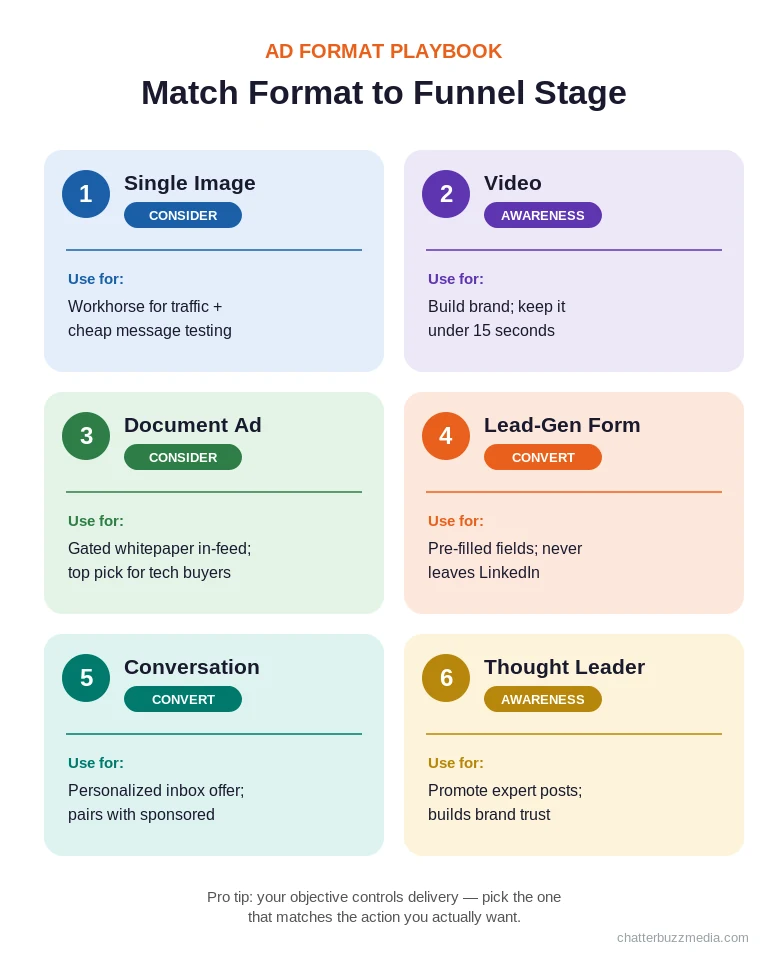
LinkedIn offers several core formats inside sponsored content, the native posts that appear directly in the feed. Single-image ads are your workhorse for driving traffic and testing messaging cheaply. Video ads build brand and demonstrate product, and they tend to earn the strongest engagement when kept under 15 seconds.
Document ads are the quiet overperformer for mid-market B2B. They let a buyer preview a whitepaper or case study inside the feed, then trade an email for the full version—generating leads without ever leaving LinkedIn. For manufacturers and financial firms with technical buyers, a gated spec sheet or compliance guide often beats a generic demo request.
Lead-gen forms attach to sponsored content and pre-fill with the user’s profile data, which lifts conversion rates sharply. Conversation and message ads deliver a personalized offer straight to the inbox and pair well with sponsored content to raise clickthrough. Test at least two to three creative variants per campaign so the algorithm has enough signal to find a winner. When your ad drives to a landing page instead of a form, that page has to convert—review the fundamentals in our guide to landing pages that convert leads.
Your objective selection quietly controls everything downstream. LinkedIn optimizes delivery around the objective you choose, so a “brand awareness” campaign will chase cheap impressions even if you secretly want leads.
Pick the objective that matches the action you actually want, then build the creative to serve it. A conversion objective paired with a document ad and a lead-gen form is a proven combination for mid-market pipeline, while an awareness objective with video is better reserved for warming cold accounts.
Step 2: Build a Precise Audience with LinkedIn Targeting
Build your LinkedIn audience from the inside out: start with job function and seniority, layer in company attributes, then exclude the profiles that waste spend. Broad industry targeting alone is the fastest way to burn budget on people who will never buy.
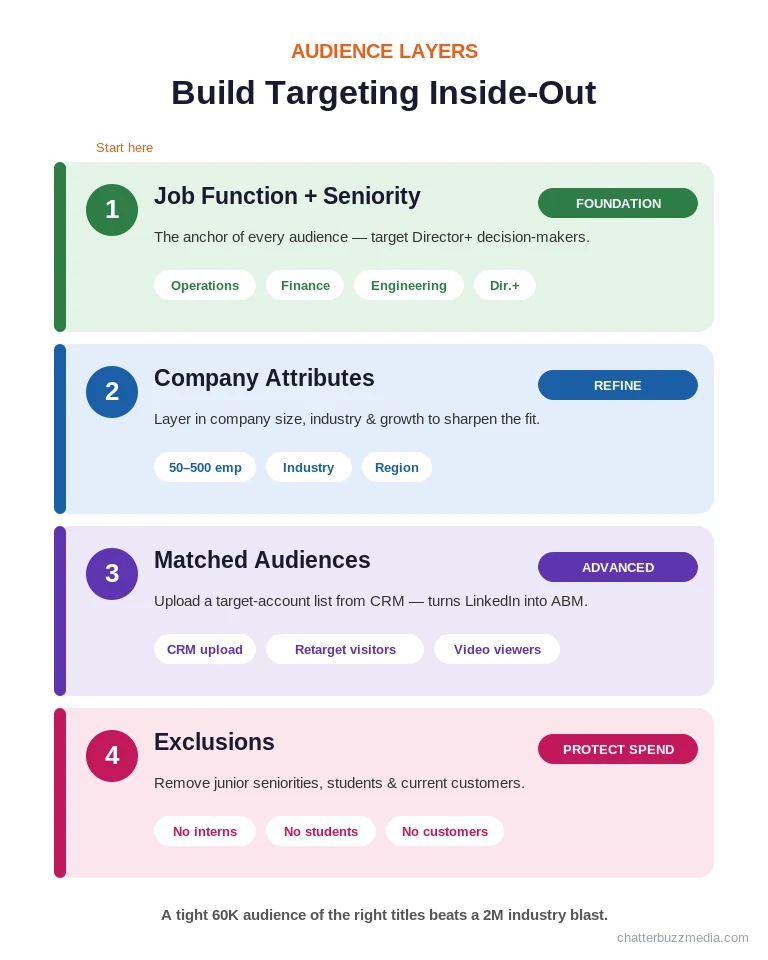
The most reliable targeting combination for mid-market B2B is job function plus seniority. Targeting “Operations” function at “Director” seniority and above reaches decision-makers without locking you into exact job titles, which people phrase inconsistently. Job-title targeting is precise but narrow, so use it to layer, not to anchor.
Matched Audiences is where LinkedIn becomes an account-based channel. Upload a CRM list of target companies and LinkedIn will serve ads only to employees at those accounts, turning a broad platform into a surgical one. You can also retarget website visitors and video viewers to keep warm prospects moving.
Keep audiences above roughly 50,000 members for feed formats so delivery doesn’t stall, but resist the urge to go broad for its own sake. A tight 60,000-person audience of the right titles beats a 2-million-person industry blast every time. This is the same discipline behind building a strong B2B buyer persona—precision compounds.
Vertical targeting rewards specificity. For LinkedIn ads in manufacturing, skip the broad “Manufacturing” industry filter and target functions like Operations, Engineering, and Supply Chain at Director-and-above seniority instead.
Financial services works the same way. Combine job function (Finance, Risk, Compliance) with company size and seniority so you reach the VP who signs off, not the analyst who researches. Our manufacturing marketing strategy and financial services marketing breakdowns show how to define those buyer segments in detail.
Step 3: Set Budgets and Bids That Match Mid-Market Reality
Set a monthly LinkedIn budget of at least $5,000 to $10,000 so the algorithm gathers enough conversion signal to optimize. Below that floor, campaigns starve for data and costs stay stubbornly high.
Think of your budget in three buckets across the funnel. Allocate roughly 20% to awareness, 30% to consideration, and 50% to conversion when you’re driving pipeline, then shift toward the top of funnel once your retargeting pools fill up. This mirrors how we structure spend in any paid media management program.
On bidding, start with maximum delivery to let LinkedIn learn, then move to manual or cost-cap bidding once you know your acceptable cost per lead. Cost-cap bidding protects you from runaway CPCs while still scaling the winners. Watch your daily pacing—if a campaign spends under 30% of its daily budget, your audience is too narrow or your bid is too low.
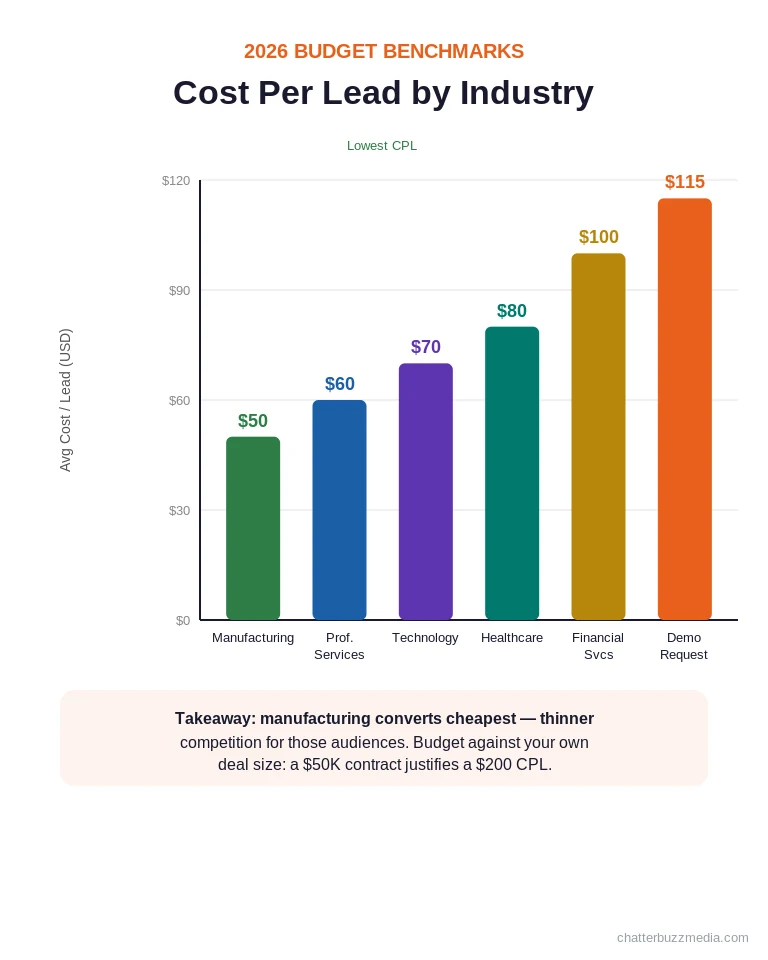
Expect industry-specific costs. Technology and financial services run higher CPLs (often $70–$100), while manufacturing tends to convert cheaper (around $50) because competition for those audiences is thinner, per 2026 benchmark data. Budget against your own deal economics, not a generic average—a $50,000 average contract easily justifies a $200 cost per lead.
Plan the first 90 days as a phased ramp, not a launch. Spend month one gathering data across two or three audiences and formats, month two cutting the losers and doubling down on the leaders, and month three scaling the proven combination.
Hold roughly 20% of your budget in reserve for testing throughout. New creative, new audiences, and new offers all decay eventually, and a standing test budget keeps you ahead of fatigue instead of scrambling once results dip.
Step 4: Integrate LinkedIn Ads with Your ABM Strategy
Integrate LinkedIn ads with account-based marketing by feeding your target-account list into Matched Audiences and coordinating ad sequencing with sales outreach. LinkedIn is the single best paid channel for ABM because it can target named accounts by company and role simultaneously.
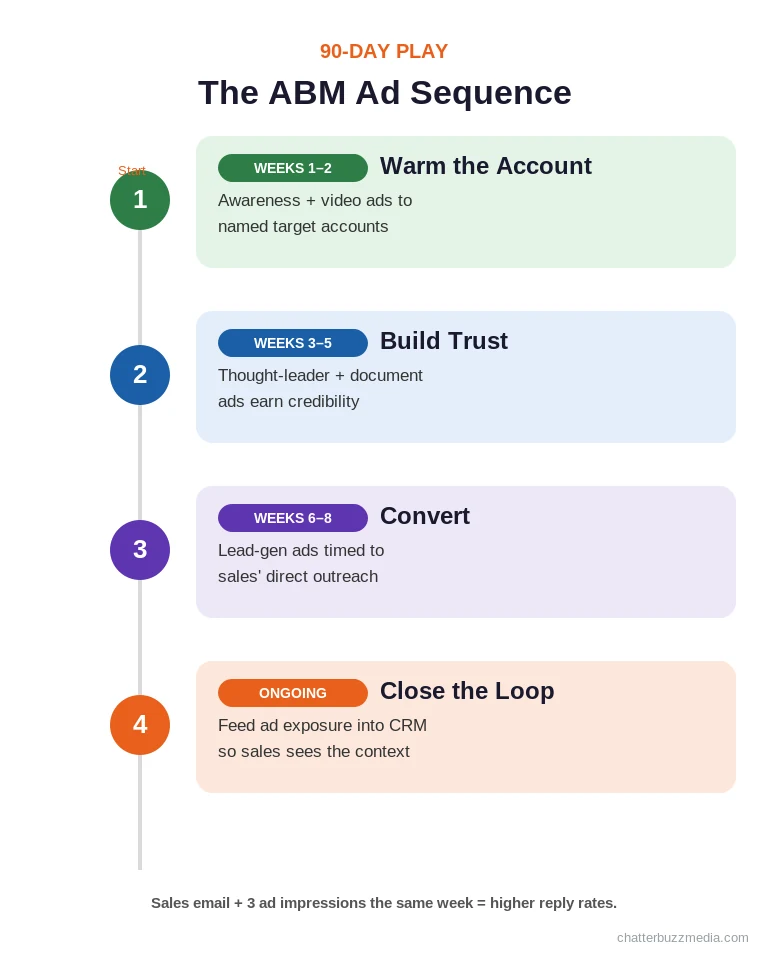
Start by aligning marketing and sales on the same account list. Upload those companies as a Matched Audience, then build a phased sequence: awareness ads to warm the account, thought-leadership and document ads to build trust, and conversion ads timed to when sales begins direct outreach. Our account-based marketing guide details how to structure those account tiers.
The magic is in the sequencing. When a sales rep’s cold email lands the same week a decision-maker has seen three of your ads, reply rates climb because the brand already feels familiar. LinkedIn’s data shows sponsored content plus message ads can raise clickthrough by over 70% when used together.
Tier your accounts so budget follows value. Reserve your richest, most personalized creative for a small list of one-to-one strategic accounts, run one-to-few campaigns for mid-tier clusters that share a pain point, and use broad one-to-many ads to keep the widest list warm.
Feed everything back into your CRM. Tag which accounts were exposed to ads, and let sales see that context before they call. This closed loop is what separates real ABM from spray-and-pray, and it’s proven out in our ABM case study. For industrial teams, the manufacturing ABM playbook shows the same integration applied to long sales cycles.
Step 5: Measure ROI Beyond the Click—and Avoid Costly Mistakes
Measure LinkedIn ROI by cost per opportunity and pipeline influenced, not cost per lead or clickthrough rate. LinkedIn’s default 7-day attribution window closes long before most B2B deals do, so the platform badly understates its own impact.
Connect LinkedIn to your CRM through the conversions API or Insight Tag, then track the metrics that map to revenue. Cost per marketing-qualified lead tells you if the funnel is filling; cost per opportunity and influenced pipeline tell you if it’s working. A campaign showing 200 leads but only 12 opportunities has a lead-quality problem, not a volume win—strong reporting and data visualization surfaces that gap fast.
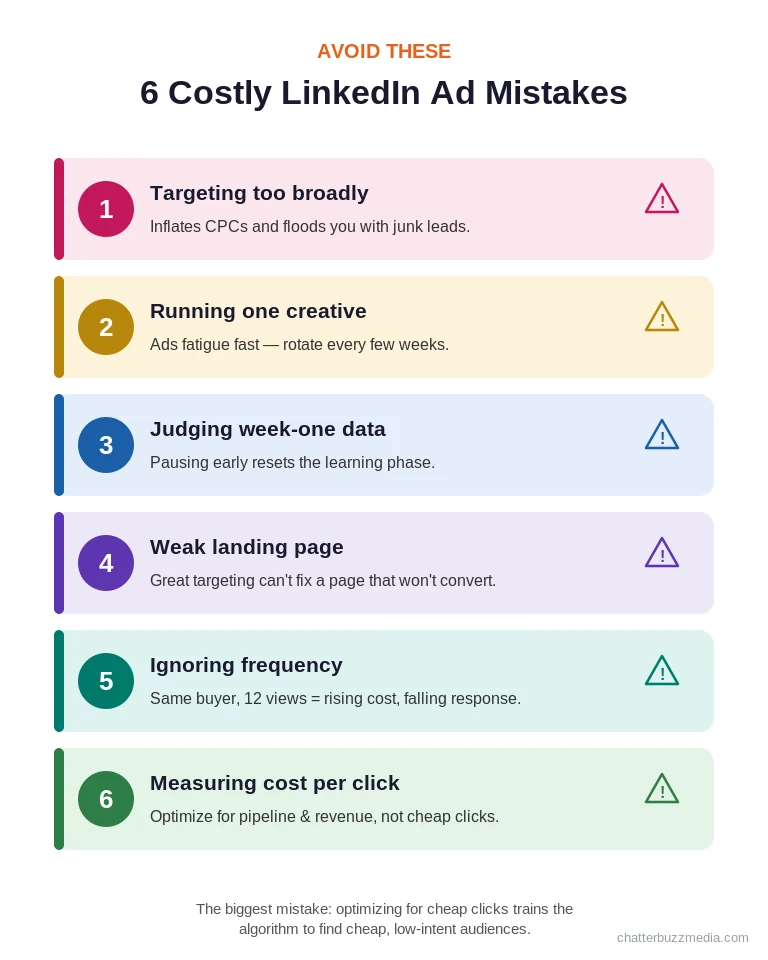
The most common mistakes are avoidable. Targeting too broadly inflates CPCs and drowns you in junk leads. Running one creative until it fatigues kills performance, so rotate assets every few weeks. Judging campaigns on week-one data pulls the plug before LinkedIn’s algorithm finishes learning.
Two more traps catch mid-market teams often. The first is sending expensive LinkedIn traffic to a weak landing page, then blaming the platform when it doesn’t convert.
The second is ignoring frequency. When the same buyer sees your ad a dozen times in a week, response drops and cost climbs, so cap frequency and refresh creative before your audience tunes you out. A disciplined conversion-rate optimization process on the destination page often recovers more return than any bid adjustment.
The biggest mistake is measuring the wrong thing entirely. Optimizing for cheap clicks trains the algorithm to find cheap, low-intent audiences. Optimize for pipeline and closed revenue, and the platform learns to find buyers—which is the entire point of paying a premium in the first place. That same revenue-first lens should govern every channel in your social media advertising mix.
Frequently Asked Questions
1. 🔍 What is a good cost per lead for LinkedIn ads?
A good cost per lead on LinkedIn typically falls between $75 and $150, though it varies by offer and industry. Gated content and webinar signups run cheaper, while demo and contact-sales requests run higher. Judge your CPL against your average deal size, not a universal benchmark.
2. 📊 How much should I spend on LinkedIn ads to see results?
Mid-market companies should budget at least $5,000 to $10,000 per month to give LinkedIn’s algorithm enough conversion signal to optimize. Spending below that floor usually keeps costs high because campaigns never gather enough data. Plan for a 60–90 day ramp before judging performance.
3. ⚡ What LinkedIn ad format works best for B2B lead generation?
Lead-gen forms attached to single-image or document ads convert best for B2B lead generation because they pre-fill profile data and never make the user leave LinkedIn. Document ads are especially strong for technical buyers in manufacturing and financial services. Pair them with conversation ads to boost clickthrough.
4. 🏦 Do LinkedIn ads work for manufacturing and financial services?
Yes—LinkedIn ads work exceptionally well for manufacturing and financial services because those buyers hold specific, verifiable job titles. Narrow targeting by job function and seniority rather than broad industry buckets. Manufacturing often sees lower cost per lead thanks to thinner competition for those audiences.
5. 🤝 How do I target decision-makers on LinkedIn?
Target decision-makers by combining job function and seniority (for example, Finance function at Director level and above) rather than relying on job titles alone. Layer in company size and industry, then use Matched Audiences to focus on your named target accounts. Exclude junior seniorities to stop wasting spend.
6. 💰 Are LinkedIn ads worth the higher cost?
LinkedIn ads are worth the higher cost when your deal size and buyer profile justify the premium. You pay more per click but reach verified decision-makers you can’t find at scale anywhere else. For high-value B2B sales, the precision usually outperforms cheaper, lower-intent channels.
7. 🚀 How long before LinkedIn ads start working?
Expect a 60–90 day ramp before LinkedIn ads reach stable performance. The first few weeks are learning phase, where the algorithm gathers conversion data and costs run high. Resist pausing early; premature changes reset the learning and waste your initial spend.
8. 📈 Should I run LinkedIn ads alongside an organic strategy?
Yes—paid LinkedIn ads perform best on top of a credible organic presence. A well-built company page and consistent thought-leadership content make your ads feel trustworthy instead of intrusive. Buyers who see your organic content and your ads convert at higher rates.
Conclusion: Build a LinkedIn Strategy That Compounds
LinkedIn advertising rewards discipline over cleverness. The companies that win aren’t the ones with the flashiest creative—they’re the ones that qualify their economics, target precisely, integrate with ABM, and measure real pipeline.
Here’s your four-step action plan:
- Qualify the fit. Confirm your deal size supports a $100-plus cost per lead and name the exact titles you sell to.
- Build the foundation. Set a realistic $5K–$10K monthly floor, match formats to funnel stage, and target by function and seniority.
- Layer in ABM. Upload your target-account list to Matched Audiences and sequence ads with sales outreach.
- Measure what matters. Connect LinkedIn to your CRM and optimize for cost per opportunity and influenced pipeline, not cheap clicks.
Get those four right and LinkedIn stops being an expensive experiment and becomes a predictable pipeline engine. For the bigger picture of how paid, account-based, and demand-gen tactics fit together, explore our complete B2B demand generation guide.

Victoria Wallace
Victoria Wallace is a senior content strategist and marketing writer with 30+ years of experience helping more than 200 brands translate complex business goals into clear, conversion-focused content. Her background spans paid media, marketing strategy, go-to-market planning, brand positioning, and full-funnel campaign development, giving her a deep understanding of how SEO content connects to real business growth.