
 321-236-2899

Custom Home Builder Marketing: Win Semi-Custom Buyers
Most custom home builder marketing fails for one reason: it borrows playbooks built for production builders. A spec-home ad that pushes “move-in ready” means nothing to a buyer who wants to shape allowances, pick a semi-custom plan, and spend a year getting it right.
We have run campaigns for builders selling everything from $400K semi-custom plans to $3M full customs, and the pattern holds. The builders who win treat marketing as a filter and a nurture engine, not a lead firehose.
This guide walks through the exact system, step by step: how to define and qualify the semi-custom shopper, build a site that sells the build experience, get found locally, run paid media that screens for budget fit, nurture a 12-month decision, and turn past clients into a referral engine. By the end you will know which lever to pull first.
Key Takeaways
- Custom and semi-custom buyers decide over 9 to 18 months, so marketing has to nurture, not just capture.
- Your best lead source is not an ad — referrals convert near 40% and return 480–520% on spend, far above paid media.
- Qualify for budget and timeline early or you will burn weeks designing for buyers who were never ready.
- The semi-custom shopper needs process clarity: allowances, selections, and realistic pricing ranges on your website.
- Visual proof wins the build — renderings and virtual tours shorten the sales cycle more than any headline.
What Makes Custom Home Builder Marketing Different
Custom home builder marketing is different because the product is a decision, not an inventory item. A production builder sells a finished house; a custom or semi-custom builder sells a year-long relationship that ends in a home that does not exist yet.
That changes everything about how you attract and convert. The buyer is not comparing move-in dates — they are comparing trust, process, and whether you can turn their Pinterest board into a build they can afford.
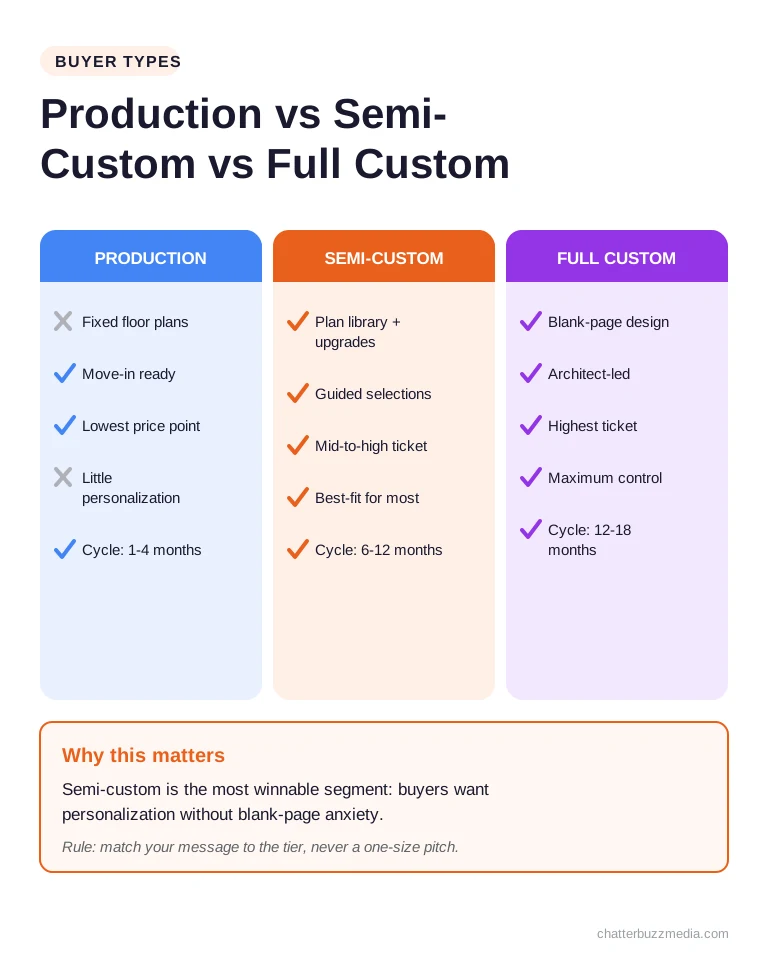
The semi-custom shopper sits in the middle and is the most winnable. They want personalization without the blank-page anxiety of a full custom, and they are actively comparing builders who offer plan libraries with upgrade paths.
Three traits define this buyer. The decision cycle runs long, the ticket is high, and emotion drives the purchase as much as logic.
Because the cycle is long, a single lead-gen push rarely closes anyone. You need a system that captures interest early and stays present for months, which is why the steps below are sequenced the way they are. For the wider category, our home builder marketing strategies cover production and spec tactics in more depth.
Step 1: Define and Qualify Your Semi-Custom Buyer
Start by defining who you can actually build for, then build a filter that screens leads before they reach your calendar. The fastest way to lose money in custom building is designing for “dreamers” who have no land, no budget, and no timeline.
A qualified semi-custom lead has three things in place. Define each one as a hard gate.
- Budget reality: a financing pre-qualification or cash range that matches your floor price.
- Land or lot status: owned, under contract, or actively shopping with a clear area.
- Timeline: ready to break ground within 12 months, not “someday.”
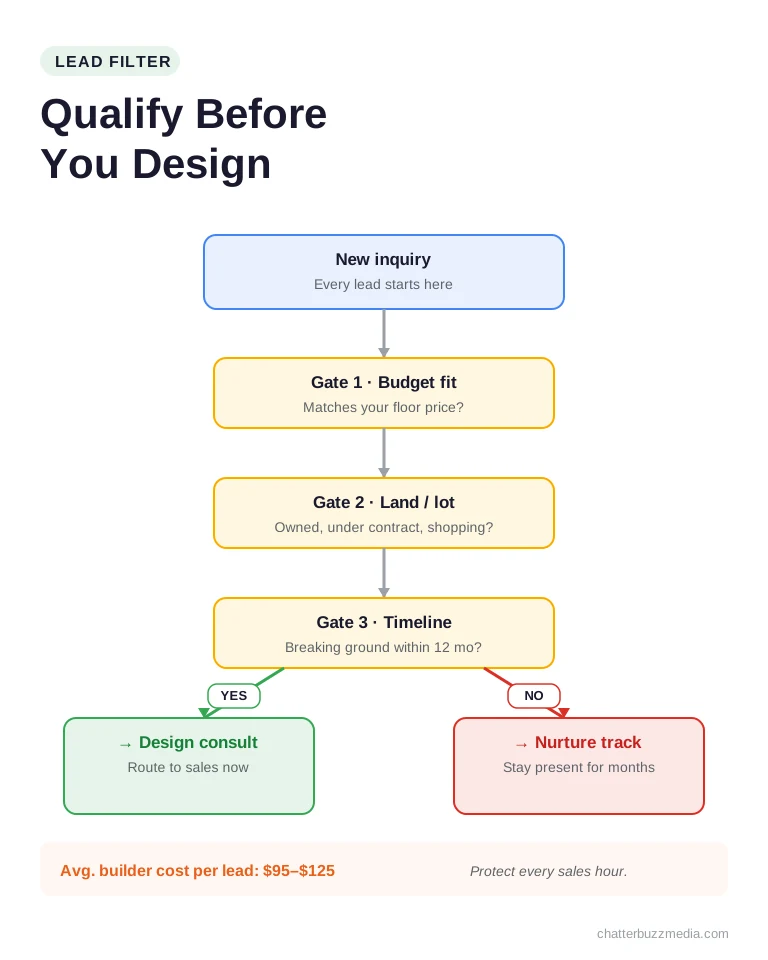
Build this into your intake form and your first call. A short qualifying questionnaire — budget band, lot status, desired move-in — routes ready buyers to a design consult and everyone else into a nurture track.
This matters because custom leads cost more. Industry data from Buildern’s 2026 residential construction marketing report puts the average builder cost per lead at $95 to $125, so protecting your sales team’s hours is a direct margin play.
A reliable filter also protects your reputation. Turning down a poor-fit prospect gracefully, with a referral to a better-matched builder, earns goodwill that often comes back as a qualified lead later.
Segment your audience into three tiers: ready-to-build, researching (6 to 12 months out), and early dreamers. Each tier gets different content, which we map in the nurture step. If you need a structured approach to buyer definition, our guide to building an ideal customer profile walks through the framework.
Step 2: Build a Website That Sells the Build Experience
Your website should sell the experience of building with you, not just display finished homes. Semi-custom buyers bounce when they cannot picture the process or gauge whether they can afford it.
Nearly every buyer now researches builders online before they ever call, and the National Association of Realtors reports that essentially all buyers use the internet during their home search. The site is your first and often only chance to qualify yourself to them, so give them the information they are hunting for.
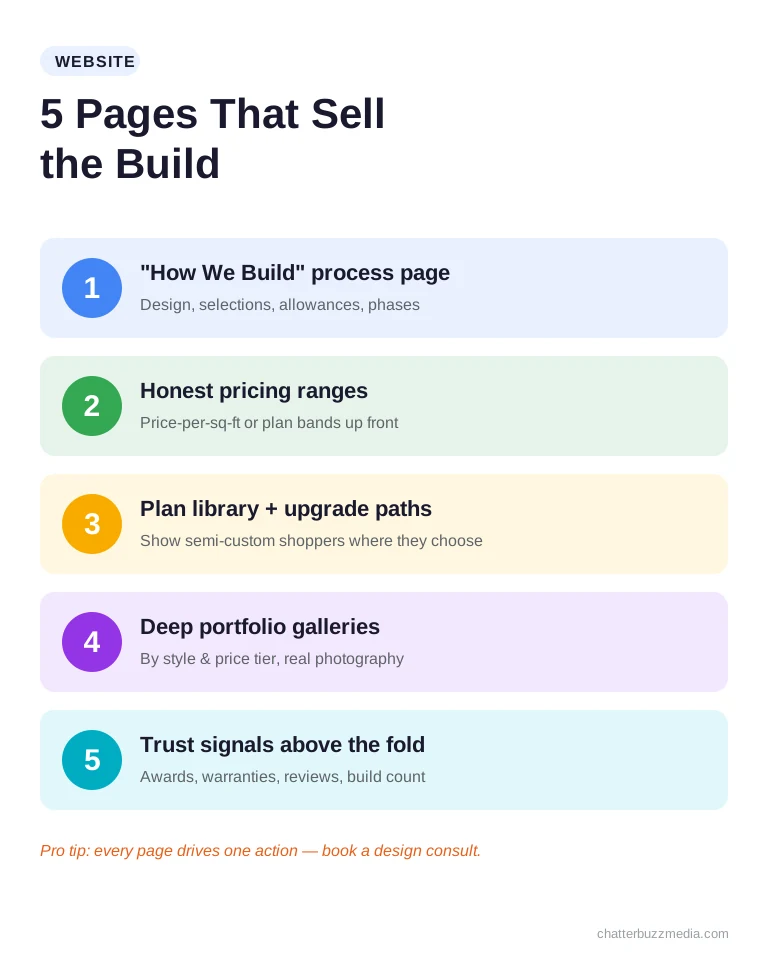
Prioritize these elements in order of impact. Each one removes a reason to leave.
- A “How We Build” process page: lay out design, selections, allowances, and construction phases so the year ahead feels knowable.
- Honest pricing ranges: publish starting price-per-square-foot or plan price bands to pre-qualify traffic and filter out mismatched budgets.
- A plan library with upgrade paths: show semi-custom shoppers exactly where personalization happens.
- Deep portfolio galleries: organize by style and price tier with real project photography, not stock.
- Proof and trust signals: awards, warranties, testimonials, and build counts above the fold.
Speed and mobile experience are non-negotiable because buyers browse plans on their phones at night. A slow gallery kills interest before the story starts.
Every page should drive to one clear action: book a design consult. If your site gets traffic but no inquiries, run a conversion audit to find what is leaking, and study the elements of a high-converting landing page. For the full build, see how to approach a website built for home builders.
Step 3: Get Found by Buyers Searching Locally
Capture buyers at the exact moment they search by owning local organic results and the map pack. Custom home searches are intensely local — “custom home builder near me” and “[city] semi-custom homes” are where ready buyers show up.
Your Google Business Profile is the single highest-leverage asset here. A complete, photo-rich, review-backed profile wins the map pack, and the map pack wins the click.
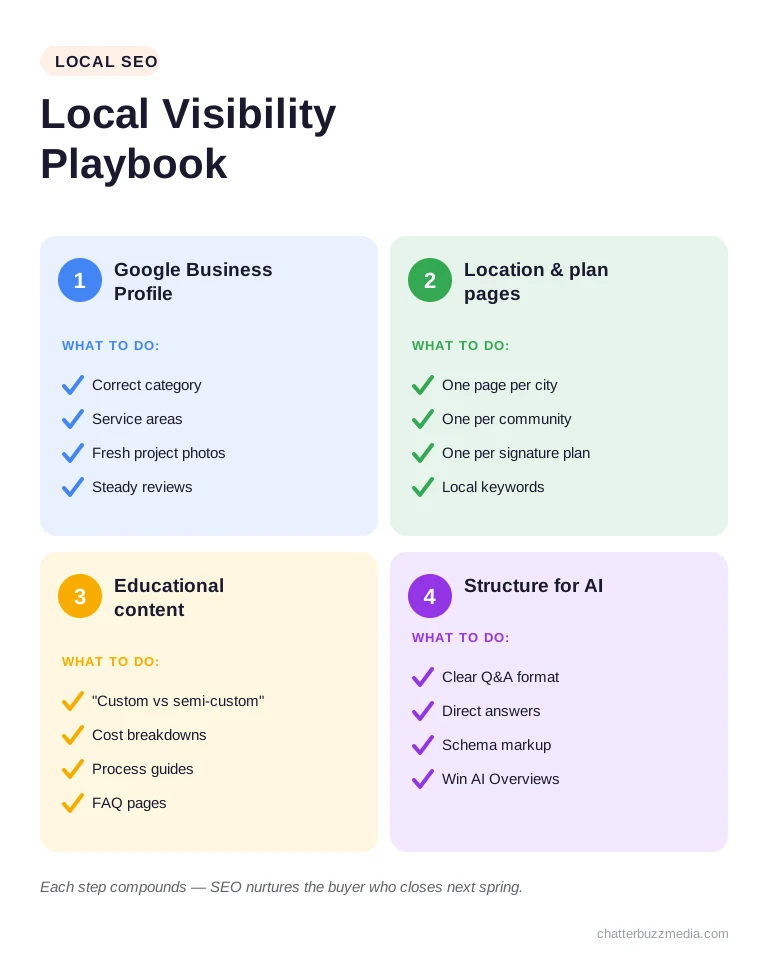
Work the local visibility playbook in this order. Each step compounds on the last.
- Optimize your Google Business Profile: correct category, service areas, fresh project photos, and a steady stream of reviews. See our walkthrough on how to optimize your Google Business Profile.
- Build location and plan pages: a page for each community, city, and signature plan so you rank for specific searches.
- Publish educational content: answer the questions buyers ask before they commit, from “custom vs semi-custom” to cost breakdowns.
- Structure content for AI answers: clear questions and direct answers so you get surfaced in AI Overviews and answer engines.
Content is how you earn trust before the consult. A well-planned SEO content strategy turns one blog post into months of qualified traffic, and the technical foundation is covered in our home builder SEO guide.
SEO is a compounding asset, not a quick win, which is exactly why it pairs well with the long sales cycle. The content you publish today nurtures the buyer who closes next spring.
Step 4: Run Paid Media That Filters for Budget Fit
Run paid media to reach ready buyers fast, but engineer every campaign to filter out poor-fit leads rather than maximize raw volume. For a custom builder, a hundred cheap leads with no budget cost more than ten qualified ones.
The channels work together. Search captures active demand, social creates it, and retargeting keeps you present across a long decision.
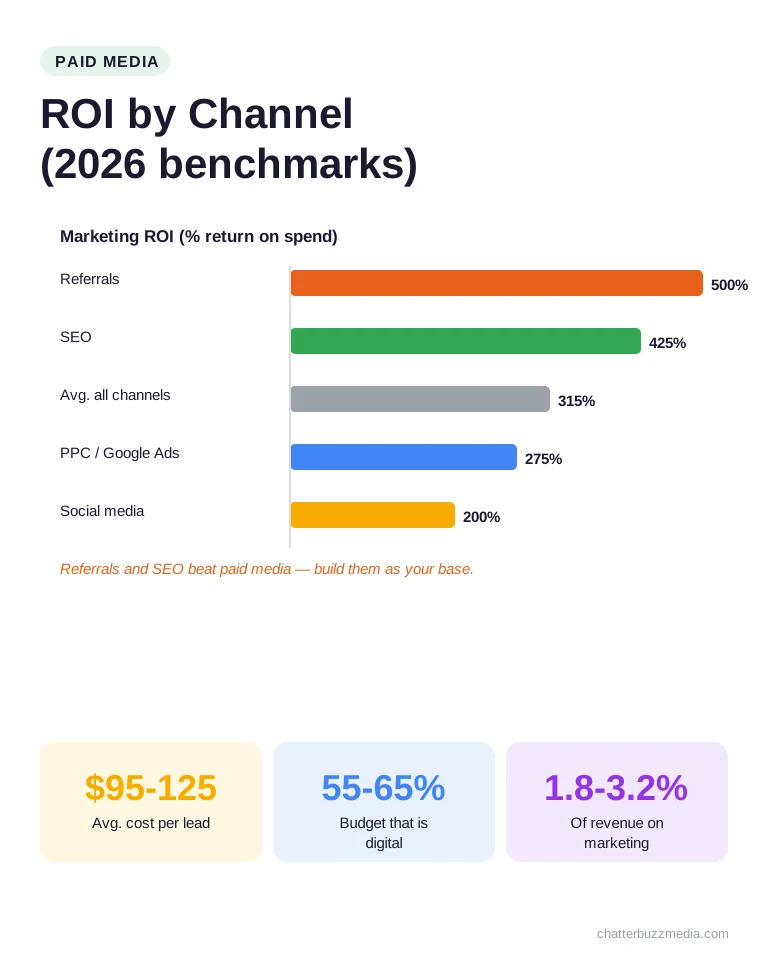
Returns vary widely by channel, so weight your budget toward what converts. The data below reflects 2026 residential construction benchmarks.
- Google Ads and Local Services Ads: highest intent; put price-qualifying language in the copy so unqualified clicks self-select out. Start by learning to audit your Google Ads for waste.
- Meta and Instagram: visual-first demand creation; Facebook ads for home builders work best showing lifestyle and finished builds.
- Retargeting: essential for a 12-month cycle; stay in front of everyone who viewed a plan or price page. Our retargeting strategy breaks down the sequence.
Feed real conversions back into the platforms so they optimize for consults booked, not form fills. A unified cross-channel paid media plan keeps spend accountable, and Performance Max can extend reach once your tracking is clean.
Budget discipline matters more here than almost anywhere. Builders typically invest 1.8% to 3.2% of revenue in marketing, according to the Association of Professional Builders, so every dollar has to screen for fit and feed the pipeline.
Watch your cost per qualified consult, not your cost per click. A campaign that doubles cheap form fills while your booked-consult rate drops is quietly losing you money.
Step 5: Nurture the Long Decision With Visuals and Email
Nurture is where custom builders win or lose, because the buyer who inquires today will not sign for 9 to 18 months. Most builders chase the lead for two weeks, go quiet, and lose it to whoever stayed present.
Visual proof does the heavy lifting. Renderings and virtual tours let a buyer see their semi-custom plan before a single wall goes up, which shortens the cycle and builds confidence.
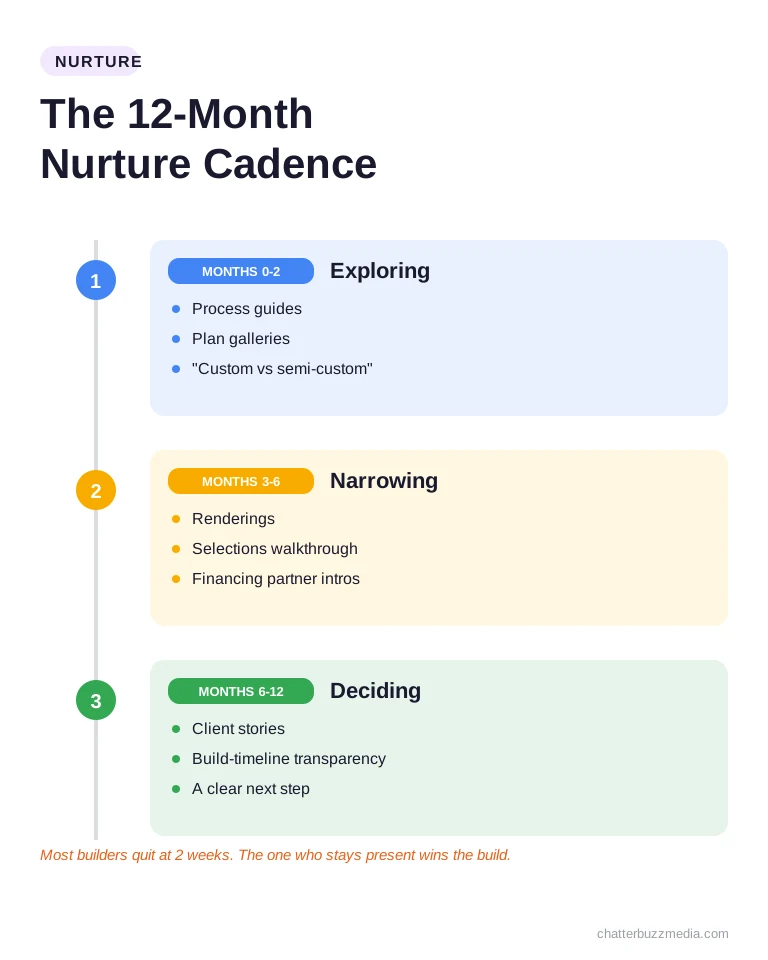
Map your nurture to the decision timeline. Each stage answers the question the buyer is actually asking.
- Months 0–2 (exploring): send process guides, plan galleries, and “custom vs semi-custom” education.
- Months 3–6 (narrowing): share renderings, selections walkthroughs, and financing partner intros.
- Months 6–12 (deciding): deliver client stories, build-timeline transparency, and a clear next step.
Automate this with a simple CRM sequence so no lead goes cold. Builders that connect attribution to their CRM see 10% to 15% lower acquisition costs, because they stop spending on leads they already have.
Video is the most underused nurture tool in this space. A two-minute walkthrough of a finished semi-custom build earns more trust than a dozen emails, and it travels well across lead generation channels. For the paid side of launches, our paid media guide for home builders goes deeper.
Step 6: Build a Referral and Partnership Engine
Build a deliberate referral engine because word of mouth is the highest-converting, lowest-cost channel a custom builder has. Referrals convert near 40% and return 480% to 520% on spend in 2026 construction marketing benchmarks — numbers no ad platform matches.
The mistake is treating referrals as luck. A structured program — past clients, trade partners, and industry allies — turns goodwill into a predictable pipeline.
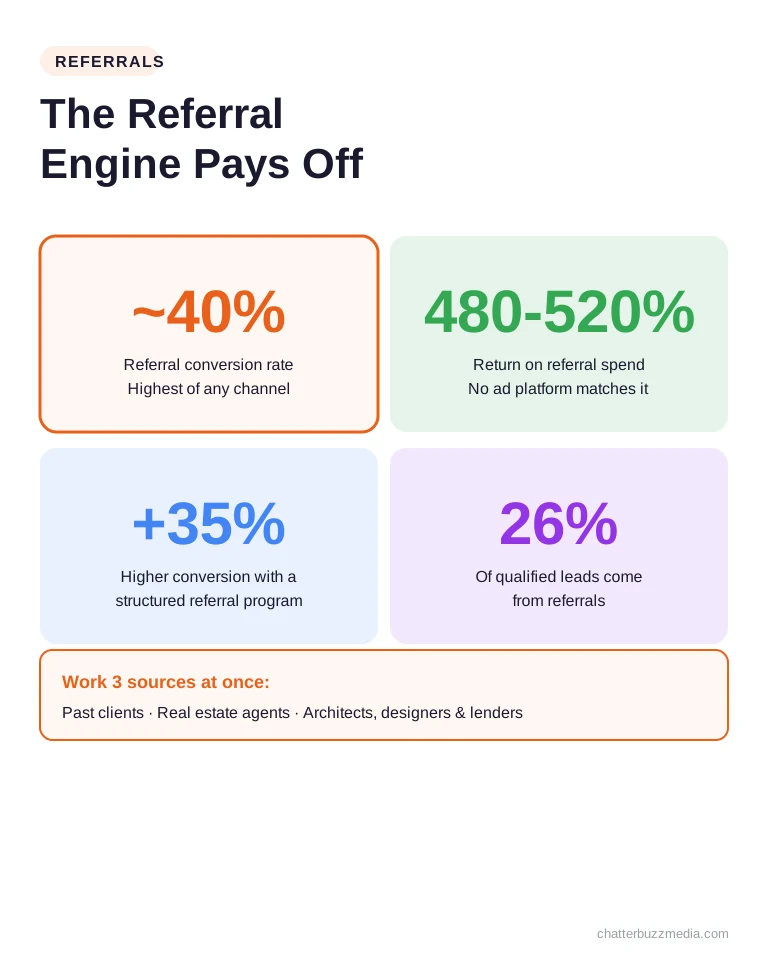
Work three referral sources at once. Each reaches your buyer at a different moment.
- Past clients: ask at move-in and at the one-year mark, and make referring effortless with a simple incentive.
- Real estate agents: agents guide buyers toward builders they trust; the same relationship powers strong real estate lead generation.
- Architects, designers, and lenders: these partners meet your buyer before you do, so stay top of mind with them.
Reputation feeds referrals. A steady flow of reviews on Google and Houzz gives every partner a reason to send business your way with confidence.
Firms with structured referral programs report up to 35% higher conversion rates. That is the compounding payoff of treating relationships as a channel, and it is why partnerships belong in your plan from day one, not as an afterthought.
Frequently Asked Questions
1. 🔍 How much should a custom home builder spend on marketing?
Most builders invest between 1.8% and 3.2% of annual revenue in marketing, with digital taking 55% to 65% of that budget. Custom and semi-custom builders should weight toward the higher end early, since the long sales cycle demands sustained presence rather than one-time pushes.
2. 📊 What is the best marketing strategy for custom home builders?
There is no single best channel — the winning strategy is a sequenced system: qualify leads for budget fit, capture local search demand, run filtered paid media, and nurture the long decision with visuals and email. Referrals and SEO deliver the strongest returns, so build those as your foundation and use paid media to accelerate.
3. ⚡ How do custom home builders generate qualified leads?
Qualified leads come from pairing strong local SEO and a Google Business Profile with a website that pre-screens for budget and timeline. A short intake questionnaire — budget band, lot status, move-in window — routes ready buyers to a consult and everyone else into nurture, protecting your sales team’s hours.
4. 🏠 How is marketing semi-custom homes different from fully custom?
Semi-custom buyers want personalization without the blank-page anxiety of a full custom, so your marketing should lead with plan libraries and clear upgrade paths. Show exactly where they get to make choices — allowances and selections — rather than asking them to design from scratch.
5. 🤝 How long is the custom home sales cycle?
Most custom and semi-custom buyers take 9 to 18 months from first inquiry to signed contract. That timeline is why nurture matters more than any single lead-capture tactic — the builder who stays present with helpful content and visuals for a year is the one who wins the build.
6. 💰 Should custom home builders show pricing on their website?
Yes — publishing starting price-per-square-foot or plan price bands pre-qualifies your traffic and filters out buyers whose budgets do not match. Transparency builds trust with serious shoppers and saves your team from consults that were never going to close.
7. 🚀 Is SEO or paid advertising better for custom home builders?
Both, in sequence — SEO is a compounding asset that returns 400% to 450% over time, while paid media delivers ready buyers faster but costs more per lead. Start paid to fill the pipeline now, and invest in SEO and content so your cost per lead drops as organic visibility grows.
8. 📈 How do custom builders measure marketing success?
Track cost per qualified consult and close rate, not raw lead volume — a hundred unqualified leads mean nothing if none can afford to build. Connect your ad platforms and CRM so you optimize for booked consults and signed contracts, which is where revenue actually lives.
Conclusion: Your Custom Home Builder Marketing Action Plan
Winning custom and semi-custom buyers is not about more leads — it is about the right leads, nurtured over a long decision until they trust you enough to build. The builders who treat marketing as a filter and a relationship engine outlast the ones chasing cheap clicks.
Here is where to start, in order:
- Qualify first. Add a budget, lot, and timeline questionnaire to your intake this week so your team only spends hours on ready buyers.
- Fix the website. Add a process page and honest pricing ranges so semi-custom shoppers can picture the build and self-qualify.
- Own local search. Complete your Google Business Profile, build location and plan pages, and publish content that answers buyer questions.
- Nurture for a year. Set up a CRM sequence with renderings, client stories, and video so no lead goes cold before month 12.
Build these foundations and your referral engine compounds on top of them, turning every finished home into the next three inquiries. When you are ready to put the full system to work, explore our home builder marketing resources and free guides to go deeper on each step.

Victoria Wallace
Victoria Wallace is a senior content strategist and marketing writer with 30+ years of experience helping more than 200 brands translate complex business goals into clear, conversion-focused content. Her background spans paid media, marketing strategy, go-to-market planning, brand positioning, and full-funnel campaign development, giving her a deep understanding of how SEO content connects to real business growth.