
 321-236-2899
Retargeting Strategy: 7 Steps to Re-Engage Lost Visitors
Most retargeting campaigns quietly waste money by showing the same ad to people who already bought, already bounced for good, or never had real intent in the first place. This guide fixes that.
You will learn a 7-step retargeting strategy that treats your visitor data like a segmented pipeline instead of one giant “everyone who visited” bucket. It is the same disciplined approach that separates campaigns hitting a 40 to 60 percent lower cost-per-acquisition from the ones burning budget on impressions that never convert.
By the end, you will know exactly how to build exclusion audiences that stop overspending, sequence your messaging across the funnel, and set frequency caps before your ads start annoying the very people you want back. Let’s start with the foundation every profitable retargeting program depends on.
Key Takeaways
- Retargeted users are roughly 70% more likely to convert than first-time visitors, but only when you show the right message to the right segment.
- Exclusion audiences are the single biggest budget saver — removing converters and dead traffic can cut wasted spend dramatically.
- Segment by intent, not just page views: a cart abandoner and a blog reader should never see the same ad.
- Sequential messaging beats repetition — move people forward with a new message instead of repeating the same creative.
- Frequency caps protect performance: unlimited impressions drive ad fatigue and rising costs.
- Server-side tracking via the Conversions API rebuilds the audience match rates that cookie loss has eroded.
Step 1: Install Your Pixels and Build a Clean Data Foundation
A retargeting strategy is only as good as the data feeding it, so the first step is capturing accurate visitor signals across every platform you plan to advertise on. Without clean tracking, every segment and message you build later is guesswork.
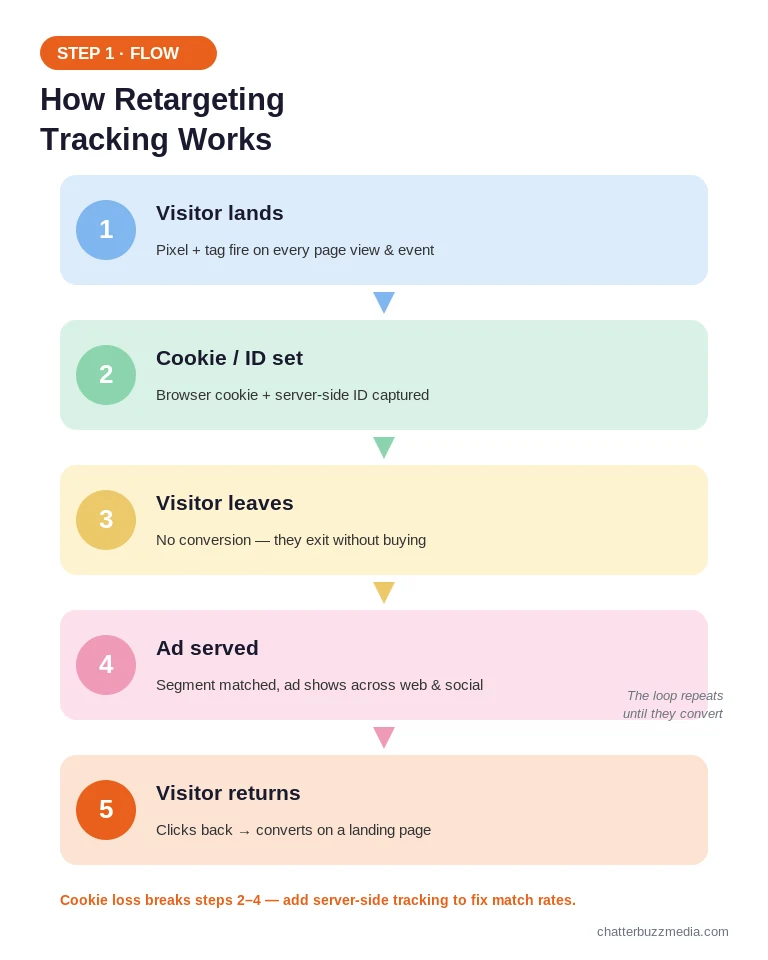
Retargeting works by tracking behavior with a small piece of code — a pixel or tag — that records who visits your pages and what they do there. When someone leaves without converting, that signal is what lets you reach them again on other sites, social platforms, and apps.
The problem is that browser-based cookies are disappearing. Safari and Firefox already block most third-party cookies, and privacy changes have shrunk the pool of people you can reach with pixel-only tracking.
Here is what a clean foundation actually requires:
- Install the platform pixels correctly — the Meta Pixel and Google Ads tag on every page, firing on both page views and key events like add-to-cart, form starts, and purchases.
- Add server-side tracking through the Meta Conversions API so conversions are sent from your server, not just the browser, restoring match rates that cookie loss destroys.
- Define standard events consistently so your audiences are built on reliable actions rather than vague “visited the site” data.
- Verify with the platform’s diagnostics before spending a dollar, because a broken event silently poisons every downstream audience.
Get this right and every later step compounds in your favor. Skip it, and you will optimize toward bad data for months without knowing it.
With accurate signals flowing in, the next move is turning that raw traffic into intent-based segments.
Step 2: Segment Audiences by Intent, Not Just Page Views
The fastest way to waste retargeting budget is treating all visitors as one audience. A person who read a single blog post and a person who abandoned a full cart have completely different intent, and they deserve completely different ads.
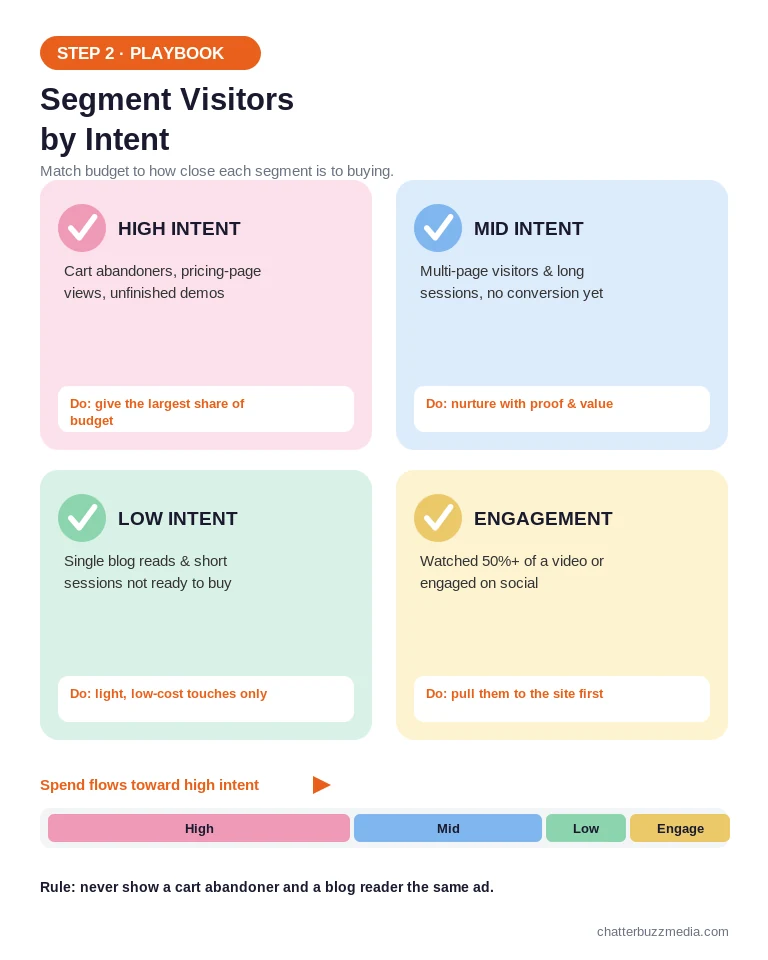
Segmentation is where retargeting best practices separate profitable campaigns from money pits. The goal is to match each segment to where it sits in the buying journey, then spend more on the segments closest to converting.
Build your core segments around depth of intent:
- High intent: cart abandoners, pricing-page viewers, and demo or form starters who did not finish. These convert fastest and deserve the largest share of budget.
- Mid intent: visitors who viewed multiple product or service pages, or spent significant time on-site without a clear conversion action.
- Low intent: single-page blog readers and short-session visitors who may not be ready and should get lighter, cheaper touches.
- Engagement audiences: people who watched 50% or more of a video or interacted with your social content but never visited the site.
Time-on-site and multi-page behavior are strong qualifiers — targeting people who spent real time or viewed several pages ensures you reach visitors who are genuinely interested rather than accidental clicks.
Once your segments reflect intent, you can assign budget and messaging with precision instead of spraying one ad at everyone. Next, you protect that budget by deciding who should never see your ads at all.
Step 3: Build Exclusion Audiences to Stop Wasting Budget
Exclusion audiences are the highest-leverage, most-ignored lever in retargeting. If you are still paying to advertise to people who already converted, you are lighting money on fire every single day.
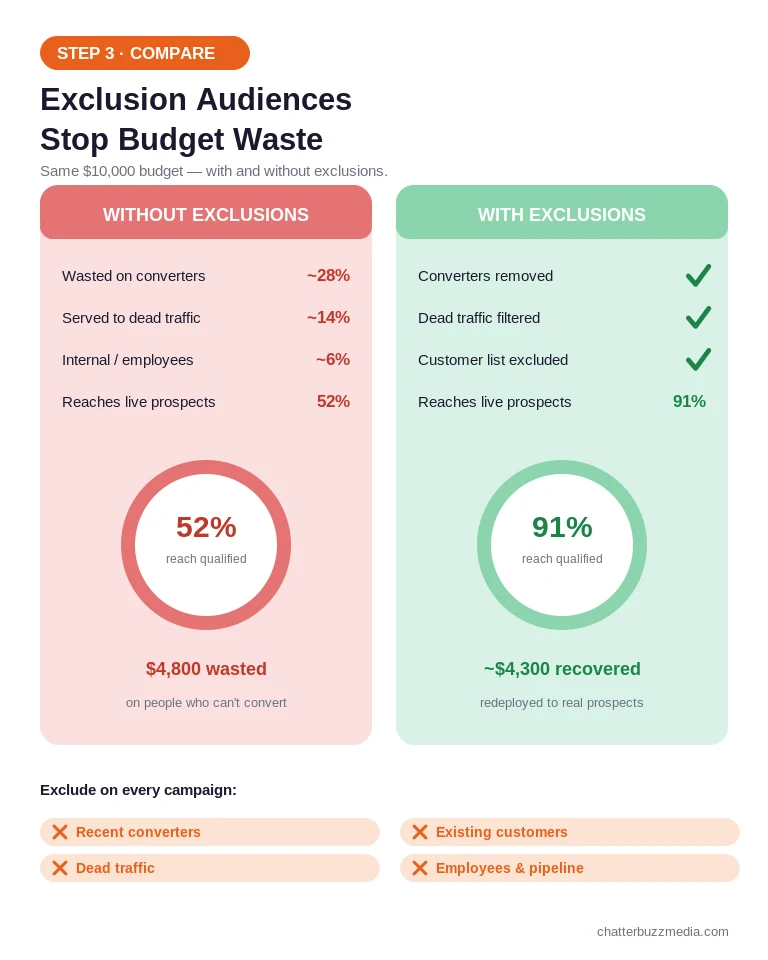
Exclusions tell the platform who to remove from your targeting. Done well, they concentrate spend on the people who can still take action and eliminate the impressions that inflate your costs without adding revenue.
Set up these exclusions on every retargeting campaign:
- Recent converters: exclude anyone who purchased, booked, or submitted a lead form in the relevant window so you stop paying to re-sell people who already bought.
- Existing customers: upload your customer list as an exclusion for acquisition campaigns, then use it separately for genuine re-engagement offers.
- Dead traffic: exclude bounces under a few seconds and bot-like sessions that will never convert.
- Employees and existing pipeline: exclude internal traffic and active sales opportunities that ads would only annoy.
The math is simple: every impression served to someone who already converted is a wasted impression that could have gone to a live prospect. On a fixed budget, exclusions directly increase how many qualified people you actually reach.
A well-built exclusion strategy quietly improves every metric at once — lower cost-per-acquisition, higher return on ad spend, and less wasted frequency. With the wrong people filtered out, you can focus on saying the right thing to the right people, in the right order.
Step 4: Sequence Your Messaging Across the Funnel
Repeating one ad is not a retargeting strategy — sequencing is. The most effective campaigns move people forward with a deliberate series of messages, each one matched to the next step in the decision.
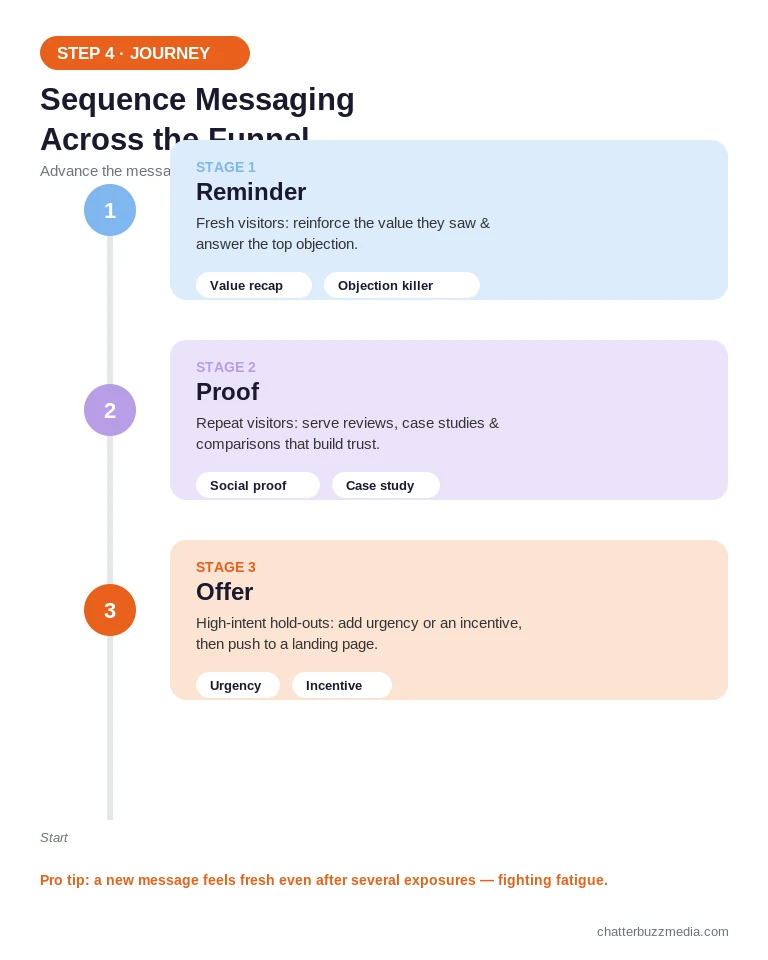
Sequential retargeting delivers a story rather than a single reminder. Instead of showing the same creative until someone converts or tunes out, you advance the message based on how engaged the person already is.
A proven three-stage sequence looks like this:
- Stage 1 — Reminder: for fresh visitors, reinforce the value they saw and address the obvious objection that made them hesitate.
- Stage 2 — Proof: for people who keep coming back, serve social proof, reviews, case studies, or a comparison that builds confidence.
- Stage 3 — Offer: for high-intent segments still on the fence, introduce urgency or an incentive that closes the gap, then send them to a dedicated landing page built to convert paid traffic.
Dynamic retargeting supercharges this for e-commerce by showing the exact product a visitor viewed rather than a generic brand ad, which keeps the specific item top of mind and pulls down abandoned-cart rates.
Sequencing also fights fatigue, because a new message feels fresh even to someone who has seen your brand several times. Refreshing your ad creative regularly keeps each stage working. Speaking of fatigue — that is exactly what the next step is designed to prevent.
Step 5: Set Frequency Caps and Membership Durations
Unlimited frequency is how retargeting turns from helpful to creepy. Show the same person your ad twenty times in three days and you do not just waste impressions — you damage the brand and train people to ignore you.
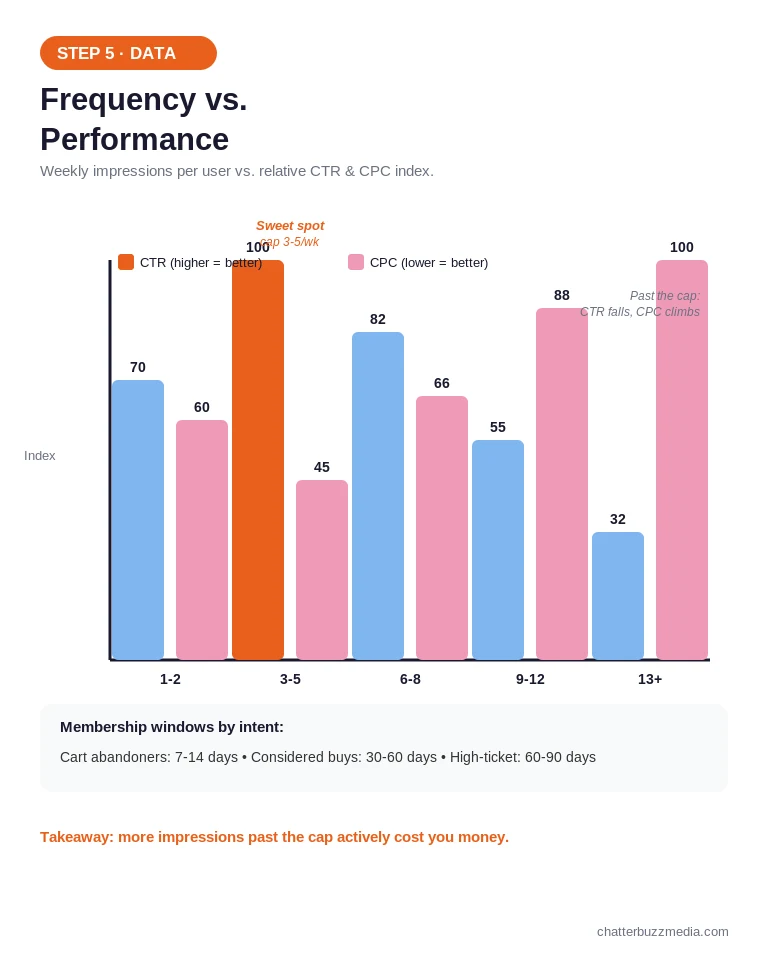
Two controls keep this in check: frequency caps that limit how often someone sees your ads, and membership durations that control how long someone stays in a retargeting audience after their visit.
Use these as practical starting points, then tune with your own data:
- Frequency caps: a common baseline is roughly 3 to 5 impressions per user per week, adjusted by funnel stage and creative volume.
- Membership windows by intent: keep high-intent cart abandoners in short 7 to 14 day windows when urgency is highest, and use longer windows for considered, high-ticket purchases.
- Multiple creatives: rotate several ads so people do not see the same image repeatedly, which is a leading cause of ad fatigue.
- Watch the frequency-to-CTR curve: when click-through rate falls and cost-per-click climbs, your frequency is too high.
The data is consistent — performance degrades as frequency rises beyond the sweet spot, so more impressions past that point actively cost you money. Matching window length to intent means you stop paying to chase people whose interest expired weeks ago.
Once your pacing is disciplined on one platform, you can safely expand the same audiences across channels for more reach.
Step 6: Run Cross-Platform Retargeting on Facebook and Google
Your lost visitors do not live on a single platform, so your retargeting shouldn’t either. The same high-intent segment can be reached on Facebook and Instagram, across the Google Display Network, on YouTube, and through the search results — each with a different strength.
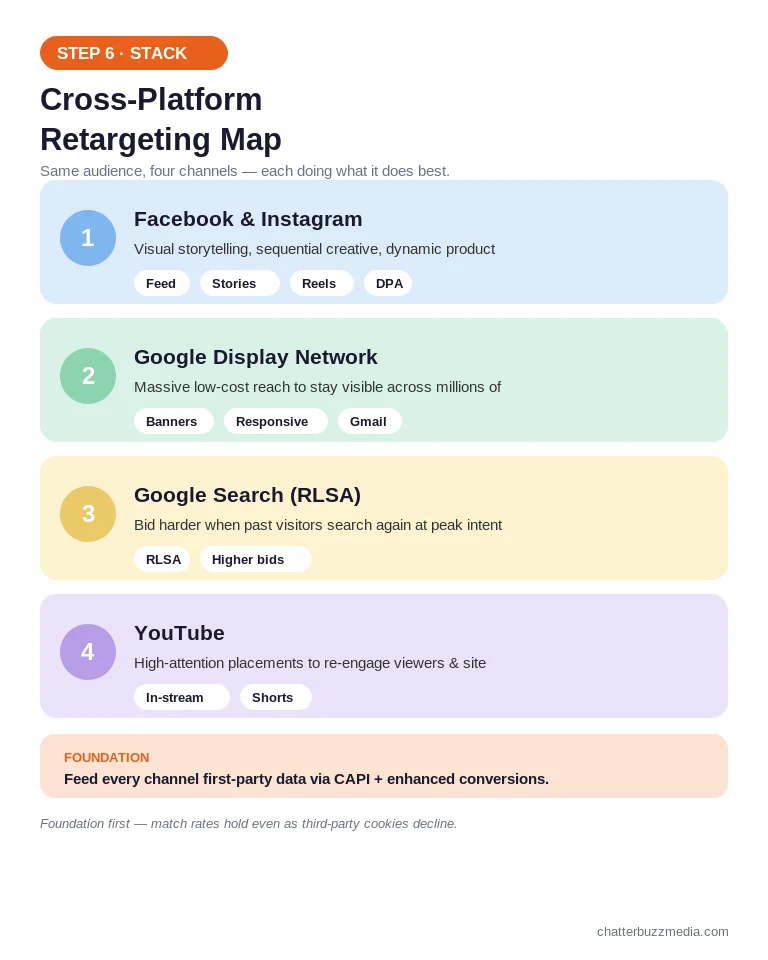
Cross-platform retargeting increases the number of qualified touches without increasing the size of your audience. The key is using each channel for what it does best rather than copying one ad everywhere.
Here is how the major channels compare for retargeting:
- Facebook and Instagram retargeting: unmatched for visual storytelling, sequential creative, and dynamic product ads that rebuild interest through the feed.
- Google Display retargeting: massive reach across millions of sites to keep your brand visible at a low cost-per-impression.
- Google Search RLSA: bid more aggressively when past visitors actively search again, catching them at the exact moment of renewed intent.
- YouTube retargeting: re-engage video viewers and site visitors with high-attention placements that drive consideration.
To make this work across platforms, feed each one strong first-party data. Server-side signals from the Conversions API and Google’s enhanced conversions keep match rates high even as cookies decline, which is what makes cross-platform audiences accurate.
Coordinated correctly, your channels reinforce one another instead of competing for the same click. The final step makes sure you can actually prove which of those touches earned the conversion.
Step 7: Measure Incrementality, Not Just Last-Click ROAS
Retargeting is the most over-credited channel in digital advertising. Because it targets people already close to converting, last-click reporting hands it credit for sales that would have happened anyway — and that illusion drives bad budget decisions.
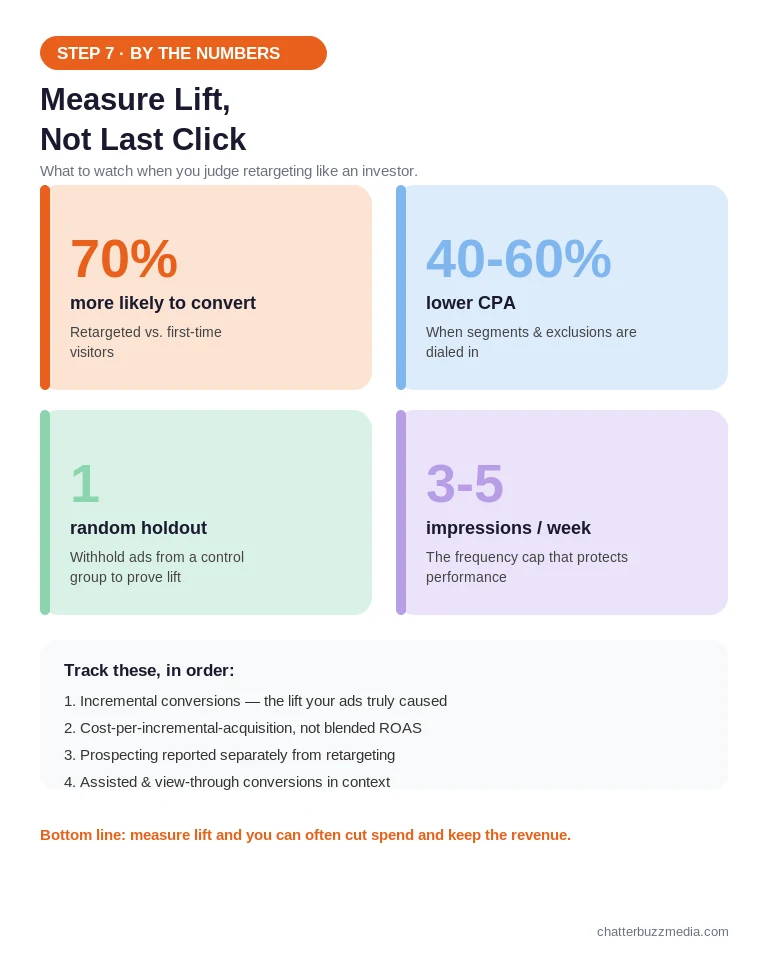
The fix is measuring incrementality: the extra conversions your retargeting actually caused, beyond what you would have gotten for free. This is the difference between a campaign that looks profitable and one that truly is.
Measure your retargeting like an investor, not a cheerleader:
- Run holdout tests: withhold ads from a random slice of your audience and compare their conversion rate to the exposed group to isolate true lift.
- Watch cost-per-incremental-acquisition, not just blended return on ad spend, so you fund the touches that add real revenue.
- Separate prospecting from retargeting reporting so retargeting cannot quietly claim credit for awareness campaigns that did the heavy lifting.
- Track assisted conversions and view-through with a clear-eyed view of what your paid media and pages contribute at each stage.
When you measure lift instead of last click, you often find you can cut retargeting spend and keep most of the revenue — then redeploy that budget into prospecting that fills the funnel. That is how disciplined advertisers scale profitably instead of plateauing.
Put all seven steps together and retargeting stops being a budget drain and becomes one of the most efficient lines in your media plan.
Frequently Asked Questions
1. 🔍 What is a retargeting strategy?
A retargeting strategy is a plan for re-engaging people who already interacted with your brand — visiting your site, viewing a product, or abandoning a cart — by serving them tailored ads across other sites, social platforms, and search. A strong strategy segments those visitors by intent, sequences the messaging, and excludes people who already converted so budget goes to the prospects most likely to act.
2. 📊 How is retargeting different from remarketing?
The terms are used almost interchangeably, but retargeting usually refers to paid ads served to past visitors across the web and social platforms, while remarketing often describes re-engaging existing contacts through email. In practice, the strongest programs combine both: a retargeting strategy for paid reach and a remarketing strategy for owned channels like email.
3. ⚡ Does retargeting actually work?
Yes — retargeted users are roughly 70% more likely to convert than first-time visitors because they already know your brand. The catch is that results depend entirely on execution: without exclusion audiences, frequency caps, and intent-based segments, retargeting can just re-buy conversions you would have won anyway.
4. 🏦 How much of my budget should go to retargeting?
Retargeting is typically a smaller share of paid budget than prospecting, because your audience size is limited to people who already visited. A common approach is to fund retargeting to fully cover your high-intent segments, then invest the majority of budget in prospecting that keeps refilling the retargeting pool.
5. 🤝 How do cookie changes and privacy rules affect retargeting?
Third-party cookie loss has shrunk browser-based audiences and lowered match rates, which makes pixel-only retargeting less reliable. Server-side tracking through tools like the Meta Conversions API and Google’s enhanced conversions restores accuracy by sending first-party event data directly from your server.
6. 💰 Why is my retargeting wasting budget?
The most common culprits are missing exclusion audiences, no frequency caps, and treating every visitor as one segment. Fixing those three — excluding converters, capping impressions, and separating high-intent from low-intent visitors — usually recovers a meaningful portion of wasted spend.
7. 🚀 How long should someone stay in a retargeting audience?
It depends on intent and purchase cycle. High-intent cart abandoners belong in short 7 to 14 day windows when urgency is highest, while considered, high-ticket purchases justify longer windows of 30 to 90 days.
8. 📈 How do I measure if retargeting is truly profitable?
Use incrementality testing rather than last-click return on ad spend. Withhold ads from a random control group, compare their conversion rate to the exposed group, and measure the lift — the extra conversions your ads actually caused beyond what would have happened anyway.
Conclusion: Turn Retargeting Into Your Most Efficient Channel
Retargeting rewards discipline, not volume. The advertisers who win are the ones who treat their visitor data as a segmented pipeline and refuse to pay for impressions that cannot move the needle.
Here is your action plan to put this strategy to work:
- Fix your foundation: verify your pixels and add server-side tracking so every audience is built on clean, reliable data.
- Segment and exclude: split visitors by intent and build exclusion audiences to stop paying for people who already converted.
- Sequence and cap: replace repeated ads with a message sequence, then set frequency caps and intent-based windows to protect performance.
- Measure true lift: run holdout tests to prove incremental value, then redeploy wasted spend into prospecting that refills your funnel.
If you want a deeper look at how paid media, landing pages, and conversion optimization fit together, explore our performance marketing guide, our PPC management services, and conversion rate optimization to build a full-funnel plan around your retargeting.

Victoria Wallace
Victoria Wallace is a senior content strategist and marketing writer with 30+ years of experience helping more than 200 brands translate complex business goals into clear, conversion-focused content. Her background spans paid media, marketing strategy, go-to-market planning, brand positioning, and full-funnel campaign development, giving her a deep understanding of how SEO content connects to real business growth.