
 321-236-2899

AEO Prompts: How to Build a Tracked Prompt Set by Vertical

Most teams start tracking AI search by picking a tool, and that is exactly backwards. The prompts you choose decide everything you will learn, so a weak prompt set produces confident-looking dashboards that measure nothing useful.
This guide covers AEO prompts from the ground up, using two published frameworks: Conductor’s persona, intent, and brand-type fan-out and seoClarity’s entity, aspect, and intent format. It then adds the piece most guides skip, which is how the starter set changes by vertical.
By the end, you will have a six-step method, a prompt template for seven verticals, and a maintenance cadence that keeps your set honest as AI answers shift. Let’s start with why the set matters more than the software.
Key Takeaways
- Your prompt set is your measurement instrument. A biased or thin set makes every visibility number misleading.
- Decide what you are measuring first: mentions, citations, or sentiment each need different prompts.
- Write one aspect per prompt using the entity + aspect + intent format, and sample 3 to 5 prompts per core term.
- Fan out across seven intent stages, personas, and branded versus unbranded variants so the set reflects real buying behavior.
- Run each prompt repeatedly. AI answers vary, so track how often you appear across runs, not what one answer said.
- Vertical context changes the set. A credit union, a home builder, and a manufacturer ask AI very different questions.
What AEO Prompts Are and Why Your Prompt Set Decides Everything
AEO prompts are the specific questions you ask AI engines on a schedule to measure whether your brand is mentioned, cited, or recommended. They are the AI-search equivalent of a keyword list, except there is no search-volume column to tell you which ones matter.
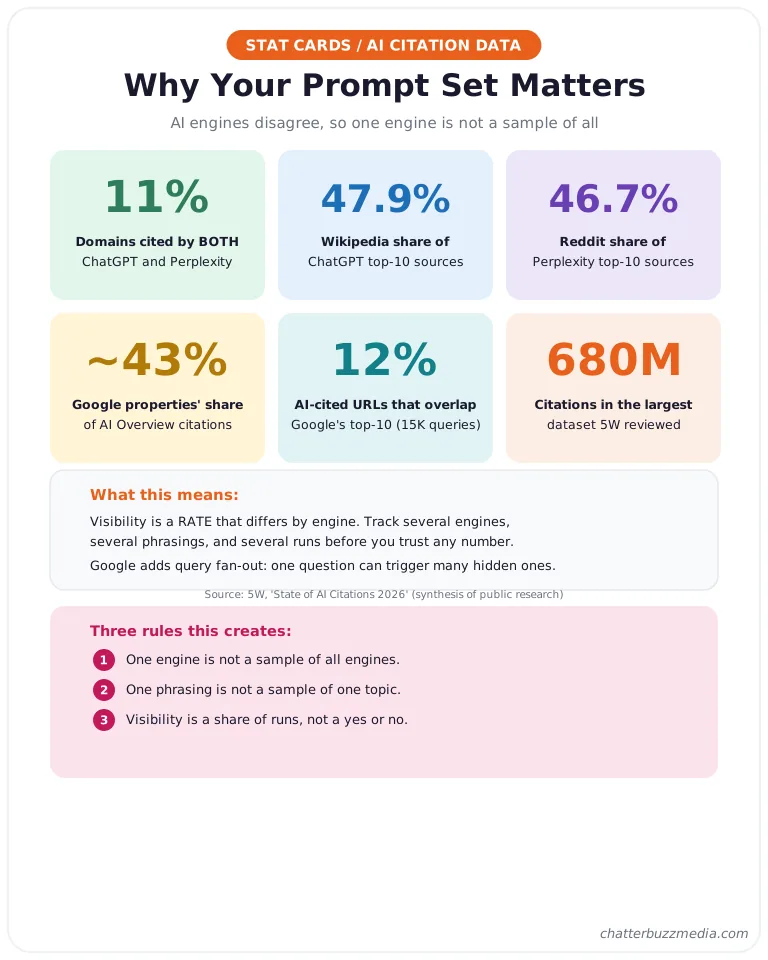
That missing column is the core problem. Traditional keyword research hands you demand data, while AI prompt research hands you a blank page and a guess.
The stakes are real because the engines disagree with each other. According to 5W’s 2026 synthesis of public AI citation research, only about 11% of domains are cited by both ChatGPT and Perplexity.
The same report shows Wikipedia at 47.9% of ChatGPT’s top-10 source share and Reddit at about 46.7% for Perplexity.
Google also behaves differently. Google’s documentation on AI features says AI Overviews and AI Mode may use a “query fan-out” technique that issues multiple related searches across subtopics.
In other words, one question can trigger several hidden ones.
Three consequences follow for anyone building a prompt set:
- One engine is not a sample of all engines. A set tested only in one tool tells you about that tool.
- One phrasing is not a sample of one topic. The same need can be asked ten ways, and your brand may win only some of them.
- Visibility is a rate, not a yes or no. You will appear in a share of runs, so you need enough prompts and runs to see that share.
Google is also clear that nothing special is required to appear in these features. Its documentation states there are “no additional requirements to appear in AI Overviews or AI Mode,” so your prompt set should test the quality of your existing search foundations rather than a secret formula.
If you need the foundations first, start with our guide to answer engine optimization and our comparison of SEO versus AEO.
With the stakes clear, the first decision is what you are actually trying to measure.
Step 1: Define What You Are Measuring Before You Write a Prompt
Start by choosing one primary outcome per prompt: a mention, a citation, or a sentiment read. Each one needs a different kind of question, and mixing them in one prompt muddies the result.
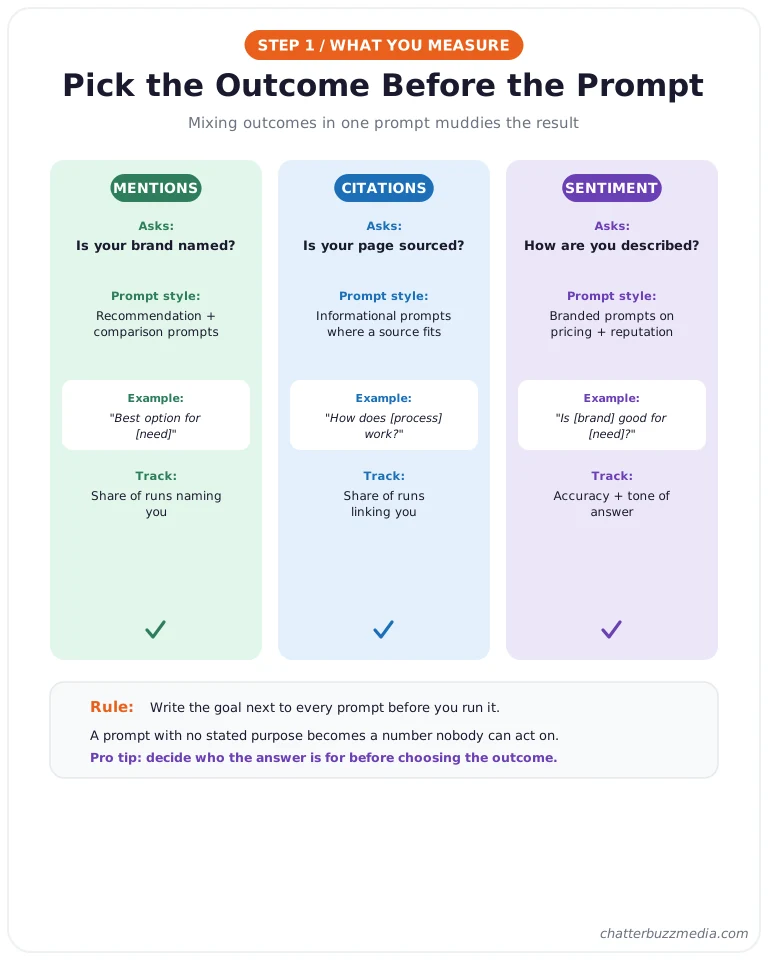
seoClarity makes the same point: begin with what you want to measure, then match each prompt to its expected outcome. Their guide to choosing prompts to track separates prompts that target mentions from prompts that target citations.
Here is how the three outcomes differ in practice:
- Mentions: Does the AI name your brand in its answer? These come from recommendation and comparison prompts such as “best option for [need].”
- Citations: Does the AI link to or source your content? These come from informational prompts where a source page is the natural support, such as a how-to or definition.
- Sentiment and accuracy: How does the AI describe you, and is it correct? These come from branded prompts about your pricing, reputation, and offering.
Write the goal next to each prompt before you do anything else. A prompt with no stated purpose becomes a number on a dashboard that nobody can act on.
It also helps to decide who the answer is for. A credit union tracking member acquisition cares about different outcomes than a manufacturer tracking RFQ requests, which is why the vertical section later in this guide starts from the buyer, not the brand.
Once the goal is set, you can write prompts in a format that keeps results clean.
Step 2: Write Every Prompt in Entity + Aspect + Intent Format
The cleanest prompt has one entity, one aspect, and enough context to signal intent. This is the structure seoClarity recommends, and it prevents the most common mistake in prompt tracking, which is stuffing several questions into one.
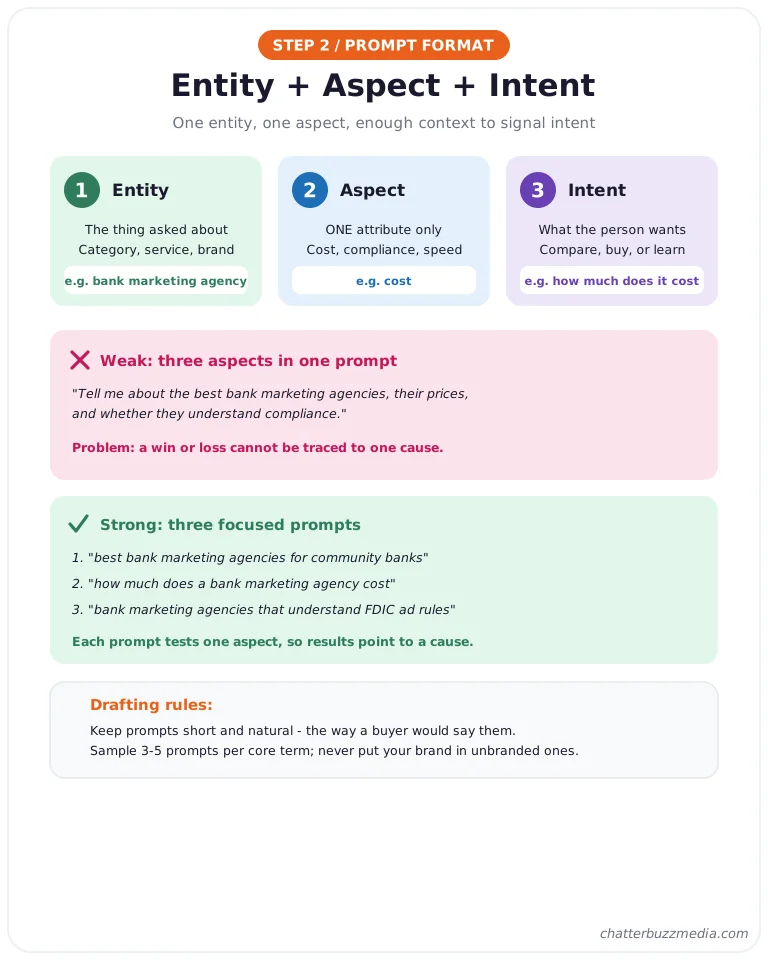
The format works like this:
- Entity: The thing being asked about, such as a product category, service, or brand.
- Aspect: One attribute of that entity, such as cost, compliance, speed, or quality.
- Intent: The context that tells the AI what the person wants to do, such as compare, buy, or learn.
Compare a weak prompt with a strong one. “Tell me about the best bank marketing agencies, their prices, and whether they understand compliance” bundles three aspects, so you cannot tell which one drives a mention.
The focused version is three separate prompts: “best bank marketing agencies for community banks,” “how much does a bank marketing agency cost,” and “bank marketing agencies that understand FDIC advertising rules.” Each one tests a single aspect, so a win or a loss points to a specific cause.
Use these rules when drafting:
- Keep prompts short and natural. Write them the way a buyer would type or say them.
- One aspect per prompt. If you wrote the word “and” between two needs, split it.
- Sample 3 to 5 prompts per core term. seoClarity recommends varying the intent across them, such as informational and transactional.
- Avoid leading phrasing. Do not put your brand name into an unbranded prompt.
A short, stable format also makes your set portable across tools and easy to audit later. Now you need real language to fill the template.
Step 3: Seed Your Prompts From Real Customer Language
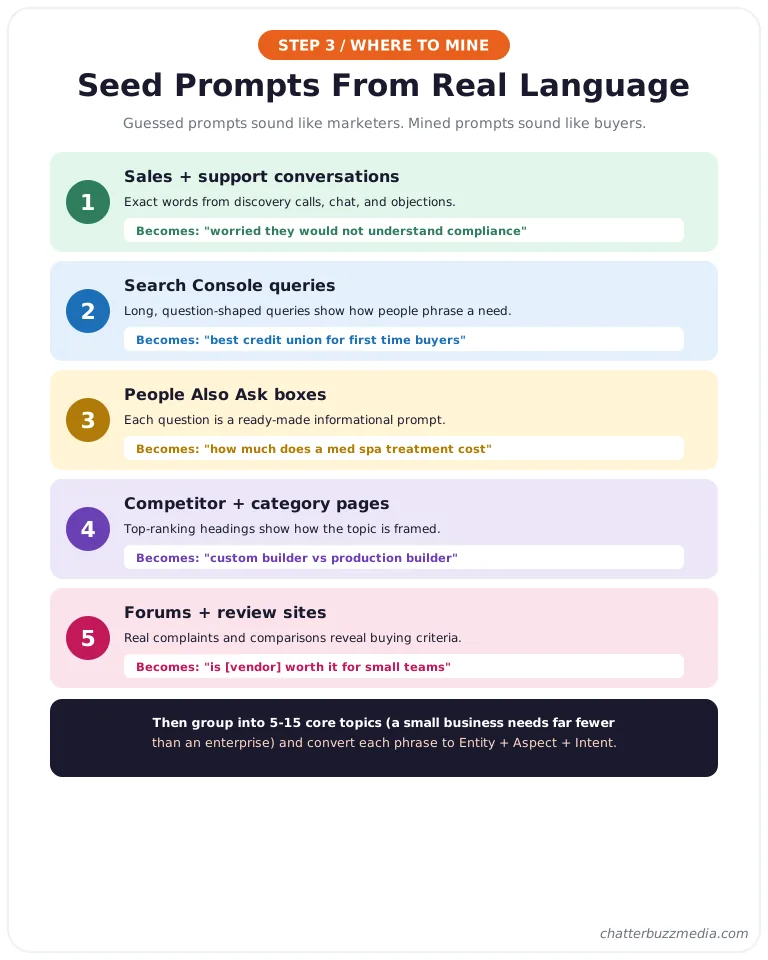
Seed prompts from sources that already contain buyer language, not from brainstorming. Conductor warns that most enterprise teams generate prompts by guesswork, which breaks down because guessed prompts reflect how marketers talk, not how customers ask.
Their prompt index playbook recommends starting with topic discovery grounded in your own data, such as clustering organic keywords by theme and weighting them by search volume. You can do a lighter version of that without enterprise tooling.
Pull raw material from these places, roughly in order of value:
- Sales and support conversations: The exact words prospects use on discovery calls, in chat, and in objections.
- Search Console queries: Long, question-shaped queries already tell you how people phrase a need.
- People Also Ask boxes: Each question is a ready-made informational prompt.
- Competitor and category pages: Headings on top-ranking pages show how the topic is framed.
- Forums and review sites: Real complaints and comparisons reveal buying criteria.
Convert each raw phrase into the entity + aspect + intent format. A call note that says “we were worried the agency would not understand compliance” becomes the prompt “marketing agency that understands compliance for [your vertical].”
Group the results into core topics, usually 5 to 15 for a focused business. Conductor’s example is a brand with 3,000 keywords clustering into roughly 150 topics, which they present as illustrative, and a smaller company should expect far fewer.
With topics in hand, you can expand each one into the full range of questions a buyer might ask.
Step 4: Fan Out Across Intent Stages, Personas, and Brand Type
Fan out each core topic across three dimensions: intent stage, persona, and brand type. This is the structure Conductor describes, and it turns a handful of topics into a set that reflects how buying actually unfolds.
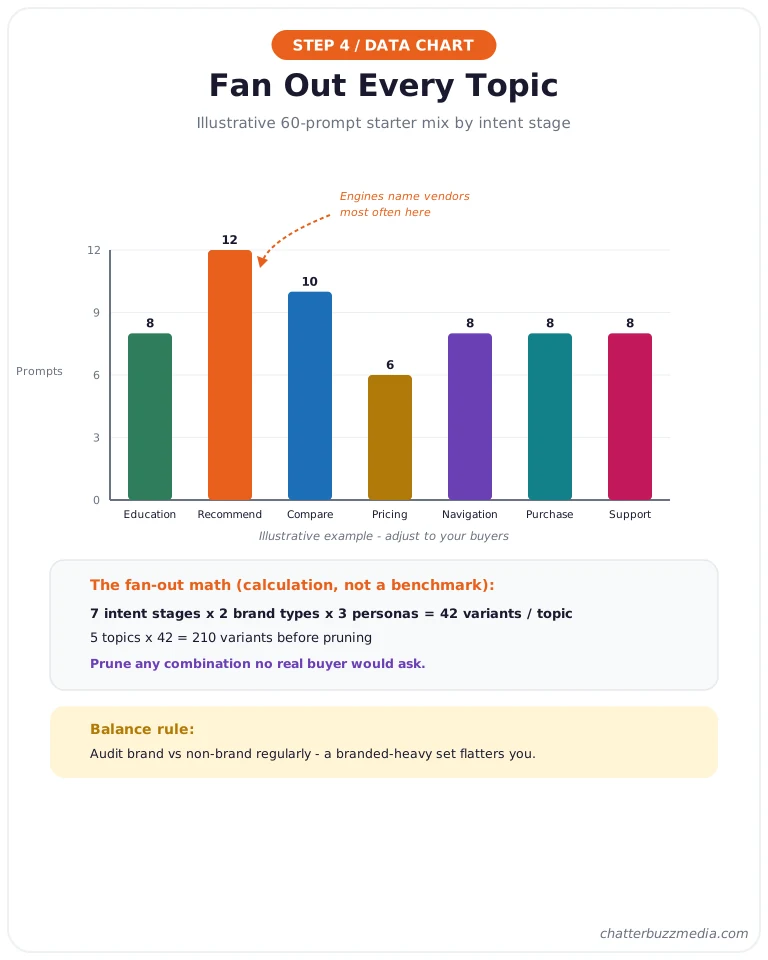
Conductor lists seven intent stages, and each one produces a different style of prompt:
- Education: “What is [concept] and how does it work?”
- Recommendations: “Best [category] for [situation].”
- Comparison: “[Option A] vs [Option B] for [use case].”
- Pricing: “How much does [service] cost?”
- Brand or service navigation: “[Brand] services for [need].”
- Purchase: “How to choose and hire a [provider].”
- Support: “How to fix or manage [problem] with [product].”
Next, add personas. The same topic is asked differently by a CFO, a marketing manager, and a founder, and the AI may answer each differently.
Finally, split every prompt into branded and unbranded versions. Unbranded prompts show whether you are discovered, while branded prompts show how you are described once someone already knows your name.
The arithmetic grows quickly, so it pays to plan it. Seven intent stages, two brand types, and three personas produce 42 prompt variants for a single topic.
Across five topics, that is 210, which is why you prune the combinations that no real buyer would ask.
Keep the balance deliberate. seoClarity advises balancing brand and non-brand prompts and auditing the mix regularly, since a set that drifts toward branded prompts will flatter you.
Here is a simple illustrative mix for a 60-prompt starter set, shown in the chart at the top of this section. It leans toward recommendation and comparison prompts because those are the moments when AI engines name vendors.
Now apply the method to specific industries, where the questions diverge sharply.
Step 5: Build a Starter Prompt Set for Your Vertical
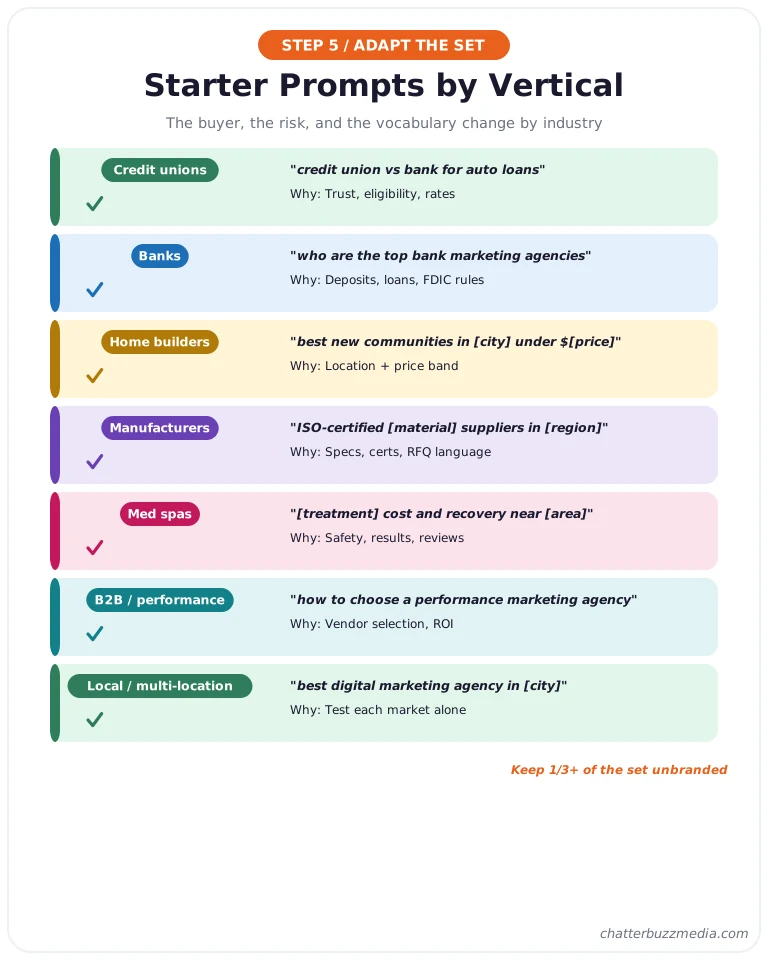
A vertical changes the prompts because the buyer, the risk, and the vocabulary all change. Use the templates below as seeds, then replace the brackets with your own market, products, and competitors.
Credit Unions
Members compare credit unions to banks and ask about rates, eligibility, and trust. Compliance language matters because regulated claims shape what AI repeats.
- “Best credit union for first-time homebuyers in [city]”
- “Credit union vs bank for auto loans”
- “Who can join [credit union name]”
- “Credit union marketing agencies that understand NCUA advertising rules”
For the content side of this vertical, see our resources on AI search for credit unions and credit union marketing.
Banks
Bank prompts split between consumer needs and business buyers choosing a vendor. Deposit growth, loan origination, and regulator-safe messaging all show up in the wording.
- “Best community bank for small business loans in [region]”
- “Who are the top bank marketing agencies”
- “How much does a bank marketing agency cost”
- “Bank marketing agencies that understand FDIC advertising requirements”
Our bank marketing agency guide shows how those evaluation criteria read on a page.
Home Builders
Buyers ask about communities, floor plans, timelines, and incentives. Location and price band are almost always part of the question.
- “Best new home communities in [city] under $[price]”
- “Custom home builder vs production builder”
- “How long does it take to build a new home in [state]”
- “Home builder marketing ideas that fill model homes”
Related reading: home builder marketing strategies and the home builder SEO guide.
Manufacturers
Industrial buyers ask spec-driven, technical questions and evaluate suppliers on capability and certification. Prompts should read like an RFQ, not a consumer search.
- “Best [process] manufacturer for [industry] components”
- “ISO-certified [material] suppliers in [region]”
- “How to evaluate a contract manufacturer”
- “Manufacturing marketing strategy for lead generation”
Go deeper with our manufacturing marketing strategy post and the manufacturing SEO guide.
Med Spas
Prospective clients ask about treatments, safety, recovery, results, and price, and they weigh reviews heavily. Local intent is nearly universal.
- “Best med spa for [treatment] near [neighborhood]”
- “How much does [treatment] cost”
- “[Treatment A] vs [Treatment B] for [concern]”
- “Is [treatment] safe and how long is recovery”
See how local visibility is built in our med spa SEO post.
B2B and Performance Marketing
B2B buyers research categories, compare vendors, and ask about pricing models. Agency-selection prompts are especially common.
- “Best performance marketing agency for mid-market B2B”
- “How to choose a performance marketing agency”
- “Performance marketing agency pricing models”
- “How to measure ROI from paid media”
The performance marketing agency guide covers the evaluation side.
Local and Multi-Location Queries
Local prompts pair a service with a place, and the place changes the answer. Multi-location brands should test each market separately rather than assuming one city represents all.
- “Best digital marketing agency in [Florida city]”
- “Top SEO companies in [city]”
- “Marketing agency near me that works with [industry]”
- “Local SEO services for businesses with multiple locations”
Foundational local work is covered in our local SEO services overview and our post on multi-location SEO.
Whatever the vertical, keep at least a third of the set unbranded and tied to a real buying question. Then test whether the set is stable enough to trust.
Step 6: Validate Coverage, Run Repeats, and Maintain the Set
Validate a prompt set by running each prompt multiple times and tracking your appearance rate, not by reading a single answer. AI responses vary from run to run, so one result is an anecdote.
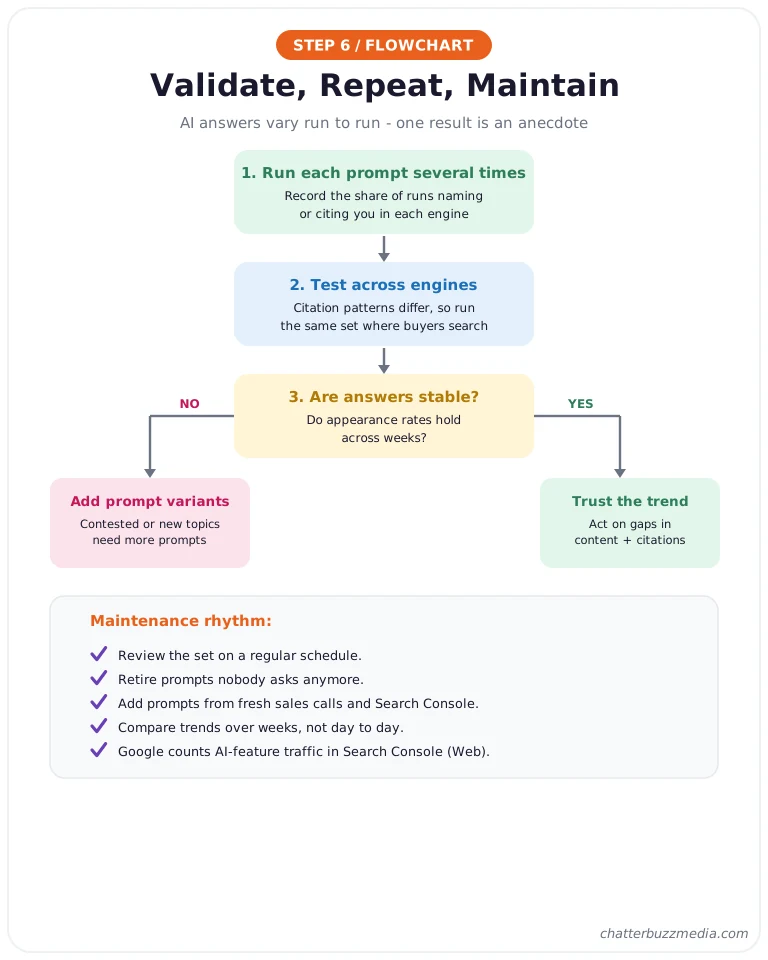
Conductor’s approach is to assess statistical coverage across topics and see which have stabilized. Their article notes that the number of prompts you need per topic depends on how much AI engines agree, and that newer or more contested topics need more prompts.
Apply that idea in a practical way:
- Run each prompt several times per cycle. Record the share of runs where you are mentioned or cited.
- Test across engines. Run the same set in each engine your buyers use, since citation patterns differ.
- Flag unstable topics. If answers swing widely, add more prompt variants before drawing conclusions.
- Separate signal from noise. Look for trends over weeks, not day-to-day changes.
Then set a maintenance rhythm so the set does not decay. Review it on a regular schedule, retire prompts nobody asks, and add new ones from fresh sales conversations and Search Console queries.
Finally, connect the results to action. Visibility gaps point to content, citations, and entity work, and clean reporting keeps stakeholders focused on trends; our reporting and data visualization overview shows how to present them.
Google also notes that AI feature traffic is included in your overall Search Console data under the Web search type, so pair prompt tracking with your existing reports.
Frequently Asked Questions
1. 🔍 What are AEO prompts?
AEO prompts are the specific questions you run on a schedule in AI engines to measure whether your brand is mentioned, cited, or recommended. Unlike keywords, they have no built-in search volume, so you choose them from real customer language and buying stages.
2. 📊 How many prompts should I track?
Start with 40 to 60 prompts across five to ten core topics, then grow only where answers are unstable. The right number depends on how much the engines agree on a topic, and contested or newer topics need more prompts.
3. ⚡ How is prompt research different from keyword research?
Keyword research starts from search volume data, while prompt research starts from conversations and buying stages because AI prompts are not searches with published volume. You also measure a rate of appearance across repeated runs rather than a ranking position.
4. 🏦 Should I track branded or unbranded prompts?
Track both, and keep the balance deliberate. Unbranded prompts show whether you are discovered, while branded prompts show how you are described, and a set that leans branded will overstate your visibility.
5. 🤝 Why do AI answers change every time I run a prompt?
AI engines generate answers dynamically, and some use query fan-out to run several related searches behind one question. That is why you run each prompt repeatedly and track the share of runs where you appear.
6. 💰 Do I need a paid tool to track prompts?
No, you can start with a spreadsheet and manual runs for a small set. Tools help once you need scale, multiple engines, and scheduled runs, but the prompt design matters more than the software.
7. 🚀 Does Google require special optimization for AI Overviews?
No. Google states there are no additional requirements to appear in AI Overviews or AI Mode, and no special schema is needed.
Pages must be indexed and eligible to appear with a snippet, so standard SEO fundamentals still apply.
8. 📈 How often should I update my prompt set?
Review it on a regular schedule and add prompts from new sales conversations and Search Console queries. Retire prompts that no longer reflect real buyer questions so the set stays representative.
Conclusion: Build the Set Before You Buy the Software
Good AI visibility measurement comes down to good prompt design. Define the outcome, write focused prompts, seed them from real customer language, fan them out across intent, persona, and brand type, adapt them to your vertical, and validate with repeated runs.
Here is your four-step action plan:
- Define the goal. Choose mentions, citations, or sentiment for each topic and write it next to the prompt.
- Draft 40 to 60 prompts. Use the entity + aspect + intent format and pull language from sales calls, Search Console, and People Also Ask.
- Adapt to your vertical. Start from the templates above and add your markets, products, and competitors.
- Run, repeat, and review. Run each prompt several times, track your appearance rate, and refresh the set on a regular cadence.
If you want the foundation that makes these prompts pay off, our answer engine optimization guide and the wider marketing resource library are the best next reads. Build the instrument first, and the data that follows will actually mean something.

Victoria Wallace
Victoria Wallace is a senior content strategist and marketing writer with 30+ years of experience helping more than 200 brands translate complex business goals into clear, conversion-focused content. Her background spans paid media, marketing strategy, go-to-market planning, brand positioning, and full-funnel campaign development, giving her a deep understanding of how SEO content connects to real business growth.