
 321-236-2899

ABM Advertising: Channels, Budgets, and Tracking Guide
Most B2B advertising still works like a net: cast it wide, catch whatever swims in. ABM advertising works like a guest list, putting your ads only in front of the companies you have already decided are worth winning.
That shift matters more than it sounds. Gartner finds a typical B2B buying group has six to 10 decision makers, and buyers spend only about 17% of their time meeting with suppliers at all. Spray-and-pray spend burns through budget reaching people who will never buy and still misses most of the committee that will.
This guide walks through exactly how to run ABM advertising against a named target-account list: the channels that do the work, how to split a budget across tiers and platforms, and the tracking setup that ties ad spend back to pipeline. By the end you will have a channel-by-channel plan you can copy and a measurement model that survives a CFO’s questions.
The approach assumes nothing about your tech stack beyond a CRM and ad accounts you already own. Everything here works whether you run it in-house or with a partner, and whether your list is 50 accounts or 2,000.
Key Takeaways
- ABM advertising targets a fixed, named list of accounts instead of broad audiences, so almost every impression reaches a company you actually want as a customer.
- LinkedIn, Google, and programmatic display each do a different job. Match the channel to the account tier and buying stage rather than spreading spend evenly.
- Split budget by tier first, then by channel. A rough 50/30/20 tier split and a realistic monthly floor keep a multi-channel program from spreading too thin to work.
- Account targeting lives or dies on match rates and list hygiene. Upload and refresh company lists correctly or your ads quietly leak to the wrong firms.
- Measure account engagement and influenced pipeline, not clicks. Tie ad exposure to named accounts in your CRM before you spend a dollar scaling.
What ABM Advertising Is (and How It Differs From Programmatic)
ABM advertising is paid media aimed at a fixed, pre-chosen list of named companies rather than a broad demographic or interest audience. You decide which accounts matter, then you buy ads that only those accounts and the people inside them can see.
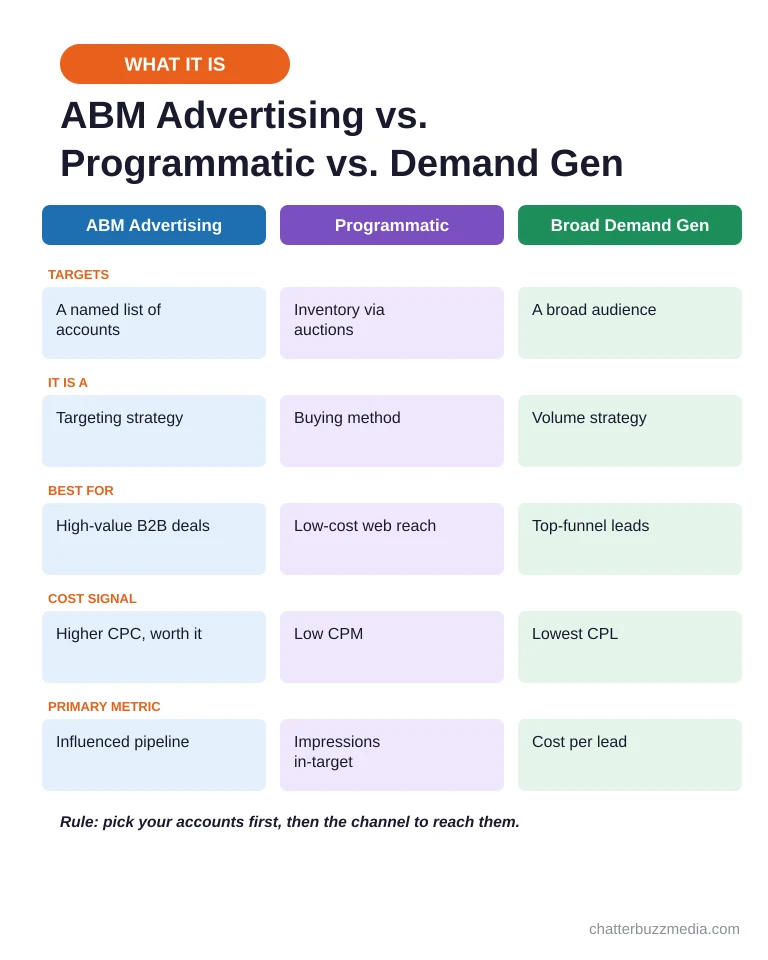
This is where the line between ABM advertising and programmatic advertising gets blurry, because the two overlap. Programmatic is the buying method: automated, real-time auctions for display, video, and native inventory across the open web.
ABM advertising is the targeting strategy: who you reach and why. You can run ABM programmatically, by feeding a named account list into a demand-side platform, but you can also run it on LinkedIn or Google without any programmatic display at all.
The practical difference matters for planning. Traditional demand generation optimizes for volume and cost per lead; ABM advertising optimizes for reaching and influencing a specific set of high-value accounts, even when the raw cost per click looks worse.
It also differs from lead generation. Lead gen chases individuals who raise a hand; ABM advertising surrounds an entire buying committee at companies you selected, whether or not anyone has filled out a form yet. If you want the deeper strategic picture before the advertising layer, our account-based marketing guide covers the full program, and ABM versus lead generation unpacks the contrast.
This model fits long, committee-driven sales cycles especially well. When a decision involves six to 10 people over several months, reaching only the one who clicked a form leaves most of the room uninfluenced, and ABM advertising exists to cover the rest of the table.
With the definition settled, the first real step is deciding exactly who makes the list.
Step 1: Build and Tier Your Target-Account List
Start by naming the companies you want, then rank them into tiers so your budget follows your priorities. ABM advertising only works when the list is deliberate, not a dump of every lead in your CRM.
Build the list from three sources: your best current customers (find more that look like them), accounts already in active sales conversations, and ideal-fit companies your sales team wants to break into. A sharp account-based marketing strategy and a clear B2B buyer persona keep the list honest rather than aspirational.
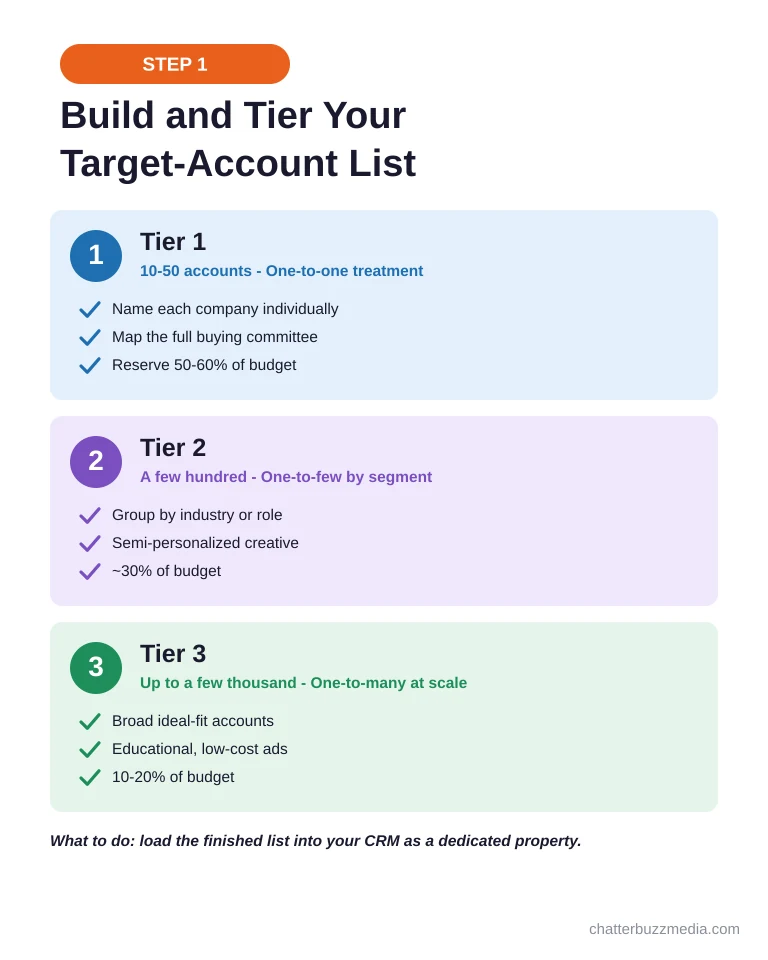
Then tier it. Tier 1 is your most strategic accounts, usually 10 to 50 companies that justify one-to-one treatment. Tier 2 is a larger set of strong-fit accounts, a few hundred, that get one-to-few campaigns by industry or role.
Tier 3 is everyone else who fits your ideal profile, up to a few thousand, handled one-to-many at low cost. Most programs run a combined list of roughly 100 to 2,000 accounts depending on deal size and budget.
What to do: get the finished list into your CRM as a dedicated account property before you touch any ad platform. That single field is what later lets you prove which named accounts your ads actually reached. Our ABM data breakdown covers the firmographic and intent signals worth adding while you build it.
Once the list is tiered and in the CRM, you can decide where to spend to reach it.
Step 2: Choose the Right ABM Advertising Channels
Pick channels by the job they do, not by habit, because no single platform reaches a full buying committee on its own. Three channels carry most ABM advertising programs, with two more as support.
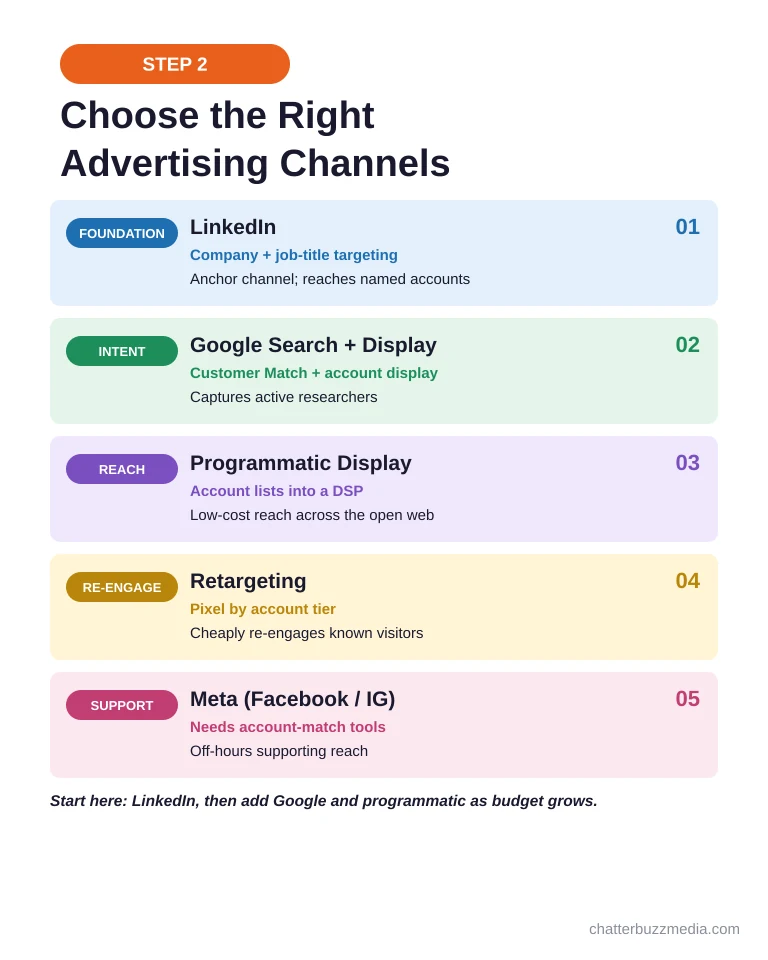
LinkedIn is the backbone for B2B. Its company-list and job-title targeting let you reach named accounts and specific roles with precision no other platform matches, which is why it anchors most programs despite higher costs. Our LinkedIn advertising strategy for B2B and the real LinkedIn ad costs are worth reading before you set spend.
Google covers intent and reach. Search captures accounts actively researching your category, while Customer Match and account-based display keep your brand in front of the same companies across the web.
Programmatic display extends your account list far beyond any single platform. By loading company or IP-based account lists into a demand-side platform, you can serve display and video to target accounts across the open web at a low cost per impression. If programmatic is new to you, start with what programmatic buying is and our programmatic advertising overview.
Retargeting and Meta round out the mix. Retargeting re-engages known account visitors cheaply, and Meta can reach the same buyers off-hours, though it needs account-matching tools to approximate B2B targeting. Our retargeting strategy and broader paid media strategy show how the layers fit together.
Choosing channels is only half the work; each one has to be set up to honor your account list.
Step 3: Set Up Account Targeting on Each Platform
The setup step is where most ABM advertising quietly fails, because the account list has to be loaded correctly on every platform or your ads leak to companies you never chose. Each channel matches your list a little differently.
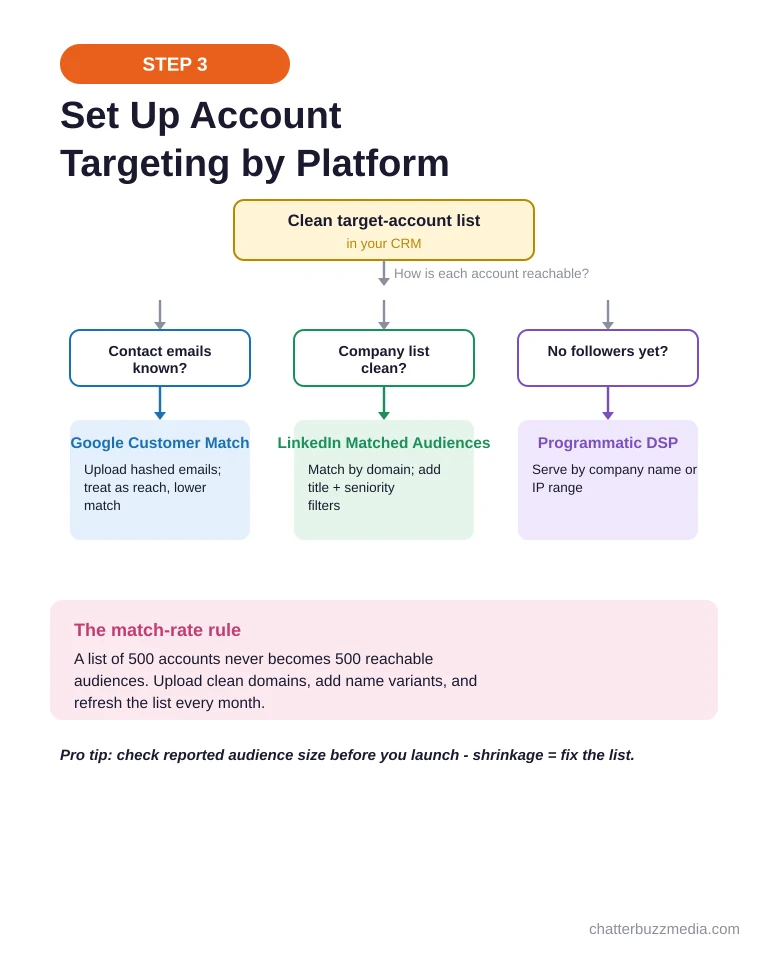
On LinkedIn, upload your company list as a Matched Audience. LinkedIn matches company names and domains against its graph, and company matching typically resolves a high share of a clean list, which is why LinkedIn anchors precise targeting. Review LinkedIn’s ad targeting documentation and its Matched Audiences list guide for exact formatting rules, then layer job-title and seniority filters on top so you reach the buying committee, not the whole company.
On Google, use Customer Match to upload known contacts at your accounts, and layer account-based display to reach the broader company. Match rates on email-based lists are lower than LinkedIn’s company match, so treat Google as reach, not pinpoint targeting. Google’s own audience targeting documentation explains how to combine Customer Match with other signals without losing account precision.
For programmatic display, your DSP ingests the account list as company names or IP ranges and serves ads to devices inside those organizations. This is how you reach accounts that have no one following you on LinkedIn yet.
The match-rate rule: a target list of 500 accounts never becomes 500 reachable audiences. Expect to lose a meaningful share to formatting errors, name variants, and platform gaps, so upload clean domains, include name variants, and refresh lists monthly as accounts enter and leave the program.
Run a quick sanity check before you launch. Pull the audience size each platform reports back and compare it to your list; a Tier 1 audience that collapses from 40 accounts to a handful of reachable ones is a signal to fix the list, not to launch anyway.
Pro tip: set up pixel-based retargeting segmented by tier at the same time, so visitors from Tier 1 accounts get different follow-up than Tier 3. With targeting live and clean, the next decision is how much to spend where.
Step 4: Allocate Budget Across Tiers and Channels
Allocate budget by account tier first, then by channel, so your spend concentrates where the revenue is. A flat split across every account and platform is the fastest way to underfund the accounts that matter most.
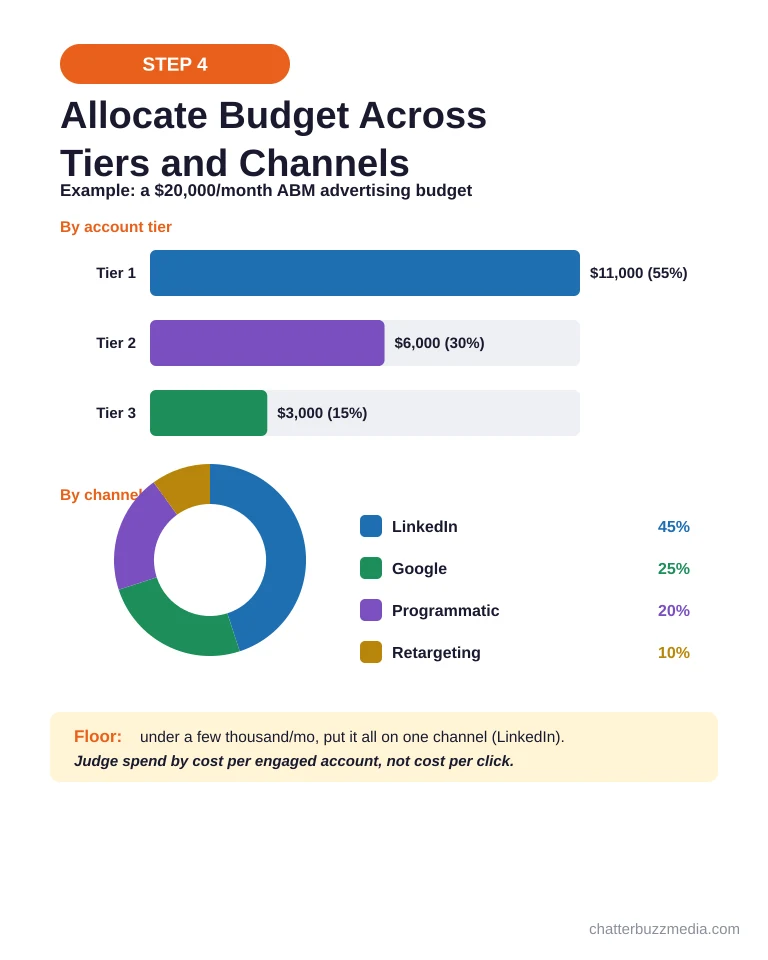
Start with the tier split. A workable default sends roughly 50 to 60% of budget to Tier 1, 30% to Tier 2, and 10 to 20% to Tier 3. Tier 1 earns the concentration because those accounts carry the largest deals and the longest committees.
Then split within each tier by channel. A common starting mix is LinkedIn as the largest line, Google search and display next, and programmatic display filling in low-cost reach, with a small retargeting layer across all tiers.
Budgets have a floor. Below roughly a few thousand dollars a month, concentrate everything on one channel such as LinkedIn rather than spreading thin; a true multi-channel program generally needs a higher monthly commitment to reach accounts often enough to matter.
Worked example: on a $20,000 monthly budget, that is about $11,000 to Tier 1, $6,000 to Tier 2, and $3,000 to Tier 3, with LinkedIn taking the largest share inside each tier. For a deeper framework, see our digital marketing budget breakdown.
Judge budget efficiency by cost per engaged account and influenced pipeline, not cost per click. Two channels with identical click costs can produce wildly different account engagement, and that gap is where you reallocate spend each month.
Consider: plan for a minimum three-month run before judging results. ABM advertising compounds as accounts move from unaware to engaged, and judging it on week two guarantees a wrong call. With budget set, the campaign structure decides how it gets spent.
Step 5: Build Cold and Warm Campaign Layers
Structure every account program in two layers, cold and warm, so your creative matches how aware each account already is. Running one undifferentiated campaign at every account wastes the warm ones and rushes the cold ones.
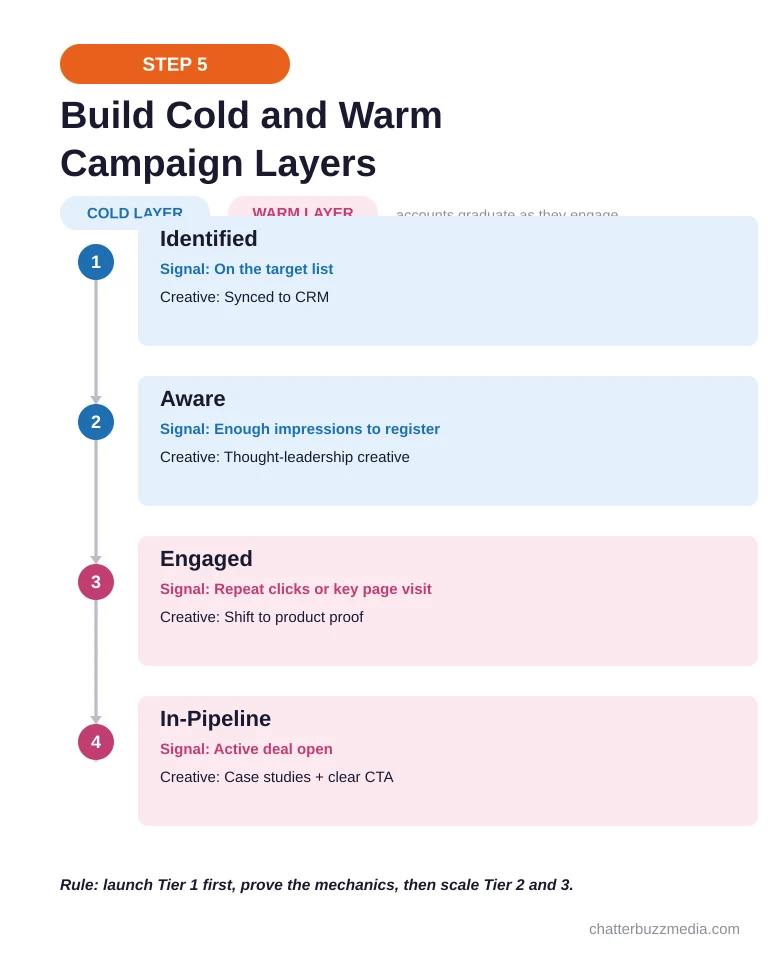
The cold layer targets accounts that fit your profile but do not know you yet. Lead with educational, thought-leadership creative that frames the problem rather than pushing a demo, and keep frequency high enough to build recognition.
The warm layer targets accounts already showing engagement, such as site visits, ad clicks, or an open opportunity. Here you shift to product proof, case studies, and clear calls to action, because these accounts are evaluating, not discovering.
Accounts move between layers based on behavior. When a cold account crosses an engagement threshold, it graduates into the warm layer and sees the next message, which is why your CRM sync from Step 1 matters so much.
Rule: launch Tier 1 first, prove the mechanics, then add Tier 2 and scale Tier 3 with what is left. Sequencing beats launching everything at once and drowning in data you cannot act on. For the full campaign checklist, see running B2B ABM campaigns and our B2B ABM checklist.
Layered campaigns only pay off if you can see which accounts are moving, which is the tracking problem.
Step 6: Track Account Engagement and Tie Spend to Pipeline
Measure ABM advertising at the account level and connect it to pipeline, not at the click level. The whole point of naming your accounts is that you can finally report on companies instead of anonymous traffic.
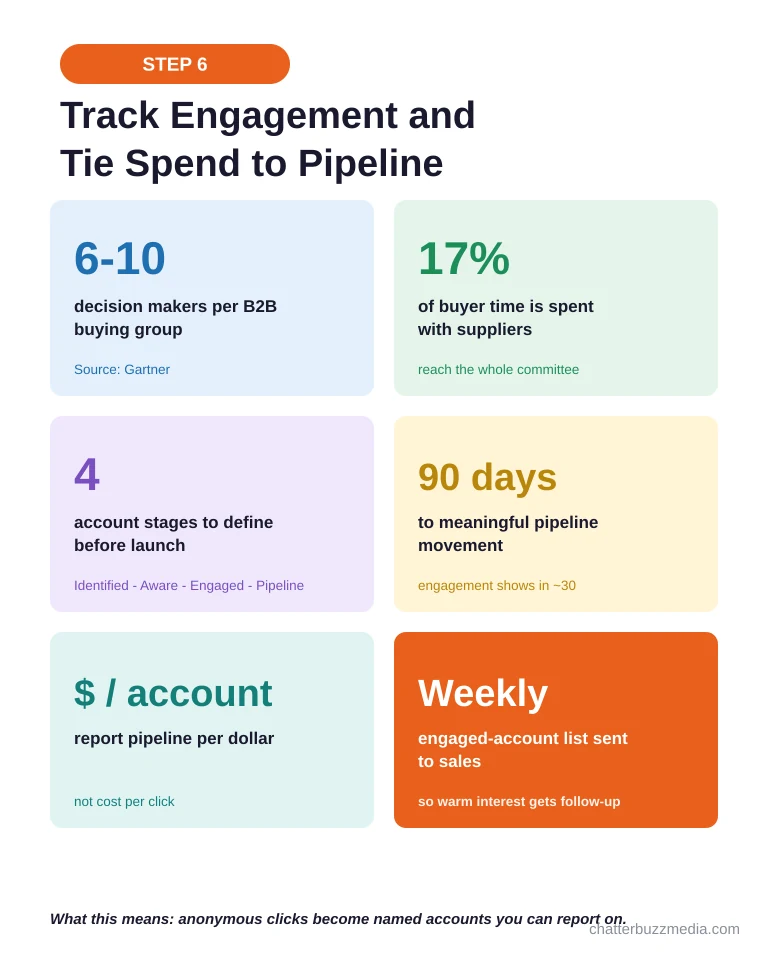
Define account stages before launch: Identified, Aware (enough impressions to register), Engaged (repeat clicks or a high-intent page visit), and In-Pipeline (an active deal). These stages turn scattered ad metrics into a progression you can actually manage.
Instrument the plumbing. Use consistent UTM parameters on every ad, sync ad engagement back to the account property in your CRM, and report by company rather than by campaign so you can see which named accounts advanced.
Track the metrics that prove value: account engagement (counting multiple contacts per company), influenced pipeline, pipeline per dollar, and win rate on targeted accounts. Impressions and blended click-through rate belong in a diagnostic view, not an executive report. Our marketing attribution approach and CRO for paid media help close the loop from impression to revenue.
Report on a lag that matches your sales cycle. If deals take 90 days to close, a 30-day report should show engagement and pipeline movement, not revenue, and setting that expectation early stops anyone from killing a program that is working exactly as designed.
What to watch: send a weekly list of newly engaged accounts to sales so warm interest gets a human follow-up before it cools. ABM advertising creates the opening; the SDR’s role in ABM is to walk through it.
Even a well-tracked program stalls on a few predictable mistakes, so it is worth naming them.
Common ABM Advertising Mistakes to Avoid
Most underperforming ABM advertising fails on a short list of avoidable errors rather than on the strategy itself. Catching these early saves a quarter of wasted spend.
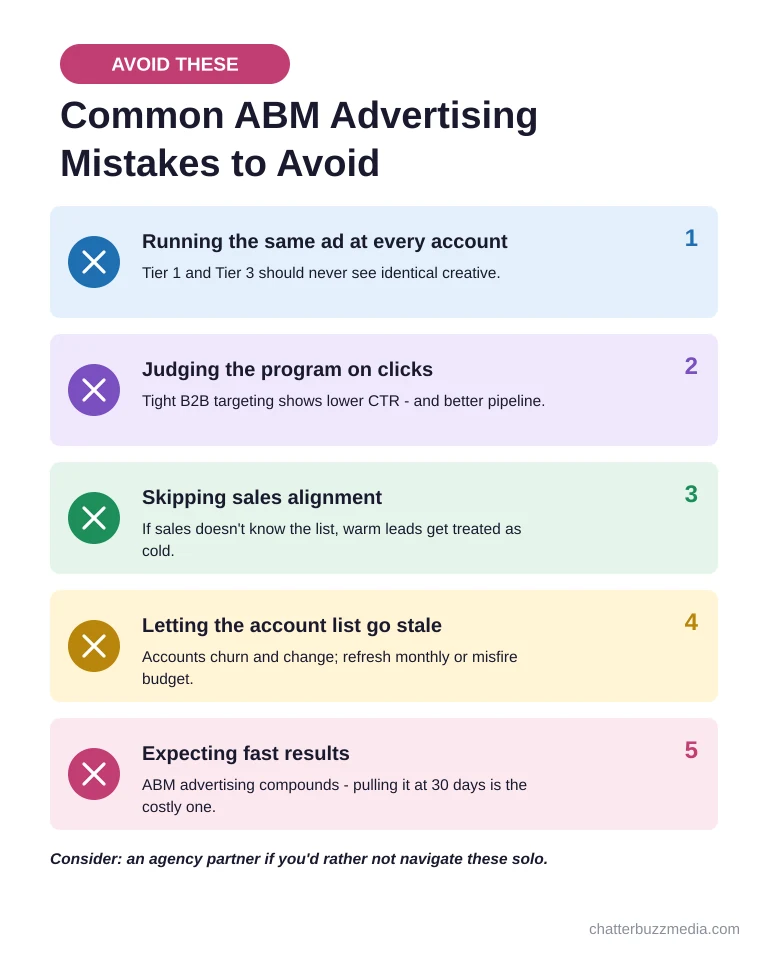
Running the same ad at every account. A Tier 1 enterprise and a Tier 3 fit account should never see identical creative; relevance is the entire advantage of ABM.
Judging it on clicks. Click-through rate on tightly targeted B2B ads often looks worse than broad campaigns, which is fine when the pipeline is better.
Skipping sales alignment. If sales does not know which accounts you are advertising to, warm leads get treated like cold ones and the program’s best moments slip away.
Letting lists go stale. Accounts churn, win, and change; a list you never refresh slowly points your budget at the wrong companies.
Expecting fast results. ABM advertising is a compounding play, and pulling it after a month is the most common and most expensive mistake. If you would rather not navigate these alone, see how to choose an ABM agency.
Frequently Asked Questions
1. 🔍 What is the difference between ABM advertising and account-based marketing?
Account-based marketing is the full program of targeting named accounts across sales and marketing, while ABM advertising is specifically the paid-media layer of that program. Advertising is how you reach the accounts at scale; ABM is the broader strategy that decides which accounts and what happens after the click.
2. 📊 How much budget do you need for ABM advertising?
Below a few thousand dollars a month, focus everything on a single channel such as LinkedIn rather than running multi-channel. A true multi-channel program usually needs a higher monthly commitment sustained over at least three months to reach accounts frequently enough to influence a buying committee.
3. ⚡ Is ABM advertising the same as programmatic advertising?
No. Programmatic is a buying method (automated auctions for display and video), while ABM advertising is a targeting strategy (reaching a named account list). You can run ABM programmatically by loading account lists into a demand-side platform, but you can also run ABM on LinkedIn or Google with no programmatic display at all.
4. 🏦 Can you run ABM advertising on Facebook and Instagram?
Yes, but Meta lacks native B2B firmographic targeting, so you need account-matching tools or customer lists to approximate it. Most programs use Meta as a supporting reach-and-retargeting layer rather than the primary channel for named accounts.
5. 🤝 How many accounts should be on a target list?
It depends on tier and deal size, but most programs run between 100 and 2,000 accounts combined across tiers. Tier 1 is usually 10 to 50 one-to-one accounts, with larger one-to-few and one-to-many tiers beneath it.
6. 💰 How long does it take to see results from ABM advertising?
Expect account engagement signals within about 30 days and meaningful pipeline movement in roughly 60 to 90 days. Because B2B buying committees are large and deliberate, ABM advertising compounds over a quarter rather than spiking in a week.
7. 🚀 What is the best channel for ABM advertising?
LinkedIn is the most reliable starting channel for B2B because of its company and job-title targeting, but the best mix pairs it with Google for intent and programmatic display for low-cost reach. The right channel depends on where your accounts’ buying committees actually spend attention.
8. 📈 How do you measure account engagement in ABM advertising?
Track engagement at the company level by counting signals across every known contact at an account, not per individual. Combine ad clicks, site visits, and high-intent page views into account stages, then sync those stages to your CRM so you can report influenced pipeline by named account.
Conclusion: Your ABM Advertising Action Plan
ABM advertising works when your list is deliberate, your channels do distinct jobs, your budget follows your tiers, and your tracking reports companies instead of clicks. Get those four things right and the paid-media layer stops being a cost center and starts feeding pipeline you can name.
Here is the path from here:
- Build and tier your target-account list and load it into your CRM as a dedicated property.
- Set up account targeting on LinkedIn, Google, and a programmatic platform, then verify match rates before spending.
- Allocate budget by tier, launch Tier 1 first, and build cold and warm campaign layers.
- Define account stages and instrument tracking so every dollar ties back to influenced pipeline from week one.
If you want the strategy that sits above the ads, start with our account-based marketing guide, then browse the full marketing resource library for the channel playbooks referenced throughout this post.

Victoria Wallace
Victoria Wallace is a senior content strategist and marketing writer with 30+ years of experience helping more than 200 brands translate complex business goals into clear, conversion-focused content. Her background spans paid media, marketing strategy, go-to-market planning, brand positioning, and full-funnel campaign development, giving her a deep understanding of how SEO content connects to real business growth.