
 321-236-2899

How to Choose an ABM Agency: Vet Before You Sign
Hiring an ABM agency is one of the highest-stakes vendor decisions a B2B marketing leader makes, because the wrong fit burns a quarter of budget before you see a single sourced opportunity. This guide gives you the exact criteria, proof artifacts, and contract terms to vet an agency on before you sign anything.
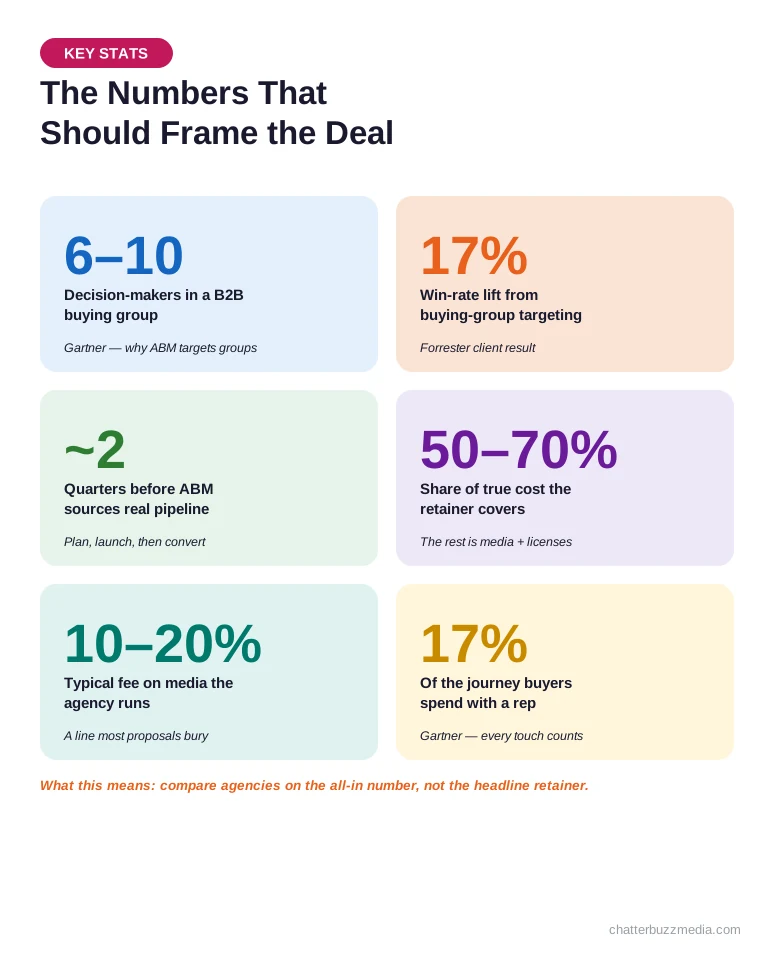
The stakes are real. B2B buying groups now involve six to ten decision-makers, according to Gartner, and buyers spend only about 17% of the journey meeting with any one supplier. Account-based marketing is built to win in exactly that environment, which is why account-based marketing keeps gaining budget share.
The upside is well documented when it is done right. Forrester’s research on demand and ABM ties account- and buying-group strategies to higher win rates, and one client reported a 17% win-rate lift after shifting from lead-based to buying-group targeting. The catch is that those results depend entirely on execution, which is exactly what you are hiring an agency to deliver.
By the end, you will know how to separate agencies that run real revenue plays from those that dress up demand generation and call it ABM. Let’s start with the question most buyers skip.
Key Takeaways
- Decide if you even need an agency first. A platform plus a lean in-house team often beats a retainer for companies with fewer than 50 target accounts.
- Demand proof, not logos. Ask for a case study with named stages, sourced pipeline, and the account list methodology behind it.
- The account list is the whole game. If an agency cannot explain how it builds and tiers your target accounts, nothing downstream matters.
- Sales alignment is non-negotiable. Any agency that does not require your sales team in the engagement is selling you demand gen, not ABM.
- Pricing is bigger than the retainer. Media, platform licenses, and management fees routinely add 40% to 60% on top of the monthly fee.
- Lock down data ownership before you sign. Confirm in writing who keeps the account data, intent signals, and tooling when the engagement ends.
1. Decide Whether You Actually Need an Agency
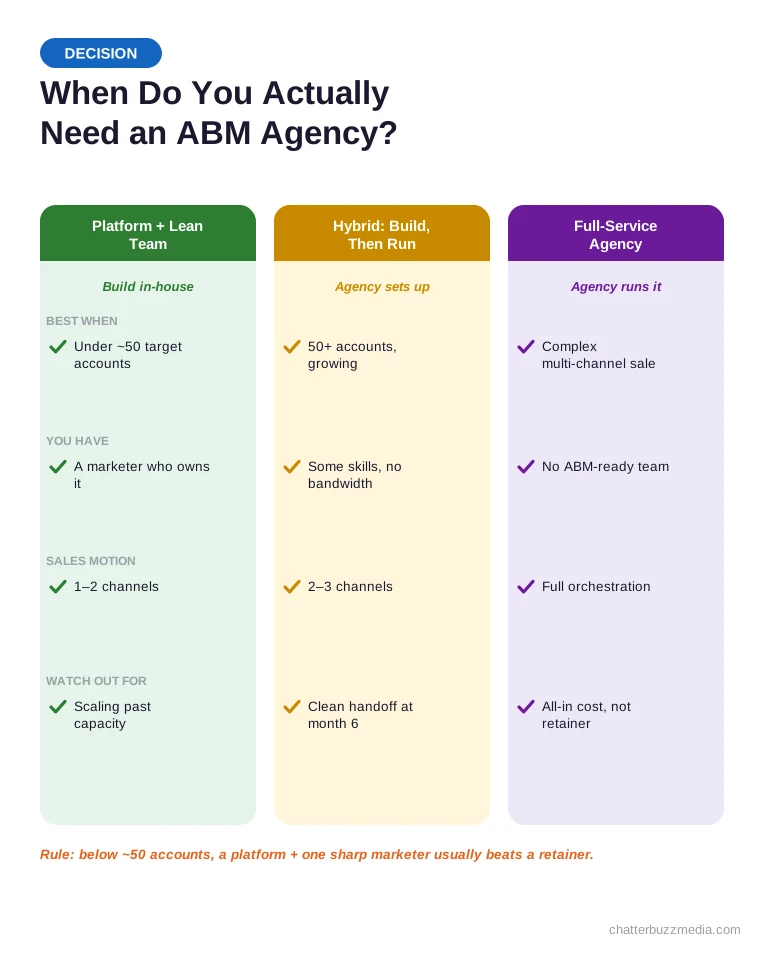
You need an ABM agency when you have more than roughly 50 target accounts, a complex multi-stakeholder sale, and no in-house team that already lives in a CRM and an intent platform. Below that threshold, a self-serve platform and one sharp marketer usually outperform a retainer.
This matters because the biggest ABM failures start before any campaign launches. Companies hire a full-service agency to run a program they could have run leaner, then blame “ABM” when the math never works.
Run the decision this way. Choose a platform plus in-house when your list is small, your motion is one or two channels, and you have someone who can own targeting and reporting.
Choose an agency when you need orchestration across advertising, email, content, and sales outreach at the same time, and you lack the people or the MarTech maturity to coordinate it. Choose a hybrid when you want the agency to build the engine and your team to run it after six months.
Be honest about internal capacity, too. If your team cannot name the tools, people, and hours a program would require, that gap is precisely what a strong B2B marketing partner fills, and it is a legitimate reason to buy rather than build.
If you are still deciding between ABM and broader demand programs, our breakdown of demand generation versus lead generation and the B2B demand generation guide will sharpen the call. Once you know you need a partner, the vetting starts with proof.
2. Demand Proof From Comparable Accounts
The single best predictor of agency fit is a detailed case study from a company that looks like yours in deal size, sales cycle, and buying complexity. A wall of client logos is not proof, and neither is a vague “we drove pipeline growth.”
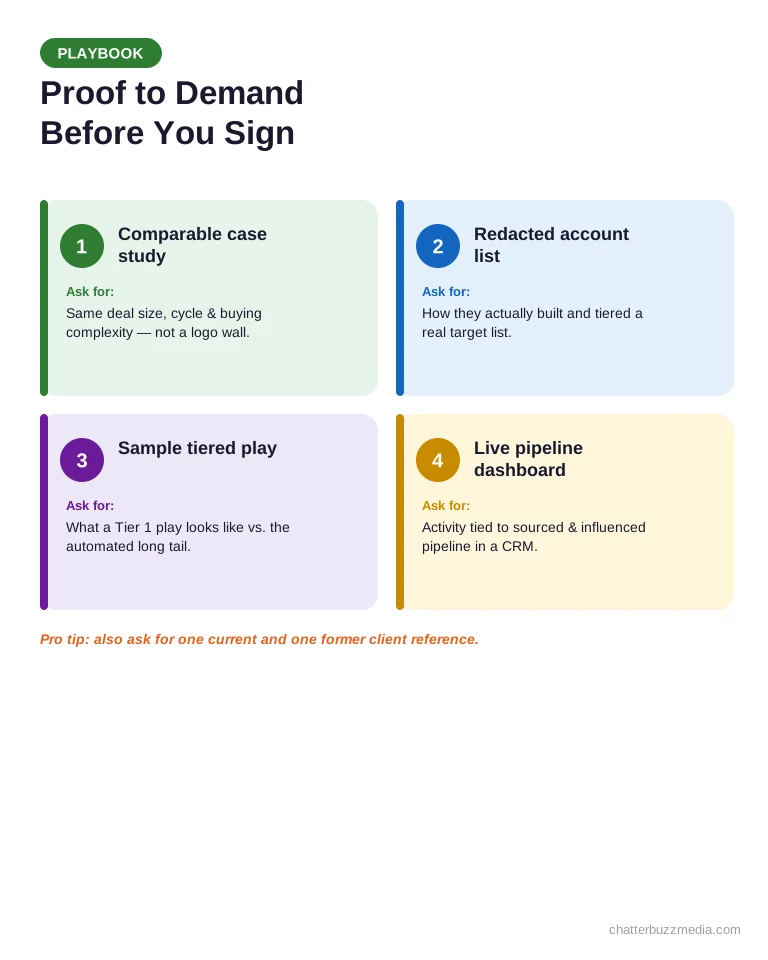
Ask for the artifacts, not the anecdotes. A credible agency can show you a redacted target account list, a sample tiered play, and a reporting dashboard that ties activity to sourced and influenced pipeline.
References matter as much as case studies. Ask to speak with a current client and a former one, because the client who left will tell you how the agency handled a program that underperformed, which is the situation you most need to understand before signing.
Push on the specifics of any result they claim. Get the starting point, the time frame, the number of accounts, and the sales motion, because a “300% pipeline lift” means nothing without the base it grew from.
Industry relevance beats raw prestige. An agency that has run ABM for a 12-month enterprise sale will understand your buying committee far better than one whose wins all came from fast transactional deals, as our look at whether ABM actually works shows with a real example.
If an agency cannot produce this proof under NDA, treat it as a red flag and move on. Proof of past results only matters if they can repeat the process, which is why the account list comes next.
3. Pressure-Test Their Target Account Methodology
Ask an agency exactly how it will build and tier your target account list, and listen for a repeatable process rather than “we’ll work with your sales team.” The account list is the foundation of every ABM program, and a weak one guarantees wasted spend no matter how good the creative is.
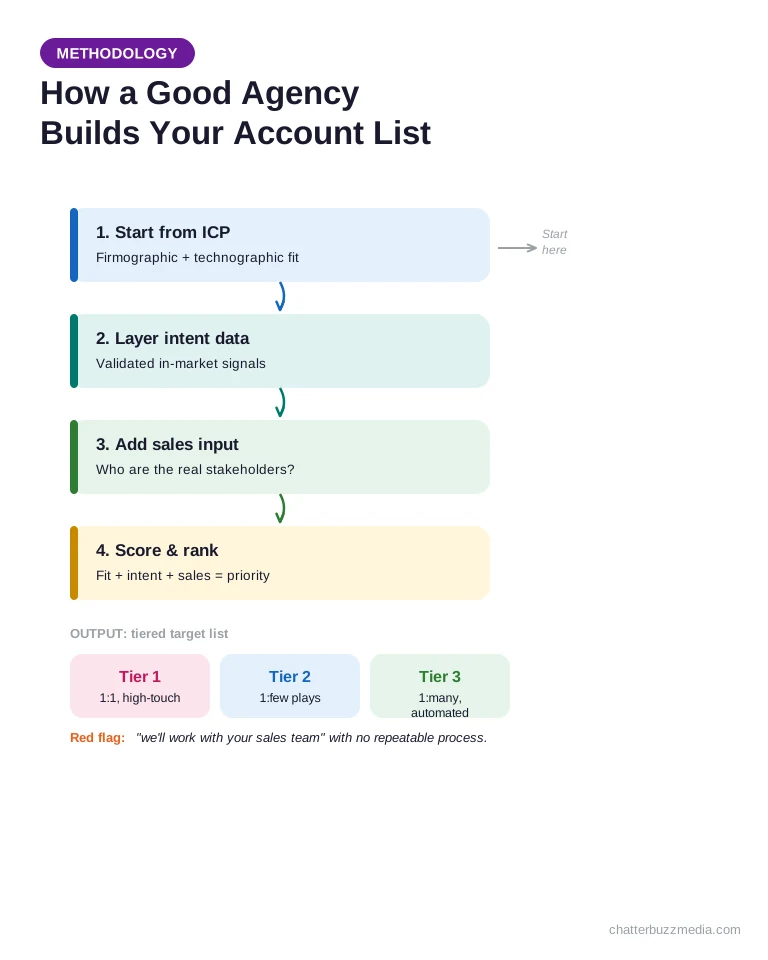
A strong answer starts with your ideal customer profile and layers firmographic fit, intent signals, and sales input to rank accounts into tiers. Each tier should map to a different level of personalization and spend.
Dig into their intent data. Ask which providers they use, how they validate signals, and how they turn an in-market signal into a specific play rather than just another ad impression.
Data hygiene is the quiet part of this question. A good agency will ask about the state of your CRM records and contact data before promising results, because a target list built on stale or incomplete data sends personalized plays to the wrong people.
Watch for agencies that treat every account the same. Real ABM concentrates the most human effort on a small number of tier-one accounts and uses lighter, more automated plays for the long tail, a structure covered in our ABM tactics for high-value clients.
The methodology question exposes thin agencies fast. If they cannot walk you through list-building and tiering in plain language, they will not be able to do it for you either. A great list still fails without sales, which is the next thing to confirm.
4. Confirm Sales and Marketing Alignment Is Built In
An agency running true ABM will require your sales team to be part of the engagement from day one, not treat sales as a downstream recipient of leads. If sales involvement is optional in their model, you are buying demand generation with an ABM label.
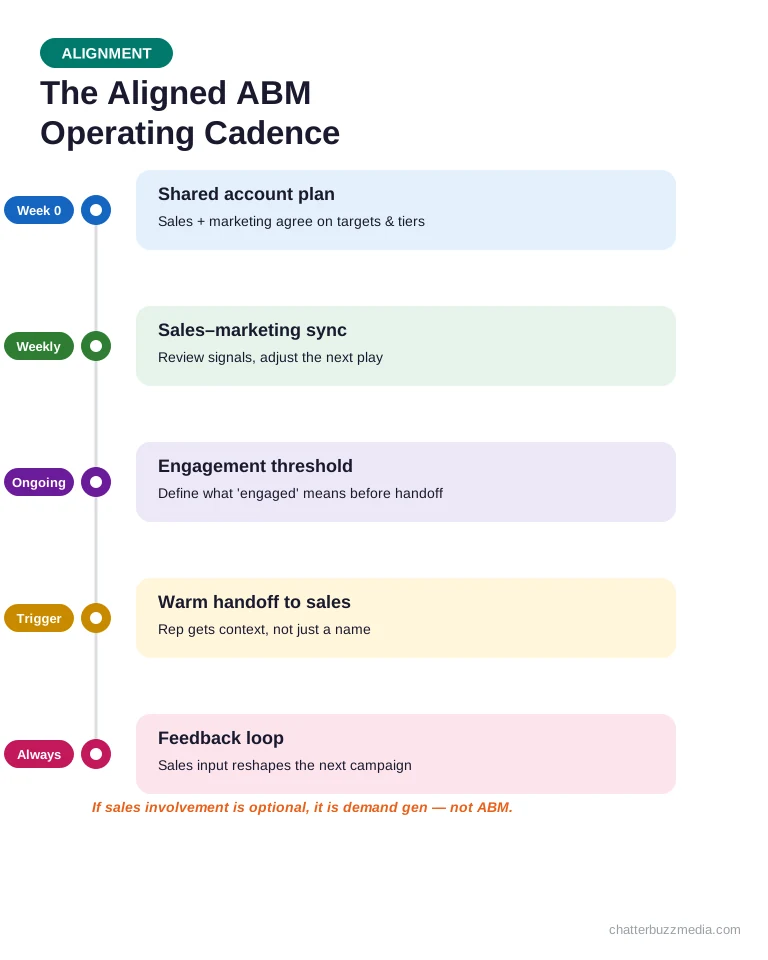
The reason is structural. ABM targets whole buying groups, and only your sellers can tell you who the real stakeholders are, what each one cares about, and when an account is genuinely ready for a conversation.
Ask how they operationalize alignment. Strong agencies run a shared account plan, a regular sales-and-marketing sync, and a clear definition of what “engaged” means before an account is handed to a rep.
Probe the handoff and the feedback loop. You want to hear how sales feedback changes the next play, not just how marketing passes names over the wall, a discipline we unpack in aligning marketing and sales and in the SDR’s role in ABM.
Channel coordination is part of this, too. Ask how the agency sequences advertising, email, and direct outreach so that a prospect sees a coherent story, and whether their LinkedIn approach is integrated with sales outreach rather than running on its own track.
Alignment is where most programs quietly break, so make it an explicit evaluation criterion. With sales committed, the next question is whether the technology can actually support the work.
5. Audit the Tech Stack, CRM Integration, and Data Ownership
Confirm that the agency’s tools integrate cleanly with your CRM and that you, not the agency, own the data and account intelligence the program generates. A disconnected stack produces reporting you cannot trust and a program you cannot continue if you switch partners.
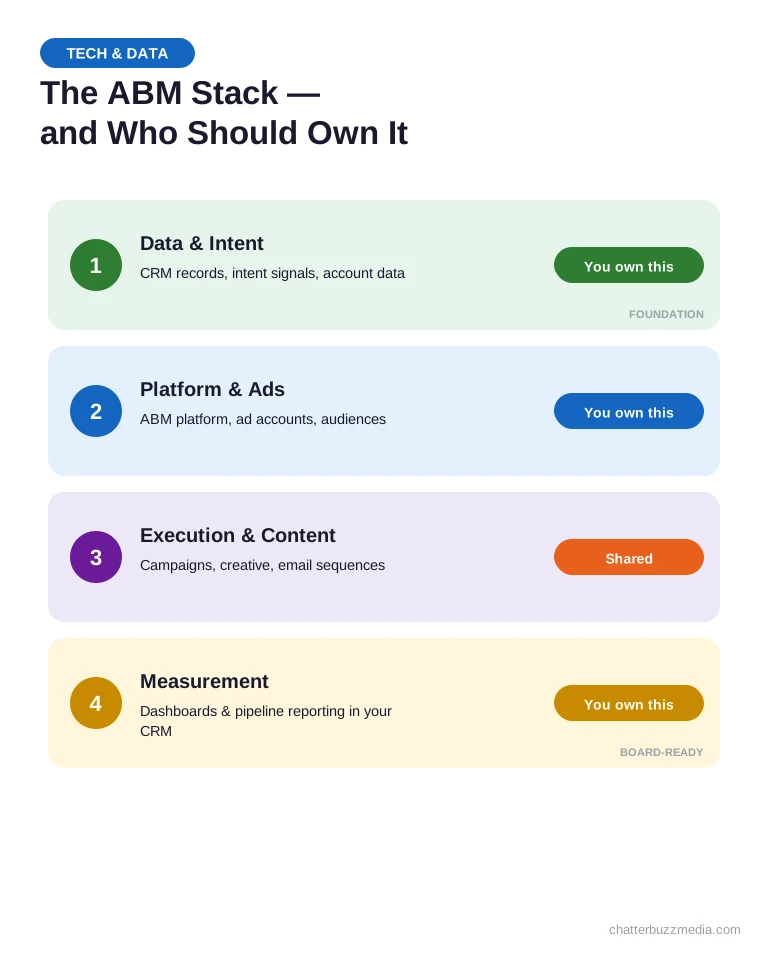
Map the stack across four layers: data and intent, platform and advertising, execution and content, and measurement. Ask what sits in each layer and whether it is consolidated or stitched together from six or more point tools.
Integration with your CRM is the make-or-break detail. If the agency cannot sync engagement and pipeline data into the system your sales team already uses, your revenue reporting will never reconcile, so a clean HubSpot implementation or equivalent matters more than any single ABM platform.
Then settle ownership in writing. Confirm who keeps the target account lists, the intent data, and the dashboards when the contract ends, because agency-owned tooling can strand your entire program the day you leave.
Marketing automation sits at the center of this, so confirm the agency can work inside your existing platform rather than forcing a migration. Our marketing automation guide is a useful reference for what that integration should look like in practice.
A clean, integrated, client-owned stack is a sign of a mature partner, and the opposite is a warning. Once the stack checks out, make sure it is pointed at the right numbers.
6. Insist on Pipeline-Grade Measurement
A serious ABM agency reports on account engagement, sourced pipeline, influenced pipeline, and revenue, not on impressions, clicks, and MQLs. Activity metrics are how weak agencies hide the absence of business results.
Ask to see a live reporting dashboard before you sign. You want to confirm the agency can tie its work to opportunities and closed revenue inside your CRM, not in a spreadsheet they control.
Agree on the metrics that matter up front. Account engagement shows momentum, sourced and influenced pipeline show contribution, and deal velocity and win rate show whether ABM is changing outcomes rather than just activity.
Set the measurement cadence too. Monthly reviews should connect program activity to pipeline movement, and quarterly reviews should reset the account list and the plays based on what the data showed.
Measurement should also reach past the first touch into conversion. The best agencies tie their reporting to what happens on your site and in your funnel, so ask how their work connects to conversion rate optimization rather than ending at the click.
If an agency leads with vanity metrics in the pitch, assume that is what you will get in the reports. Clear measurement also makes the final hard question easier to answer: what are you really paying?
7. Decode the Pricing and Hunt the Hidden Costs
The monthly retainer is usually only 50% to 70% of what an ABM program actually costs, because media spend, platform licenses, and management fees sit on top of it. Get the all-in number before you compare agencies, or you will compare the wrong thing.
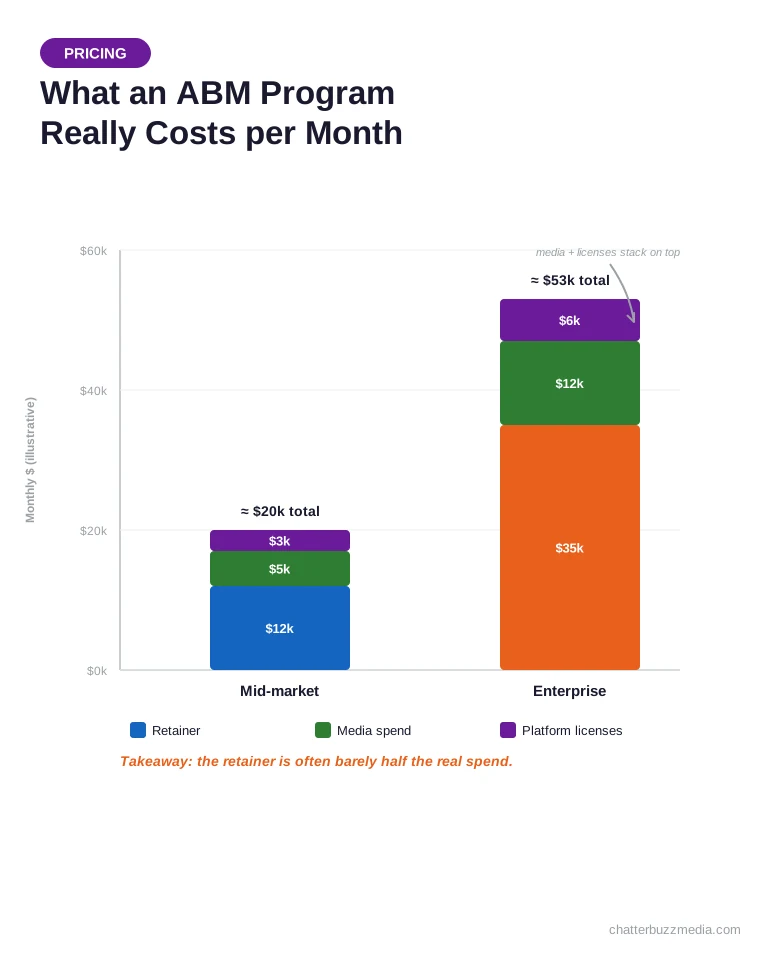
Retainers vary widely by scope. Mid-market programs commonly run in the five figures per month, while enterprise orchestration across many accounts and channels costs several times that.
Then add the layers most proposals bury. Media spend is a separate line, platform licenses can add a meaningful monthly cost, and many agencies charge a management fee of 10% to 20% of the media they run.
Ask how pricing scales and what triggers a change. You want to know what happens when you add accounts, enter a new region, or expand channels, so there are no surprise mid-contract increases.
Compare scope, not just the sticker price. A specialized account-based marketing engagement and a broad digital marketing services retainer solve different problems, and lining up two proposals that cover different work is how buyers end up overpaying for the wrong thing.
The goal is not the cheapest agency but the clearest one, and transparency here predicts transparency everywhere else. The last filter is the fastest: the red flags that should end a conversation.
8. Spot the Red Flags Before You Sign
Certain agency behaviors reliably predict a failed engagement, and recognizing them early saves you a wasted quarter. Treat any one of these as a reason to slow down and dig deeper before signing.
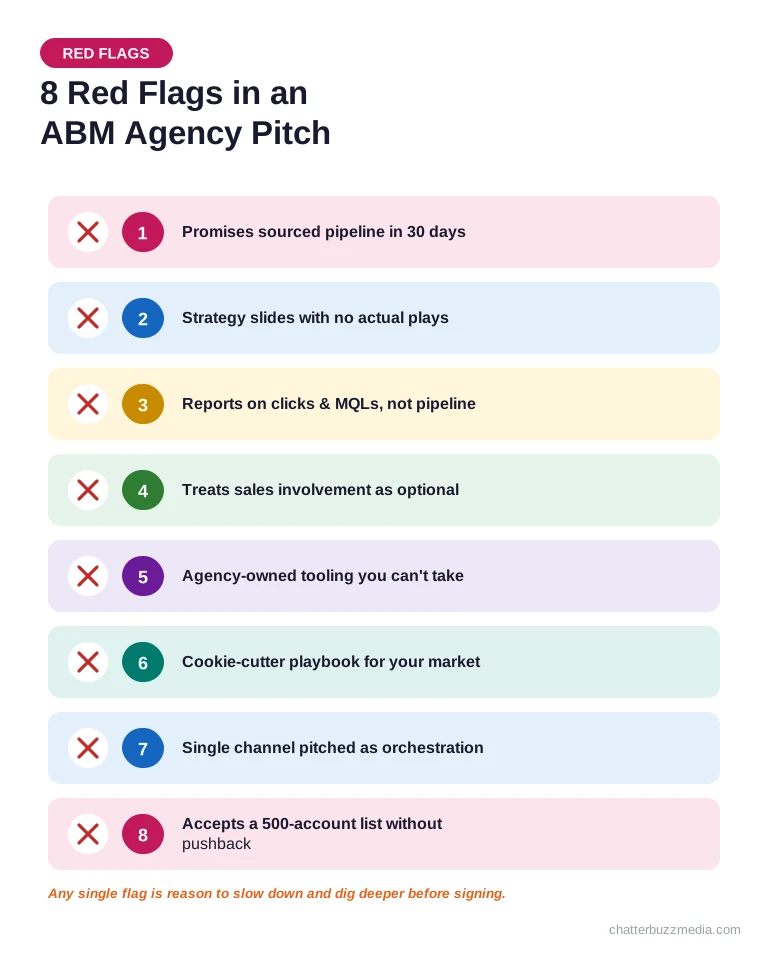
The most common red flag is an agency that promises pipeline in 30 days. Real ABM takes about one quarter to instrument and launch and a second quarter to convert engagement into meetings, so a fast-pipeline promise signals either inexperience or a demand-gen play in disguise.
Watch for strategy with no plays, reporting built on activity metrics, and a model where sales involvement is optional. Each one means the agency is selling a concept rather than an operating engine.
Be equally wary of agency-owned tooling you cannot take with you, cookie-cutter playbooks that ignore your market, and a single-channel pitch dressed up as orchestration. These choices protect the agency, not your program, a theme we cover in picking the right marketing agency and what a marketing agency actually does.
One subtler red flag is an agency that accepts your target list without challenge. A partner who will take 500 accounts at face value and promise to personalize to all of them is either overselling capacity or planning to automate everything, and neither produces the concentrated effort that makes ABM work.
None of these red flags is subtle once you know to look for them. With the filters in hand, here is how to run the evaluation and reach a decision.
Frequently Asked Questions
1. 🔍 How much does an ABM agency cost per month?
Mid-market ABM retainers commonly run in the five figures per month, and enterprise programs run several times higher. Remember that the retainer is usually only 50% to 70% of the real total once you add media spend, platform licenses, and a 10% to 20% media management fee.
2. 📊 What questions should I ask an ABM agency before signing?
Ask for a comparable case study with sourced pipeline, how they build and tier your account list, which intent data they use, and how they require sales involvement. Then confirm all-in pricing, CRM integration, measurement, and who owns the data and tooling when the engagement ends.
3. ⚡ How long before an ABM program shows results?
Plan on roughly one quarter to instrument and launch the program and a second quarter to convert account engagement into meetings and pipeline. Any agency promising sourced pipeline in 30 days is either inexperienced or selling demand generation labeled as ABM.
4. 🏦 Do I need an ABM agency or an ABM platform?
Choose a platform plus a lean in-house team when you have a small account list and the skills to run targeting and reporting yourself. Choose an agency when you need coordinated orchestration across channels and sales and lack the people or MarTech maturity to run it internally.
5. 🤝 Who owns the data and tooling when the engagement ends?
You should, and it needs to be in the contract. Confirm in writing that your target account lists, intent data, and reporting dashboards stay with you, because agency-owned tooling can strand your program the moment you switch partners.
6. 💰 Is in-house ABM cheaper than hiring an agency?
In-house can be cheaper at a small scale, but it carries hiring, tooling, and ramp costs that are easy to underestimate. An agency is usually faster to results when you lack ABM-experienced staff, which is why many teams start with an agency and bring the program in-house later.
7. 🚀 What should an ABM agency report on every month?
Monthly reporting should cover account engagement, sourced pipeline, influenced pipeline, and movement toward revenue, tied directly to your CRM. Clicks, impressions, and raw MQL counts belong in the appendix, not the headline.
The Bottom Line: Vet the Process, Not the Pitch
The best ABM agency is not the one with the slickest deck but the one that can show you a repeatable process for building account lists, aligning sales, integrating your stack, and reporting on revenue. Every criterion in this guide points back to that one idea: vet the operating engine, not the promise.
Here is how to run the evaluation and decide:
- Qualify the need. Confirm your account count, sales complexity, and in-house gaps justify an agency over a platform-plus-team model.
- Shortlist on proof. Keep only agencies that can show a comparable case study, a real account list methodology, and sales alignment built into the model.
- Run a scored evaluation. Compare finalists on proof, methodology, tech and data ownership, measurement, and all-in pricing, and weight the first three highest.
- Pilot before you commit. Start with a scoped engagement that includes a clear 90-day plan and exit terms so you can judge the work before a long contract.
When you are ready to pressure-test an agency against these criteria, start from a clear foundation with our complete account-based marketing guide and the wider marketing resource library. Together they lay out the strategy an agency should be executing, so you can tell the difference between a partner who runs real ABM and one who just sells the name.

Victoria Wallace
Victoria Wallace is a senior content strategist and marketing writer with 30+ years of experience helping more than 200 brands translate complex business goals into clear, conversion-focused content. Her background spans paid media, marketing strategy, go-to-market planning, brand positioning, and full-funnel campaign development, giving her a deep understanding of how SEO content connects to real business growth.