
 321-236-2899
Programmatic Advertising: What It Is & When to Use It
Programmatic advertising now accounts for the vast majority of digital display spending, yet most guides explain it as if every reader has an enterprise budget and a media-buying team. That gap leaves mid-market marketers with a fundamental question unanswered: does this actually make sense for a company spending $20,000 to $50,000 a month?
This guide breaks down what programmatic advertising is, how the real-time auction works, and the platforms and deal types behind it. More importantly, it gives you an honest framework for deciding when programmatic earns its place in your budget and when Google and Meta will serve you better.
By the end, you will know the specific spend thresholds and conditions that separate a smart programmatic investment from an expensive learning experience. Let’s start with the fundamentals.
Key Takeaways
- Programmatic advertising is the automated, real-time buying and selling of digital ad space using software, data, and algorithms instead of manual negotiations.
- The ecosystem runs on four core technologies — DSPs for advertisers, SSPs for publishers, ad exchanges that host the auction, and DMPs that supply audience data.
- Programmatic reaches beyond banner ads into connected TV, digital out-of-home, audio, native, and video that Google and Meta cannot access on their own.
- Mid-market brands usually need a stable $15,000 to $20,000 per month in programmatic spend for the algorithms and data costs to pay off.
- Programmatic complements Google and Meta rather than replacing them — it wins on reach, premium inventory, and channels the walled gardens don’t own.
What Is Programmatic Advertising?
Programmatic advertising is the automated buying and selling of digital ad space in real time, using software and data to place each impression in front of a specific person. Instead of a salesperson negotiating a fixed placement, algorithms decide which ad to show, to whom, and at what price in the milliseconds it takes a webpage to load.
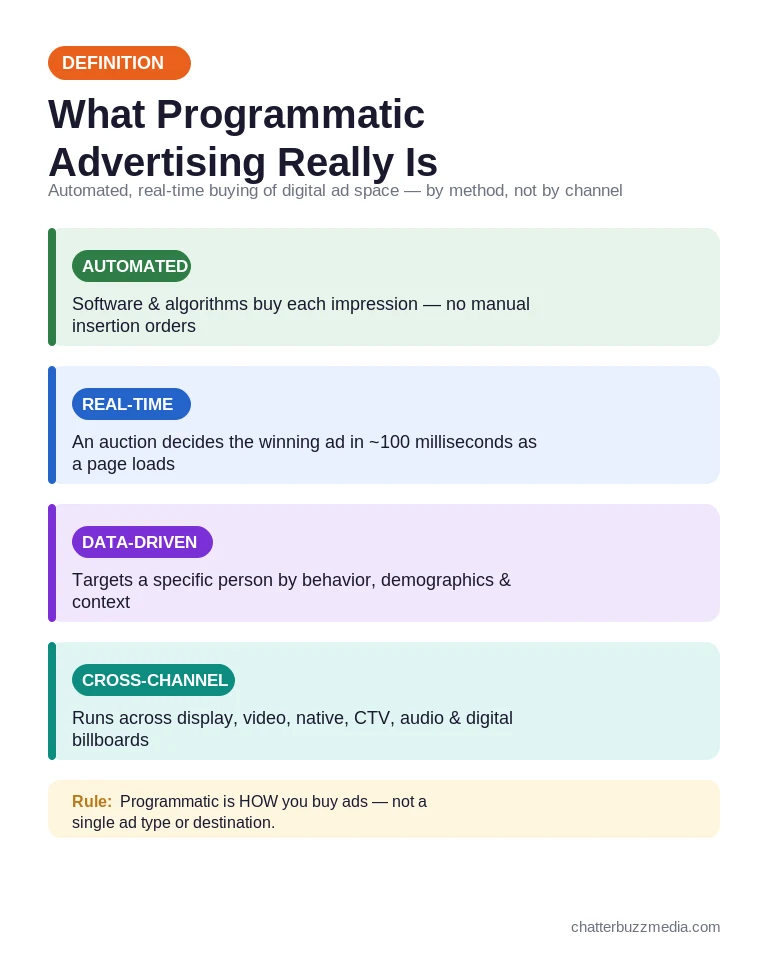
That automation is the entire point. It replaces insertion orders, phone calls, and manual trafficking with a data-driven system that evaluates every available impression individually.
The distinction matters because “programmatic” is often confused with the channels it delivers. It is not a type of ad — it is the method of buying ads across display, video, audio, and more.
Here is how programmatic differs from the paid channels you likely already run:
- Versus traditional media buying: No manual negotiation or fixed insertion orders — inventory is bought impression by impression through automated auctions.
- Versus PPC (Google Search): Search ads target keyword intent; programmatic targets people based on behavior, demographics, and context across millions of sites and apps.
- Versus social ads (Meta, LinkedIn): Those are “walled gardens” that only sell their own inventory. Programmatic reaches the open internet — news sites, streaming services, apps, and billboards.
Put simply, programmatic is the plumbing beneath modern digital advertising. When you run a display campaign on The Trade Desk, retarget site visitors across the web, or place an ad inside a streaming app, you are almost always buying programmatically — whether or not anyone uses the word.
If you are weighing this against search specifically, our breakdown of SEO versus PPC and how Google Ads actually works pairs well with this guide. Understanding that programmatic is a buying method, not a destination, is the foundation for everything that follows.
Next, let’s look at why so much of the industry’s ad spend has moved this way.
Why Programmatic Advertising Is Growing So Fast
Programmatic advertising is growing fast because it delivers precision, scale, and measurable efficiency that manual buying cannot match. It now represents the way most digital display inventory changes hands, and the numbers behind that shift are hard to ignore.
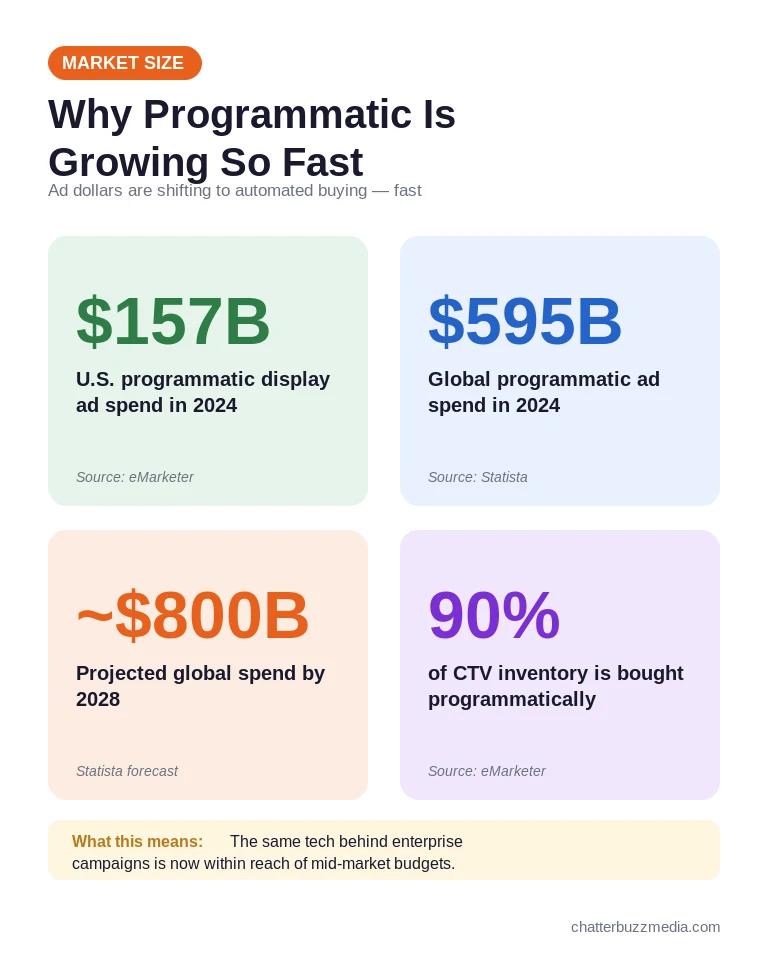
According to eMarketer, U.S. programmatic digital display ad spend reached roughly $157 billion in 2024, up from under $5 billion a decade earlier. Globally, Statista estimates programmatic ad spend hit around $595 billion in 2024 and is on track to approach $800 billion by 2028.
That growth is driven by concrete advantages over legacy media buying. Here is what pulls budgets toward programmatic:
- Precision targeting: Reach people by demographics, interests, behavior, location, and context instead of buying a whole placement and hoping.
- Efficiency and scale: Manage thousands of placements across channels from one platform, with no manual insertion orders.
- Real-time optimization: Adjust targeting, budget, and creative while campaigns run, rather than waiting for an end-of-flight report.
- Transparency: See where ads ran, who saw them, and what each impression cost.
- Cross-channel reach: Extend into connected TV, audio, and digital out-of-home that traditional buys and walled gardens can’t unify.
The channel breadth is a big part of the story. Connected TV alone is one of the fastest-growing formats, and eMarketer reports the overwhelming majority of CTV inventory is now transacted programmatically.
For a mid-market brand, the relevance is simple: the same automated, data-driven buying that powers enterprise campaigns is now accessible at far smaller budgets than a decade ago. The question is no longer whether you can access programmatic, but whether it fits your stage and goals.
Those benefits are real, but they only translate to results when the mechanics underneath are working. Let’s open the hood on the auction itself.
How Programmatic Advertising Works
Programmatic advertising works through a real-time auction that completes in roughly 100 milliseconds — faster than a webpage finishes loading. Every time someone opens a site with ad space, an instant auction determines which advertiser’s ad they see.
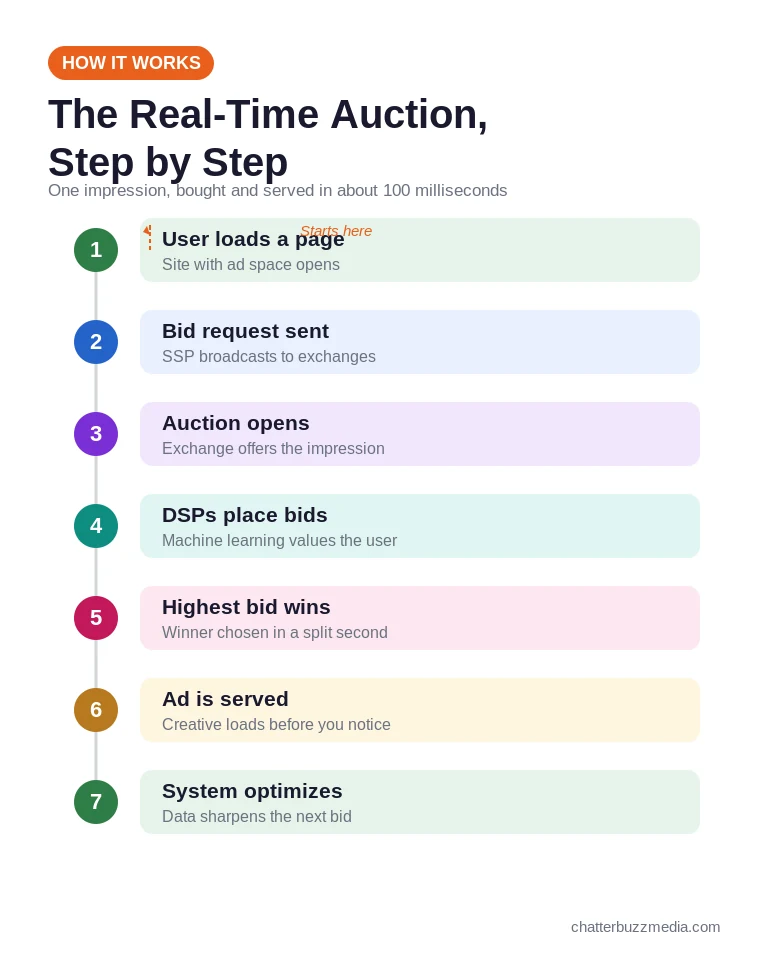
The process feels complex, but it follows a predictable sequence. Understanding it helps you see exactly where your budget goes and why targeting decisions matter.
Here is the step-by-step flow of a single programmatic impression:
- 1. A user loads a page. Someone visits a website or opens an app that has ad inventory available to sell.
- 2. The publisher sends a bid request. The site’s supply-side platform (SSP) packages anonymized data about the user and the placement, then broadcasts it to ad exchanges.
- 3. The auction opens. The ad exchange presents the impression to demand-side platforms (DSPs) representing advertisers.
- 4. DSPs evaluate and bid. Each advertiser’s DSP uses machine learning to judge how valuable that specific user is against campaign goals, then places a bid.
- 5. The highest bidder wins. The exchange selects the winning bid in a fraction of a second.
- 6. The ad is served. The winning creative loads on the page before the user notices anything.
- 7. The system optimizes. Performance data feeds back into the DSP to sharpen future bids automatically.
The critical takeaway is that no human touches any individual transaction. Your team sets the strategy — audience, budget, goals, guardrails — and the machines execute it billions of times.
This is also why programmatic rewards clean data and clear objectives. Vague targeting produces vague bidding, which wastes spend.
The DSP’s bid decision draws on a stack of signals in that split second: who the user appears to be, what page they’re on, the device and time, and how well all of it matches your campaign goals. The better your audience definitions and conversion tracking, the smarter those bids become over time.
It’s worth noting how much this depends on data signals. As third-party cookies fade and privacy rules tighten, first-party data and contextual targeting are becoming the fuel that makes this auction accurate, according to the Interactive Advertising Bureau.
To manage all of this, you need to know the platforms doing the work.
The Programmatic Ad Tech Ecosystem
The programmatic ecosystem runs on four connected technologies that move an ad from advertiser to audience: DSPs, SSPs, ad exchanges, and DMPs. Advertisers work primarily inside a DSP, while the other three make the marketplace function.
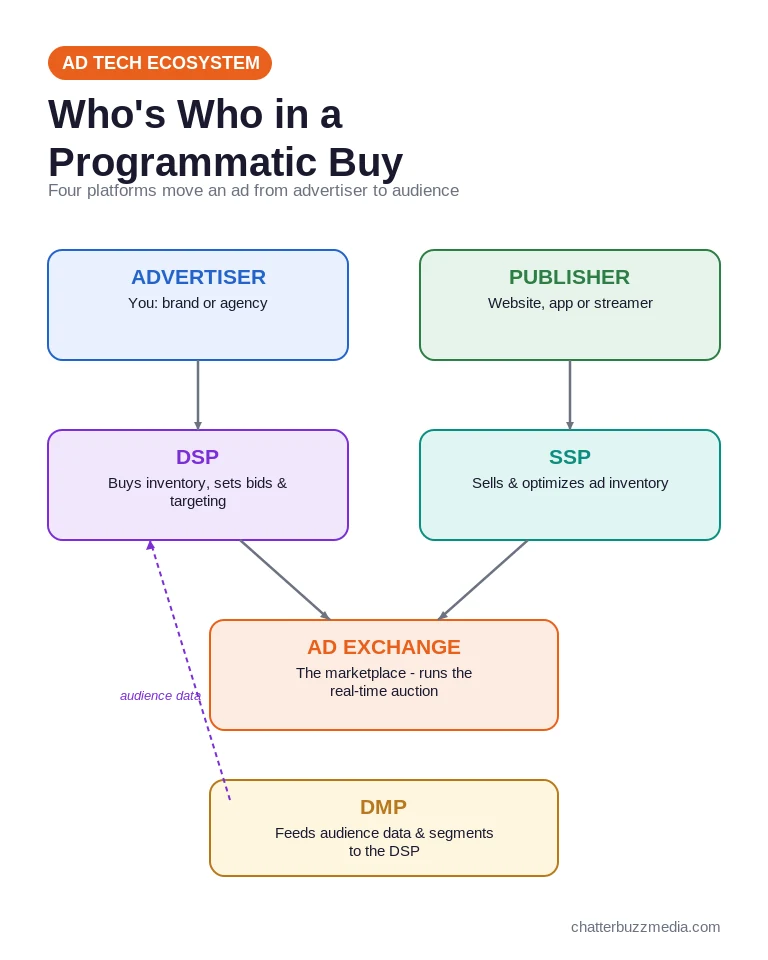
Knowing these pieces isn’t academic. When an agency or platform pitches you, this vocabulary tells you what you’re actually paying for and where fees stack up.
Think of it like a supply chain: the DSP is your buyer, the SSP is the seller’s agent, the exchange is the trading floor, and the DMP is the market research feeding every decision. Once you can name each layer, evaluating a partner’s transparency and pricing gets far easier.
The four core platforms each play a distinct role:
- Demand-Side Platform (DSP): The advertiser’s cockpit. You use a DSP — such as The Trade Desk, DV360, or StackAdapt — to set targeting, budgets, and bids, then buy inventory across the open web.
- Supply-Side Platform (SSP): The publisher’s counterpart. It helps websites and apps package and sell their ad inventory to the highest bidder.
- Ad Exchange: The marketplace itself. It connects DSPs and SSPs and runs the real-time auction, functioning like a stock exchange for ad impressions.
- Data Management Platform (DMP): The audience engine. It collects and organizes first- and third-party data into segments the DSP uses to decide who’s worth bidding on.
The relationship is straightforward once you map it: advertisers bid through DSPs, publishers sell through SSPs, exchanges match them, and DMPs supply the audience intelligence. Each layer typically takes a cut, which is why total media cost and “working” media cost can differ meaningfully.
This fee stacking is also why “walled gardens” like Google and Meta feel simpler — they bundle these layers inside one platform. The open programmatic ecosystem trades that simplicity for far broader reach and control.
For mid-market brands, those economics are a real consideration — we’ll return to them when we talk budgets. First, let’s cover the different ways you can actually buy inventory.
Types of Programmatic Deals
There are four main types of programmatic deals, and they trade off between reach, price, and control. Choosing the right one depends on whether you prioritize scale and efficiency or premium placement and brand safety.
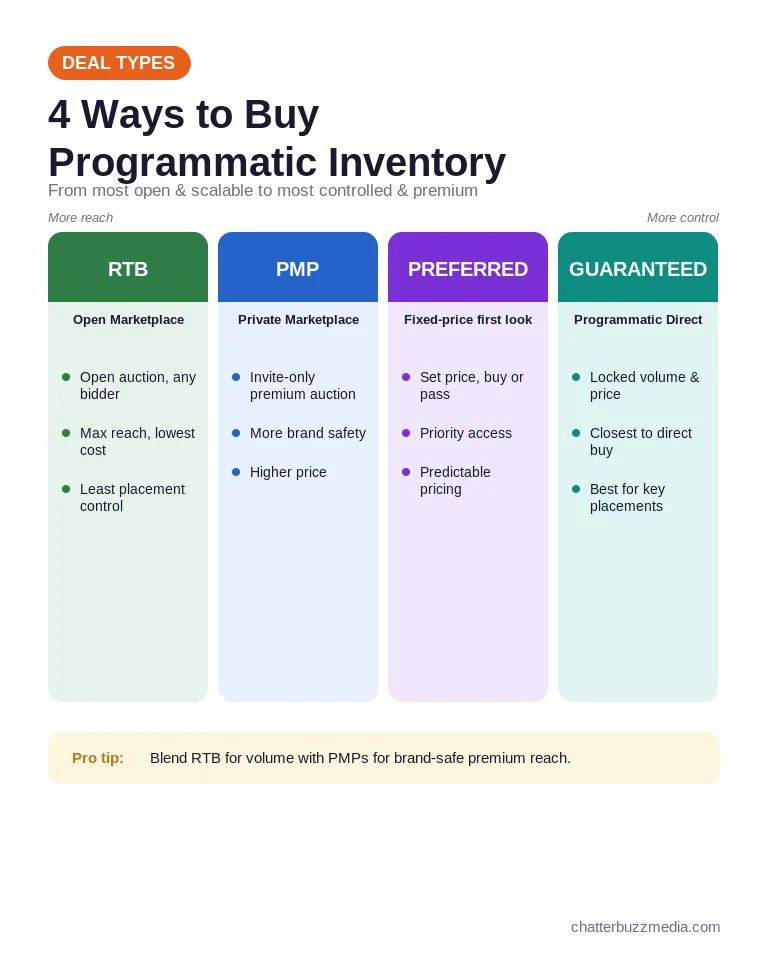
Most mid-market campaigns start in the open marketplace and graduate to private deals as they mature. Knowing all four keeps you from overpaying for exclusivity you don’t need — or settling for low-quality inventory you should avoid.
Here are the four deal types, from most open to most controlled:
- Real-Time Bidding (RTB) / Open Marketplace: Open auctions where any advertiser can bid. Maximum reach and lowest entry cost, but the least control over exactly where ads appear.
- Private Marketplace (PMP): Invite-only auctions where select advertisers bid on a publisher’s premium inventory. More transparency and brand safety than the open market, at a higher price.
- Preferred Deals: A fixed price negotiated with a publisher, giving you first look at inventory before it hits the PMP or open market — buy it or pass.
- Programmatic Guaranteed: The closest thing to a traditional direct buy. You lock in a guaranteed volume of impressions at a set price, executed through programmatic pipes.
The pattern is simple: the more control and premium access you want, the more you pay and the less scale you get. Open RTB is the efficient workhorse; guaranteed deals are for high-stakes placements you can’t leave to an auction.
A smart mid-market approach often blends them — RTB for prospecting volume, PMPs for brand-safe premium environments. If you want a primer on the mechanics, our older overview of what programmatic buying is covers the basics from the publisher side. Now let’s look at where those impressions actually run.
Programmatic Channels and Formats
Programmatic buying spans far more than website banners — it powers display, native, video, connected TV, digital out-of-home, and audio. This channel breadth is programmatic’s single biggest advantage over the walled gardens.
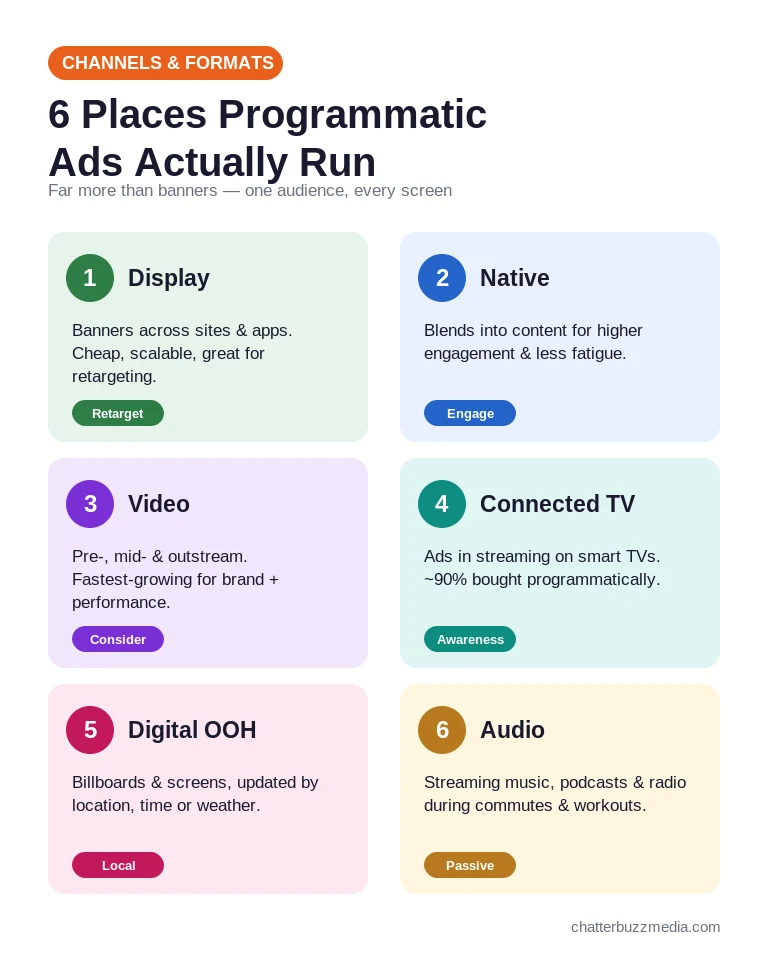
These are the same channels driving the growth in overall programmatic spend, with video and connected TV pulling budgets fastest. Matching a channel to your goal is where strategy starts to matter.
The major programmatic channels and formats include:
- Display: The classic banner across websites and apps. Cheap, scalable, and ideal for retargeting and awareness.
- Native: Ads that match the look of surrounding content, delivering higher engagement and less banner fatigue. Our guide to native advertising and content marketing goes deeper here.
- Video: Pre-roll, mid-roll, and outstream placements — one of the fastest-growing formats for both brand and performance goals.
- Connected TV (CTV): Ads inside streaming services on smart TVs, bringing digital targeting to the living-room screen. The large majority of CTV inventory is transacted programmatically.
- Digital Out-of-Home (DOOH): Programmatic billboards and screens in high-traffic places, updatable by location, time, or even weather. It pairs naturally with geofencing advertising for location-based targeting.
- Audio: Ads across streaming music, podcasts, and digital radio, reaching people during commutes and workouts.
Choosing among them comes down to funnel stage and goal. Display and native are workhorses for retargeting and efficient awareness; video and CTV build brand and drive consideration; DOOH and audio add real-world and passive-moment touchpoints that reinforce the rest.
The strategic lesson is that programmatic lets you follow one audience across screens — a display ad, then a CTV spot, then an audio message — from a single platform. That cross-channel reach is genuinely hard to replicate through Google and Meta alone.
But breadth is only valuable if the budget behind it is large enough to matter. That brings us to the comparison every mid-market marketer actually needs.
Programmatic vs. Google and Meta: Where It Actually Fits
For most mid-market companies, programmatic complements Google and Meta rather than replacing them — and it should usually be the third channel you add, not the first. Google captures intent, Meta captures attention, and programmatic extends reach into premium inventory and channels neither platform owns.
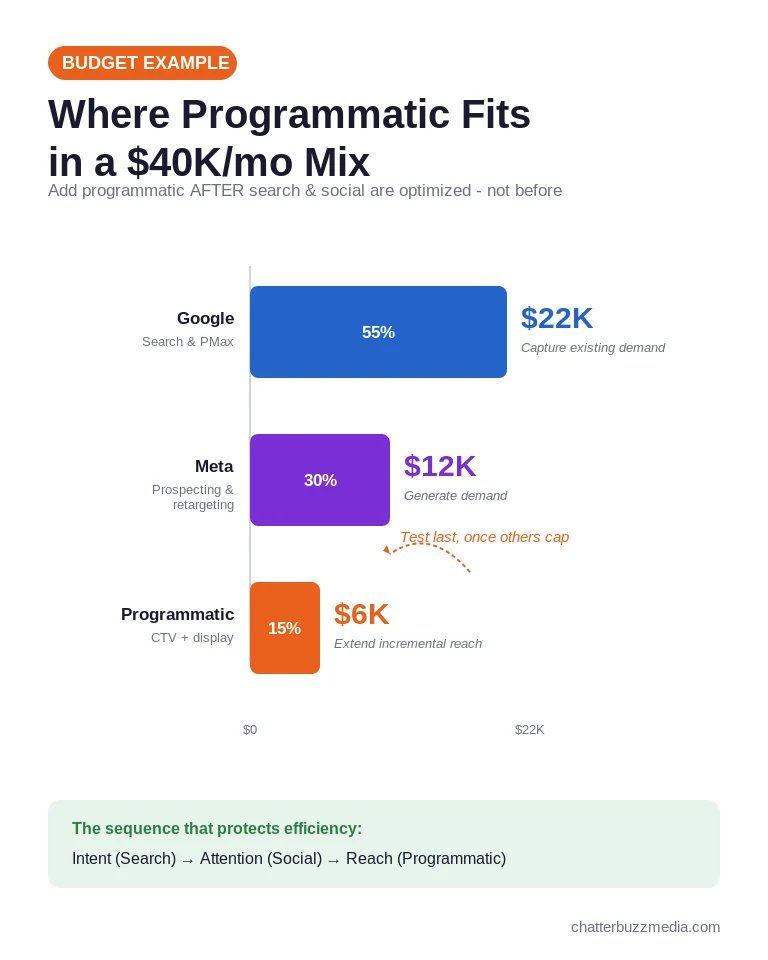
This is where a lot of enterprise-focused advice steers smaller advertisers wrong. Shifting budget into programmatic before your search and social are maxed out almost always dilutes results.
Here’s an honest breakdown of where each channel earns its keep:
- Google Search: Best for capturing existing demand. When someone searches “commercial HVAC repair,” search intent is unbeatable — start here.
- Meta and Instagram: Best for demand generation and creative-led prospecting to precise interest and lookalike audiences at efficient cost.
- Programmatic: Best for scaling reach beyond those platforms — premium news sites, CTV, DOOH, and B2B environments — plus advanced retargeting across the open web.
The realistic sequencing for a mid-market brand looks like this: max out high-intent search first, build a working prospecting engine on social media advertising second, then layer in programmatic once you’ve saturated those channels and still need incremental reach. Programmatic shines brightest for brands with longer sales cycles, considered purchases, or audiences that live on premium content and streaming rather than social feeds.
Here’s a concrete example. A $40,000-per-month brand might run $22,000 in Google Search and Performance Max to capture demand, $12,000 in Meta prospecting and retargeting, and reserve the remaining $6,000 to test programmatic CTV and premium display once the first two channels are clearly capped.
That sequencing protects your efficiency. It ensures you’re only paying programmatic’s fee premium for reach you genuinely can’t buy more cheaply elsewhere.
It’s also the right tool when your goal is genuine omnichannel presence — being visible on the news site, the podcast, and the smart TV, not just the search results page. A sharp ideal customer profile is what makes that cross-channel targeting precise rather than wasteful.
The question isn’t whether programmatic is powerful; it’s whether your budget and goals are ready for it.
When Mid-Market Companies Should (and Shouldn’t) Use Programmatic
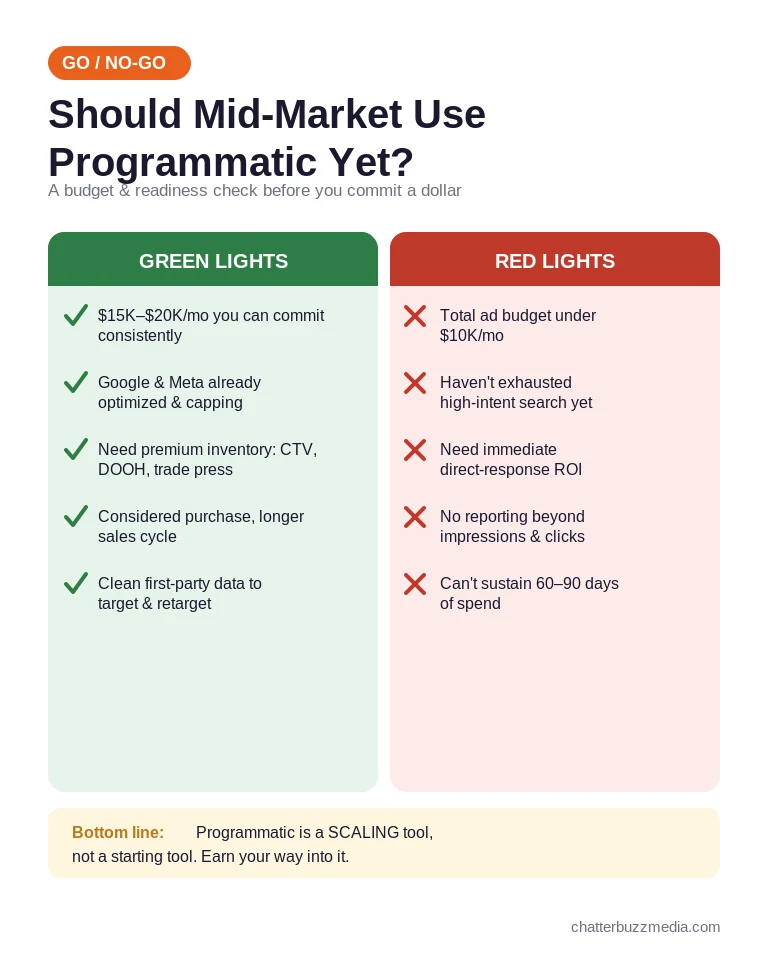
Mid-market companies should use programmatic when they have a stable monthly budget of roughly $15,000 to $20,000 to commit to it, a clear reach or awareness goal, and existing search and social channels already optimized. Below that threshold, the fees and data costs usually eat too much of your working media for the algorithms to learn effectively.
That number surprises people, so it’s worth explaining. A meaningful share of programmatic spend goes to the tech stack — DSP fees, data fees, exchange fees, and often an agency management fee — before a single impression is served.
On a small budget, that overhead is fatal. If $4,000 of a $10,000 spend disappears into fees and data before you buy media, the algorithm never sees enough conversions to optimize, and your cost per acquisition stays stubbornly high. At $20,000 a month, that same overhead is a smaller share, leaving enough working media for the system to actually learn.
Green lights — programmatic is likely a smart move when:
- You can commit at least $15,000 to $20,000 per month consistently, not as a one-time test.
- Your Google and Meta campaigns are already well-optimized and hitting diminishing returns on reach.
- You need premium or specific inventory — CTV, DOOH, industry publications — that walled gardens can’t provide.
- You sell a considered purchase with a longer sales cycle that benefits from sustained, multi-touch presence.
- You have clean first-party data (a CRM list, site visitors) to power targeting and retargeting.
Red lights — hold off on programmatic when:
- Your total monthly ad budget is under $10,000 — concentrate it on search and social where every dollar works harder.
- You haven’t exhausted high-intent search yet; that demand is cheaper to capture than to create.
- You need immediate, direct-response ROI on a tight timeline — programmatic often takes weeks to optimize.
- You lack the reporting infrastructure to see past vanity metrics like impressions and clicks.
The honest bottom line: programmatic is a scaling tool, not a starting tool. When you’ve built demand capture and generation and need to expand reach with data-driven precision, it becomes one of the most powerful levers available — especially for B2B brands targeting narrow, high-value audiences across the open web.
Deciding how much to commit is really a question of overall how much to invest in marketing. If you can check the green-light boxes, the final step is knowing how to launch without wasting your first few months.
How to Launch Your First Programmatic Campaign
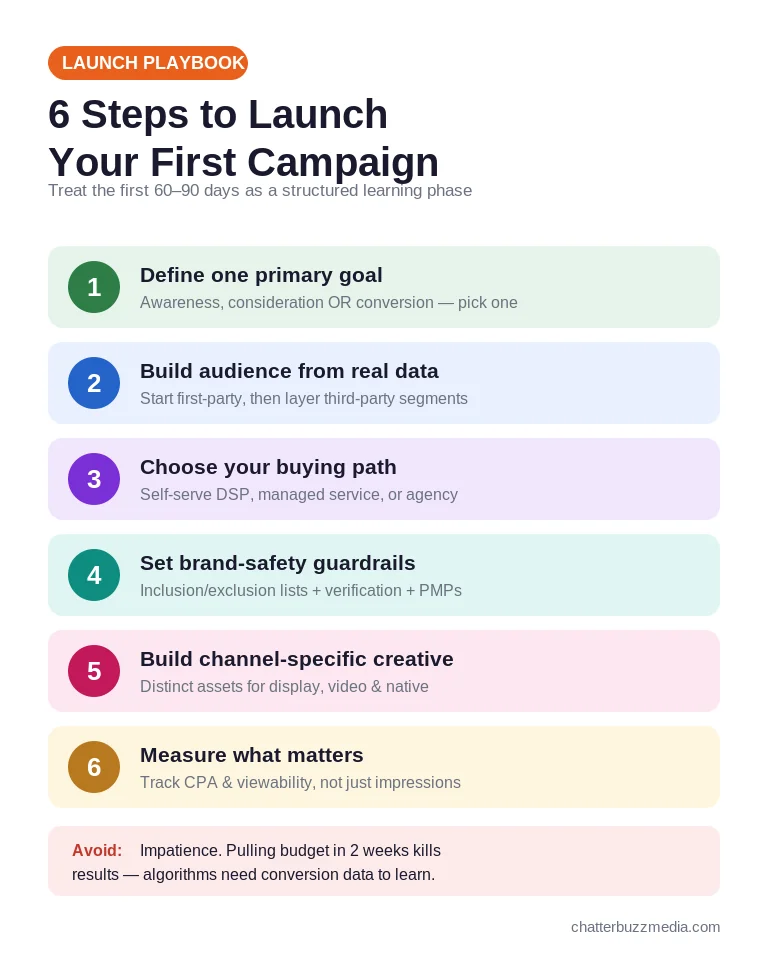
Launching a programmatic campaign starts with a clear goal and clean audience data, then moves through platform selection, creative, and disciplined optimization. The brands that succeed treat the first 60 to 90 days as a structured learning phase, not a set-and-forget buy.
You’ll also need to actively manage two risks the walled gardens largely handle for you: ad fraud and brand safety. Building those guardrails in from day one protects your budget.
Whether you run it in-house or with a partner, the fundamentals are the same — and skipping them is where most first campaigns stumble. A structured launch beats a fast one.
Follow this sequence to get started:
- 1. Define one primary goal. Awareness, consideration, or conversion — pick one so the algorithm optimizes toward a single, measurable outcome.
- 2. Build your audience from real data. Start with first-party segments (customer lists, site visitors) before layering in third-party audiences to avoid casting too wide a net.
- 3. Choose your buying path. Decide whether to self-serve on a DSP, work through a managed-service partner, or use an agency — each carries different fees and required expertise.
- 4. Set brand-safety guardrails. Use inclusion and exclusion lists, verification tools, and PMPs to keep ads in trustworthy environments and away from fraudulent inventory.
- 5. Develop channel-specific creative. Design distinct assets for display, video, and native rather than forcing one size everywhere.
- 6. Launch, then measure what matters. Track conversions, cost per acquisition, and viewability — not just impressions and clicks — and give the campaign time to optimize before judging it.
The single most common mistake is impatience. Programmatic algorithms need a learning window and sufficient conversion volume before performance stabilizes, so pulling budget after two weeks guarantees disappointment.
The second most common mistake is ignoring measurement infrastructure. If you can’t unify data across channels into a clear view of cost per outcome, you can’t optimize — and strong reporting and data visualization is what turns raw spend into decisions.
It also helps to fix conversion leaks before you scale spend. Driving more traffic to pages that don’t convert simply wastes programmatic’s reach, which is why conversion rate optimization should run in parallel, not after.
Get those two things right, and programmatic becomes a durable growth channel rather than a gamble.
Frequently Asked Questions About Programmatic Advertising
1. 🔍 What is the difference between programmatic and PPC?
PPC usually refers to search ads bought by keyword intent, like Google Search. Programmatic buys ad space across display, video, audio, and CTV based on audience data and behavior rather than keywords, so it targets who a person is instead of only what they searched.
2. 📊 How much does programmatic advertising cost?
Programmatic display CPMs typically run from a few dollars to $10 or more, but the bigger cost consideration is the tech and management fees layered on top of media. For mid-market brands, a realistic minimum monthly commitment is around $15,000 to $20,000 for the channel to perform.
3. ⚡ Is Google Ads considered programmatic?
Partly. The Google Display Network and Display & Video 360 operate programmatically through real-time bidding, but Google’s flagship Search ads use a separate keyword auction. So Google runs both programmatic and non-programmatic products.
4. 🏦 Is programmatic advertising worth it for small or mid-sized businesses?
It can be, but only after search and social are optimized and you can commit a stable monthly budget. Below roughly $10,000 a month in total ad spend, most businesses see better returns concentrating on Google and Meta than spreading into programmatic.
5. 🤝 What are DSPs and SSPs?
A demand-side platform (DSP) is the software advertisers use to buy programmatic inventory and set targeting and bids. A supply-side platform (SSP) is what publishers use to sell their ad space — the two connect through an ad exchange that runs the auction.
6. 💰 How is programmatic different from social media advertising?
Social platforms like Meta and LinkedIn are walled gardens that only sell inventory inside their own apps. Programmatic reaches the open internet — news sites, streaming services, apps, and billboards — giving you audiences those platforms can’t deliver on their own.
7. 🚀 How long does it take programmatic advertising to work?
Most campaigns need a 60-to-90-day learning phase before performance stabilizes, since algorithms require conversion data to optimize bidding. Pulling budget in the first couple of weeks is the fastest way to undermine results.
8. 📈 What is real-time bidding (RTB)?
RTB is the automated auction that decides which ad shows on a page in about 100 milliseconds. When a user loads a site, advertisers’ DSPs bid on that impression, and the highest bidder’s ad is served before the page finishes loading.
Conclusion: Making Programmatic Work for Your Budget
Programmatic advertising is one of the most powerful tools in digital marketing — automated, data-driven, and capable of reaching audiences across every screen they use. But power without the right budget and sequencing is just expensive complexity.
The honest takeaway for mid-market brands is that programmatic is a scaling channel. It rewards companies that have already built demand capture and generation, have clean data, and can commit meaningful, sustained spend.
Used at the wrong stage, it drains budget into fees and unmeasured reach. Used at the right one, it unlocks premium inventory and precision that search and social simply cannot reach on their own.
Here’s your four-step action plan to decide if it’s right for you:
- 1. Audit your current channels. Confirm your Google Search and Meta campaigns are optimized and hitting diminishing returns before adding programmatic.
- 2. Pressure-test your budget. Make sure you can commit at least $15,000 to $20,000 per month consistently — not as a one-time experiment.
- 3. Define a reach or awareness goal. Identify the premium inventory or channels (CTV, DOOH, industry sites) that justify the investment.
- 4. Build your measurement foundation. Put reporting in place to track cost per outcome across channels before you spend a dollar.
If you’re weighing whether programmatic fits your broader mix, start by getting the fundamentals of your paid strategy right. A clear-eyed look at your paid media management alongside a structured free digital marketing audit will tell you exactly where programmatic belongs — and when it’s worth the investment. For the bigger picture, our performance marketing guide and broader marketing resource library map how every paid channel fits together.

Victoria Wallace
Victoria Wallace is a senior content strategist and marketing writer with 30+ years of experience helping more than 200 brands translate complex business goals into clear, conversion-focused content. Her background spans paid media, marketing strategy, go-to-market planning, brand positioning, and full-funnel campaign development, giving her a deep understanding of how SEO content connects to real business growth.