
 321-236-2899
Marketing Attribution Services That Connect Ad Spend to Closed Revenue
A marketing attribution agency that optimizes your campaigns on closed revenue, not leads — because we manage the media and the CRM. Multi-touch attribution, offline conversion import, and closed-loop reporting that connects every ad dollar to the deal it actually produced.
What Is Marketing Attribution?
Marketing attribution is the process of identifying which campaigns, channels, and touchpoints produced the leads that became paying customers — tracing the full journey from first ad impression to closed deal, not just the last click. Marketing attribution services do that work for you: the tracking, the CRM configuration, and the revenue attribution model. Chatter Buzz Media, a performance marketing agency headquartered in Orlando, builds closed-loop attribution by managing both the ad platforms and the CRM, so campaigns are optimized on revenue rather than cost per lead.
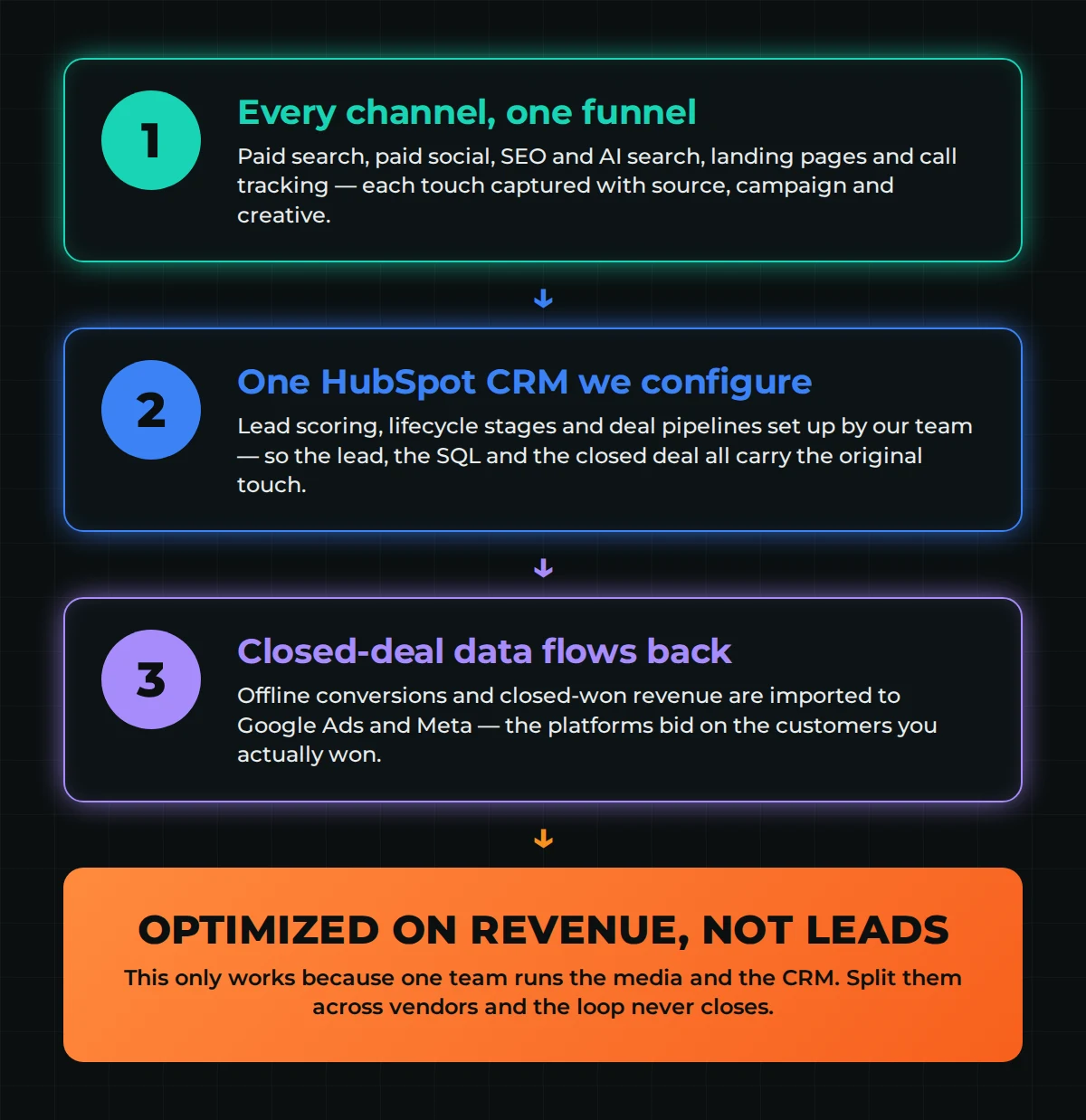
In practice that means paid search, paid social, SEO and AEO, and landing pages feed a HubSpot CRM we configure — with lead scoring, lifecycle stages, and deal pipelines — and closed-deal data flows back to Google and Meta as offline conversions. Everything surfaces in one reporting layer your CFO can read. It is the measurement backbone behind every integrated marketing package and fractional CMO engagement we run.
The $25,000 Question No Other Agency Can Answer
Which campaign produced your last closed deal? Not which one generated a lead — which one produced revenue?
Most mid-market companies cannot answer this. The agency optimizes to cost-per-lead. The CRM is a mess. Sales says the leads are garbage. Marketing says the leads are fine. And nobody can prove which channel actually produced revenue. That gap is where marketing budgets go to die — it is the first thing a digital marketing audit exposes, and the reason B2B marketing attribution is now a leadership question, not a reporting one.
We close that loop. We manage the campaigns and the CRM, so we can track every dollar from ad impression to closed deal — and optimize on the metric that actually matters: revenue. See how that played out for Khameleon Software, where rebuilding measurement around bottom-of-funnel intent lifted sales-qualified leads 250%.
From Ad Click to Closed Deal. Every Step Tracked.
Most agencies report up to step 2. We report through step 6. That is the difference between knowing your cost-per-lead and knowing your cost-per-customer.
Ad Impression
Google, Meta, LinkedIn, TikTok, programmatic — tracked by platform and campaign
Click & Landing Page Visit
UTM attribution, session tracking, page-level conversion events
Lead Capture
Form fill, phone call (CallRail), chat — source and campaign attributed
MQL — Marketing Qualified Lead
HubSpot lead scoring, lifecycle stage automation, sales handoff triggered
SQL — Sales Qualified Lead
Sales accepts the lead, enters pipeline — deal stage tracked in HubSpot
Closed Deal — Revenue Attributed
Deal closed in CRM. Revenue attributed back to the original campaign, channel, and ad creative.
How We Close the Loop
Three integrated capabilities most marketing attribution agencies in our size class cannot deliver — because they do not manage the CRM. They are the foundation of closed-loop marketing, and the same data our fractional CMOs plan against.
Multi-Touch Attribution
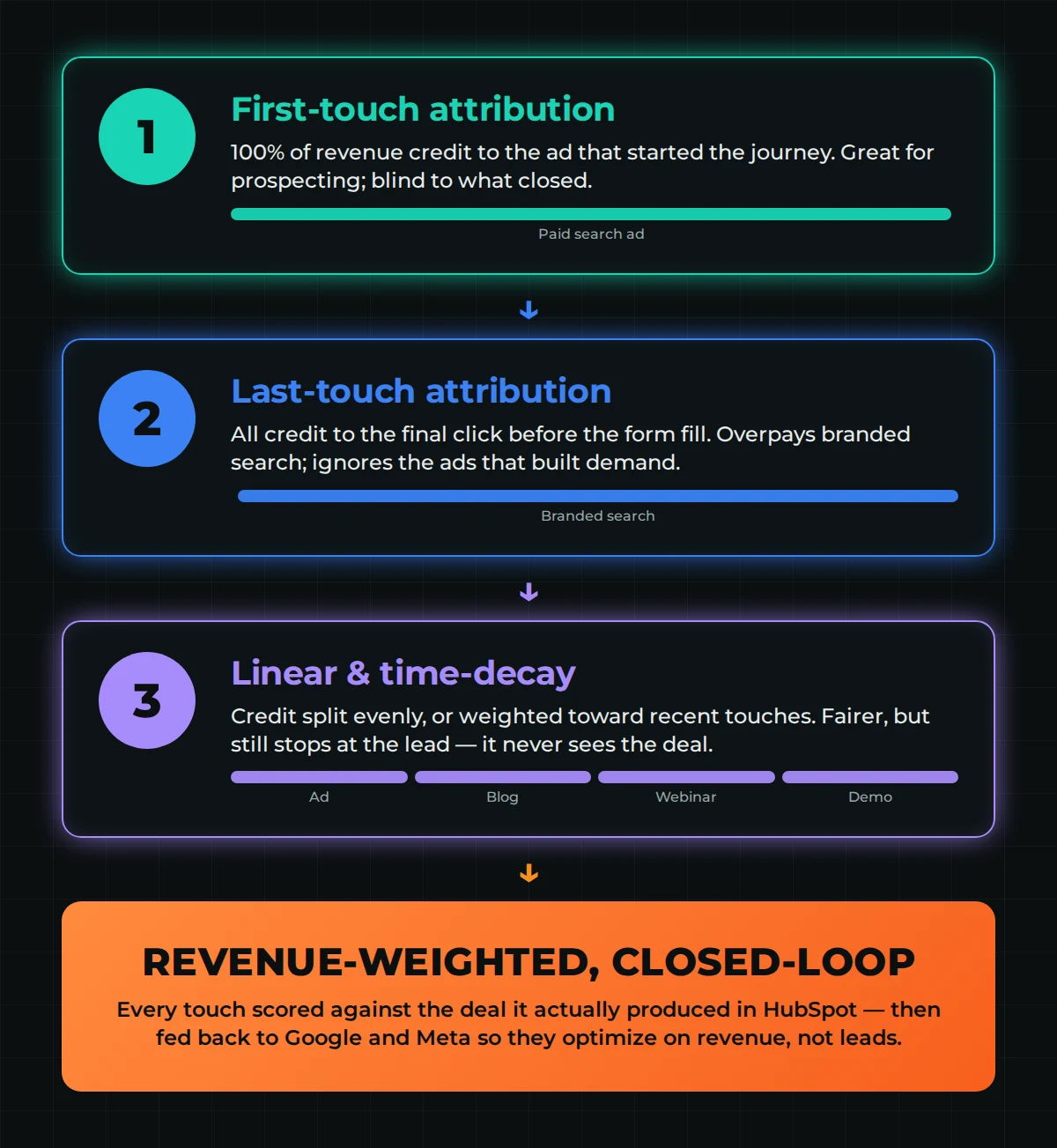
We track every touchpoint a lead interacts with before converting — first touch, last touch, and every assist in between. You see the full path from awareness to deal, not just the last click that gets credit.
Offline Conversion Import
Phone calls, in-person meetings, trade show leads, and sales team outreach are imported into the attribution model. Offline interactions that drive deals are captured and connected to the campaigns that generated them.
Closed-Loop Reporting
Ad platform data flows into HubSpot. CRM deal data flows back to the ad platforms. Google and Meta optimize on actual revenue signals — not form fills — because we feed closed-deal data back into their algorithms. It is the closed-loop reporting layer a serious paid media strategy is built on, and what a Google Ads audit usually finds missing.
This Only Works Because We Run Both Sides
Most agencies run your ads but do not touch your CRM. Most CRM consultants set up HubSpot but do not run campaigns. That separation is exactly why attribution breaks.
At Chatter Buzz, we manage the paid media, the SEO, the landing pages, the CRM, the lead scoring, the lifecycle stages, and the reporting — under one roof. When we optimize a Google Ads campaign, we are not optimizing on leads. We are optimizing on which leads became customers and how much revenue they produced.
That is not a reporting feature. That is a fundamentally different way of running performance marketing.
Built on HubSpot. Backed by Diamond Partnership.
As a HubSpot Diamond Partner, we do not just use HubSpot — we build the attribution infrastructure inside it. Lead scoring, lifecycle stage automation, deal pipeline configuration, offline conversion import, and closed-loop reporting are all built and managed by our team. See our HubSpot onboarding and implementation services.
- Diamond PartnerHubSpot
- Premier PartnerGoogle
- Business PartnerMeta
- PartnerCallRail
What We Build in HubSpot
Lead scoring models, lifecycle stage automation, deal pipeline stages, marketing-to-sales handoff workflows, source attribution properties, campaign ROI dashboards, and offline conversion import pipelines.
What We Feed Back to Ad Platforms
Closed-deal revenue data imported back into Google Ads and Meta as offline conversions — so their algorithms optimize on revenue signals, not just form submissions. This is how cost-per-customer drops while lead quality rises.
What You Can Finally Answer
With closed-loop revenue attribution in place, these are the questions your leadership team can answer for the first time — across the 15 industries we serve.
Which campaign produced revenue?
Not which one generated leads — which one produced deals that closed and how much revenue they contributed.
What is our true cost-per-customer?
Not cost-per-lead. The actual cost to acquire a paying customer, by channel, campaign, and ad creative.
Where do leads fall off?
See exactly where leads drop between MQL, SQL, and closed deal — and fix the gap that is costing you revenue.
Is sales right about lead quality?
Data replaces opinions. You see lead-to-close rates by source, so the marketing-vs-sales argument is settled by numbers.
Which channels should get more budget?
Allocate budget based on revenue production, not lead volume. The channel with the cheapest leads is rarely the one producing the most revenue.
What is marketing’s ROI?
A single number your board can understand: dollars spent on marketing vs. dollars of revenue marketing produced.
Attribution Terms, Defined
Multi-Touch Attribution
A method that assigns credit to every marketing touchpoint a buyer interacts with before purchasing — first touch, last touch, and each assist between — instead of crediting a single click.
Closed-Loop Reporting
Connecting ad platforms to the CRM so that when a deal closes, its revenue is attributed back to the originating campaign, producing a true marketing ROI rather than a cost per lead.
Offline Conversion Import
Sending CRM outcomes such as a closed deal or qualified opportunity back to Google Ads and Meta as conversion events, so their bidding algorithms optimize toward buyers rather than form fills.
Cost per Customer (CAC)
Total marketing and sales spend divided by the number of new paying customers acquired — the downstream metric closed-loop attribution makes measurable by channel and campaign.
Powered by ChatterBuzz IQ
All attribution data flows into ChatterBuzz IQ — our proprietary marketing attribution dashboard that unifies 20+ data sources, layers in competitive intelligence, and gives your team full access to the same dashboards we use. Learn more about our reporting and data visualization and how AI search visibility is measured in the same view.
FAQS
Frequently Asked Questions
What is marketing attribution?
Marketing attribution is the process of connecting marketing activity to business outcomes — specifically, identifying which campaigns, channels, and touchpoints produced leads that became paying customers. True attribution tracks the full journey from ad impression to closed deal, not just first click or last click.
What is closed-loop reporting?
Closed-loop reporting connects your ad platforms to your CRM so that when a deal closes, the revenue is attributed back to the campaign that originated the lead. This creates a complete feedback loop: ad spend goes out, revenue data comes back, and you can calculate true marketing ROI — not just cost per lead.
What is multi-touch attribution?
Multi-touch attribution assigns credit to every marketing touchpoint a lead interacted with before becoming a customer — not just the first or last click. A prospect might see a LinkedIn ad, click a Google search result, attend a webinar, and then convert on a retargeting ad. Multi-touch attribution captures all of that so you know which channels work together to produce revenue.
What is offline conversion import?
Offline conversion import takes deal data from your CRM — when a lead becomes a customer — and sends that revenue signal back to Google Ads and Meta. This teaches their algorithms to find more people like the ones who actually buy, not just the ones who fill out forms. It fundamentally changes how your campaigns optimize.
What is the difference between cost per lead and cost per customer?
Cost per lead measures what you pay for a form fill or call; cost per customer measures what you pay for a closed, paying account. Most agencies can only report the first because they never see CRM deal data. Closed-loop attribution makes the second visible by channel, campaign, and creative — which is the number a CFO actually budgets against.
Why can’t my current agency do this?
Most agencies manage campaigns but do not touch your CRM. Without access to deal data in HubSpot or Salesforce, they cannot connect ad spend to revenue. They optimize on cost-per-lead because that is the furthest downstream metric they can see. We manage both the campaigns and the CRM, so we optimize on the metric that matters: closed revenue.
Does Chatter Buzz provide marketing attribution and revenue measurement services?
Yes. Chatter Buzz Media provides marketing attribution services and marketing attribution consulting as a performance marketing agency and HubSpot Diamond Partner headquartered in Orlando, Florida, with offices in Tampa and New York. It builds multi-touch attribution, offline conversion import, and closed-loop reporting for mid-market companies — documented in our case studies — by managing both the paid media and the HubSpot CRM, so campaigns are optimized on closed revenue rather than leads.
What CRMs do you support?
We are a HubSpot Diamond Partner and build attribution infrastructure primarily in HubSpot. We also support Salesforce and GoHighLevel integrations through ChatterBuzz IQ. The most common setup for our mid-market clients is HubSpot CRM connected to Google Ads, Meta, LinkedIn, and CallRail.
Do I need HubSpot to work with you?
HubSpot is our strongest recommendation for mid-market B2B companies and we can implement it as part of our engagement. If you are already on Salesforce or GoHighLevel, we can build attribution through those platforms as well. The critical requirement is a CRM with pipeline and deal tracking — without that, closed-loop reporting is not possible.
What do marketing attribution services cost, and how are they priced?
Attribution is not sold as a standalone line item. It is built into our paid media, SEO, and fractional CMO engagements, which start at $10,000 per month for mid-market companies; the CRM configuration, offline conversion import, and ChatterBuzz IQ reporting are included. Companies that need the attribution infrastructure first, before scaling media, typically begin with a HubSpot implementation and a 30–60 day closed-loop setup. See our plans and packages for how engagements are structured.
How long does it take to set up attribution?
For clients already on HubSpot with basic pipeline tracking, we can have closed-loop reporting operational within 30 days. For new HubSpot implementations or CRM migrations, setup typically takes 60–90 days including lead scoring, lifecycle automation, and offline conversion import configuration.
Stop Optimizing on Leads. Start Optimizing on Revenue.
Schedule a free strategy session and we will show you exactly where your attribution gaps are, how to close the loop between marketing spend and closed deals, and what revenue-optimized performance marketing looks like for your business.