
 321-236-2899
AI Search Optimization Services from an AEO & GEO Agency
Get your brand cited by ChatGPT, Google AI Overviews, Perplexity, and Gemini — so you are the answer, not just a result. An AEO agency built on 13 years of search data, not a rebranded SEO retainer.
Why AI Search Visibility Matters Now
Search did not disappear. It changed shape. A question that used to return ten links now returns one synthesized answer built from a handful of sources — and the traffic that used to land on your site increasingly never leaves the results page.
The Click Is Disappearing
AI answers resolve the question in place. Impressions hold steady, clicks fall, and the standard rank report shows nothing wrong — because nothing is wrong with the ranking.
Three Sources, Not Ten Links
An AI answer typically cites a small handful of sources. Position four on page one was a real business. Source five in an AI answer does not exist.
Buyers Arrive Pre-Decided
When the shortlist is assembled by an AI system before anyone visits a website, the vendor evaluation is over before your site gets a turn. Being cited is how you enter it.
What the data shows
Share of Google searches where users clicked a traditional result when an AI Overview was present versus absent — a 47% relative decline across 68,879 real searches.
Source: Pew Research Center, July 2025Lower average click-through rate for the top-ranking page when an AI Overview appears, comparing 300,000 keywords in December 2025 against the pre-AI Overview baseline.
Source: Ahrefs, February 2026Year-over-year growth in AI-driven referral traffic to US retail sites during the November–December 2025 holiday season; travel grew 539% and financial services 266%.
Source: Adobe Digital Insights, January 2026How AI Search Engines Decide Which Sources to Cite
Most AI search advice stops at “write good content.” That is not a method. Generative systems follow a retrieval pipeline, and each stage is a place where a brand gets included or dropped. Understanding where you are being filtered out is the whole job.
Access
The AI crawler has to be permitted to fetch your content. GPTBot, ClaudeBot, PerplexityBot, and Google-Extended are separate agents from Googlebot, and many sites block them by accident through robots.txt, a CDN rule, or a bot-protection setting nobody revisited. This is the most common cause of total AI invisibility — and usually a ten-minute fix.
Retrieval
When someone asks a question, the system runs its own queries and pulls candidate passages — not whole pages. Content that only makes sense in the context of the full page, or that buries the answer under three paragraphs of preamble, does not survive being pulled out of context.
Entity Recognition
The system has to know what your brand is, what it does, and that mentions across the web refer to the same organization. Inconsistent naming, a thin knowledge panel, missing Organization schema, and conflicting directory descriptions fragment your entity — and a fragmented entity is a weak candidate.
Corroboration
Generative systems prefer claims they can verify in more than one place. A capability stated only on your own website is an assertion. The same capability reflected in industry publications, review platforms, and third-party coverage is a fact. This is why digital PR now does more for AI visibility than for rankings.
Synthesis & Citation
Finally the model writes an answer and attributes parts of it to sources. Passages that are specific, quotable, dated, and attributable get cited. Vague marketing copy gets absorbed into the answer without attribution — you informed the response and got nothing for it.
What Our AI Search Optimization Services Include
Nine workstreams, mapped to the five stages above. Every engagement starts by finding which stage is failing, because the fix for a crawler block is nothing like the fix for a weak entity.
AI Crawler Access & Technical Readiness
Audit and repair of robots.txt, CDN and bot-protection rules, server-side rendering, and crawl paths for GPTBot, ClaudeBot, PerplexityBot, and Google-Extended. Includes llms.txt implementation and monitoring of AI crawler activity in your server logs.
Entity & Knowledge Graph Optimization
Organization schema, sameAs relationships, knowledge panel claiming and correction, consistent naming and descriptions across every profile and directory, and author entities for the people behind your content.
Answer-First Content Architecture
Restructuring existing pages and writing new ones so each answers a specific question in a self-contained, extractable passage — question-shaped headings, definition blocks, comparison tables, and specifics an AI system can quote. See our content marketing practice and our guide to SEO content strategy.
Structured Data Implementation
FAQPage, HowTo, Article, Product, Organization, DefinedTerm, and Speakable markup — validated, monitored, and kept current as schema specifications change. The same markup powers featured snippet optimization.
Conversational Query Mapping
People ask AI systems longer, more specific questions than they type into Google. We map the real prompts your buyers use, cluster them by intent and stage, and identify which ones you are already cited for and which are open.
Citation Building & Digital PR
Earning third-party mentions on the sources AI systems actually retrieve from — industry publications, review platforms, comparison sites, and forums. Corroboration is what converts a claim into a citable fact. Related: managed link building and national link building services.
AI Visibility Monitoring & Reporting
Weekly tracking of brand mentions, citation share, and share of voice across ChatGPT, Google AI Overviews and AI Mode, Perplexity, Gemini, and Copilot — plus what AI systems say about you, reported in ChatterBuzz IQ next to paid and organic.
Sentiment & Answer Accuracy Correction
AI systems sometimes describe brands inaccurately — wrong services, outdated pricing, a competitor’s feature attributed to you. We find these, trace them to the source that caused them, and correct the underlying record.
Foundational SEO
AI search visibility is built on the same crawlable, credible, well-linked foundation as organic search. We do not sell GEO to companies with broken technical SEO — we fix that first, because nothing else works without it. Start with our SEO best practices for 2026.
SEO vs. AEO vs. GEO: What Is Actually Different
They share a foundation and diverge in what they optimize for and how you know it worked. For the long version, read SEO vs AEO: why traditional SEO alone will not cut it and our answer engine optimization guide.
| DIMENSION | SEO | AEO | GEO |
| Rankings | Answers | Citations | |
| Goal | Rank in the results list | Be the extracted answer | Be cited inside an AI answer |
| Where it shows up | Blue links, Maps | Featured snippets, voice, People Also Ask | ChatGPT, AI Overviews, Perplexity, Gemini, Copilot |
| Unit of optimization | The page | The passage | The entity and its corroboration |
| Primary metric | Rankings, sessions | Snippet and PAA capture | Citation share, share of voice |
| Keyword behavior | Short, typed | Question-shaped | Long conversational prompts with context |
| Content style rewarded | Comprehensive, in-depth | Direct, concise, structured | Specific, quotable, attributable, corroborated |
| Off-site work that matters | Backlinks | Limited | Brand mentions, whether linked or not |
| Produces a click | Usually | Sometimes | Often not — the value is influence, not the visit |
| Reported in Search Console | check | Partially | wrong |
| SEO SERVICES | AEO GUIDE | GEO AUDIT |
The last row is why most companies do not realize they have a problem. AI visibility does not appear in the reports you already read.
The AI Engines We Optimize For
Each system retrieves and cites differently. A single generic “AI SEO” approach leaves visibility on the table in at least three of them.
ChatGPT Search
Blends its training corpus with live retrieval. Brand familiarity built over time matters alongside what is crawlable today.
Rewards: established entity presence, third-party corroboration, GPTBot access
Google AI Overviews & AI Mode
Grounded in Google’s index, so classic SEO strength carries over — but citation selection favors passage-level clarity over page authority.
Rewards: strong organic foundation, schema, extractable passages
Perplexity
The most citation-transparent engine, and the most useful for diagnosis. What it cites tells you what the others are likely weighing.
Rewards: freshness, direct answers, clean source pages
Google Gemini
Draws on Google’s index and knowledge graph. Entity clarity and knowledge panel accuracy move the needle here more than anywhere else.
Rewards: knowledge graph presence, entity consistency
Microsoft Copilot
Built on Bing’s index, which many teams stopped maintaining years ago. Often the fastest visibility win available, precisely because it is neglected.
Rewards: Bing Webmaster Tools hygiene, IndexNow, clean markup
Claude & Emerging Assistants
A growing share of research and vendor shortlisting happens in assistants that were not search products a year ago. We track new entrants as they gain retrieval.
Rewards: crawler access, well-structured public documentation
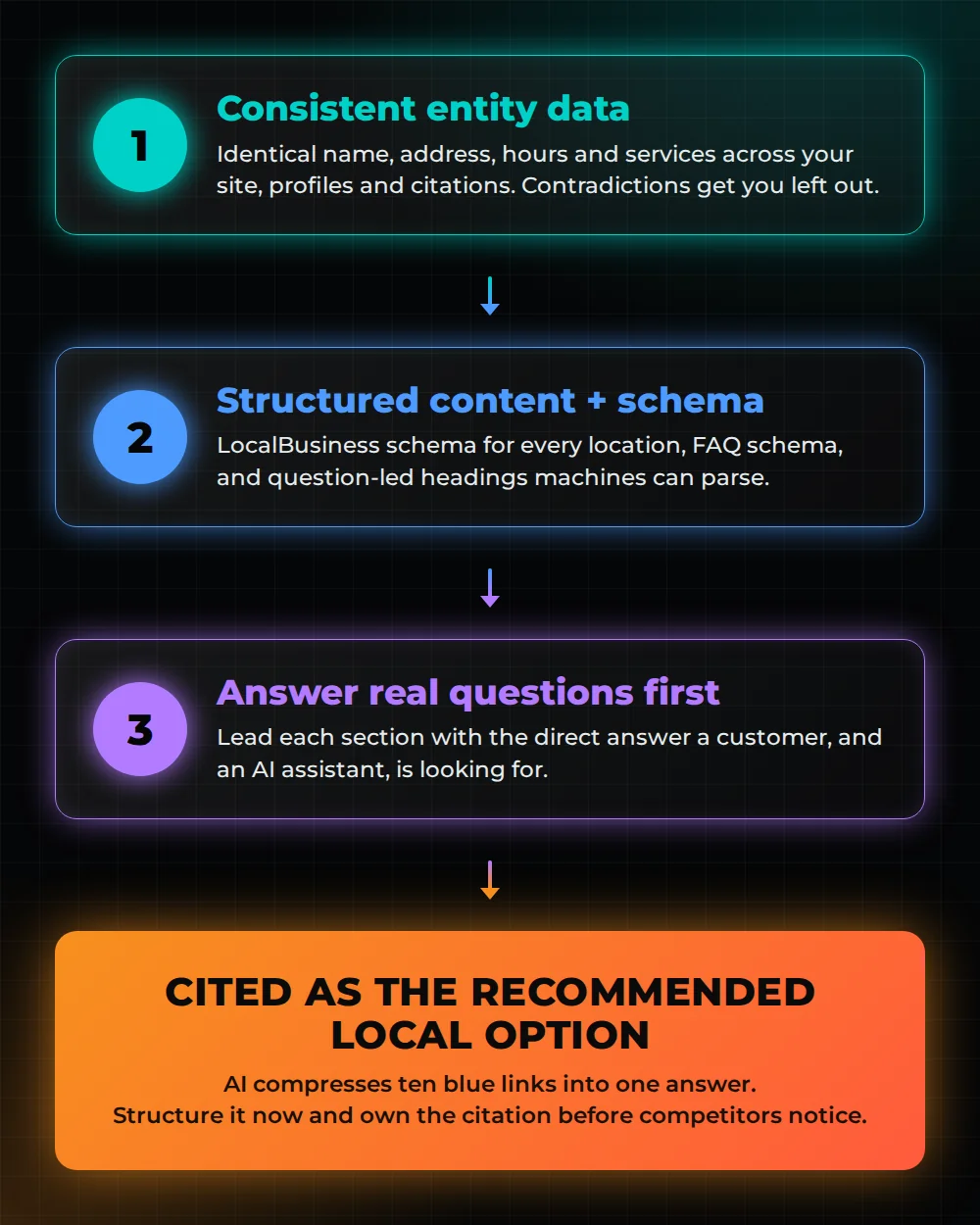
AI Visibility for Local and Multi-Location Businesses
When someone asks an AI assistant for the best option near them, the answer is assembled from Google Business Profile data, review platforms, directories, and local publications — then synthesized into a recommendation of two or three businesses. Ranking in the Map Pack and being named in that recommendation are related but not the same thing.
For multi-location brands the gap widens: an AI system has to understand that fourteen locations belong to one organization, each serving a different area, with consistent details at every one. Fragmented location data produces fragmented recommendations, or none. See how this plays out in multi-location marketing and AI search for credit unions.
Local profile work, citations, reviews, and Map Pack rankings are covered on our local SEO services and local link building pages. This page covers the AI layer that sits on top of it.
How We Measure AI Search Visibility
This is where most AI search engagements fall apart. If the deliverable is “we optimized for AI” with no measurement, you have bought a belief. These are the numbers we report.
Citation Share
How often your brand is cited in AI answers for a tracked set of buying-intent prompts, versus your named competitors. The core number.
Share of Voice
Across all AI mentions in your category, what percentage name you. Tracks whether you are gaining ground or just holding.
Prompt Coverage
Of the conversational queries mapped to your funnel, how many return you at all — and at which stage the gaps sit.
Answer Accuracy
What AI systems actually say about you. Wrong services, stale pricing, and competitor features attributed to you are tracked as defects and fixed at the source.
AI Crawler Activity
Server-log monitoring of GPTBot, ClaudeBot, PerplexityBot, and Google-Extended — proof that access is working, and an early warning when it breaks.
AI Referral Traffic & Conversions
Sessions and conversions attributed to AI sources in GA4, connected through ChatterBuzz IQ and HubSpot to pipeline — so AI visibility is tied to revenue, not vanity. AI-referred visitors arrive further along, which is why conversion rate optimization on the landing page matters.
Reported weekly in ChatterBuzz IQ alongside your paid, organic, and conversion data — because AI visibility that is not measured next to everything else becomes a side project nobody defends at budget time.
Our AI Search Optimization Process
Every engagement opens with the audit, because the answer to “why are we not being cited” is different for almost every site — and the wrong fix costs a quarter.
AI Visibility Audit
Crawler access, entity health, schema coverage, and a baseline of where you appear across all six engines today.
Prompt & Gap Mapping
The real questions your buyers ask AI systems, clustered by intent, scored against where you are and are not cited.
Technical Remediation
Crawler access, llms.txt, rendering, schema, and entity markup. The unglamorous work that unblocks everything after it.
Content & Corroboration
Answer-first restructuring of existing pages, new content against the gaps, and digital PR on the sources AI systems retrieve from.
Monitor & Compound
Weekly tracking, accuracy correction, and reallocation toward the prompts and engines actually producing pipeline.
Start With the Audit
We will show you every prompt where your competitors are cited and you are not, what is blocking you, and what it would take to change it — before you commit to an engagement.
AI Search Optimization Results
Documented outcomes from engagements where AI visibility was part of the program — the proof an AEO agency should be able to show you before you sign. We run AI search optimization for mid-market companies across the United States from offices in Orlando, Tampa, and New York — see our Orlando, Tampa, and New York SEO teams, the industries we serve, or browse all case studies.

B2B Manufacturing
Hallmark Nameplate
- +349%Website traffic
- +40%Revenue YoY
- +250%Site-generated leads
A combined SEO, AEO, and GEO program for a technical B2B manufacturer with a long, specification-driven buying cycle. More on our manufacturing marketing work.
Read the case study →
IT & Managed Services
Tabush Group
- #1Google & AI ranking
- +2,100%Organic traffic
- +502%Impressions YoY
#1 Google ranking and #1 AI recommendation for “Managed IT for Law Firms” — a query buyers now ask assistants as often as search engines. See our technology marketing practice.
Read the case study →
Multi-Location Healthcare
Age Rejuvenation
- #1“HRT near me”
- $250→$105Cost per lead
- +500%Lead increase
#1 for “hormone replacement therapy near me” through entity consistency across locations, structured service and provider data, and answer-first content on the questions patients actually ask. See our healthcare marketing practice.
Read the case study →What Is AI Search Optimization?
AI search optimization is the discipline of increasing how often a brand is retrieved, cited, and accurately described by generative AI systems such as ChatGPT, Google AI Overviews and AI Mode, Perplexity, Gemini, and Microsoft Copilot. It combines generative engine optimization (GEO) and answer engine optimization (AEO): technical crawler access, entity clarity, third-party corroboration, and content structured for passage-level retrieval.
Chatter Buzz Media is a performance marketing agency headquartered in Orlando and an AEO agency in practice: it delivers AI search optimization as an extension of its SEO and organic search practice, measured weekly in ChatterBuzz IQ against citation share and share of voice. In this industry, GEO means generative engine optimization — not geographic targeting. Local search visibility in Google Maps and the local pack is handled on our local SEO services page; this page covers the AI layer that sits on top of it.
Generative Engine Optimization (GEO)
Generative engine optimization is the practice of increasing how often a brand is retrieved and cited by generative AI systems. GEO focuses on entity clarity, third-party corroboration, and content structured for passage-level retrieval rather than on keyword rankings. It is measured in citation share and share of voice, not positions.
Answer Engine Optimization (AEO)
Answer engine optimization is the practice of structuring content so a search or AI system can extract a direct, self-contained answer from it. AEO covers question-shaped headings, concise definition passages, structured data markup, and machine-parseable formatting. It is the work behind featured snippets, voice results, and AI answer citations.
FAQS
AI Search Optimization FAQs
What is generative engine optimization (GEO)?
Generative engine optimization is the practice of increasing how often a brand is retrieved and cited by generative AI systems such as ChatGPT, Google AI Overviews, Perplexity, Gemini, and Copilot. GEO focuses on entity clarity, third-party corroboration, and content structured for passage-level retrieval, rather than on keyword rankings. In search marketing, GEO stands for generative engine optimization and is unrelated to geographic targeting.
What is answer engine optimization (AEO)?
Answer engine optimization is the practice of structuring content so a search or AI system can extract a direct, self-contained answer from it. AEO covers question-shaped headings, concise definition passages, structured data markup, and formatting machines can parse. It is the work behind featured snippets, voice search results, and AI answer citations.
What is the difference between GEO and SEO?
SEO optimizes a page to rank in a list of results; GEO optimizes an entity to be cited inside an AI-generated answer. SEO is measured in rankings and sessions, GEO in citation share and share of voice. SEO’s main off-site lever is backlinks; GEO’s is brand mentions, whether or not they link. They share a foundation — crawlable, credible, well-structured content — so GEO does not replace SEO, it extends it.
Does SEO still matter if AI search is taking over?
Yes, and more than most coverage suggests. Google AI Overviews and Gemini are grounded in Google’s index, so organic strength directly influences whether you are a citation candidate. A site that cannot be crawled, rendered, or understood by traditional search will not be retrieved by generative systems either. AI search raises the value of technical SEO rather than retiring it.
How do I get my business cited by ChatGPT?
Five things have to be true: GPTBot can access your site, your content answers specific questions in self-contained passages, your brand is a clearly defined entity with consistent details everywhere it appears, your claims are corroborated by third-party sources, and your information is current. Most brands that are absent from ChatGPT fail at the first or third of these, and both are fixable.
How do I appear in Google AI Overviews?
AI Overviews draw primarily from Google’s existing index, so pages already ranking for a query are the candidate pool. Selection within that pool favors passage-level clarity: a direct answer near the top of the section, question-shaped headings, structured data, and specifics rather than generalities. Strong rankings make you eligible; extractable structure gets you chosen.
How long does AI search optimization take to work?
Technical fixes such as unblocking AI crawlers can change visibility within weeks, sometimes days, because the constraint was access rather than quality. Entity and corroboration work compounds over three to six months, since it depends on third-party sources publishing and being re-crawled. Content restructuring sits in between. Any agency promising AI citations in 30 days is describing the first category and implying the others.
How do you measure AI search visibility?
We track six things: citation share against named competitors, share of voice across category mentions, prompt coverage across your mapped buyer questions, answer accuracy, AI crawler activity in server logs, and AI referral traffic and conversions in GA4. All six report weekly in ChatterBuzz IQ alongside your paid and organic data. Search Console does not report AI citations, which is why separate tracking is required.
What is llms.txt and do I need one?
llms.txt is a proposed plain-text file at your site root that gives AI systems a curated map of your most important content in a clean, easily parsed format. Adoption is not universal and it is not a ranking factor, but it is inexpensive to implement and carries no downside. We treat it as hygiene rather than strategy — worth doing, not worth building a program around.
Will AI search optimization increase my website traffic?
Sometimes, but traffic is the wrong primary metric. Many AI answers resolve the question without a click, so the value is influence at the moment a shortlist is formed rather than a session. What reliably improves is the quality of the traffic you do get: buyers who arrive having already seen you recommended tend to convert at higher rates and shorter cycles. We measure citation share first and referral traffic second.
Is AI search optimization the same as local SEO?
No. Local SEO earns visibility in Google Maps, the local pack, and geographic searches through Google Business Profile, citations, and reviews. AI search optimization earns citations in AI-generated answers regardless of location. They overlap when someone asks an AI assistant for a recommendation near them, because that answer is partly assembled from local data — which is why multi-location brands usually need both.
What does AI search optimization cost?
Engagements are scoped to the gap the audit finds, which varies widely — a crawler access problem is a small fix, while rebuilding a fragmented entity across hundreds of third-party sources is a program. Most clients run AI search optimization as part of an integrated organic engagement rather than a standalone line item, because it shares a foundation with technical SEO and content.
What should I look for in an AEO agency?
Ask four things. First, whether they can show citation share and share of voice for a real client, not a screenshot of one prompt — an AEO agency that cannot measure AI visibility cannot improve it. Second, whether the work is grounded in an existing organic search practice, because AI systems retrieve from the same index Google ranks; GEO bolted onto nothing does not hold. Third, how they earn third-party citations — our managed link building and digital PR feed the sources AI engines actually retrieve from. Fourth, whether they will tell you when AI search optimization is not the right priority for your business yet.
Chatter Buzz Media is an AEO and GEO agency headquartered in Orlando, Florida, with offices in Tampa and New York, and every engagement is measured weekly in ChatterBuzz IQ.
Does Chatter Buzz offer GEO and AEO services?
Yes. Chatter Buzz Media is a performance marketing agency headquartered in Orlando, Florida, with offices in Tampa and New York, that provides generative engine optimization and answer engine optimization as part of its organic search practice: AI crawler access audits, entity and knowledge graph optimization, answer-first content architecture, structured data, conversational query mapping, citation building, and weekly AI visibility reporting in its ChatterBuzz IQ platform.
Find Out What AI Says About You
Most companies have never checked. We will show you every buying-intent prompt where your competitors are cited and you are not, what is blocking you, and what it would take to change it.