
 321-236-2899
Multi-Location Marketing: How to Scale Local Relevance
Opening a second location feels like a win until your marketing starts working against you. Suddenly your Tampa store is bidding on the same keywords as your Orlando store, your brand looks different on every Google listing, and no one can tell you which location actually drove last month’s leads. (If you would rather hand this to a team, see how our multi-location marketing agency runs it location by location.)
We have built and scaled multi-location marketing programs for credit unions with dozens of branches, med spas across several metros, and home builders selling in a dozen communities at once. The pattern is always the same: the brands that win treat “national consistency” and “local relevance” as partners, not trade-offs.
This guide walks through the exact six-step system we use to scale campaigns across locations without diluting the local signals that actually convert. By the end, you will know how to structure your site, split your budget, and measure results so every location pulls its weight.
Key Takeaways
- Local relevance is a ranking and conversion signal, not a nice-to-have. 76% of “near me” searchers visit a business within a day, so generic messaging leaves real revenue on the table.
- Decide what’s controlled centrally vs. locally before you scale. A written governance model prevents both brand drift and location-manager frustration.
- Location pages and geo-modified keywords stop locations from cannibalizing each other. Each market should rank on its own without competing internally.
- Split budget by market maturity. New locations need brand building; established ones need conversion tactics.
- Measure by location, not just by brand. Brand-level averages hide the locations that are quietly losing money.
What Multi-Location Marketing Is (and Why It’s Harder Than It Looks)
Multi-location marketing is the practice of promoting one brand across multiple physical locations while keeping the brand unified and each location locally relevant. In plain terms, it means every branch, store, or community feels like the same trusted brand while still speaking to its own market.
That balance is the entire challenge. A single-location business optimizes one audience, one Google listing, and one set of reviews, while a multi-location brand juggles a different audience, competitor set, and search landscape for every pin on the map.
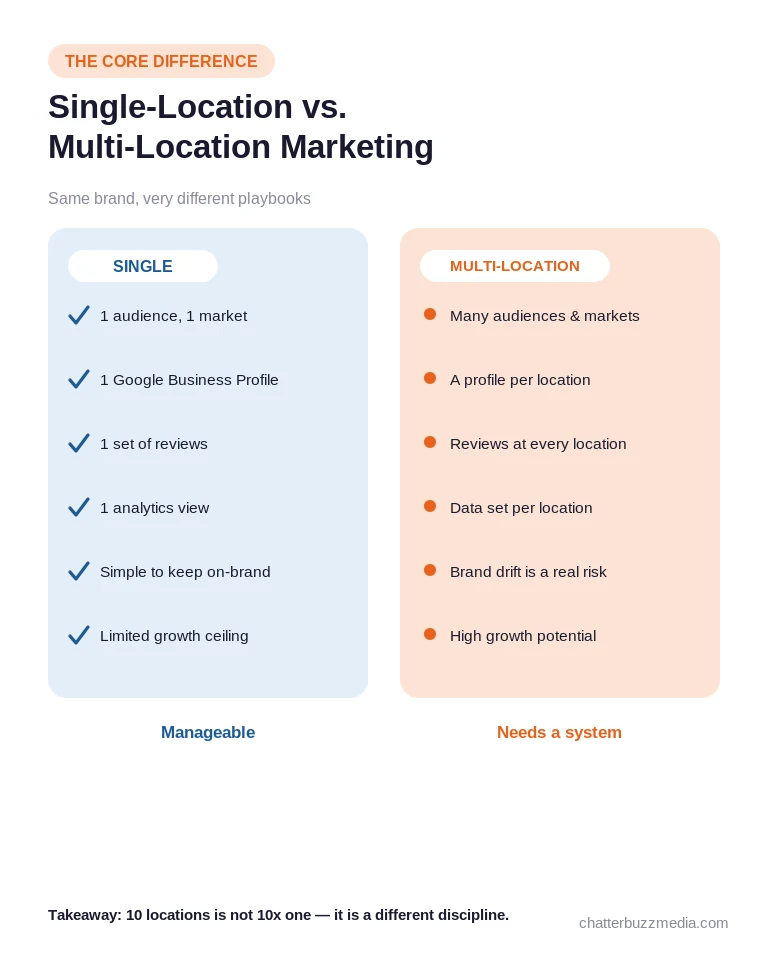
The complexity compounds fast. Ten locations is not ten times the work of one, because you also have to manage brand consistency, internal competition, and reporting across all of them at once.
Local relevance is not a branding nicety either. According to aggregated local search data, 76% of people who run a “near me” search visit a business within a day, and 28% of those searches end in a purchase.
That intent is exactly what generic, one-size-fits-all campaigns fail to capture. When a customer searches for your service near them, the location that shows up with accurate hours, real reviews, and a local page wins the click, and the ones that don’t simply lose the sale.
Why it matters: each location competes in its own local market, and ranking well in one city does not carry over to the next. Without deliberate local optimization, a strong flagship can open a new location that stays invisible to nearby customers.
The goal is not to choose between corporate control and local flexibility. It is to build a system where the brand provides the framework and each location fills in the local detail, which is exactly what the next six steps deliver.
Step 1: Draw the Line Between Brand Control and Local Freedom
Start by deciding, in writing, what corporate controls and what each location can adapt. This governance model is the single most important document in multi-location marketing because it prevents both brand chaos and the internal friction that stalls campaigns.
Without it, two things break at once. Locations either drift so far off-brand that customers get confused, or corporate locks everything down so tightly that local teams can’t respond to their own market.
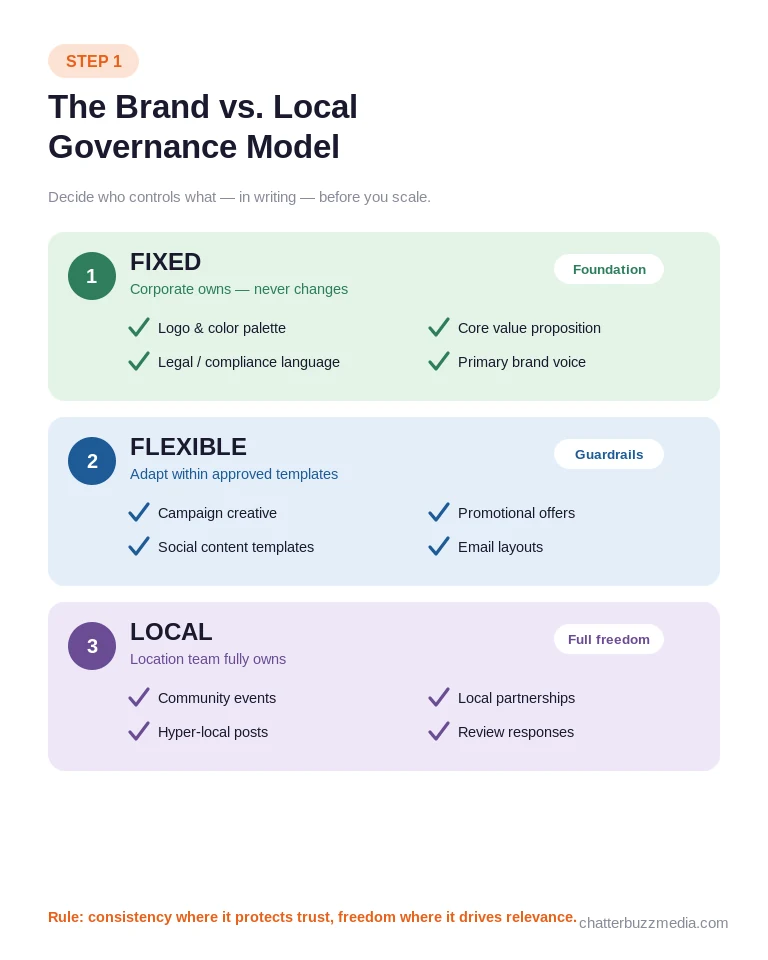
The fix is a simple three-tier framework. Fixed elements never change, flexible elements adapt within guardrails, and local elements are fully owned by the location team.
- Fixed (corporate owns): logo, color palette, core value proposition, legal and compliance language, and primary brand voice.
- Flexible (adapt within templates): campaign creative, promotional offers, and social content built from approved templates.
- Local (location owns): community events, local partnerships, hyper-local posts, and responses to reviews.
Here is what that looks like in practice. Corporate ships an approved fall promotion with locked logos, colors, and legal disclaimers, and each location swaps in its own offer end-date, local phone number, and a line about a nearby community event.
The customer sees one consistent brand, and the local team still gets to sound like it belongs in the neighborhood. That is the whole point of the model: consistency where it protects trust, freedom where it drives relevance.
Put this in a shared, living document that every location can access. A centralized brand messaging guide keeps the “fixed” tier airtight while giving local teams a clear runway.
This is also where a fractional CMO-led structure earns its keep. One strategic owner sets the framework once, then every location executes against it instead of reinventing strategy market by market. With the rules of engagement set, you can build the digital foundation that makes each location findable.
Step 2: Build Location Pages That Rank Without Cannibalizing
Give every location its own dedicated, indexable landing page under one domain. This is the structural backbone of multi-location marketing, and skipping it is the fastest way to make locations invisible or force them to compete against each other.
A single generic “Locations” list page cannot rank each market. Search engines need a unique, content-rich URL for each location to understand and surface it, which is why the location page is non-negotiable.
Use a clean, scalable URL pattern like yourbrand.com/locations/city-state. Each page should carry unique local content, not a template with the city name swapped in, or you risk duplicate-content problems that suppress the whole set.
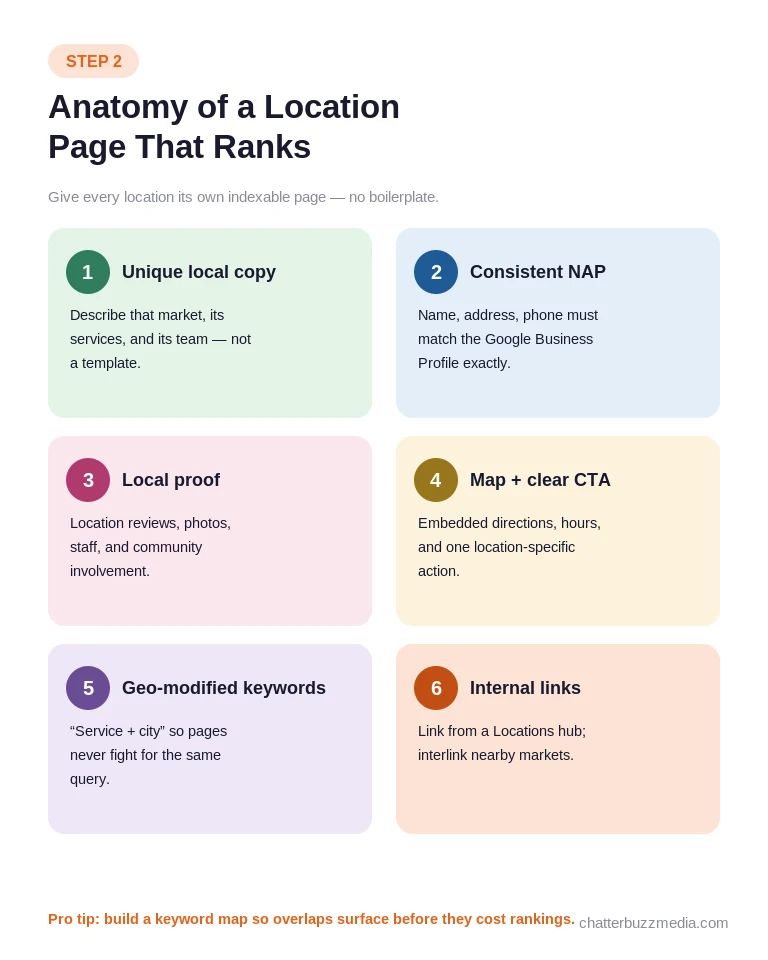
Every location page needs a few things to earn its ranking:
- Unique local copy describing that market, its services, and its team rather than boilerplate.
- Consistent NAP (name, address, phone) that matches your Google Business Profile exactly.
- Local proof such as location-specific reviews, photos, staff, and community involvement.
- Embedded map and directions plus clear hours and a location-specific call to action.
To avoid keyword cannibalization, assign each location a geo-modified keyword set so they never fight for the same query. “Med spa Orlando” and “med spa Tampa” let both pages win without stealing each other’s rankings.
Structure matters as much as content. Link every location page from a central “Locations” hub and interlink nearby markets, so authority flows through the set instead of stranding pages with no internal links.
Then map keywords deliberately across the portfolio. Build a simple spreadsheet that assigns each location its primary “service + city” term and a handful of supporting phrases, and you will spot overlaps before they ever cost you rankings.
The same discipline that powers high-converting landing pages applies here: clear intent, local detail, and one obvious next step. Once the pages exist, you optimize the local search signals that push them to the top of the map.
Step 3: Win Local Search at Every Location
Local search is won location by location through optimized profiles, consistent citations, and active review management. For multi-location brands, that means treating each Google Business Profile as its own asset with its own owner and cadence.
This is where most of the local traffic actually comes from. The map pack and “near me” results are decided by proximity, prominence, and relevance, and you can influence two of those three directly.
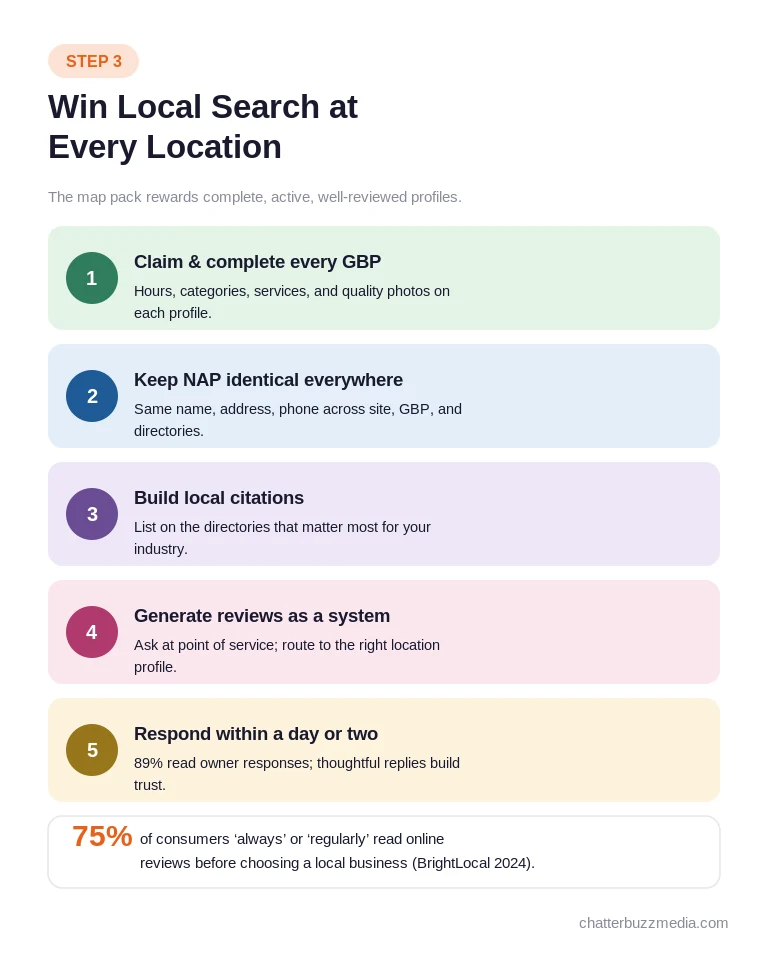
Work down this checklist for every single location:
- Claim and fully complete each Google Business Profile, with accurate hours, categories, services, and high-quality photos.
- Keep NAP identical everywhere across your site, GBP, and every directory to reinforce trust and relevance.
- Build local citations on the major directories, prioritizing the ones that matter for your industry.
- Generate and respond to reviews at each location, since reviews drive both rankings and conversions.
Reviews deserve special attention because they move real behavior. In BrightLocal’s 2024 survey, 75% of consumers “always” or “regularly” read online reviews, and 56% said a thoughtful response to a negative review improved their perception of the business.
The practical takeaway is to make review generation a system, not a hope. Ask every satisfied customer at the point of service, route them to the right location’s profile, and respond to every review within a day or two.
Google’s own Business Profile guidelines reward complete, accurate, and actively maintained listings. Filling out every field, adding services, and posting updates gives each location more surface area to match local searches.
Optimizing a profile is not a one-time task. Fresh photos, posts, and new reviews signal an active location, which is why a repeatable local process beats a one-off cleanup. Our team leans on tactics from this local SEO method and dedicated local SEO management to keep every pin healthy. With organic visibility handled, paid budget becomes the accelerator.
Step 4: Split Budget Between National Brand and Local Conversion
Allocate budget based on each location’s market maturity, not an equal split across the board. New locations need brand awareness to exist, while established ones need conversion tactics to capture demand that is already there.
Treating national and local spend as competing line items is the classic mistake. National campaigns build the equity that makes local conversion cheaper, and local campaigns turn that awareness into appointments, foot traffic, and sales.
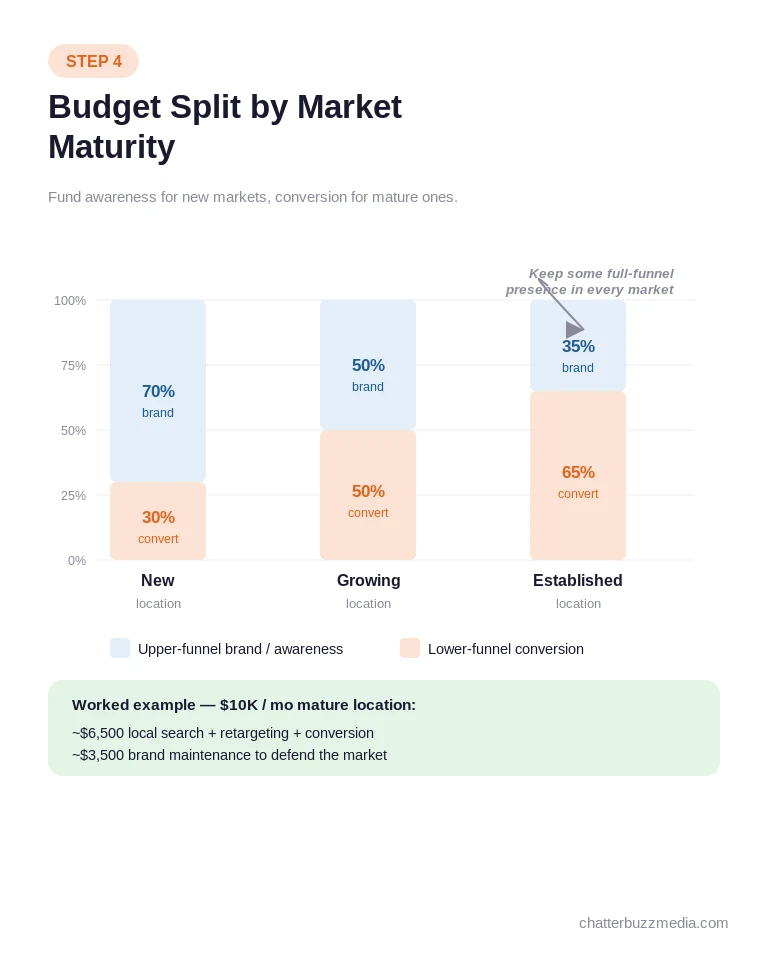
A practical way to think about the split is by stage:
- New locations: roughly 70% upper-funnel awareness and 30% conversion capture for early adopters.
- Growing locations: around a 50/50 split as recognition and market position build.
- Established locations: about 60-70% lower-funnel conversion with 30-40% brand maintenance.
Consider a simple worked example. If a mature location has a $10,000 monthly budget, you might put roughly $6,500 into local search, retargeting, and conversion campaigns and about $3,500 into brand maintenance.
Flip that for a brand-new location in the same portfolio. Around $7,000 goes to awareness that builds recognition and about $3,000 goes to capturing the early demand that awareness creates.
Local dollars should be geo-targeted so you never pay to reach the wrong market. Geo-fenced paid search and social keep spend tight around each location’s real trade area, a tactic we detail in our geofencing guide.
The balance between brand and performance is well established. Harvard Business Review has documented how brand building and performance marketing reinforce each other rather than compete, which is exactly the dynamic multi-location brands need to exploit.
Whatever the split, maintain some presence across the full funnel in every market. Abandoning brand building in mature markets creates future vulnerability, and neglecting conversion in new ones wastes your awareness spend. Structured paid media management keeps these ratios honest as locations mature. Once budget is flowing, the creative has to feel local too.
Step 5: Localize Campaigns and Measure by Location
Run brand-built campaigns that are localized at the edges, then measure performance for each location separately. Localization drives relevance, and location-level measurement is the only way to know what is actually working.
Generic ads underperform because they ignore the very thing that makes local marketing convert. A geo-targeted ad that names the neighborhood, references a local promotion, and points to the nearest location beats a national creative every time.
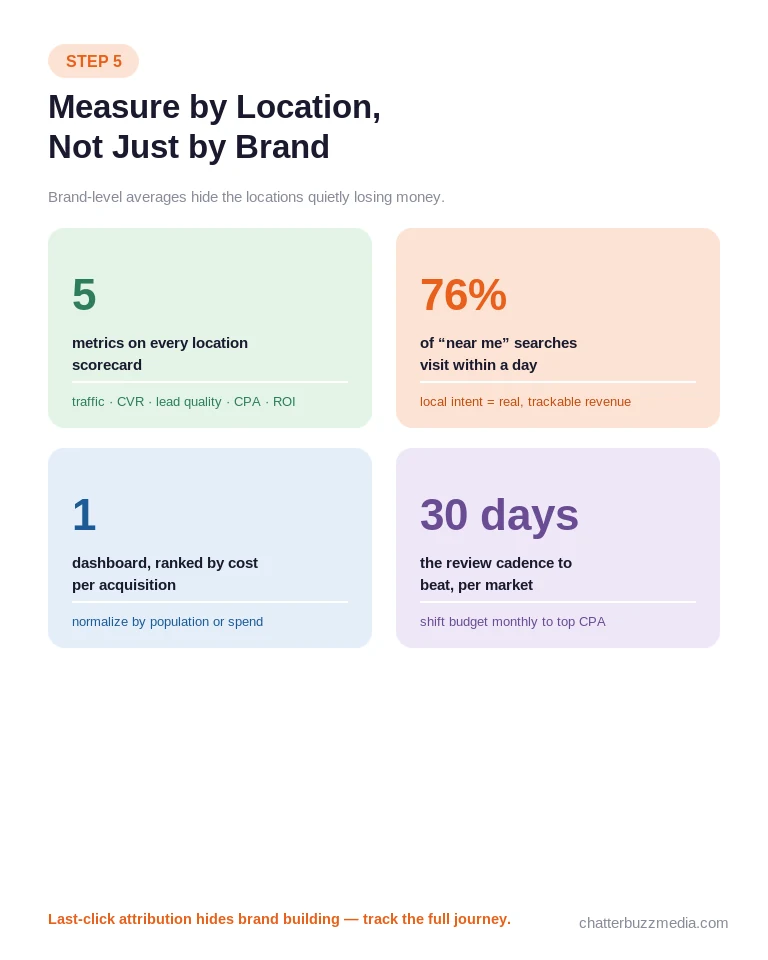
Localize at scale without rebuilding everything from scratch:
- Build from templates, then swap in local offers, imagery, and place names.
- Run corporate and location social accounts, using corporate for brand news and local for community moments.
- Personalize landing pages so each campaign points to the matching location page, not a generic homepage.
Measurement is where multi-location programs live or die. Single-touch, last-click attribution rewards the final ad and hides the brand building that made the conversion possible, so it quietly misleads your budget decisions.
Track a consistent scorecard for every location: local traffic, conversion rate, lead quality, cost per acquisition, and ad-spend ROI. Reporting at the market level surfaces the locations that need help before a small gap becomes a lasting problem, which is the whole point of a live reporting dashboard.
Set up your reporting to compare markets fairly. Normalize by population or spend so a large metro and a small town can sit in the same dashboard, and rank locations by cost per acquisition rather than raw lead volume.
Then turn measurement into a habit, not a quarterly scramble. Review the location scorecard monthly, shift budget toward the markets returning the best cost per acquisition, and diagnose the laggards before the gap widens.
Weak conversion at a healthy-traffic location is usually a landing-page problem, not a traffic problem. That is where conversion rate optimization turns existing visits into more revenue without spending another dollar on ads. The final piece is adapting all of this to the realities of your specific industry.
How to Flex the Playbook Across Verticals
The six-step system stays the same, but the “location” changes shape by industry. A branch, a med spa suite, and a model home are all locations, and each needs the same structure tuned to its buyer.
This is where a one-size-fits-all agency approach falls apart. The governance model, location pages, and budget logic transfer cleanly, but the local signals and compliance needs differ sharply across verticals.
Compliance is the biggest variable. A credit union has disclosure requirements a med spa does not, and a home builder has inventory and pricing rules a bank never touches, so the “fixed” tier of your governance model looks different in each industry.
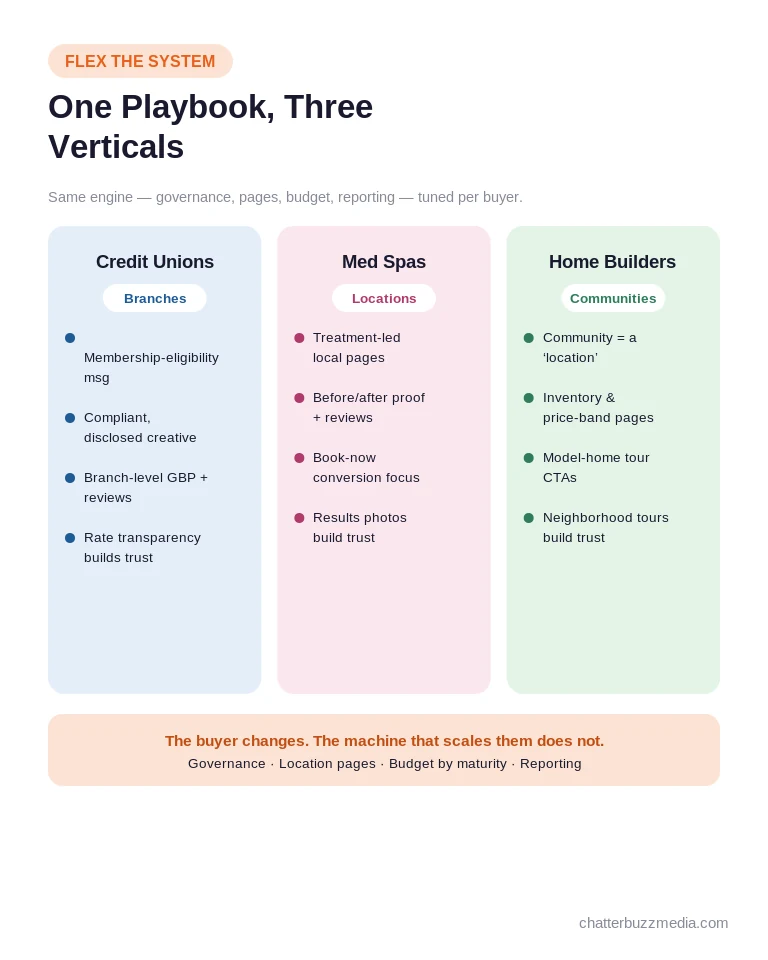
Here is how the same playbook flexes across three location-heavy industries:
- Credit unions and banks: each branch needs its own local presence, membership-eligibility messaging, and compliant creative. Our multi-location SEO for credit unions breakdown shows how branches rank without competing, backed by a credit union marketing approach built for regulated growth.
- Med spas and aesthetic practices: each location competes on treatments, reviews, and before-and-after proof. Pair strong location pages with the tactics in our med spa SEO guide and full med spa marketing strategy.
- Home builders: each community is a “location” with its own inventory, price band, and buyer. The ideas in our home builder marketing playbook and builder advertising approach map community-level demand to real sales.
The reviews, proof points, and creative angles change with the buyer, but the underlying machine does not. A branch earns trust with rate transparency, a med spa with results photos, and a builder with community tours, yet all three run on the same governance, location-page, budget, and reporting engine.
The through-line is a single strategy that flexes, not a dozen disconnected efforts. Whether you operate in Orlando, Tampa, or New York, the same framework scales with you.
Frequently Asked Questions
1. 🔍 What is multi-location marketing?
Multi-location marketing is the practice of promoting a single brand across several physical locations while keeping the brand consistent and each location locally relevant. It blends centralized brand strategy with decentralized local execution so every market can compete on its own.
2. 📊 What’s the difference between single-location and multi-location marketing?
Single-location marketing targets one audience, one search market, and one set of reviews. Multi-location marketing manages distinct audiences, competitors, and local search landscapes for each site while maintaining one unified brand across all of them.
3. ⚡ How do you avoid locations competing with each other in search?
Give each location a unique landing page and assign geo-modified keywords like “service + city” so no two locations target the same query. This lets every market rank independently instead of cannibalizing one another’s rankings.
4. 🏦 What is multi-location SEO?
Multi-location SEO is the process of optimizing each location’s digital presence so it appears in local search results for nearby customers. It centers on location pages, fully optimized Google Business Profiles, consistent NAP citations, and location-level reviews.
5. 💰 How should I split marketing budget across locations?
Base the split on market maturity rather than an even distribution. New locations should weight toward brand awareness, established locations toward conversion, and every market should keep some presence across the full funnel.
6. 🤝 How do you keep branding consistent while staying locally relevant?
Use a governance model that defines fixed brand elements, flexible template-based elements, and fully local elements. Corporate owns the non-negotiables while each location adapts creative, offers, and community content within clear guardrails.
7. 🚀 How do you measure multi-location marketing performance?
Track a consistent scorecard for each location, including local traffic, conversion rate, lead quality, cost per acquisition, and ad-spend ROI. Reporting at the market level reveals which locations need attention before small gaps become lasting problems.
8. 📈 What tools help manage multi-location marketing?
Look for platforms that centralize listings management, review monitoring, social scheduling, and location-level reporting. The goal is to keep information consistent across every location while still tailoring content to each market.
Conclusion: Turn Many Locations Into One Compounding Advantage
Multi-location marketing rewards brands that make national consistency and local relevance work together. When your framework is clear, your locations stop competing with each other and start compounding the brand’s overall equity.
The good news is that none of this requires reinventing your marketing for every new pin on the map. Build the system once, and each location you add plugs into a machine that already knows how to make it visible, relevant, and measurable.
Here is the four-step action plan to put this to work:
- Write your governance model that defines fixed, flexible, and local elements for every location.
- Build a dedicated, geo-optimized landing page for each location and fully optimize its Google Business Profile.
- Set budgets by market maturity and localize every campaign to the market it serves.
- Stand up location-level reporting so you can spot and fix underperformers early.
The brands that scale cleanly are the ones that treat this as a single strategy that flexes, not a pile of disconnected local efforts. If you want a proven framework to build on, start with our fractional CMO guide or explore the full marketing resource library to map your next move.
Need help with SEO? Explore our SEO agency services.

Victoria Wallace
Victoria Wallace is a senior content strategist and marketing writer with 30+ years of experience helping more than 200 brands translate complex business goals into clear, conversion-focused content. Her background spans paid media, marketing strategy, go-to-market planning, brand positioning, and full-funnel campaign development, giving her a deep understanding of how SEO content connects to real business growth.