
 321-236-2899

AEO Agency: How to Vet an Answer Engine Optimization Partner
Hiring the wrong search partner used to cost you a few rankings. Hiring the wrong answer engine optimization partner in 2026 can cost you visibility in the exact place your buyers now make shortlists: inside the AI answer.
This guide walks through how to choose an AEO agency the way a careful operator would, with the questions that separate real expertise from repackaged SEO. We have watched buyers evaluate these partners, and the ones who ask about citation share and prompt coverage sign better contracts than the ones who ask about rankings.
By the end you will have a 12-point vetting framework, a sample of what good reporting looks like, and the red flags that predict a wasted retainer. Let’s start with what these agencies actually do.
Key Takeaways
- AEO is not SEO with a new label. It optimizes for citations inside AI answers, not blue-link rankings, so vetting criteria are different.
- Diagnosis beats the pitch. A real partner audits how you appear in LLMs today before proposing work.
- Demand citation-based reporting. Share of voice, citation recurrence, and prompt coverage matter more than traffic.
- Expect a 90-day horizon, not a 30-day guarantee. Citations move first, referral traffic and pipeline follow.
- Red flags are consistent. Guaranteed placements, traffic-only dashboards, and annual contracts with no exit should end the conversation.
What an AEO Agency Actually Does (and How It Differs From SEO)
An AEO agency gets your brand cited inside the answers that AI engines generate, from Google AI Overviews to ChatGPT, Perplexity, Gemini, and Claude. That is a different job from ranking a page on a results list, and it is why you cannot simply grade one on old SEO metrics.
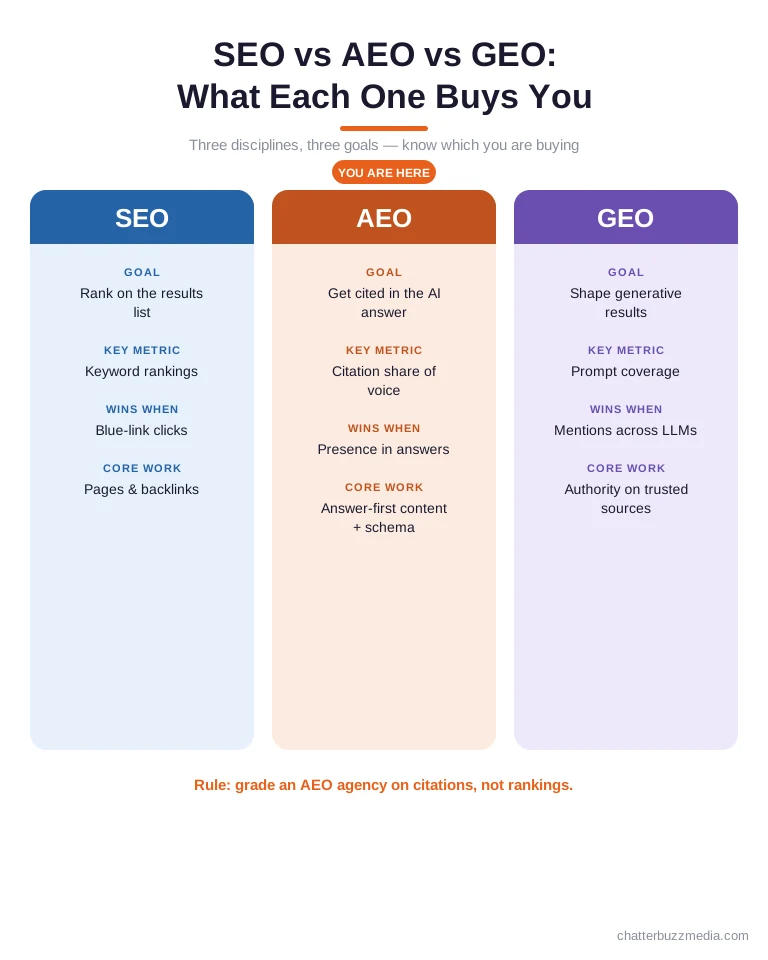
The work lives in a few concrete places. It restructures content into direct, extractable answers, implements structured data that AI engines can read, and builds the off-page citations on sources that large language models already trust.
It also monitors where and how you are mentioned, because an AI answer that describes you inaccurately is its own problem. This is the practical difference between SEO and AEO: one chases position, the other chases presence in the answer itself.
The schema piece deserves special attention, because AI engines lean on structured markup to understand what a page says and who stands behind it. A capable agency implements the specific types that Google documents for structured data, then validates them, rather than sprinkling generic tags and hoping.
The reason this matters now is money and attention. Gartner expects AI chatbots and virtual agents to cut traditional search engine volume by 25% as early as 2026, and Pew Research found that when Google shows an AI summary, users click a traditional result in only 8% of visits, versus 15% without one (Search Engine Land, Pew Research Center).
If the answer is replacing the click, the agency you hire needs to win the answer. That starts with knowing whether you even need one yet.
When You Actually Need an AEO Agency
You need an AEO agency when the queries that drive your pipeline are already returning AI answers and your brand is absent from them. If prospects describe your category to ChatGPT and a competitor gets named instead of you, that gap is the business case.
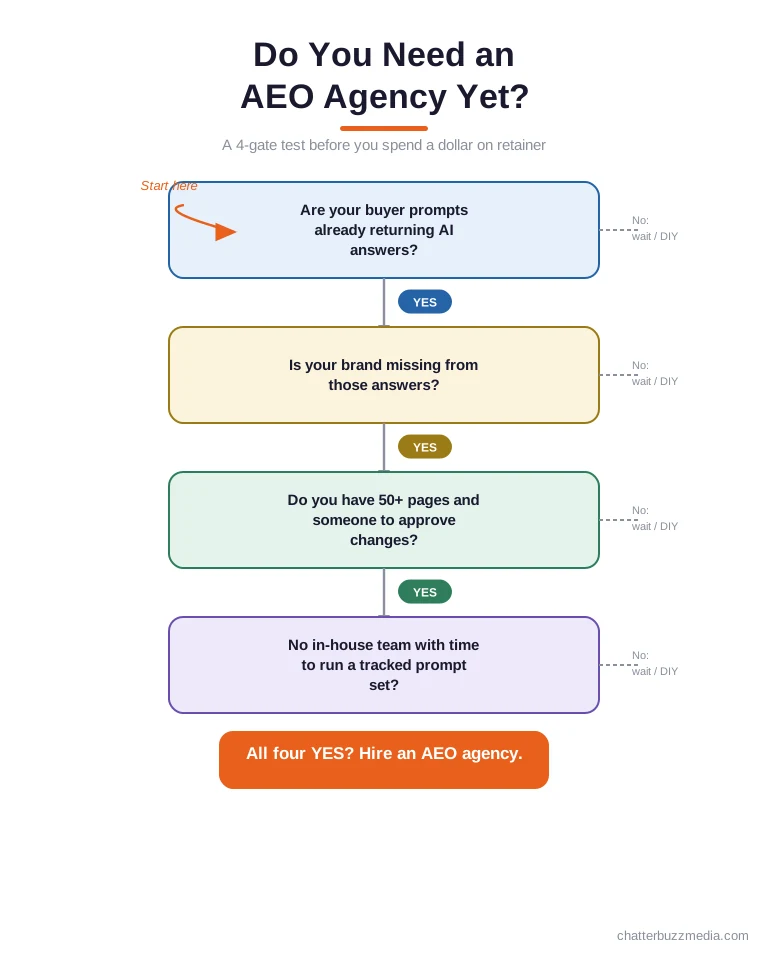
A few conditions make the investment pay off faster. You have at least 50 indexed pages worth optimizing, a real product or service people compare, and someone internal who can approve content and technical changes quickly.
You can wait if your site is tiny, your category is barely searched inside AI engines, or your current team has bandwidth to run a tracked prompt set and ship fixes themselves. AEO is learnable, and a capable in-house team with the right process can start without an agency.
Regulated industries change the math. A credit union, bank, or healthcare brand needs a partner who understands compliance review, which is why AI search in regulated industries like credit unions rewards specialists over generalists.
Industry fit cuts the other way too. A manufacturer with long, technical sales cycles has different buyer prompts than a consumer brand, and an agency fluent in industrial and B2B marketing will track the comparison and specification queries that actually precede a quote.
Once you have decided to hire, the evaluation itself is where most buyers go wrong. These questions fix that.
12 Questions That Separate Real AEO Expertise From Repackaged SEO
The fastest way to screen an AEO agency is to ask questions a traditional SEO shop cannot answer well. Use the list below as a scorecard, and weight the first four most heavily.
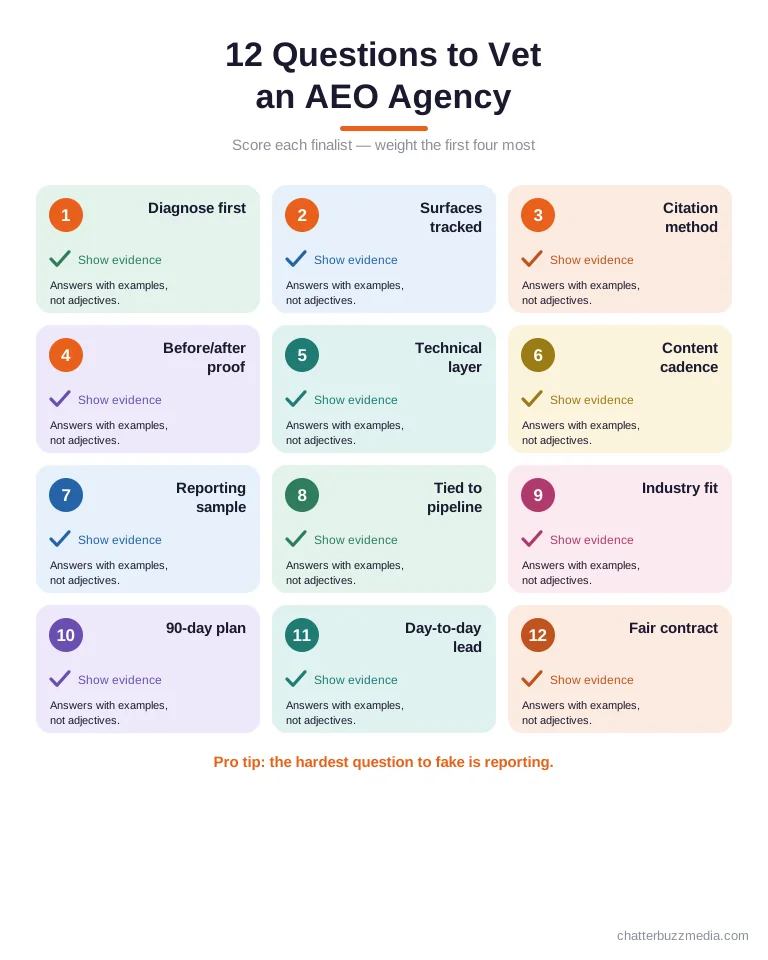
Each question is designed to surface evidence, not opinion. A strong partner answers with examples, sample reports, and specifics rather than adjectives.
- 1. How do you diagnose before you pitch? They should map the prompts your buyers actually use and audit your current AI visibility before proposing a scope.
- 2. Which AI surfaces do you track, and how? Look for named engines and dedicated tooling, not a screenshot of one ChatGPT query.
- 3. What is your citation methodology, on-page and off-page? Real AEO combines answer-first content and schema with authority building on sources LLMs cite.
- 4. Can you show prompt-level before-and-after results? Ask for a client who moved from absent to cited on specific prompts.
- 5. How do you handle the technical layer? Expect fluency in structured data, clean rendering, and a solid technical SEO foundation.
- 6. How does content actually get produced, and how often? Get concrete numbers: pages per month, who writes, who reviews.
- 7. What does reporting look like? They should show a sample dashboard before you sign, built on citation metrics.
- 8. How do you tie AEO to pipeline? A mature partner connects citations to referral traffic and revenue, and is honest about attribution limits.
- 9. Do you specialize in our industry? Category knowledge shapes which prompts and sources matter, especially in regulated verticals.
- 10. What are the first 90 days? Ask for a dated 30/60/90-day plan with specific deliverables.
- 11. Who works on the account day to day? Confirm the senior person in the pitch is not handing you to a junior after signing.
- 12. What are the contract terms? Push for a term under 12 months, a real exit clause, and ownership of your prompt sets and schema.
If an agency sails through the first four, the rest usually follow. The single hardest one to fake is reporting, so look there next.
What Good AEO Reporting Looks Like
Good AEO reporting measures presence in answers, not position on a list. If the dashboard a prospective agency shows you leads with keyword rankings and sessions, they are grading the wrong exam.
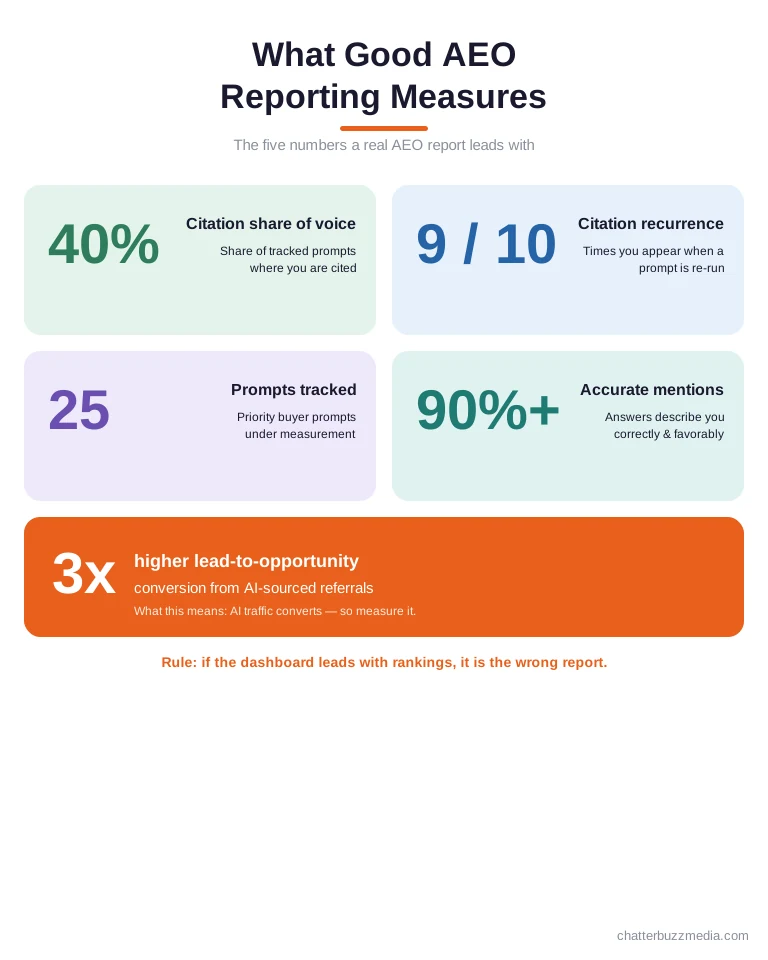
The metrics that actually track AEO progress are specific. Ask to see each of these in a sample report, with a clear definition and a trend line, through their reporting and data visualization or yours.
- Citation share of voice: the percentage of tracked prompts where your brand is cited, versus competitors.
- Citation recurrence rate: how consistently you appear when the same prompt is run repeatedly.
- Prompt coverage: how many of your priority buyer prompts are tracked at all.
- Answer accuracy and sentiment: whether the AI describes you correctly and favorably.
- AI referral traffic and pipeline: sessions and leads attributed to AI sources, with honest caveats.
A credible target arc looks like citation movement in the first 4 to 8 weeks, referral traffic gains by month two or three, and pipeline signal by month three or four. Any agency promising ranked results in 30 days is selling the old game.
Insist on seeing a redacted real report, not a template. A template proves they own the software, while a real client report proves they know how to move the numbers on it and explain what changed.
Reporting quality tells you how an agency thinks. The next filter is whether their price matches the scope they are proposing.
What an AEO Agency Costs and How to Read a Proposal
AEO pricing scales with the number of personas, prompts, and pages involved, not with a flat fee quoted before scope is discussed. A proposal that names a price before asking about your category is a proposal to be skeptical of.
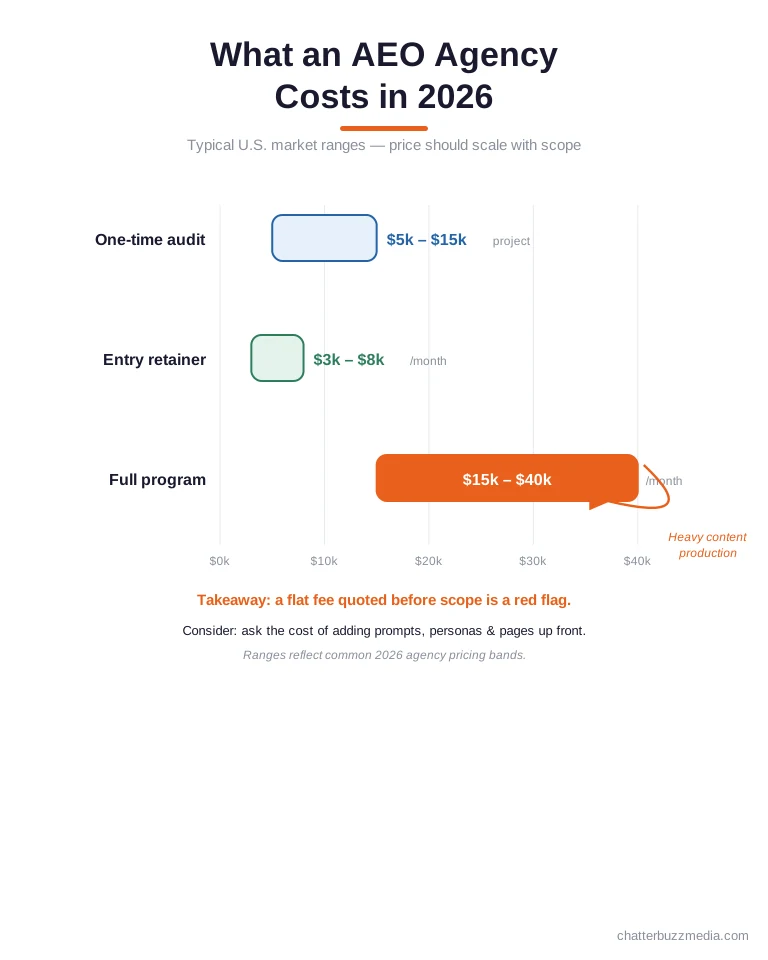
The current market sorts into a few bands. One-time audits typically run in the low five figures, entry retainers sit in the few-thousand-per-month range, and full programs with heavy content production climb into the mid five figures monthly.
Read the proposal for what the money buys, not just the number. A good one specifies monthly content output, the number of prompts and surfaces tracked, the technical scope, and the reporting cadence in writing.
Be wary of two extremes: a suspiciously cheap flat fee that cannot fund real content and authority work, and a premium retainer with vague deliverables. The same judgment that helps you avoid phony SEO experts applies here.
Ask how pricing changes as scope grows, so a win does not trigger a surprise invoice. A transparent partner will show you the cost of adding prompts, personas, or pages before you need them, which also tells you they have run programs large enough to hit those tiers.
Price and scope in hand, your last screen is the pattern of warning signs that predict failure.
Red Flags That Predict a Wasted AEO Retainer
The most reliable red flag is a guarantee. No one controls whether Google, ChatGPT, or Perplexity cites you, so any agency promising AI Overview placement is promising something it cannot deliver.
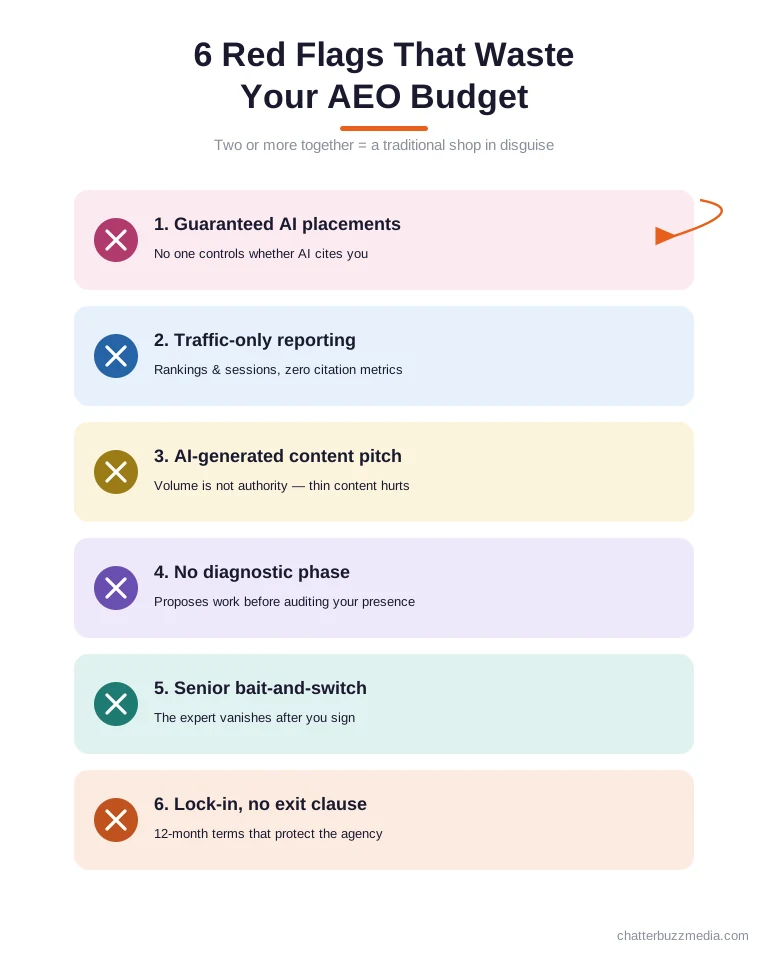
Watch for the rest of the pattern, because two or more together usually mean a traditional shop wearing an AEO label.
- Traffic-only reporting. Dashboards built on rankings and sessions with no citation metrics. Ask for share of voice instead.
- AI-generated content as the main pitch. Volume is not authority, and thin AI content can hurt visibility.
- No diagnostic phase. If they propose work before auditing your current AI presence, they are guessing.
- Senior bait-and-switch. The expert who pitches disappears after signing. Name the day-to-day lead in the contract.
- Lock-in contracts. Twelve-month terms with no exit clause protect the agency, not you.
- “AEO is just SEO.” If they treat the two as identical, they will optimize for the wrong outcome.
Seeing one of these is a conversation. Seeing several is your answer. With the filters set, here is how to run the evaluation itself.
Your 90-Day Vetting Process From Shortlist to Signature
Treat agency selection like a project with a timeline, not a single meeting. A structured 90-day evaluation surfaces the differences that a polished pitch hides.
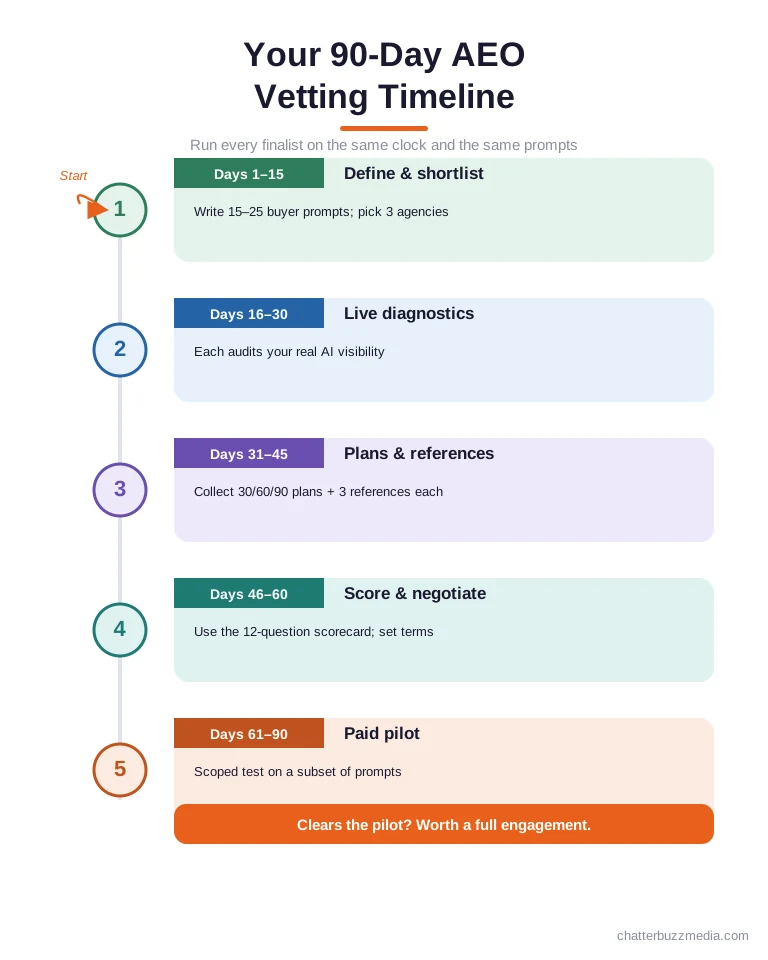
The sequence below keeps you in control and gives each finalist a fair, identical test.
- Days 1 to 15, define and shortlist. Write down your priority prompts and buyers, drawing on your ideal customer profile, then shortlist three agencies.
- Days 16 to 30, request live diagnostics. Ask each to audit your current AI visibility on your real prompts and present findings.
- Days 31 to 45, compare plans and references. Collect 30/60/90-day plans, sample reports, and three client references each.
- Days 46 to 60, score and negotiate. Use the 12-question scorecard, then negotiate term length, exit clauses, and data ownership.
- Days 61 to 90, run a paid pilot. A short, scoped pilot on a subset of prompts reveals execution quality before a long commitment.
Keep every finalist on the same clock and the same prompts, so you are comparing execution rather than sales polish. The agency that looked strongest in the pitch is not always the one whose diagnostic is sharpest or whose pilot moves the most citations.
A partner that performs through a pilot is one worth a full engagement. If none clear the bar, that result is valuable too, because the wrong retainer is more expensive than waiting.
Frequently Asked Questions
1. 🔍 Is an AEO agency different from an SEO agency?
Yes. An SEO agency optimizes to rank pages on a results list, while an AEO agency optimizes to get your brand cited inside AI-generated answers. The best partners treat AEO as an evolution of SEO, keeping technical excellence and E-E-A-T at the core while adding citation strategy.
2. 📊 How do you measure whether AEO is working?
Measure citation share of voice, citation recurrence, prompt coverage, and answer sentiment, then connect those to AI referral traffic and pipeline. Rankings and sessions alone will not tell you whether you are winning the answer.
3. ⚡ How long does AEO take to show results?
Expect citation movement in roughly 4 to 8 weeks, referral traffic gains by month two or three, and pipeline signal by month three or four. This is a similar horizon to how long SEO takes to work, so be skeptical of 30-day guarantees.
4. 🏦 Can my current SEO agency just add AEO?
Sometimes, if they track AI surfaces, build off-page citations, and report on citation metrics rather than only traffic. Ask them the 12 questions above, and if they cannot show prompt-level results or a sample citation report, they are likely repackaging SEO.
5. 🤝 Should I hire an AEO agency or build the capability in-house?
Hire out when you lack the time or tooling to track prompts and ship content and technical fixes consistently. Build in-house when you have a capable team that can own a tracked prompt set, because applying AI across your marketing is increasingly a core skill rather than a one-off project.
6. 💰 How much should an AEO agency cost?
One-time audits commonly fall in the low five figures, entry retainers run a few thousand dollars per month, and full programs reach the mid five figures monthly. Price should scale with personas, prompts, and content volume, not arrive as a flat fee before scope is defined.
7. 🚀 What tools should an AEO agency be using?
Look for dedicated AI-visibility tracking across named engines, structured data validation, and brand-mention monitoring, layered on a strong content strategy. The specific tool matters less than whether they can measure citations and act on what they find.
The Bottom Line: Vet for Evidence, Not Enthusiasm
Choosing an AEO agency comes down to one discipline: insist on evidence at every step. The partners worth hiring diagnose before they pitch, report on citations rather than clicks, and write fair terms you can exit.
Here is the action plan to run this week.
- 1. Write your prompts. List the 15 to 25 queries your buyers would type into an AI engine, grounded in your ideal customer profile.
- 2. Shortlist three agencies and send each the same request for a live diagnostic on those prompts.
- 3. Score with the 12 questions, weighting diagnosis, measurement, citation methodology, and before-and-after proof.
- 4. Run a scoped pilot before committing to a long retainer, and negotiate term, exit, and data ownership up front.
If you want the broader context first, our answer engine optimization guide and our overview of AI search optimization lay out the fundamentals, and the full resource library collects the playbooks referenced here. Vet carefully, start with a pilot, and let the evidence pick your partner.

Victoria Wallace
Victoria Wallace is a senior content strategist and marketing writer with 30+ years of experience helping more than 200 brands translate complex business goals into clear, conversion-focused content. Her background spans paid media, marketing strategy, go-to-market planning, brand positioning, and full-funnel campaign development, giving her a deep understanding of how SEO content connects to real business growth.