
 321-236-2899

Schema Markup for AI Search: Structured Data That Gets Cited

If you want your pages pulled into AI Overviews, ChatGPT answers, and Perplexity citations, schema markup is one of the few levers you fully control. It will not single-handedly earn the citation, but it makes your content unambiguous to the machines deciding what to quote.
The evidence here is mixed, and most guides either oversell schema or wave it away. We pulled the actual study data and turned it into a build order: seven steps, with copy-ready JSON-LD, that tell AI engines exactly who you are and what each page means.
By the end you will know which schema types to ship first, how to keep AI crawlers from silently ignoring them, and how to measure whether any of it moved your citations.
Key takeaways
- Schema is infrastructure, not a growth hack. In a controlled Ahrefs test, adding JSON-LD moved AI citations by only a few percentage points, yet cited pages are still about three times more likely to carry it.
- If AI crawlers cannot render it, it does not exist. Most AI bots do not execute JavaScript, so schema has to be server-rendered to count.
- Ship identity schema first. Organization and Person markup anchor your brand as one entity across the web, which is the job prose alone cannot do.
- Match markup to visible content. Schema that describes things a human cannot see on the page is the fastest way to get ignored or penalized.
- Measure with a controlled test. Treat a set of pages, hold a control group, and compare citations over 30 days instead of trusting vendor promises.
What schema markup actually does for AI search
Schema markup is structured data, written in JSON-LD, that labels the entities and facts on a page so machines can read them without guessing. For AI search, its job is disambiguation: telling an engine that “Apple” is a company, who wrote the article, and which organization stands behind the claim.
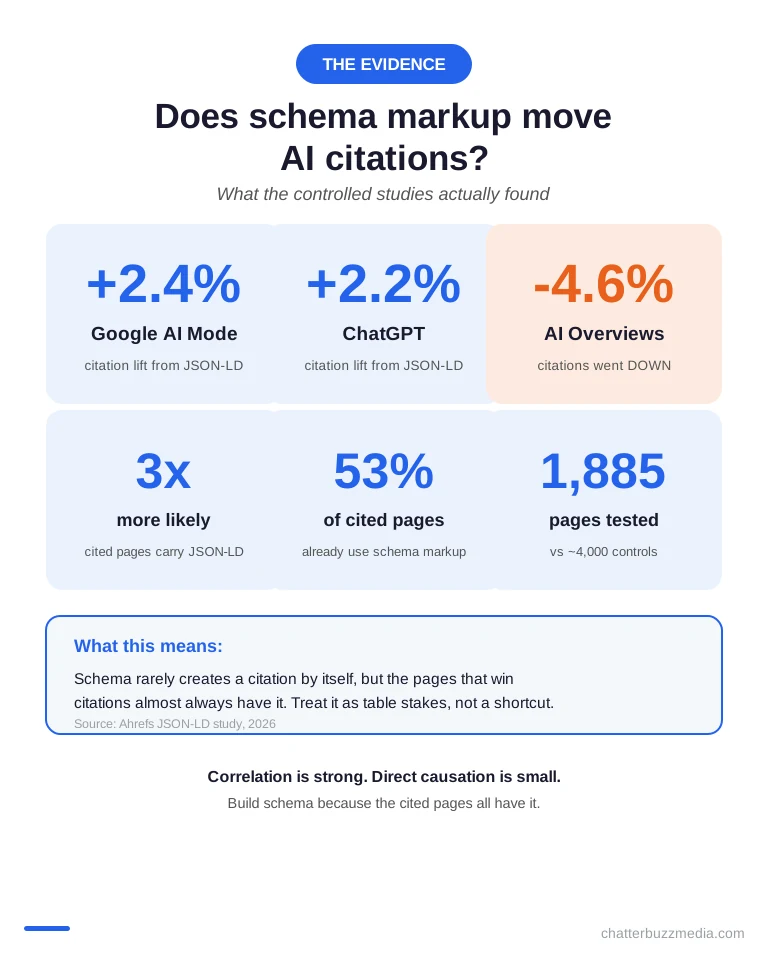
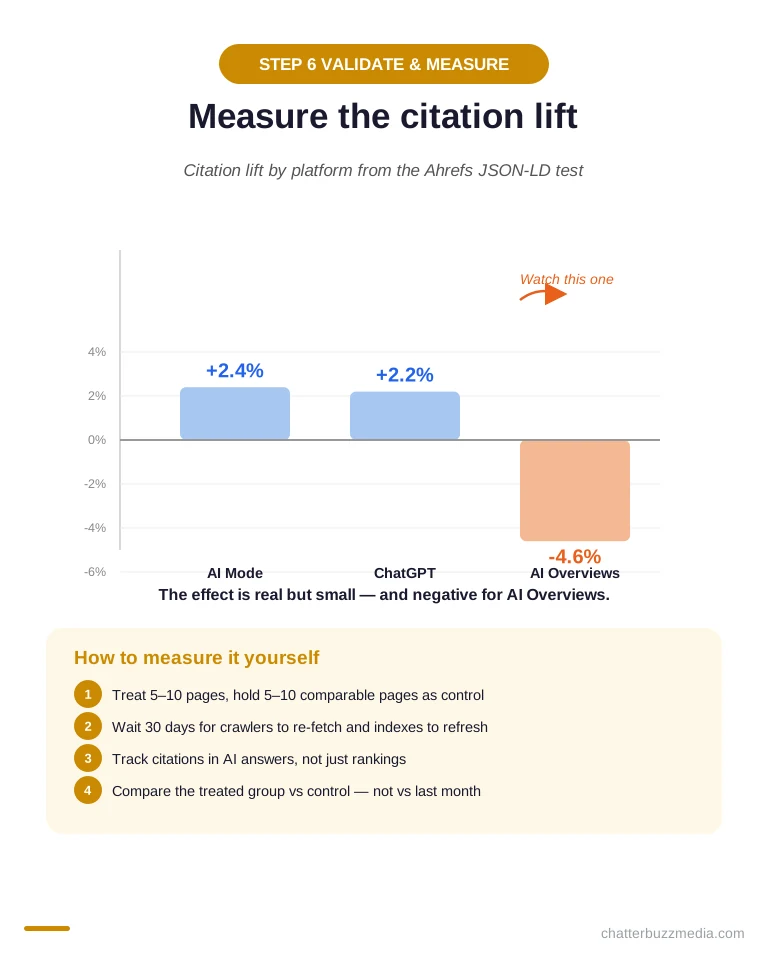
Here is the honest part most guides skip. When Ahrefs added JSON-LD to 1,885 pages and compared them against roughly 4,000 control pages, citations moved only slightly: +2.4% in Google AI Mode, +2.2% in ChatGPT, and −4.6% in AI Overviews.
So schema is not a magic citation button. But in a separate six-million-URL correlation, pages that get cited by AI were about three times more likely to carry JSON-LD, and over half of cited pages use it.
The reconciliation is simple: schema rarely creates a citation on its own, yet it is table stakes for the pages that win them. It reduces ambiguity, reinforces your entity, and unlocks traditional rich results that still drive clicks.
Treat it the way you treat a sitemap or clean HTML. It is the foundation that lets everything else get understood, which is why it belongs early in any answer engine optimization program.
One more reason it matters: schema still powers the traditional rich results that win clicks in classic search. So even on days when AI engines ignore it, the markup is earning its keep inside your broader digital marketing foundation.
Step 1: Make sure AI crawlers can actually read your schema
Before you write a single line of JSON-LD, confirm it will render server-side, because most AI crawlers never run your JavaScript. If your schema is injected by a tag manager or a client-side script, the bot fetching your page sees nothing.
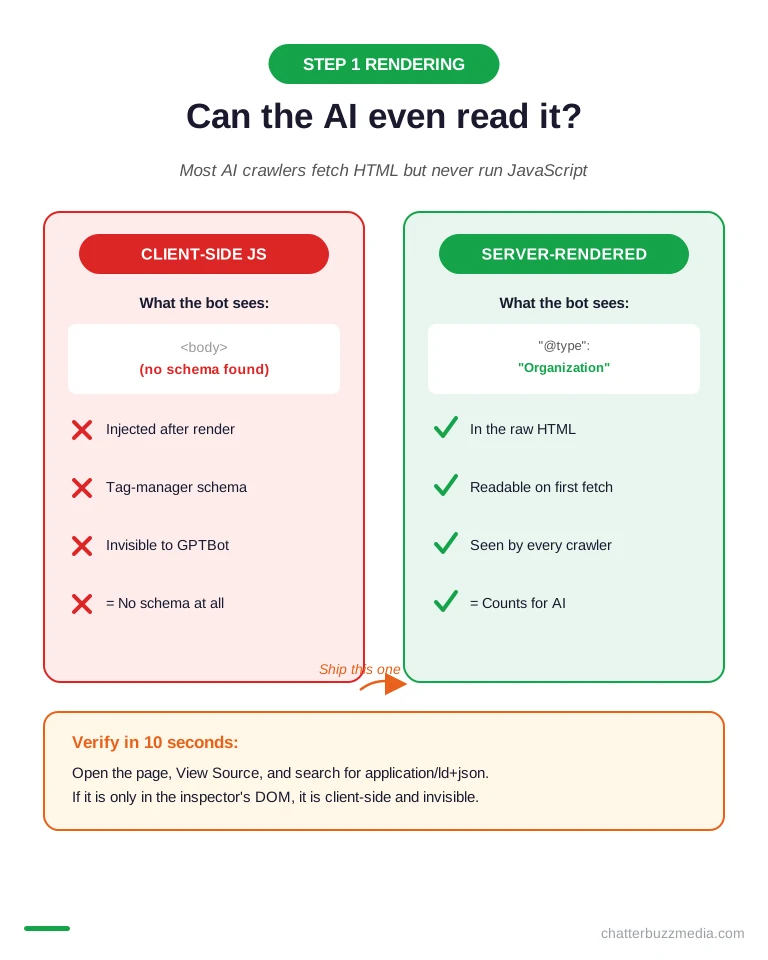
This is not a theory. Vercel’s analysis of real crawler traffic found that GPTBot downloads JavaScript on only a fraction of requests and executes none of it, and other AI bots behave the same way.
That means a page whose schema loads after render is, to an AI engine, a page with no schema at all. The fix is to output JSON-LD directly in the server-rendered HTML.
To verify, open the page, view the raw page source, and search for your application/ld+json block. If you only see it in the inspector’s rendered DOM but not in view-source, it is client-side and invisible to most bots.
A second check: paste the live URL into Google’s Rich Results Test and confirm the markup is detected on the fetched version, not just a pasted snippet. Getting this one thing right determines whether any of the next six steps matter, so it is worth protecting inside your site maintenance workflow.
Step 2: Ship your identity schema first (Organization and Person)
If you only add one thing, make it Organization and Person schema, because identity is the job schema does that writing cannot. These types tell AI engines that your brand is a single, consistent entity and connect it to the profiles that corroborate it.
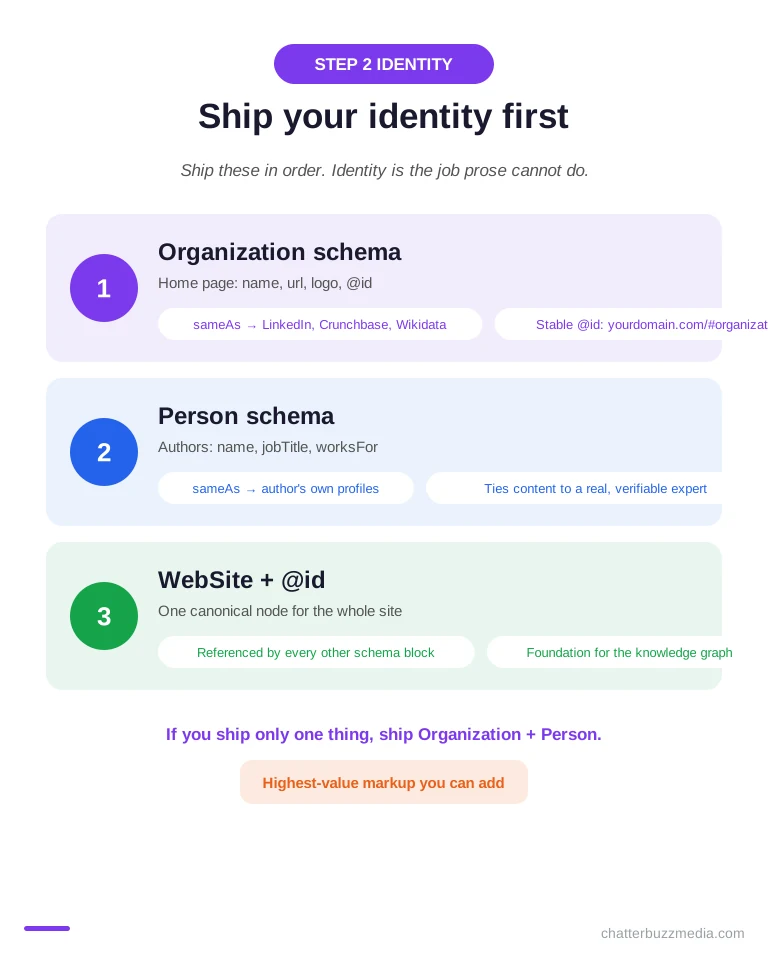
Organization schema belongs on your home page and names the brand, logo, and the sameAs links to your authoritative profiles. Those sameAs anchors, think LinkedIn, Crunchbase, Wikidata, and Wikipedia where applicable, are how an engine resolves “which company” you are.
Here is a minimal, server-ready Organization block:
- @type: Organization
- name, url, logo: the exact brand name, canonical URL, and a direct logo image URL
- sameAs: an array of your verified profile URLs
- @id: a stable identifier like
https://yourdomain.com/#organizationso other pages can reference it
Person schema does the same work for the humans behind your content. Mark up your authors with their role, employer, and their own sameAs profiles, which reinforces the author’s expertise and ties authorship to a real, verifiable identity.
This entity layer is the backbone of strong SEO and AEO performance, and it is the first thing to standardize across every property you own.
Step 3: Mark up every content page with Article and BlogPosting schema
Add Article or BlogPosting schema to every post and resource so engines can extract the headline, author, publisher, and dates cleanly. This is the markup that connects a specific page to the entity you built in Step 2.
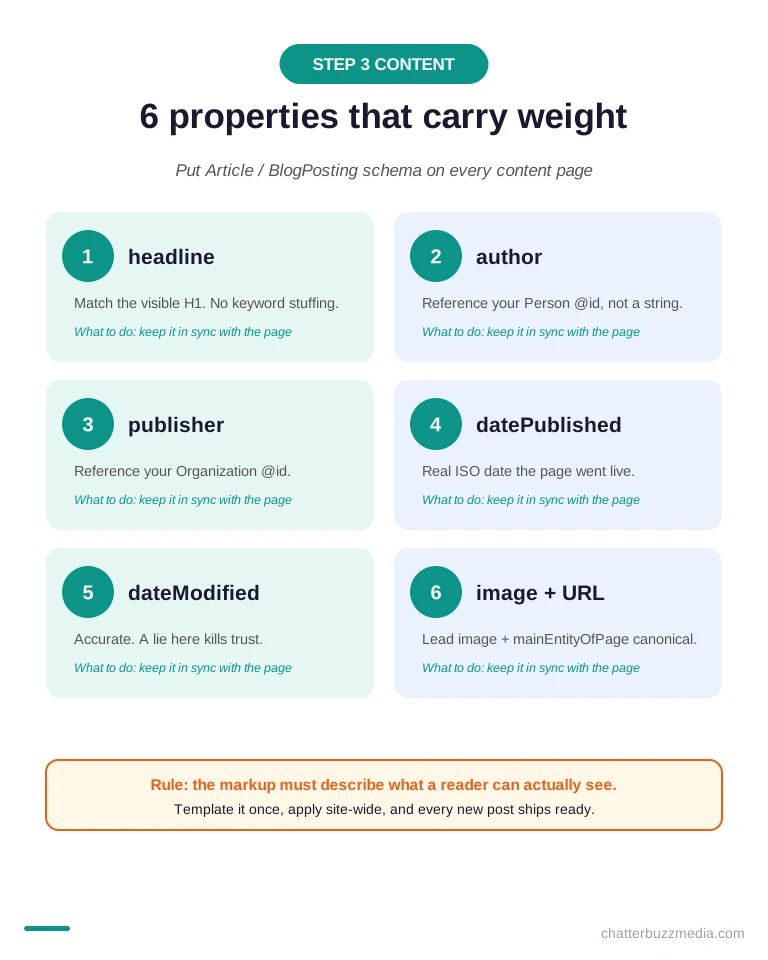
The properties that carry weight are the ones that establish freshness and provenance. Get these right on each page:
- headline: matches the visible H1, no keyword stuffing
- author: references your Person
@id, not a plain string - publisher: references your Organization
@id - datePublished and dateModified: real, accurate dates in ISO format
- image and mainEntityOfPage: the lead image URL and the canonical page URL
The single most common failure is a dateModified that lies. If your schema claims the page was updated yesterday but the visible content is years old, you undercut the trust signal you were trying to send.
Keep the markup in lockstep with what a reader sees. Accurate Article schema is low effort and compounds across a large content library, which is exactly why it is a high-leverage first project.
If your library is large, template the markup once and apply it site-wide rather than hand-coding each post. A consistent template is how a growing content operation keeps every new page machine-readable from the day it publishes.
Step 4: Add FAQ, Service, and Breadcrumb schema where they fit
Use FAQPage, Service, and BreadcrumbList schema selectively, only where the page genuinely contains that content. These secondary types add context for AI engines and, in some cases, still earn traditional rich results.
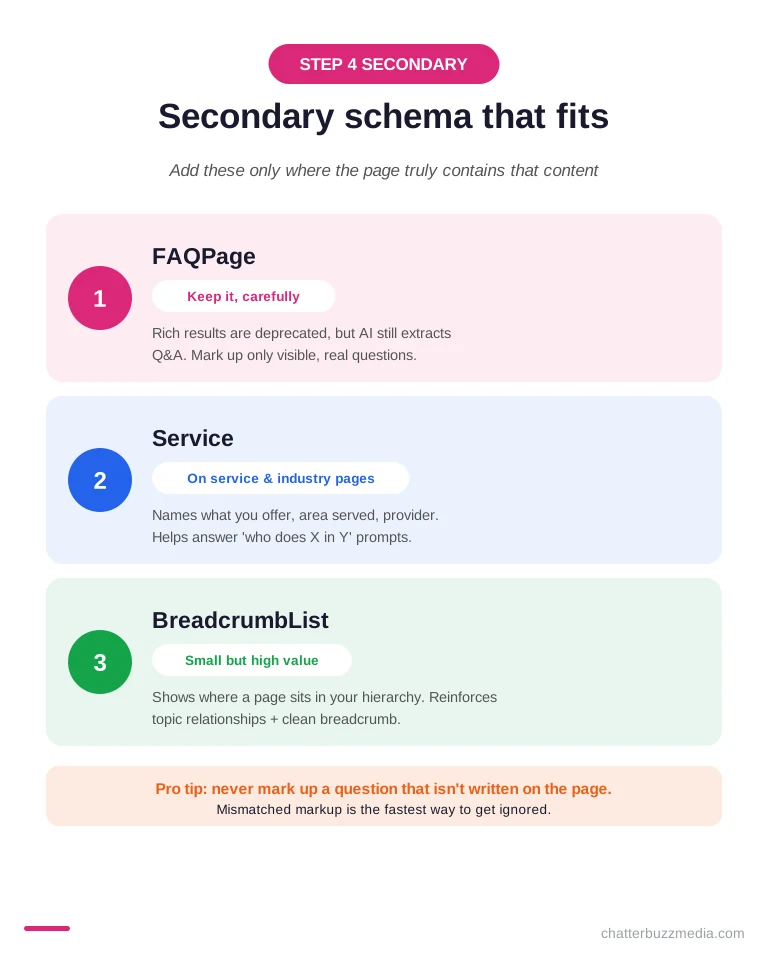
FAQ schema is worth a nuance. Google deprecated FAQ rich results for most sites, so the blue-link reward is largely gone, but the markup still helps AI engines pull clean question-and-answer pairs.
The rule: keep FAQ schema only when the questions and answers are visible on the page and genuinely useful. Never mark up questions that are not written on the page, which is a classic mismatch that gets flagged.
Service schema suits your service and industry pages. It names what you offer, the area served, and the provider, which helps engines answer “who does X in Y” style prompts for pages like local SEO services or conversion rate optimization.
BreadcrumbList is small but high-value. It communicates where a page sits in your site hierarchy, which both reinforces topic relationships and produces a clean breadcrumb in results.
Step 5: Connect everything into one knowledge graph with @id
Link your schema nodes together with @id references so engines see one coherent knowledge graph instead of disconnected snippets. This is what turns individual markup blocks into a map of your brand.
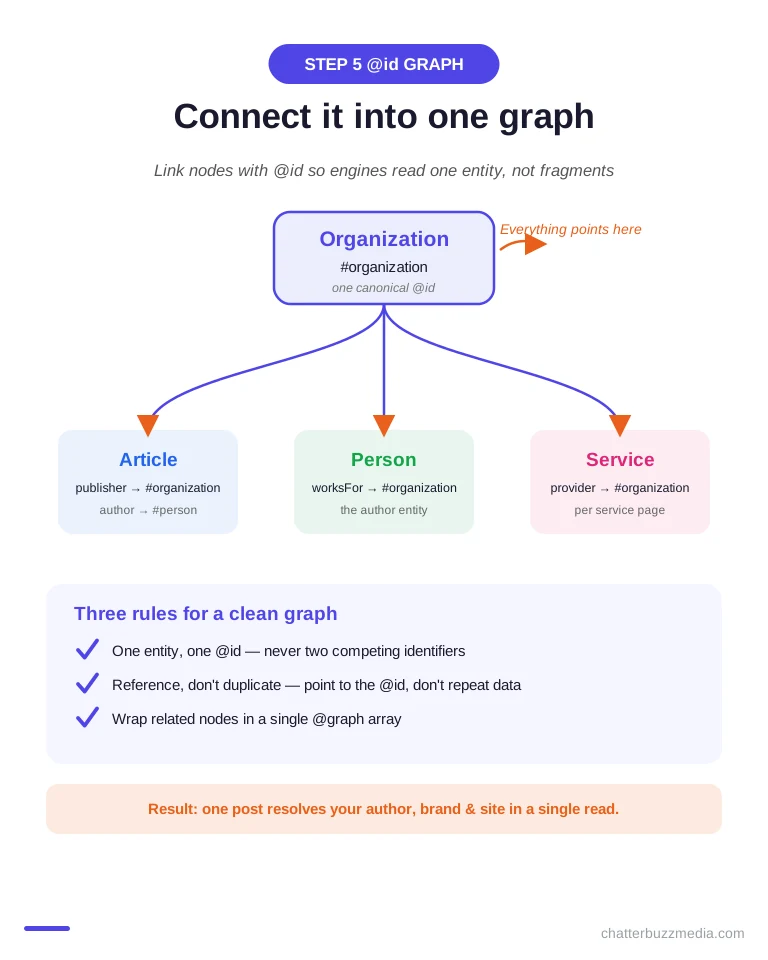
The mechanism is the @id property. Give your Organization, Person, and WebSite nodes stable identifiers, then reference those identifiers from every Article, Service, and FAQ node rather than repeating the full data.
A clean graph follows three rules:
- One entity, one @id: your organization has a single canonical identifier used everywhere, never two competing ones
- Reference, don’t duplicate: an article’s
publisherpoints to the Organization@id, keeping data consistent - Use @graph: wrap related nodes in a single
@grapharray so the relationships are explicit
When the graph is connected, an engine that lands on one blog post can resolve your author, your brand, and your site in a single read. That consistency is what entity-based search rewards, and it is the quiet advantage behind brands that get cited repeatedly across AI search surfaces.
The same entity discipline pays off in account-based programs, where buyers research you across many touchpoints before a conversation starts. A coherent graph means every surface tells the same story, which supports a tighter account-based marketing motion.
Step 6: Validate, then measure whether schema moved your citations
Validate every template before you ship, then run a controlled test to see whether schema actually changed your AI citations. Shipping invalid markup is worse than shipping none, because a parsing error can discredit the whole block.
Validation is quick. Run each page type through Google’s Rich Results Test and the Schema.org Validator, confirm there are no errors, and re-test the live, rendered URL rather than a pasted snippet.
Measurement is where most teams give up too early, and it is also where the honest data pays off. Because the citation lift from schema is small, you need a real test rather than a vibe:
- Treat and control: add or fix schema on 5 to 10 pages, leave 5 to 10 comparable pages untouched
- Hold for 30 days: let crawlers re-fetch and AI indexes refresh before you judge anything
- Track citations, not just rankings: log how often each page is cited in AI answers to your target prompts
- Compare the delta: measure the treated group against the control, not against last month
Expect modest, not miraculous, movement, and remember that content quality and third-party mentions do more heavy lifting than markup. Fold the citation numbers into your regular marketing reporting so schema earns its place on evidence, not faith.
Where schema fits in the bigger AI visibility picture
Schema markup is one input among several, and it works best alongside extractable content, entity consistency, and credible third-party coverage. On its own it is necessary but not sufficient for AI visibility.
The pages that get cited tend to do three things at once. They answer the question in plain, visible text near the top, they keep their entity signals consistent across the web, and they are validated by sources the engine already trusts.
Schema accelerates all three by making your answers machine-legible, but it cannot replace them. A thin page with perfect markup still loses to a substantive page that AI engines can quote directly.
So sequence it correctly: fix crawlability and server rendering, ship identity and content schema, connect the graph, then invest the rest of your energy in content and authority. That sequence is the core of a durable AI search strategy that holds up as engines change.
It also pairs with the broader shift in how AI is reshaping discovery and brand-building. For the wider context, our take on leveraging AI in marketing and the full library of marketing resources map where schema sits in the stack.
Frequently asked questions
1. 🔍 Does schema markup help you get cited by AI?
Modestly and indirectly. Controlled testing shows adding JSON-LD moves citations only a few percentage points, but cited pages are roughly three times more likely to carry schema, so it is best treated as foundational infrastructure rather than a direct citation trigger.
2. 📄 Do AI crawlers actually read JSON-LD schema?
Yes, when they can see it. Most AI bots fetch HTML but do not execute JavaScript, so schema must be rendered server-side in the raw HTML, or those crawlers will never process it.
3. ⚡ Which schema type matters most for AI search?
Organization and Person schema, because they establish your brand and authors as consistent entities. Identity markup is the one thing schema does that your written content cannot, which makes it the highest-priority type to ship.
4. 🧩 Is schema markup a ranking factor for AI search?
Not a direct one. Google has stated that no special structured data is required for AI features, so schema works by improving clarity and entity recognition rather than acting as a ranking signal you can dial up.
5. 🗂️ Should I remove FAQ schema now that Google deprecated FAQ rich results?
Keep it where the Q&A is genuinely visible and useful. The rich-result reward is mostly gone, but the markup still helps AI engines extract clean question-and-answer pairs, so there is little downside to compliant FAQ schema.
6. 🛠️ How do I validate my structured data?
Run each page type through Google’s Rich Results Test and the Schema.org Validator, and always test the live rendered URL instead of a pasted snippet. Invalid markup can discredit the entire block, so fix every error before shipping.
7. ⚠️ Can schema markup hurt my site?
Yes, in two ways. Markup that describes content a reader cannot see can be treated as spam, and invalid or mismatched data erodes trust, which is why accuracy and alignment with visible content matter more than volume.
8. 📈 How long until I see results from schema?
Plan on 30 days or more before judging anything. Crawlers need time to re-fetch pages and AI indexes refresh on their own schedule, so a fair before-and-after test needs a full month of data at minimum.
Conclusion: a schema build order that earns citations
Schema markup will not carry your AI visibility by itself, but skipping it leaves clarity and trust signals on the table that your competitors are already claiming. The teams that win treat it as the readable foundation under better content and stronger authority.
Here is the order to work in:
- 1. Fix rendering: confirm your JSON-LD is server-rendered and visible in view-source, not injected client-side.
- 2. Ship identity: add Organization and Person schema with accurate
sameAslinks across your core pages. - 3. Mark up content and connect it: add Article, FAQ, and Service schema where they fit, then wire everything together with
@idreferences. - 4. Validate and measure: test every template, then run a 30-day treat-and-control experiment to prove the lift.
Do those four things and your pages become unambiguous to the engines deciding what to quote. For the full strategy that schema plugs into, start with our answer engine optimization guide, or run a free digital marketing audit to see where your technical foundation stands today.

Victoria Wallace
Victoria Wallace is a senior content strategist and marketing writer with 30+ years of experience helping more than 200 brands translate complex business goals into clear, conversion-focused content. Her background spans paid media, marketing strategy, go-to-market planning, brand positioning, and full-funnel campaign development, giving her a deep understanding of how SEO content connects to real business growth.