
 321-236-2899

SEO for Financial Services: Rank for Money Terms Safely
Search is where your next member or account holder starts, long before they ever walk into a branch or open an app. Most people who are shopping for a checking account, a mortgage, or a business loan turn to online sources first, and Forrester has found that the majority research potential bank accounts online before they decide.
This guide walks through a practical, compliance-safe approach to SEO for financial services, built specifically for banks and credit unions that need to rank for high-intent “money terms” without tripping an examiner or a marketing regulation. We have used the same framework to grow organic visibility for regulated financial brands, where every rate, claim, and disclosure has to clear a compliance review before it goes live.
By the end, you will know exactly how to find the keywords worth chasing, how to build pages that rank and convert, and how to keep legal and compliance on your side instead of blocking every draft. Let’s start with why finance is a different game than most SEO advice assumes.
Key Takeaways
- Financial sites are YMYL (“Your Money or Your Life”), so Google holds them to a higher bar for experience, expertise, authoritativeness, and trust (E-E-A-T).
- Money terms are winnable when you match page type to intent: rate and product pages for transactional searches, guides for research, and local pages for “near me” demand.
- Compliance is a workflow, not a blocker—a pre-approved snippet library and a defined review SLA let you publish fast and stay within NCUA, FDIC, and CFPB rules.
- Your trust signals already exist. FDIC or NCUA insurance, real advisors, security pages, and member reviews are E-E-A-T gold when you surface them correctly.
- Measure members and funded loans, not just rankings—organic SEO compounds and usually beats paid search on long-run cost per acquisition.
What Makes SEO for Financial Services Different
SEO for financial services is harder than ordinary SEO because Google treats money topics as “Your Money or Your Life” (YMYL) content and applies its strictest quality standards to them. A thin page that would rank fine for a hobby blog will struggle for “best savings account rates,” because the stakes for the searcher are real.
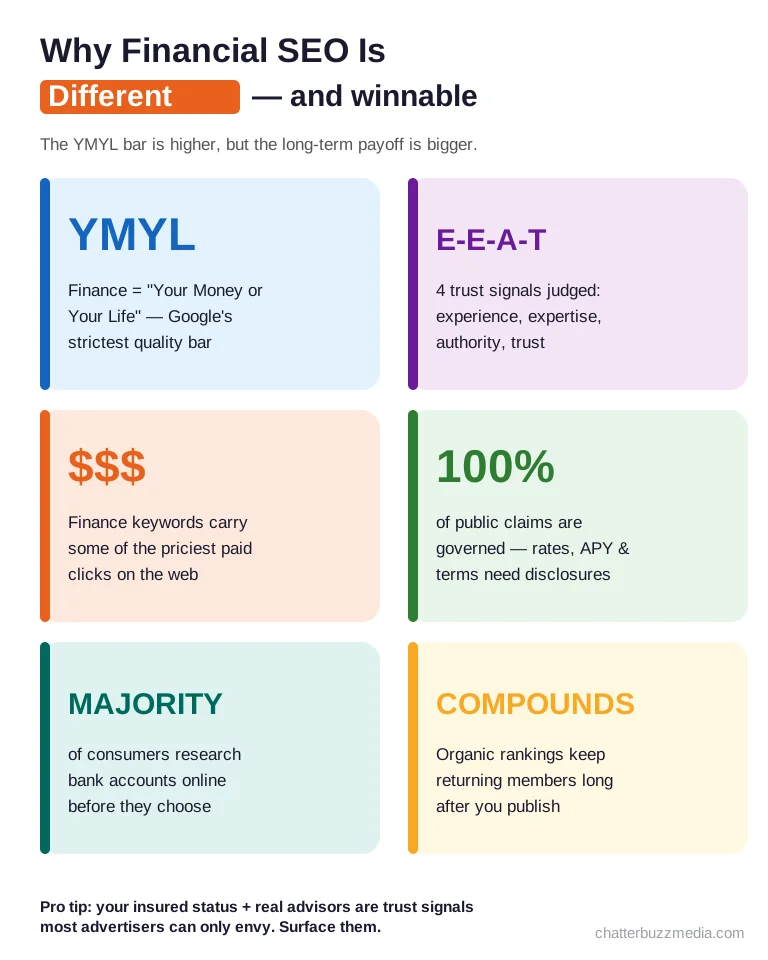
That higher bar shows up as E-E-A-T: experience, expertise, authoritativeness, and trust. Google’s own guidance on helpful, reliable content makes clear that who created the content, and how trustworthy the site is, matter more in sensitive categories.
The second complication is money. High-intent finance keywords carry some of the most expensive paid clicks on the web, which is exactly why durable organic rankings are so valuable—and why competitors fight hard for them.
The third complication is unique to regulated institutions: every public claim is governed. A rate, an APY, a loan term, or even the phrase “free checking” can trigger disclosure requirements, so your SEO process has to account for compliance from the first draft.
For banks and credit unions, that combination is actually an advantage. You hold trust signals most advertisers can only envy, and a compliance-aware approach is a real differentiator against generic SEO shops that ignore it. If you want the broader context first, our primer on digital marketing for financial services sets the stage.
One more shift raises the stakes. AI Overviews and answer engines now sit above traditional results for many finance queries, so a single cited answer can capture attention that used to be spread across ten blue links.
That makes structured, genuinely helpful content more valuable than ever. The institutions that write clearly and prove their expertise are the ones both Google and AI assistants reward.
Step 1: Map the Money Terms Worth Ranking For
Start by sorting every target keyword by search intent, because intent decides which page type can rank—not the keyword’s volume. A single product page cannot satisfy a shopper comparing rates and someone asking how an APY is calculated, so you need a map before you write a word.
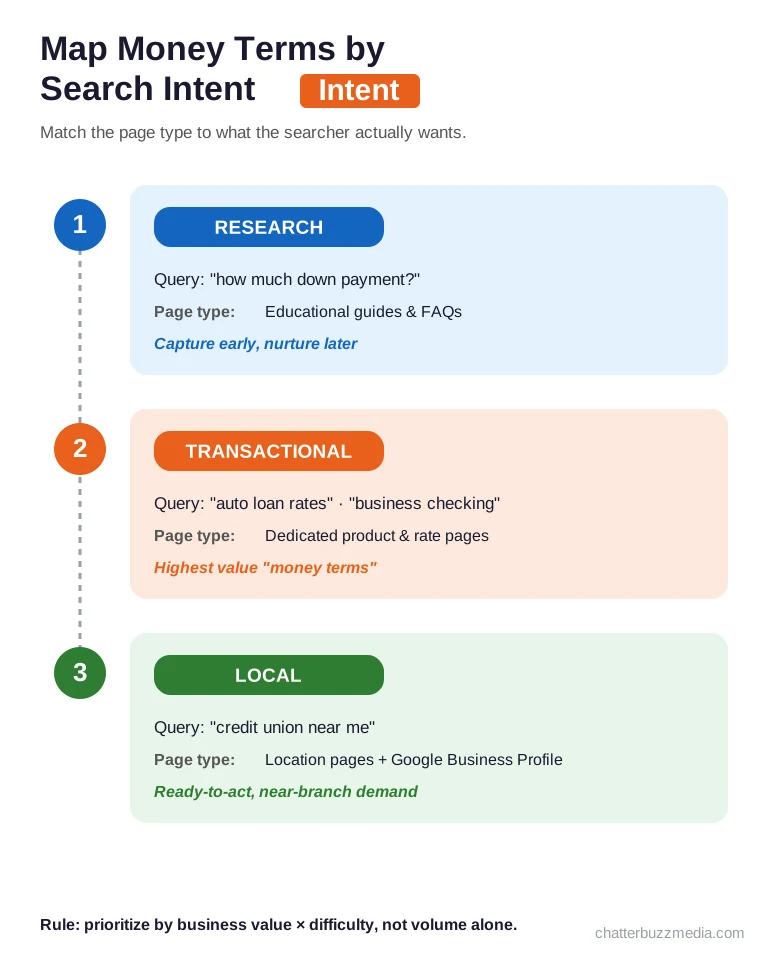
Group your opportunities into three buckets. Transactional “money terms” (“business checking account,” “auto loan rates,” “mortgage pre-approval”) deserve dedicated product and rate pages. Research terms (“how much down payment for a house,” “CD vs. money market”) deserve educational guides. Local terms (“credit union near me,” “banks in Tampa”) deserve location pages and a strong Google Business Profile.
Prioritize by a simple blend of business value, search volume, and difficulty. A keyword like “seo for financial services” may be moderate in volume but very high in value, while a long-tail question can be easy to win and send qualified traffic that converts later.
Build a topical map so every product has a hub and supporting spokes. A “mortgages” hub links to spokes on rates, first-time buyers, refinancing, and pre-approval, which signals topical authority and keeps internal links logical.
Lean on real keyword data rather than guesses. Google Search Console, Ahrefs, or Semrush show the queries you already rank for, the questions members ask, and the difficulty of each term, which keeps your map grounded in demand you can actually capture.
Separate branded from non-branded terms. Branded searches like “[your institution] routing number” convert easily but reflect existing demand, while non-branded money terms grow the top of your funnel—track them apart so wins in one do not mask stalls in the other.
Do not ignore question keywords. Searches that begin with how, what, and is often carry lower competition and map directly to FAQ content and AI answers, giving a newer site an early foothold while the head terms mature.
Then pressure-test the list against what you already own. Mapping new targets against existing pages prevents keyword cannibalization, where two URLs compete for the same term and neither ranks well.
Finally, watch for seasonal and rate-driven demand. Searches for refinancing, CD specials, and tax-season products spike predictably, so plan the content ahead of those windows instead of chasing them late.
Finally, respect your own stage. If your domain is young, win long-tail and local terms first and earn the right to compete for head terms later—our breakdown of how long SEO takes to work explains why that sequencing matters. For a deeper framework, see our SEO content strategy guide.
Step 2: Build a Compliance-Aware Content Workflow
The single biggest reason financial SEO stalls is not Google—it is an internal review process that turns every draft into a three-week negotiation. Fix the workflow first, and velocity follows.
Begin with a pre-approved snippet library. Have compliance bless the exact wording of recurring elements once—your insurance statement, equal housing lender language, APR and APY disclosure templates, and standard rate-change caveats—so writers reuse approved text instead of reinventing risky phrasing every time.
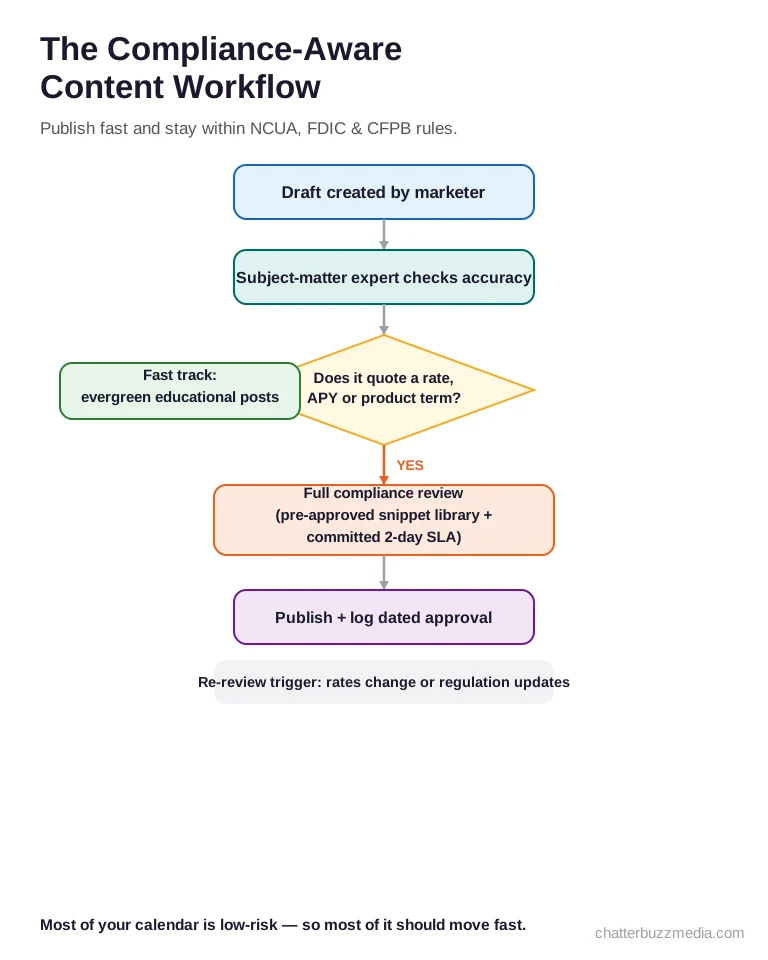
Define clear roles and a review SLA. A marketer drafts, a subject-matter expert checks accuracy, and compliance reviews only what is genuinely new or rate-sensitive, with a committed turnaround (for example, two business days) so content does not sit in limbo.
Route content by risk. Evergreen educational posts can move on a fast track, while anything that quotes a rate, an APY, or a specific product term goes through full compliance review. Most of your calendar is low-risk, so most of it should move quickly.
Give writers guardrails, not guesswork. A one-page style and claims guide—what you can say about rates, which superlatives are banned, when an “as of” date is required—prevents most compliance rework before it ever starts.
Keep an audit trail. Version every approval, date it, and set a re-review trigger whenever rates change or a regulation updates, which also satisfies examiners who want to see that marketing claims are controlled. The payoff is real: a workflow like this is the difference between publishing twice a month and publishing twice a week.
Step 3: Write Money-Term Pages That Rank and Stay Compliant
A money-term page has to do two jobs at once: satisfy the searcher’s intent well enough to rank, and carry every disclosure the product legally requires. Treat both as non-negotiable and bake them into a repeatable template.
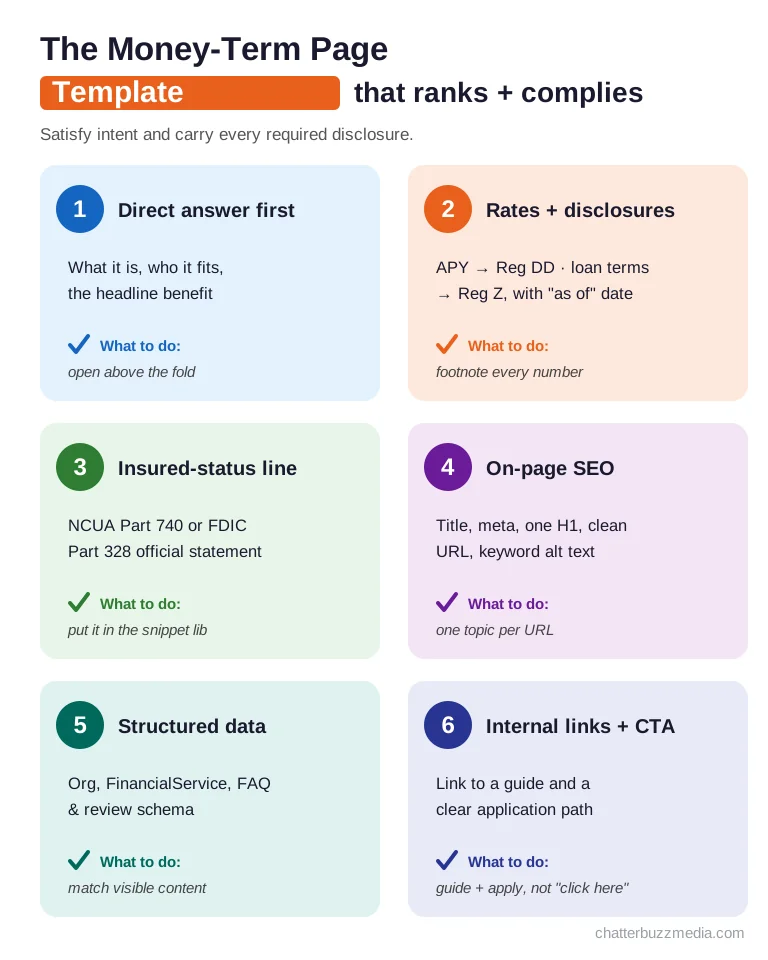
Open with a direct answer. If the query is “high-yield savings account,” the first lines should state what it is, who it fits, and the headline benefit—because a clear, direct opening is what earns featured snippets and AI search citations.
Handle rates and numbers with care. Any advertised APY must follow the Truth in Savings Act and its Regulation DD requirements, and advertised loan terms must meet Regulation Z (Truth in Lending), so pair every number with its required disclosure and an “as of” date.
Carry your insured-status language correctly. Credit unions must follow the NCUA’s advertising rule (Part 740) and display the official insured statement, while banks follow the FDIC’s Part 328 advertising and official-sign rules. These belong in your pre-approved snippet library so they appear automatically.
Add structured data. Organization, LocalBusiness or FinancialService, FAQ, and review schema help search engines and AI models understand your pages and can earn rich results, as long as the marked-up content matches what users actually see.
Write for the skimmer and the regulator at once. Short paragraphs, descriptive subheads, and a clean comparison table make a rate page easy to scan, while footnoted disclosures keep the same page defensible in a compliance review.
Keep each page focused on one product. Trying to rank a single URL for checking, savings, and loans at once dilutes relevance and confuses both searchers and Google.
Then layer on standard on-page SEO: a descriptive title and meta description, one clear H1, logical subheads, a short clean URL, and keyword-rich alt text on every image. Add a brief FAQ to capture long-tail questions, and link each product page to a relevant guide and to a conversion path—our notes on landing page CRO show how to turn that traffic into applications.
Step 4: Prove E-E-A-T With Trust Signals You Already Have
You do not need to manufacture authority for a financial brand—you need to surface the trust you have already earned. Most banks and credit unions bury their strongest E-E-A-T signals in footers and “About” pages where neither users nor Google can weigh them.
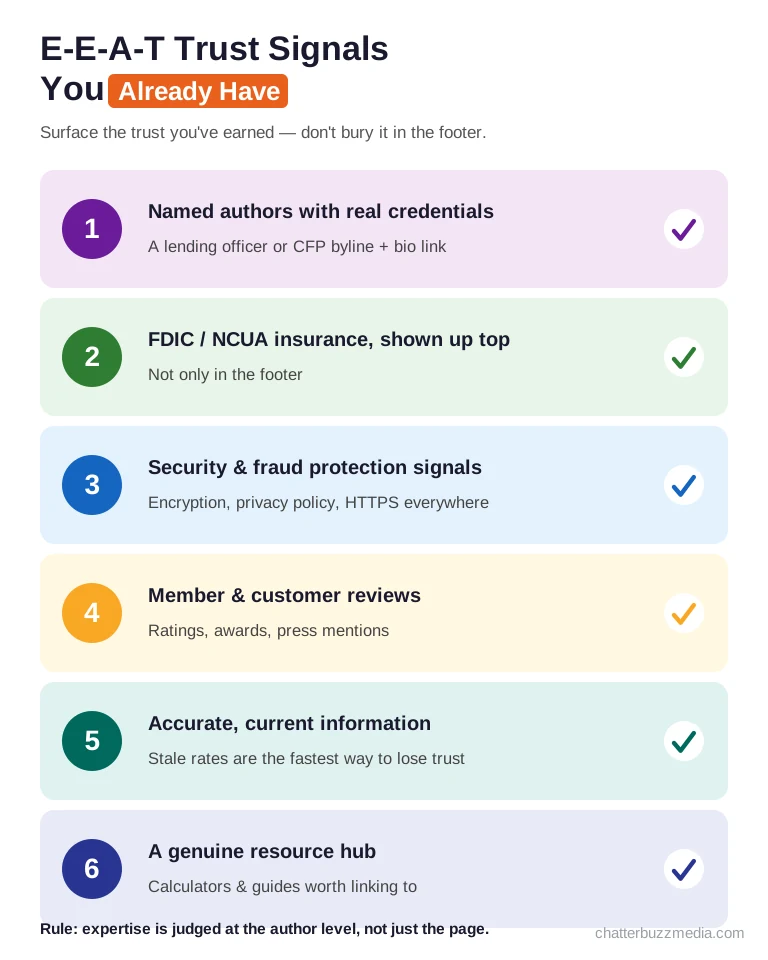
Put real people on your content. Give rate guides and product explainers a named author with genuine credentials—a lending officer, a CFP, a branch manager—and a bio that links to their profile, because expertise is evaluated at the author level, not just the page.
Make insurance and security obvious. Your FDIC or NCUA membership, encryption, fraud protection, and regulatory memberships are exactly the trust markers Google’s raters look for, so display them near the top of key pages, not only in the footer.
Do not overlook the basics of site trust. HTTPS everywhere, a clear privacy policy, visible contact information, and fast, stable performance are table-stakes signals that a financial site is legitimate and safe to transact with.
Build out a genuine resource hub. Calculators, rate explainers, and plain-language guides demonstrate first-hand experience and give other reputable sites something worth linking to, which lifts authority across your whole domain.
Use third-party proof. Member and customer reviews, recognizable ratings, awards, and press mentions all reinforce authoritativeness; a real-world example like our work with a community bank shows how reputation compounds over time.
Keep information current and accurate. Outdated rates or stale advice are the fastest way to lose trust in a YMYL category, so schedule reviews and cite reputable sources. If you want a shared vocabulary for your team, our credit union marketing glossary and SEO best practices are good internal references.
Step 5: Win Local Search and AI Citations for Every Branch
For institutions with branches, local search is often the highest-ROI SEO you can do, because “bank near me” and “credit union near me” searches come from people ready to act. The same signals that win the local map pack increasingly influence whether AI assistants recommend you too.
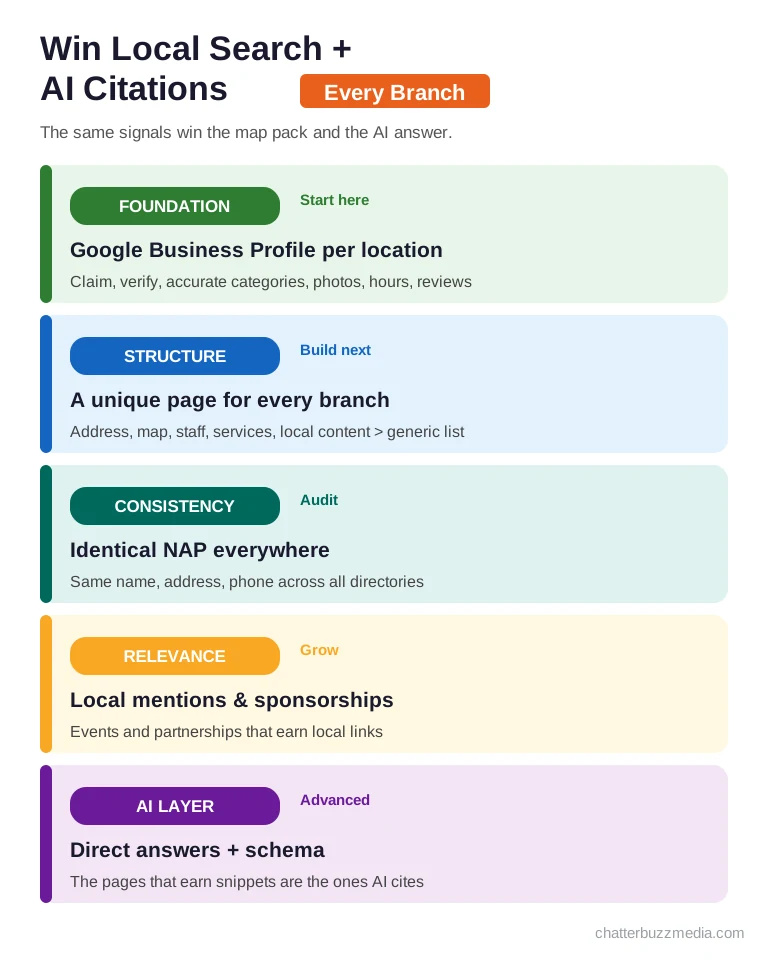
Start with your Google Business Profile for every location. Claim and verify each branch, choose accurate categories, add real photos, keep hours current, and collect and respond to reviews consistently.
Build a unique page for each branch. A real location page with its address, embedded map, staff, services, and locally relevant content will outrank a generic “locations” list—our deep dive on multi-location SEO for credit unions covers the structure in detail.
Keep your name, address, and phone (NAP) identical everywhere. Inconsistent citations across directories confuse search engines and dilute local ranking, so audit and standardize them, and lean on dedicated local SEO tooling if you manage many branches.
Earn local relevance beyond listings. Community sponsorships, financial-literacy events, and partnerships with nearby organizations create the kind of local mentions and links that strengthen both map-pack rankings and overall authority.
Make mobile the default. Most local financial searches happen on a phone, so fast load times, tap-to-call buttons, and easy branch directions directly affect whether a searcher becomes a visitor.
Extend the same work to AI search. The pages that earn featured snippets and clear, well-structured answers are also the ones large language models cite, which is why SEO and answer engine optimization now work hand in hand—see our AEO guide for the specifics.
Step 6: Measure SEO by Members and Funded Loans
Rankings are a means, not the goal—the metrics that matter to a financial institution are applications started, accounts opened, and loans funded from organic search. If your SEO report stops at keyword positions, it is not telling leadership whether the investment paid off.
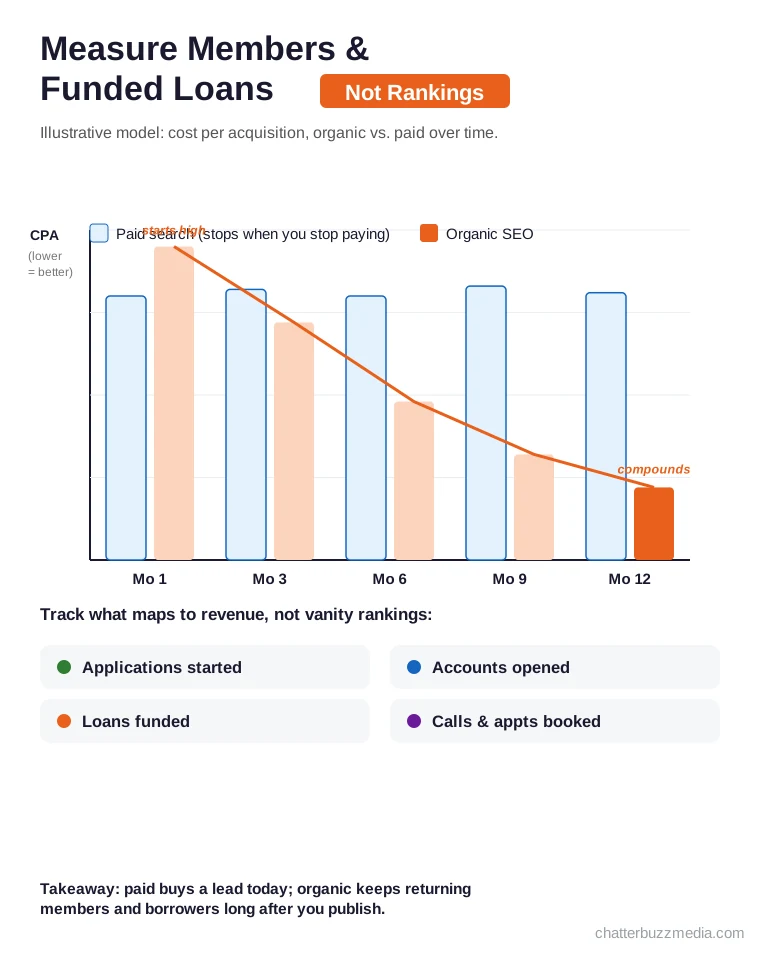
Connect organic traffic to outcomes. Track goal completions for account applications, loan inquiries, appointment bookings, and calls, and attribute them back to the pages and queries that drove them.
Watch the leading indicators too. Organic sessions, non-branded impressions, and rankings for your priority money terms tell you where momentum is building before the conversions show up, since SEO compounds over months rather than flipping on like paid media.
Compare cost per acquisition honestly. Paid search can buy a lead today, but organic rankings keep returning members and borrowers long after the content is published, which is why organic usually wins on long-run cost per funded loan.
Do not neglect the technical foundation that makes measurement trustworthy. Clean technical SEO—crawlable pages, correct canonicals, fast load times, and accurate conversion tracking—ensures the data you report reflects reality, and steady link building keeps competitive money terms within reach.
Set a reporting cadence leadership will actually read. A short monthly scorecard—organic applications, top money-term rankings, and pipeline influenced—keeps SEO funded far better than a 40-tab keyword export nobody opens.
Report in the language of the business. Translate “we gained 14 positions” into “the auto-loan page now drives an estimated X applications a month,” and pair SEO with paid search for financial services where speed matters. For the full channel picture, the credit union marketing guide ties it together.
Frequently Asked Questions
1. 🔍 What is SEO for financial services?
SEO for financial services is the practice of optimizing a bank, credit union, or fintech website so it ranks in search for the terms people use to find financial products and advice. It differs from ordinary SEO because finance is a YMYL category with a higher trust bar and strict rules on how rates, terms, and insured status are advertised.
2. 📊 Is SEO worth it for banks and credit unions?
Yes—because most consumers research financial products online before they ever contact an institution, organic visibility captures demand at the moment of intent. Unlike paid search, which stops the day you stop paying, SEO compounds and typically delivers a lower long-run cost per account or funded loan.
3. ⚡ How long does financial services SEO take to work?
Most institutions see early movement on long-tail and local terms within three to six months, with competitive “money terms” taking longer as authority builds. A young domain should win easier local and question-based keywords first before competing for head terms.
4. 🏦 How do banks and credit unions keep SEO content compliant?
The practical answer is a workflow, not a case-by-case scramble. Maintain a pre-approved snippet library for insurance statements and rate disclosures, route rate-sensitive pages through full compliance review, and keep a dated audit trail so examiners can see claims are controlled.
5. 🤝 What is YMYL and E-E-A-T in finance SEO?
YMYL (“Your Money or Your Life”) is Google’s label for topics that can affect someone’s finances, health, or safety, and finance sites fall squarely in it. E-E-A-T—experience, expertise, authoritativeness, and trust—is the set of signals Google uses to judge whether a YMYL page deserves to rank.
6. 💰 What keywords should a bank or credit union target?
Target a mix of transactional money terms (product and rate keywords), research questions your members actually ask, and local “near me” searches for each branch. Prioritize by business value and difficulty rather than volume alone, and build topical hubs so each product has supporting content.
7. 🚀 Does SEO help banks get cited by AI search engines?
It does—the same clear, well-structured, trustworthy pages that earn featured snippets are the ones AI assistants pull from when they answer financial questions. Direct-answer openings, schema markup, and strong E-E-A-T all increase the odds of being cited.
8. 📈 Can you do financial services SEO in-house?
Smaller institutions can handle local SEO and foundational content in-house, especially with a clear workflow and the right tools. Competitive money terms, technical SEO, and link building usually benefit from specialists, so many teams run a hybrid model that keeps compliance in-house.
Conclusion: Your Financial Services SEO Action Plan
SEO for financial services rewards the institutions that treat trust and compliance as features, not friction. The brands that win money terms are the ones with a clear keyword map, a fast review workflow, and pages that prove expertise on every rate and product.
Here is the order of operations to put this guide to work:
- Map your money terms by intent and build a topical hub-and-spoke for each core product.
- Stand up a compliance-aware workflow with a pre-approved snippet library and a committed review SLA.
- Rebuild your top product and local pages with direct answers, required disclosures, and surfaced trust signals.
- Measure members and funded loans from organic, and reinvest in the pages and topics that convert.
If you want a broader playbook for the vertical, start with our digital marketing guide for credit unions or browse the full library of marketing resources and guides to go deeper on any step above.

Noah Reed
Noah Reed is a growth marketing strategist at Chatter Buzz who helps credit unions and financial institutions grow membership, deposits, and loan volume through paid search, SEO, CRO, and full-funnel demand generation. Working within a Google Premier Partner team, he focuses on the metrics that actually move revenue, such as cost per acquired member, close rate, and lifetime value, rather than vanity metrics. Connect with Noah on LinkedIn.