
 321-236-2899
PPC for Healthcare: 7 Steps to Compliant Paid Media
Healthcare paid media is the only channel where a perfectly optimized campaign can also be a compliance liability. This guide walks through seven steps to build PPC for healthcare campaigns that acquire patients without exposing protected health information or tripping Google’s policy filters.
Healthcare organizations have paid over $100 million in HIPAA fines tied to tracking technology violations since 2023, and in July 2023 the FTC and HHS jointly warned roughly 130 hospital systems and telehealth providers about pixel-based data leakage. The practices that survived those warnings did not stop advertising, and many of them lean on the same fundamentals covered in our med spa marketing guide. They rebuilt their tracking, campaign structure, and creative review around a single assumption: the ad platform will never be a trusted holder of patient data.
You will learn exactly which conversion signals are safe to send to Google and Meta, and which ones quietly turn a routine appointment confirmation into a reportable disclosure. Start with the constraint that shapes everything else.
Key Takeaways
- No major ad platform will sign a BAA. Google, Meta, and LinkedIn all decline business associate agreements, which means PHI can never legally leave your systems for theirs.
- The URL is the most common leak. Page paths, query strings, and page titles routinely encode condition or procedure data into standard conversion tags.
- Healthcare CPCs now run $3.50 to $6.80 with an 18% year-over-year increase, making wasted spend more expensive than in almost any other vertical.
- Campaign structure should mirror service lines, not diagnoses. Intent-based segmentation performs better and carries dramatically lower disclosure risk.
- Certain categories require LegitScript certification before a single ad can serve, including telemedicine, addiction treatment, and many med spa services.
- Modeled and aggregated measurement is the endgame. You optimize toward cohorts and offline conversions, not individual patient journeys.
Why PPC for Healthcare Costs More and Converts Differently
Healthcare paid media is more expensive than most verticals because demand is urgent, geographically constrained, and contested by well-funded aggregators. Average CPCs in healthcare Google Ads now sit between $3.50 and $6.80 depending on specialty and market, and the category posted an 18% year-over-year CPC increase driven largely by weight-loss drug and telehealth competition.
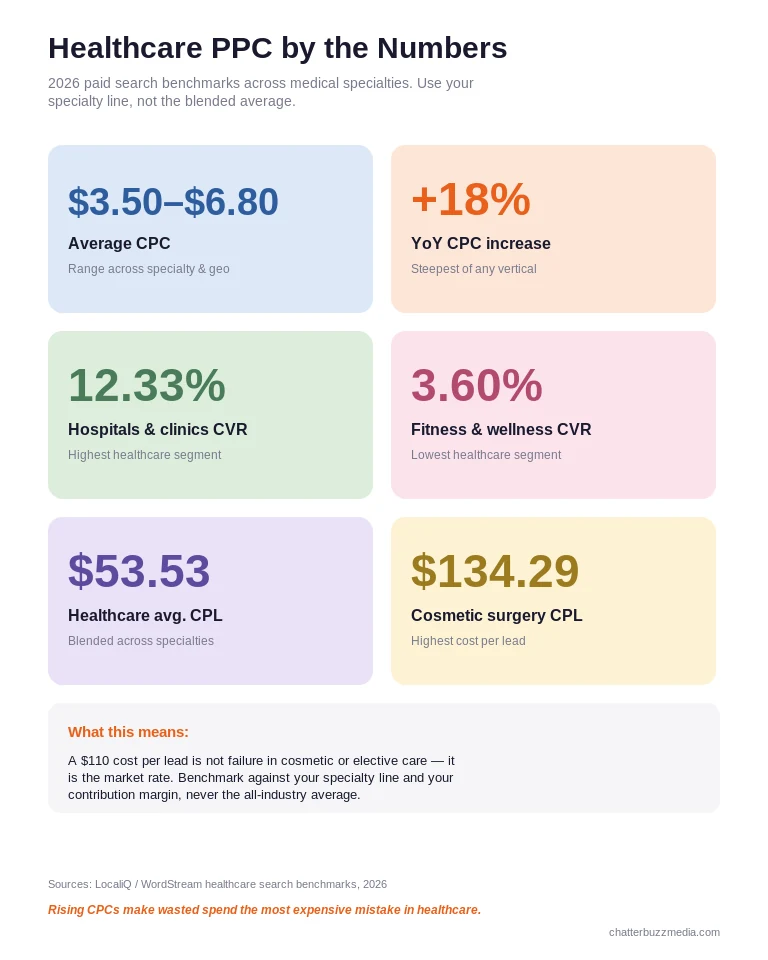
Conversion behavior splits sharply by specialty. Hospitals and clinics convert at roughly 12.33% while personal fitness services sit near 3.60%, and cost per lead ranges from about $32 for hospitals and clinics to $134 for cosmetic surgery.
That spread matters because it changes what “good” looks like. A med spa running a $110 cost per lead is not underperforming; it is operating normally in a category where the lifetime value of a patient justifies it.
Three structural factors drive the difference:
- Regulatory drag. Compliance review adds days or weeks between campaign idea and live ad, which slows the iteration cycle that makes paid media work.
- Degraded signal. Removing PHI from conversion data means the platform’s machine learning has less to optimize against than in retail or SaaS.
- Trust-gated conversion. Patients research providers longer and across more touchpoints than they do for most purchases, so last-click attribution consistently undercounts assisted conversions, a pattern we also see in other regulated verticals.
Organic visibility compounds the same effect, which is why the strongest healthcare accounts pair paid with specialty SEO and local search work. The practices that win are not the ones with the biggest budgets. They are the ones that removed compliance uncertainty from the workflow so the team can actually test.
Before you can test anything, you need to know which services you are even permitted to advertise.
Step 1: Audit Google’s Healthcare Policies Before You Build Campaigns
Google’s healthcare and medicines policy determines whether your ads can run at all, and it operates as a permission layer that sits above bidding, targeting, and creative. Some categories are outright prohibited, some require third-party certification, and some are permitted only in specific countries.
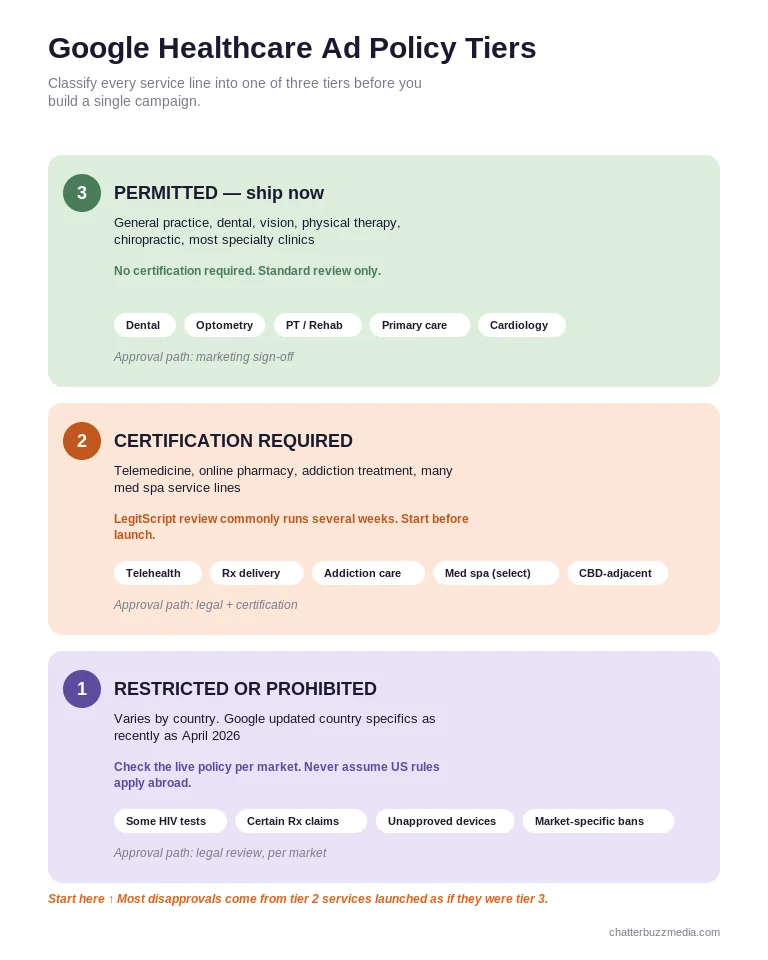
Google requires LegitScript certification for online pharmacies, telemedicine providers, and addiction treatment services. Many med spa and CBD-adjacent advertisers fall into the same bucket, and running without certification results in disapprovals and, in repeat cases, account suspension.
Work through this sequence before you write a single ad:
- Classify every service line against the current Google healthcare and medicines policy and note which require certification.
- Start certification early. LegitScript review commonly takes several weeks, so it belongs in your launch timeline, not your troubleshooting queue.
- Separate certified and uncertified services into different accounts or campaigns so a disapproval in one does not jeopardize the whole account.
- Check country-level restrictions if you serve multiple markets, since policy varies by geography and Google updated country specifics as recently as April 2026.
- Document your classification decisions in a shared file your compliance reviewer can audit later, alongside the rest of your Google Ads best practices documentation.
You now know what you are allowed to say. The harder question is what your website is allowed to send back.
Step 2: Build a HIPAA-Safe Tracking and Measurement Stack
The core rule is simple: no protected health information may reach a vendor that has not signed a business associate agreement, and no major ad platform signs one. Google Ads, Meta, LinkedIn, GA4, and Adobe Analytics all decline BAAs and prohibit PHI in their terms.
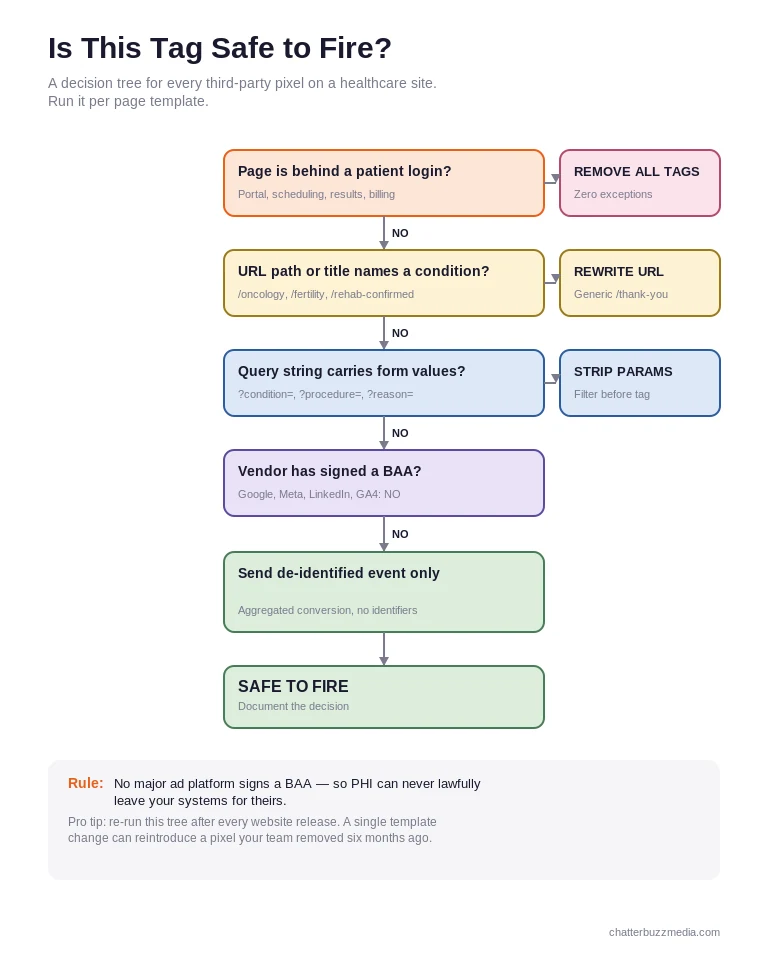
HIPAA defines 18 identifier types as PHI, and that list includes IP addresses and user IDs when they are linked to health context. A conversion tag firing on a page called /oncology/consultation-confirmed can therefore transmit PHI even though no name or record number is involved.
Build the stack in this order:
- Remove all marketing pixels from authenticated environments. Patient portals, scheduling logins, and results pages should carry zero third-party tags, full stop.
- Neutralize your URL structure. Replace condition-specific paths and confirmation pages with generic equivalents such as /thank-you so page path and page title carry no clinical meaning.
- Strip query parameters before they reach the tag. Form fields appended to a URL are the single most common accidental disclosure we see in healthcare audits.
- Route everything through a tag management system so you control precisely which tags fire on which templates, rather than relying on a global site tag.
- Understand server-side conversion APIs before you deploy one. Our Meta Conversions API guide explains what a server-side event actually contains and where filtering has to happen.
- Move to server-side tagging with field-level filtering where budget allows, which lets you send a conversion event while dropping every identifier attached to it.
- Use call tracking without recording. Forwarding numbers capture the fact and duration of a call safely; transcription and recording introduce PHI unless your vendor has signed a BAA.
One caveat on the legal landscape: a federal judge ruled in June 2024 that HHS exceeded its authority in parts of its 2022 tracking bulletin, specifically regarding IP addresses on unauthenticated pages. That ruling is narrow and does not change your obligations on authenticated pages or your vendor agreements.
With tracking contained, you can structure campaigns without worrying that segmentation itself becomes the disclosure.
Step 3: Structure Campaigns Around Service Lines, Not Conditions
Campaign architecture in healthcare should mirror how your practice delivers care, because service-line structure is both easier to manage and far less likely to encode a diagnosis into your account. A campaign named “Diabetes Patients” describes a health status; a campaign named “Endocrinology — New Patient” describes a service.
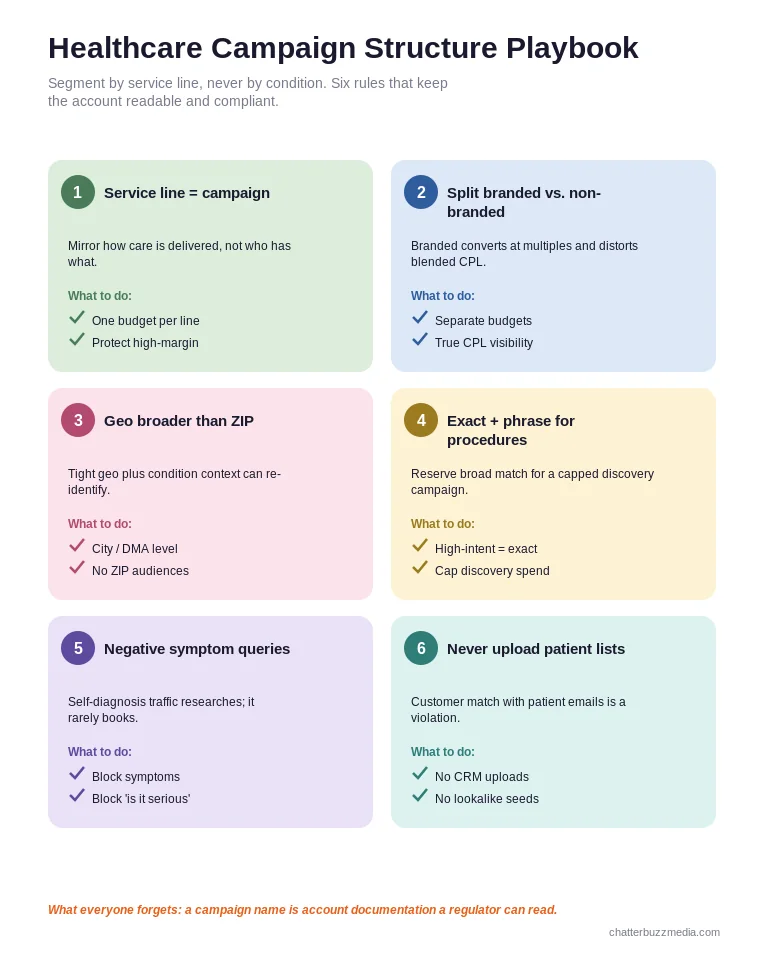
This distinction becomes concrete in audience settings. Retargeting a list of users who visited fertility treatment pages with fertility-specific creative reveals a probable health condition; retargeting all site visitors with a general brand message does not.
Apply these structural rules:
- One campaign per service line with its own budget, so a high-margin procedure never competes internally with a low-margin one.
- Separate branded and non-branded search. Branded terms convert at multiples of non-branded and will distort your blended CPL if they share a campaign.
- Keep geographic targeting broader than ZIP code for any audience-based targeting, since tight geo plus condition context can re-identify individuals.
- Use exact and phrase match for high-intent procedure terms and reserve broad match for a separate discovery campaign with a capped budget.
- Build negative keyword lists around symptoms and self-diagnosis queries, which generate research traffic that rarely books.
- Define your ideal patient profile first. The same discipline behind an ideal customer profile applies to service-line prioritization in healthcare.
- Avoid uploading patient lists entirely. Customer match with patient emails is a violation regardless of how the list was assembled.
Your account is now organized in a way a compliance officer can read without alarm. The next exposure point is the ad copy itself.
Step 4: Write Ad Copy That Converts Without Implying Health Status
The governing principle for healthcare ad copy is that the ad must never imply the viewer has a condition. Google’s personalized advertising policy prohibits creative that suggests knowledge of a user’s health status, and the same phrasing that triggers a disapproval also triggers patient distrust.
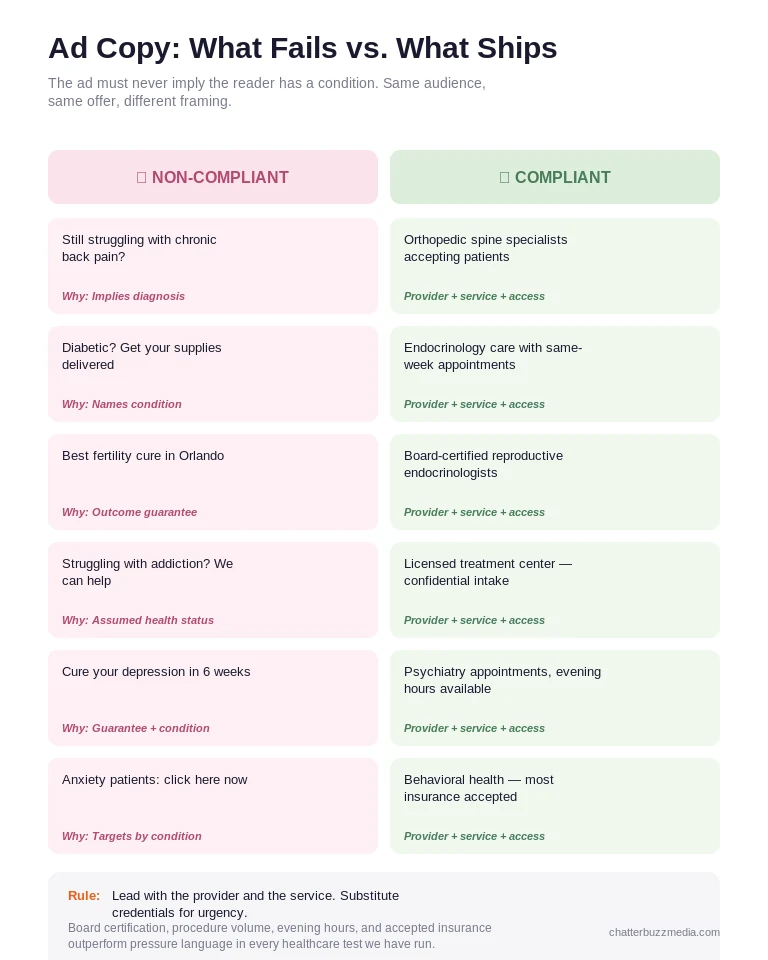
The rewrite is usually small. “Still struggling with chronic back pain?” becomes “Orthopedic spine specialists accepting new patients” — same audience, same offer, no implied diagnosis.
Use these patterns:
- Lead with the provider and the service, not the symptom or the reader’s assumed state.
- Substitute credentials for urgency. Board certification, years in practice, and procedure volume outperform pressure language in every healthcare test we have seen.
- Name the access barrier you remove. Same-week appointments, evening hours, and accepted insurance plans are the friction points patients actually screen on.
- Avoid outcome guarantees and superlatives such as “best” or “cure,” which invite both policy review and state medical board scrutiny.
- Use location and scheduling extensions aggressively, since proximity and availability drive more healthcare clicks than any headline variant.
- Refresh creative on a schedule. Healthcare audiences are small and geographically bounded, which accelerates ad fatigue — a structured creative testing framework keeps performance from decaying.
For practices running paid social alongside search, the medical spa marketing playbook and social advertising fundamentals carry over directly. Compliant copy tends to be plainer copy, and plainer copy tends to win. The same discipline applies once the click lands.
Step 5: Design Landing Pages That Convert Regulated Traffic
A healthcare landing page must accomplish something no other vertical requires: collect enough information to book a patient while collecting as little identifiable clinical data as possible before the handoff to a secure system. That tension is where most healthcare conversion rate problems originate, and it is why generic PPC landing page advice only takes a practice so far.
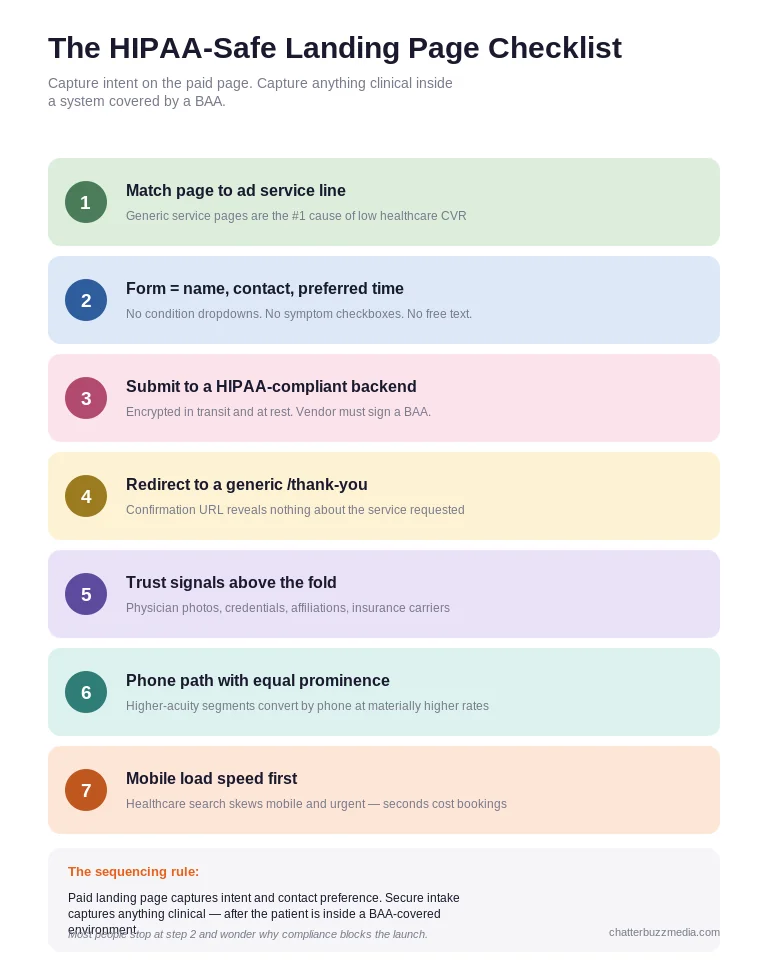
The fix is sequencing. Your paid landing page captures intent and contact preference; your secure intake system captures anything clinical, after the patient is inside an environment covered by a BAA.
Build against this checklist:
- Match the page to the ad’s service line exactly. Sending procedure traffic to a general services page is the most common cause of low healthcare conversion rates.
- Keep the paid form to name, contact method, and preferred time. No condition dropdowns, no symptom checkboxes, no free-text medical fields.
- Submit forms to a HIPAA-compliant backend with encryption in transit and at rest, and confirm your form vendor will sign a BAA.
- Redirect to a generic confirmation URL that reveals nothing about which service was requested.
- Lead trust signals above the fold — physician photos, credentials, hospital affiliations, and accepted insurance carriers.
- Offer a phone path with equal prominence. Older and higher-acuity patient segments convert by phone at meaningfully higher rates than by form.
- Test load speed on mobile first. Healthcare searches skew mobile and urgent, and every additional second measurably reduces booking rate.
Systematic conversion rate optimization matters more here than in unregulated categories, because you have fewer targeting levers to compensate with. You now have a click-to-booking path that holds up to review. What remains is proving it worked.
Step 6: Measure Performance Without Tracking Individuals
Healthcare measurement works by aggregation and modeling rather than individual attribution, which means you optimize toward cohort-level outcomes and offline conversion imports instead of user-level journeys. This is a real constraint, not a workaround, and it changes which metrics you should trust.
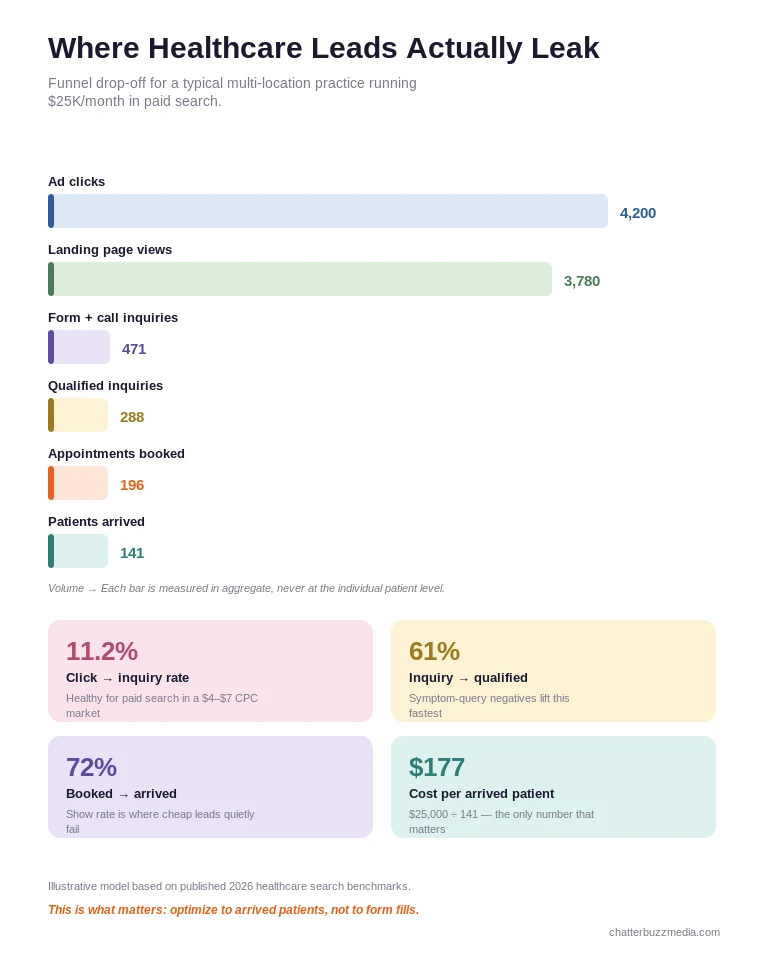
The most reliable healthcare measurement setups treat the ad platform as a bidding engine and the practice management system as the source of truth. You import de-identified outcome data back to the platform on a delay, letting it learn from booked appointments rather than form fills.
Focus your reporting on these layers:
- Cost per qualified inquiry rather than cost per form fill, since healthcare lead quality varies enormously by keyword intent.
- Show rate and booked-to-arrived ratio, which frequently exposes that your cheapest leads are your least likely to attend.
- Blended CAC by service line compared against the contribution margin of that service, not against a single practice-wide target. Our guide to calculating customer acquisition cost walks through the math.
- Geographic and time-of-day performance, which are safe dimensions carrying no clinical inference — useful inputs for geofencing and hyper-local targeting decisions.
- Incrementality tests via geo holdouts, the cleanest way to prove paid contribution when individual attribution is unavailable.
Build the reporting layer once. A consolidated reporting and data visualization setup that pulls platform spend against practice management outcomes removes most of the monthly reconciliation work.
Aggregated measurement is slower to read than a real-time dashboard, so the review cadence has to be deliberate.
Step 7: Build a Compliance Review Workflow That Scales
The difference between healthcare practices that advertise confidently and those that stall is a documented review workflow, not a more cautious marketer. When approval paths are ambiguous, teams default to inaction, and inaction is what actually costs patient volume.
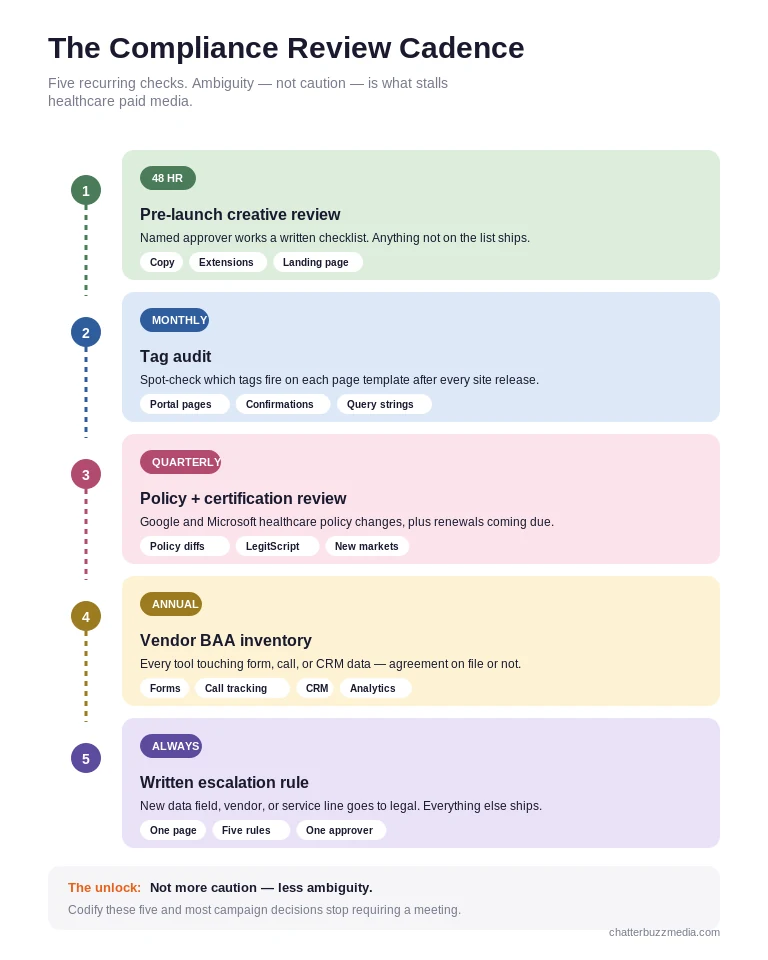
A workable cadence separates the three things that need review at three different frequencies: creative, tracking, and policy.
- Pre-launch creative review against a written checklist, with a named approver and a target turnaround of 48 hours.
- Monthly tag audit that spot-checks which tags fire on templated pages, since a single site release can reintroduce a pixel someone removed months earlier.
- Quarterly policy review covering Google and Microsoft healthcare policy changes and any certification renewals coming due.
- Annual vendor BAA inventory listing every tool that touches form data, call data, or CRM records, and whether an agreement is on file.
- An escalation rule in writing: any new data field, new tracking vendor, or new service line goes to legal before launch, and everything else ships on the marketer’s authority.
Practices without in-house paid media capacity often run this cadence with a performance marketing partner or an embedded fractional CMO who owns the approval path. Codify those five items and most campaign decisions stop requiring a meeting. That is the actual unlock — not more caution, but less ambiguity.
Frequently Asked Questions About Healthcare PPC
1. 🔍 Is Google Ads HIPAA compliant?
No. Google does not sign business associate agreements for Google Ads, so the platform cannot lawfully receive protected health information. You can still advertise compliantly by ensuring no PHI is ever transmitted — clean URLs, no pixels on authenticated pages, and no patient list uploads.
2. 📊 What is a good conversion rate for healthcare PPC?
It varies widely by specialty. Hospitals and clinics average around 12.33% while fitness and wellness services sit closer to 3.60%, against an all-industry average near 8.18%. Benchmark against your specialty, not against the aggregate.
3. ⚡ Can healthcare practices run retargeting campaigns?
Yes, with broad targeting only. Retargeting all site visitors with general brand messaging is generally acceptable; retargeting visitors of a specific treatment page with condition-specific creative discloses probable health status and carries substantial risk.
4. 🏦 Do I need LegitScript certification to advertise my practice?
Only for specific categories, including telemedicine, online pharmacy, addiction treatment, and several med spa service types. General medical practices, dental offices, and most specialty clinics do not require it, but you should verify your service lines against current policy before launch.
5. 🤝 How much should a medical practice budget for PPC?
Work backward from capacity rather than from a percentage of revenue. With healthcare CPLs averaging roughly $53 and ranging past $130 for cosmetic procedures, multiply your target monthly new-patient count by your specialty’s CPL and add 25% for testing headroom.
6. 💰 Why is healthcare PPC so expensive right now?
Healthcare posted an 18% year-over-year CPC increase, one of the steepest of any vertical, driven largely by competition around weight-loss medications and telehealth. Average CPCs now run $3.50 to $6.80 depending on specialty and geography.
7. 🚀 Can I use Google Analytics for a healthcare website?
GA4 does not offer a BAA and its terms prohibit PHI, so it can only be used on pages carrying no health context and with identifiers suppressed. Many healthcare organizations run a HIPAA-compliant analytics platform alongside or instead of GA4 for anything past the marketing site.
8. 📈 How long does healthcare PPC take to produce results?
Expect 30 to 60 days for stable signal and 90 days before optimization decisions are reliable, which tracks with general Google Ads ramp timelines. Degraded conversion data means platform learning is slower in healthcare than in verticals with full user-level tracking, so resist restructuring campaigns before you have enough volume to read.
Turning Compliance Constraints Into a Paid Media Advantage
Healthcare PPC rewards operators who treat regulation as a design input rather than an obstacle. The practices capturing patient volume right now are the ones that removed PHI from their tracking layer, structured campaigns around service lines, and gave their team a written approval path so testing could actually happen.
None of that requires a bigger budget. It requires deciding once how data moves through your systems, then building campaigns on top of that decision.
Your next four steps:
- Run a tag audit this week. List every third-party tag on your site and flag any that fire on authenticated or condition-specific pages.
- Rewrite your confirmation URLs so no page path, title, or parameter reveals a service or condition.
- Reorganize campaigns by service line and separate branded from non-branded search so your CPL numbers become readable.
- Document your review workflow — one page, five rules, one named approver — and circulate it to marketing and legal together.
For a broader view of how paid media fits alongside search, content, and conversion work in a regulated vertical, the paid search management overview, healthcare email marketing, and the full resource library cover the adjacent pieces in depth.

Victoria Wallace
Victoria Wallace is a senior content strategist and marketing writer with 30+ years of experience helping more than 200 brands translate complex business goals into clear, conversion-focused content. Her background spans paid media, marketing strategy, go-to-market planning, brand positioning, and full-funnel campaign development, giving her a deep understanding of how SEO content connects to real business growth.