
 321-236-2899

How to Get Cited by ChatGPT: The Page Changes That Earn Citations
Ask ChatGPT how to solve a problem in your industry, and it will name a handful of sources in its answer. Those cited pages win the click, the trust, and the next question. This guide shows you the exact page-level changes that move a URL from invisible to cited.
We have watched the same pattern play out across content audits: the pages that get pulled into AI answers are not always the ones ranking first in Google. They are the ones structured so a model can lift a clean, confident passage without guessing. That structure is something you control.
By the end, you will know how to rewrite a single page so ChatGPT can find it, read it, and quote it, starting with the one change that matters most.
Key Takeaways
- Lead with an answer capsule. Put a direct, 40-to-60-word answer to the page’s core question in the first 100 words, before any setup.
- Write in self-contained chunks. Each section should answer one question completely, so a model can quote it without needing the rest of the page.
- Add machine-readable schema. FAQPage, HowTo, Article, and Organization markup help ChatGPT’s retrieval layer parse what your page actually says.
- Back claims with specific numbers and named sources. Definitive, sourced statements get cited far more often than hedged opinion.
- Clear the technical blocks. If your robots.txt blocks AI crawlers or your content hides behind JavaScript, none of the above matters.
- Keep pages fresh and track citations. Citation is a moving target; dated, updated pages win, and monitoring tells you what is working.
What It Means to Get Cited by ChatGPT
Getting cited by ChatGPT means your page appears as a named, linked source inside an AI-generated answer, usually when the model browses the live web to verify a claim or find fresher information than its training data holds. A citation is not a ranking; it is an inclusion decision made passage by passage.
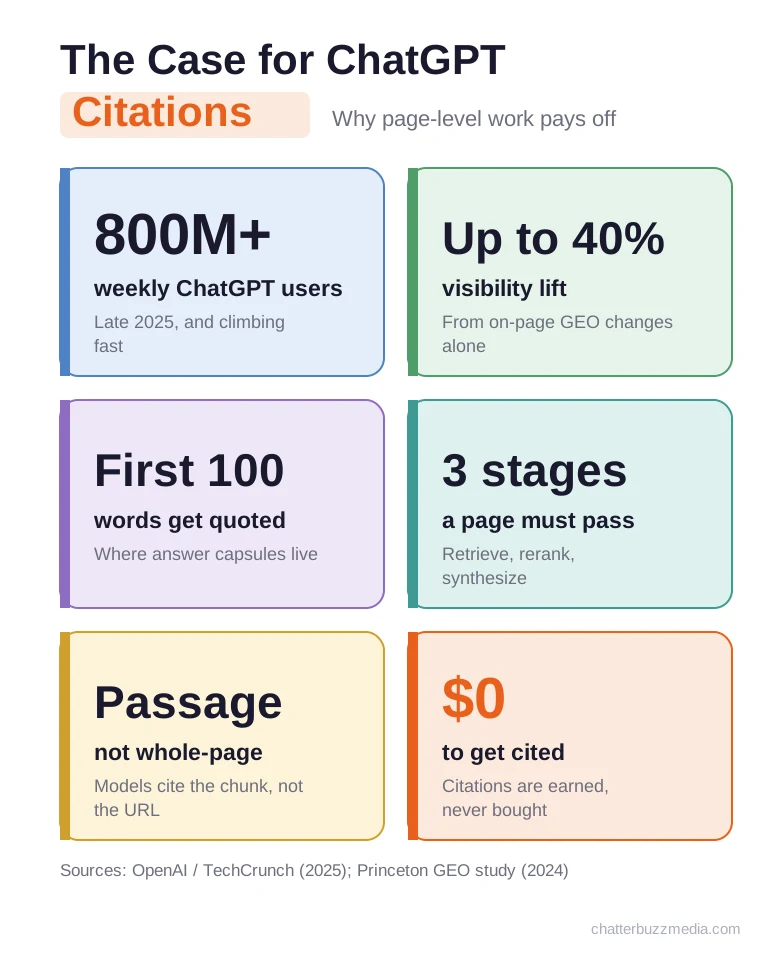
This matters because the audience is enormous and growing. ChatGPT crossed 800 million weekly active users in late 2025, and a large share of those conversations now carry commercial intent. When someone asks ChatGPT to recommend an approach or compare options, the cited sources shape the decision, a shift our AI advertising strategy breakdown traces across the funnel.
The strategic layer behind this shift is answer engine optimization, and it explains why the old playbook is not enough on its own. Our breakdown of SEO versus AEO covers that distinction in depth. This guide stays tactical: what to change on the page itself.
The good news is that citation rewards structure, not budget. A Princeton and Georgia Tech research team found that on-page changes alone can lift a page’s visibility in generative engines by up to 40%. Here is how the model decides, then the changes that earn it.
How ChatGPT Decides Which Pages to Cite
ChatGPT cites pages through a three-stage pipeline: it retrieves candidate pages from a live search index, reranks them for relevance and clarity, then synthesizes an answer and attributes the passages it actually used. Your page has to survive all three stages, and each one rewards different things.
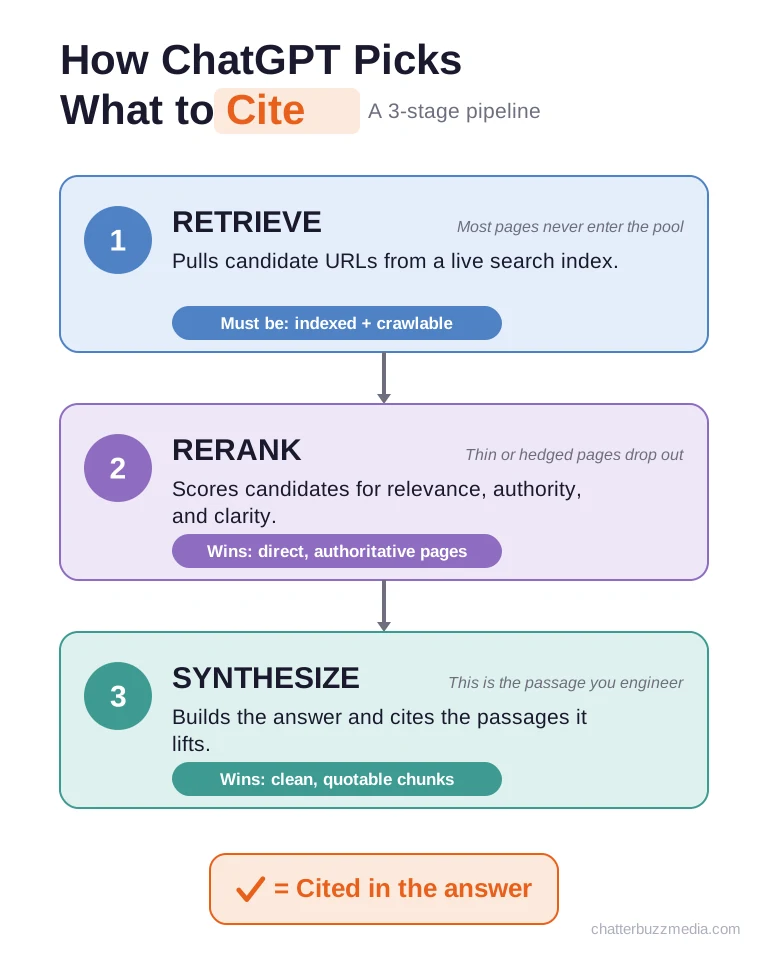
The first stage is retrieval. When ChatGPT browses, it pulls a set of candidate URLs from its search partner’s index, so if you are not indexed and crawlable, you never enter the pool.
The second stage is reranking. The model weighs each candidate for how directly it answers the query, how authoritative the domain looks, and how cleanly the relevant passage is written.
The third stage is synthesis. The model stitches together an answer and cites the specific passages it lifted, which is why a clean, quotable chunk beats a long, hedged paragraph every time. Everything below is about making your passages win stages two and three, once stage one lets you in.
Step 1: Lead Every Page With an Answer Capsule
The single highest-leverage change is to open the page with an answer capsule: a direct, 40-to-60-word answer to the page’s main question, placed in the first 100 words before any introduction or backstory. This is the passage models quote most often.
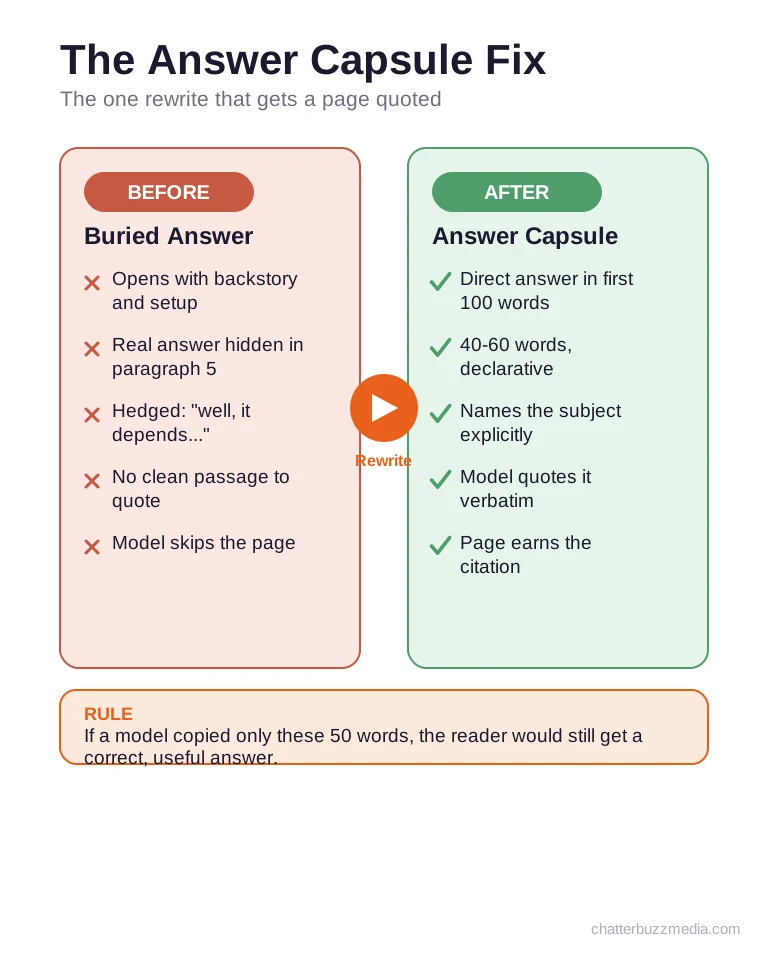
Most pages bury the answer. They open with context, a story, or a definition of the problem, forcing a model to dig for the payoff it can quote.
Flip that order. State the answer first in plain, declarative language, then expand with the nuance, examples, and caveats underneath.
A strong answer capsule does three things: it names the subject explicitly, it gives a complete answer in one or two sentences, and it avoids hedging words like “it depends” or “generally.” Write it so that if a model copied only those 50 words, the reader would still have a correct, useful answer. That is the test. This single move aligns your page with how our content maps to the customer journey, answering the real question at the moment it is asked.
Step 2: Write in Self-Contained, Citable Chunks
Break every page into self-contained chunks, where each H2 or H3 section answers one specific question completely without depending on the sections around it. Models cite at the passage level, not the page level, so a section that stands alone is a section that can travel into an answer.
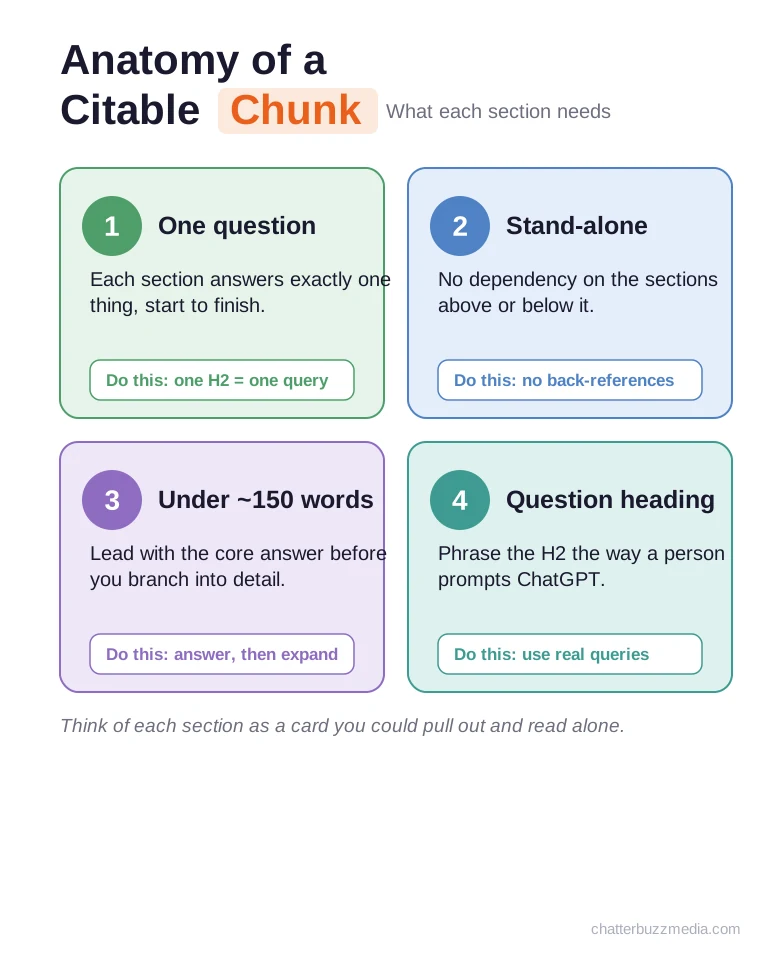
Think of each section as a card that could be pulled out and read on its own. If understanding section four requires reading sections one through three, the model cannot cleanly extract it.
Keep each chunk focused and tight, ideally under 150 words of core answer before you branch into detail. Open the section with its own mini answer capsule, the same way you opened the page.
Use a question-shaped heading whenever it fits, because it matches the way people actually prompt ChatGPT. A heading like “How long does it take to get cited?” maps directly onto a real query, and the passage beneath it becomes the obvious thing to quote. Clear structure also lifts conversions, which is why the same discipline shows up in strong conversion rate optimization work.
Step 3: Add the Schema ChatGPT’s Pipeline Can Read
Add structured data so the retrieval layer can parse exactly what your page is and what it claims, using schema.org types that match the content. Schema does not guarantee a citation, but it removes ambiguity about your page’s meaning, and clarity is what the reranking stage rewards.
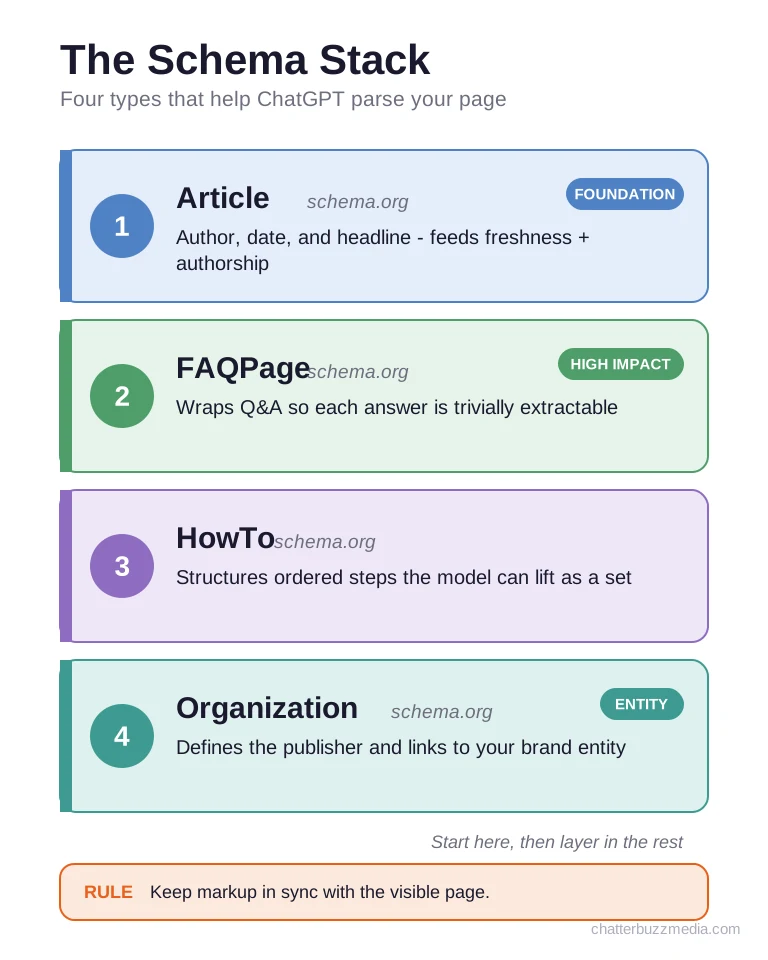
Four schema types carry most of the weight for citation-focused pages. Start with these, then layer in others only where they genuinely fit.
- Article schema establishes the page as a piece of content with an author, a publish date, and a headline, feeding the freshness and authorship signals models look for.
- FAQPage schema wraps your question-and-answer sections in machine-readable markup, making each answer trivially easy to extract.
- HowTo schema structures step-by-step content so the model can lift a complete, ordered procedure.
- Organization schema defines who published the page and connects it to your broader brand entity.
Keep your schema honest and in sync with the visible page, because markup that describes content that is not there invites penalties and erodes trust. For a fuller view of how structured data fits an AI-first strategy, our guide to AI marketing connects the technical and strategic sides.
Step 4: Make Your Brand Entity Unmistakable
Define your brand as a clear, consistent entity so ChatGPT knows what you are, what you do, and what you are not. Models reason about the world in entities, and a fuzzy or inconsistent entity is one they hesitate to cite as an authority.
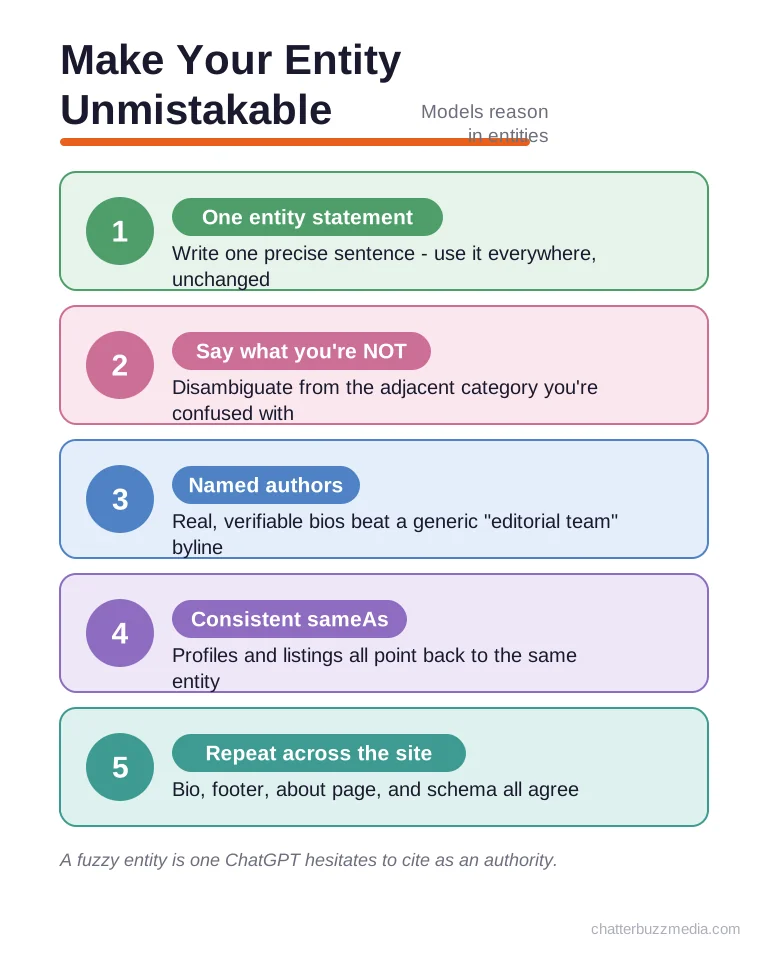
Start with a single, repeatable entity statement. Write one sentence that defines your organization precisely, and use the same phrasing across your site, your profiles, and your author bios.
Name what you are not, too. If your product is often confused with an adjacent category, say so plainly, because disambiguation helps the model place you correctly.
Reinforce the entity with consistent author identities and real bios. Pages attributed to a named, verifiable expert carry more weight than content signed by a generic “editorial team,” a pattern that overlaps with how strong brand messaging builds recognition. The same entity discipline powers precise targeting in work like building an ideal customer profile.
Step 5: Back Every Claim With Specific Numbers and Named Sources
Replace vague assertions with specific numbers, dates, and named sources, because definitive, verifiable statements get cited far more often than hedged generalities. A model synthesizing an answer prefers a passage it can attribute with confidence.
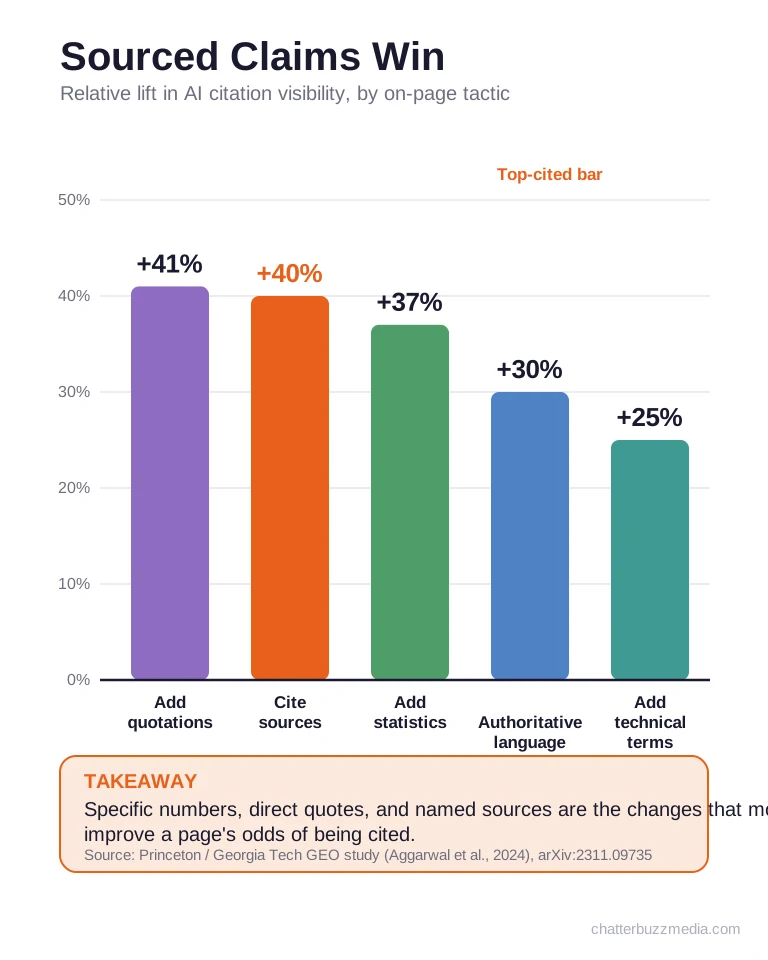
The research is blunt on this point. The same Princeton GEO study found that adding statistics, direct quotations, and cited sources were the three changes that most improved a page’s odds of being pulled into AI answers.
So audit your page for soft language. Phrases like “many companies” or “studies show” should become “63% of mid-market firms” or “a 2024 Princeton study,” each tied to a real, linkable source.
Original data is the strongest asset of all. If you can publish a statistic no one else has, from your own surveys, client results, or internal benchmarks, you become the primary source other pages cite, which compounds over time. This is the same evidence-first discipline that drives credible content marketing ROI and underpins any serious content marketing program.
Step 6: Clear the Technical Blocks and Keep Pages Fresh
Make sure AI crawlers can actually reach your content, then keep that content current, because the best-written page earns nothing if it is blocked or stale. These two checks protect everything you built in the previous steps.
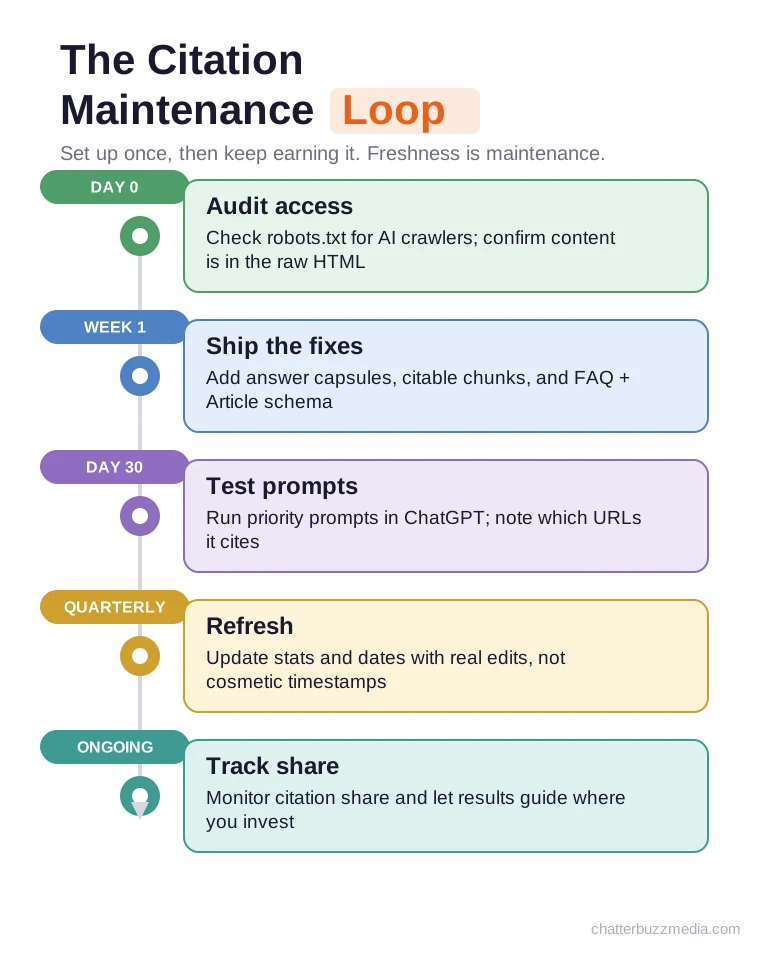
Start with crawler access. Check your robots.txt for rules that block OpenAI’s crawlers, and confirm you are allowing the bots you want by reviewing OpenAI’s published bot list.
Then check how your content renders. Content that only appears after heavy JavaScript execution, or that sits behind a paywall or login, is often invisible to the retrieval layer, so the words that matter must exist in the raw HTML.
Finally, treat freshness as ongoing maintenance. Review high-value pages on a regular cadence, update the statistics and dates, and make real edits rather than cosmetic timestamp changes. Monitor which pages ChatGPT cites using a tool like Ahrefs Brand Radar, and let what gets cited guide where you invest next. The same crawlability fundamentals underpin dependable local SEO and broader AI search visibility.
Frequently Asked Questions
1. 🔍 How long does it take to get cited by ChatGPT?
When ChatGPT is browsing the live web, a well-structured page can start appearing in cited answers within days of being indexed and crawled. Citations that rely on the model’s training data, rather than live browsing, can take months to surface, which is why structuring pages for live retrieval is the faster path.
2. 📊 Is getting cited by ChatGPT different from ranking on Google?
Yes. Google rewards whole pages competing for a keyword, while ChatGPT extracts and cites individual passages that answer a specific question. A page can rank modestly on Google yet get cited heavily by ChatGPT if its passages are clean, direct, and quotable.
3. ⚡ What is the single most important page change for citations?
Leading with an answer capsule, a direct 40-to-60-word answer in the first 100 words, is the highest-leverage change you can make. It gives the model a complete, quotable passage before any setup, and it is the passage most often pulled into answers.
4. 🏦 Do backlinks still matter for ChatGPT citations?
They matter, but less than they do for Google rankings. Third-party mentions and authoritative link building help establish your domain’s credibility in the reranking stage, yet clear on-page structure and verifiable claims often outweigh raw link volume when the model chooses a passage to cite.
5. 🤝 Can I pay to get cited by ChatGPT?
No. There is no paid placement for citations inside ChatGPT’s answers, and anyone promising guaranteed citations for a fee is selling something that does not exist. Citations are earned through structure, authority, and crawlability.
6. 💰 Should I block GPTBot to protect my content?
Blocking GPTBot stops your content from being used in training, but blocking OpenAI’s search crawler also removes you from live citations. For most businesses that want visibility in AI answers, the trade-off favors allowing the search crawler while deciding separately about training access.
7. 🚀 How do I know if ChatGPT is actually citing my pages?
Test your priority prompts directly in ChatGPT with browsing enabled and note which URLs it cites. For systematic tracking, AI visibility tools monitor your citation share across prompts over time, which turns a guessing game into a measurable one.
8. 📈 Does writing for ChatGPT hurt my Google rankings?
No. The changes that earn AI citations, clear structure, direct answers, verifiable claims, and clean schema, are the same signals that support strong search performance. Optimizing for citations tends to improve both at once.
Turning Page Changes Into Citations
Getting cited by ChatGPT is not a mystery, and it is not reserved for the biggest domains. It is the predictable result of pages structured so a model can find, read, and confidently quote them. The brands winning AI citations are the ones treating each page as a source, not just a ranking asset.
Here is the action plan to put this to work:
- Pick one high-value page and add an answer capsule. Rewrite the opening so a direct, 40-to-60-word answer sits in the first 100 words.
- Restructure the body into self-contained chunks. Give each section a question-shaped heading and a stand-alone answer, then add FAQPage and Article schema.
- Replace vague claims with sourced specifics. Swap soft language for real numbers and named, linkable sources, and lead with your own data where you have it.
- Clear the technical path and monitor. Confirm AI crawlers can reach the page, keep it fresh on a set cadence, and track which pages start getting cited.
Once the first page starts earning citations, the system repeats across your whole library. To build the broader strategy around these page-level moves, start with our answer engine optimization guide, review the full range of digital marketing services, and explore the complete set of marketing resource guides for the frameworks that connect them.

Victoria Wallace
Victoria Wallace is a senior content strategist and marketing writer with 30+ years of experience helping more than 200 brands translate complex business goals into clear, conversion-focused content. Her background spans paid media, marketing strategy, go-to-market planning, brand positioning, and full-funnel campaign development, giving her a deep understanding of how SEO content connects to real business growth.