
 321-236-2899
AI Advertising: Why Your GTM Strategy Matters More Than Your AI Tools
AI advertising has never been easier to launch. Platforms like Meta and Google now automate bidding, targeting, creative assembly, and placement — handling tasks that used to require entire media teams.
Yet companies spending more on AI-powered campaigns aren’t consistently outperforming their competitors. The AI advertising market grew to $14.12 billion in 2026, but most of that spend is going toward execution tools while the strategic layer — the part that actually determines whether campaigns work — stays underfunded and understaffed.
You’ll learn exactly why AI makes your go-to-market strategy the single biggest lever you have left — and how to tell whether your company is investing in the right layer.
Key Takeaways
AI has commoditized marketing execution — strategy is the only competitive moat that remains.
Companies using AI without a GTM strategy are scaling bad decisions faster, not making better ones.
The AI advertising market hit $14.12 billion in 2026, yet 72% of AI investments destroy value rather than create it.
Strategic thinking — positioning, timing, competitive anticipation — is the one capability AI cannot replicate for at least five more years.
The winning formula is experienced strategic leadership directing AI-powered execution, not the reverse.
AI Has Commoditized Execution — Strategy Is the Only Moat Left
AI advertising in 2026 runs on algorithms, not analysts. Meta’s Andromeda system replaced audience targeting with creative targeting. Google’s Gemini now operates as the infrastructure underneath every ad product, not just a feature bolted on top.
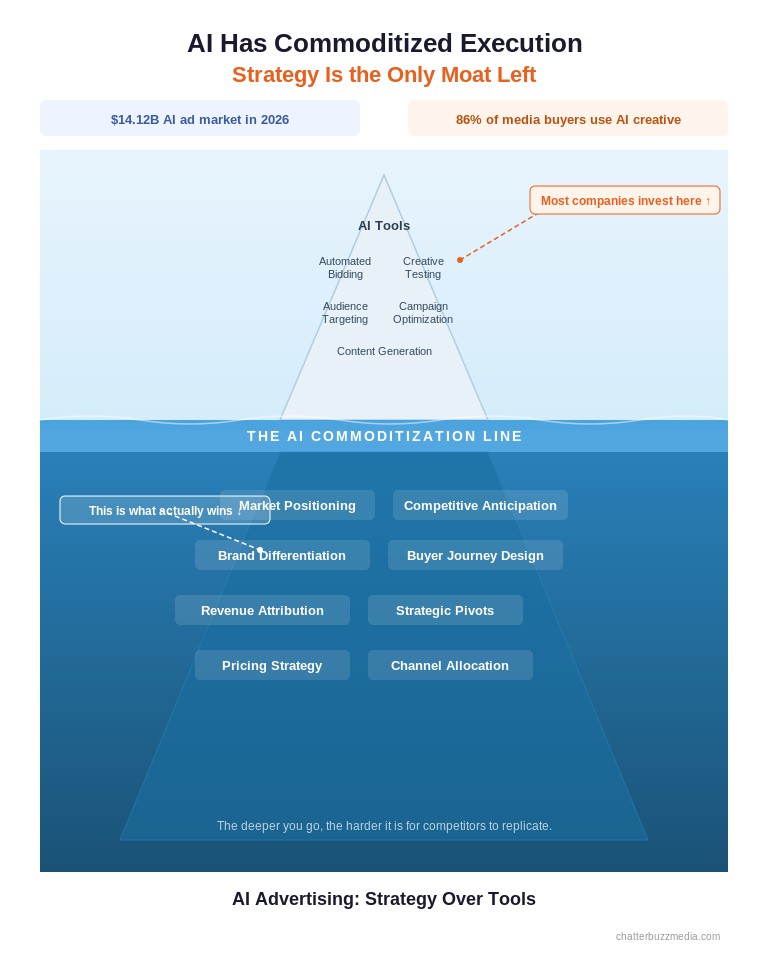
This means every company running paid media has access to the same automated bidding, the same machine-learning-driven audience signals, and the same AI-generated creative variations. PPC advertising used to reward the team that could manually optimize faster. Now the platform handles that part.
When execution is automated, it stops being a differentiator. The company with the better AI tools doesn’t win — the company with the better demand generation strategy does.
Think about what happened to stock trading. When algorithms replaced human traders, the edge shifted from speed of execution to quality of the investment thesis. AI advertising is following the same pattern.
The companies outperforming in their markets right now aren’t the ones with the most sophisticated tool stacks. They’re the ones with experienced strategic leadership that knows which markets to enter, which audiences to prioritize, and which competitive positions to defend.
That’s the shift most marketing teams haven’t made yet. They’re buying better tools when they need better thinking.
The Strategy Gap That AI Advertising Can’t Close
AI in marketing handles pattern recognition extraordinarily well. It finds correlations in campaign data, optimizes toward measurable outcomes, and scales content production. What it fundamentally cannot do is the strategic work that determines whether those outcomes matter.
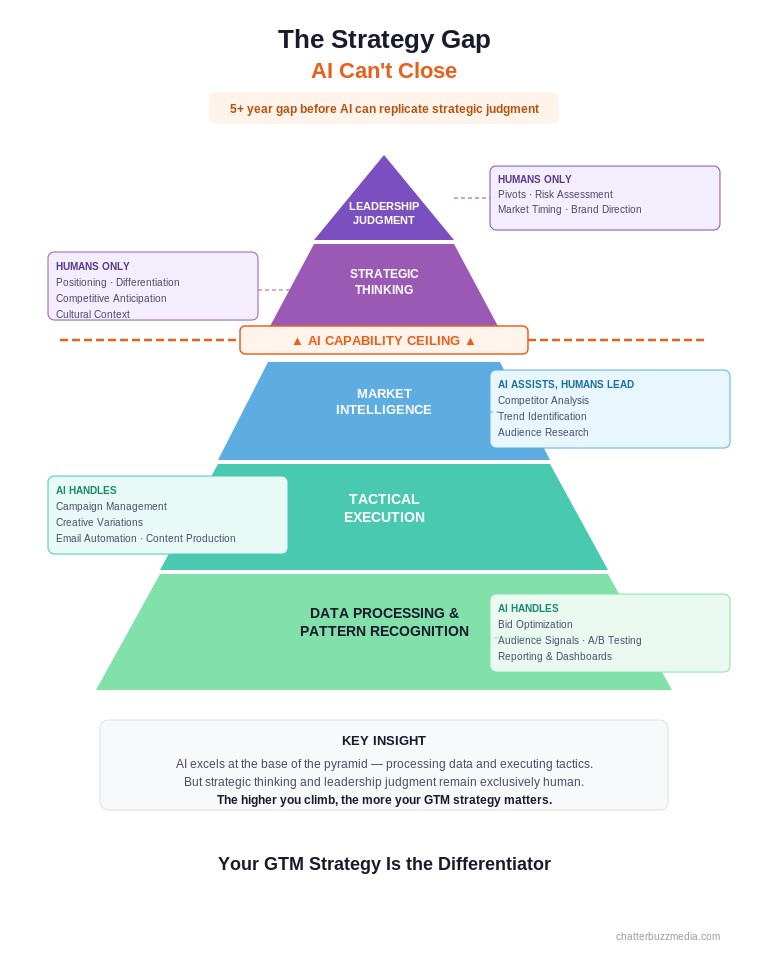
Here’s what remains beyond AI’s reach:
Anticipating market shifts before they show up in data. Every AI system is trained on historical patterns. By the time a shift appears in training data, early movers have already captured the opportunity. Strategic leaders who watch weak signals — emerging platforms, shifting buyer behaviors, cultural undercurrents — identify these windows months before any algorithm can.
Positioning novel products or services. When a new category is being created, there’s no historical data to draw from. AI can’t pattern-match against something that hasn’t existed before. Human strategists bridge unrelated concepts and build positioning from first principles.
Reading competitive dynamics with game-theory thinking. If you make this move, how will your three biggest competitors respond? And how do you counter those responses? Performance marketing AI can tell you what competitors did last quarter. It cannot predict what they’ll do next quarter when conditions change.
Making judgment calls in ambiguous situations. Should you launch a campaign during a sensitive news cycle? How do you adjust messaging when market sentiment shifts overnight? These decisions require cultural context, emotional intelligence, and reputational risk assessment that no current AI system can navigate reliably.
According to a Forbes analysis, once the production bottleneck disappears, the only remaining competitive advantage is the quality of the thinking behind it. That’s not a limitation AI will overcome with better models. It’s a reflection of what strategic work actually is.
Why Most Companies Scale Bad Strategy Faster With AI
AI is an amplifier. It takes whatever strategy you feed it and executes that strategy faster, at greater scale, and with less friction. That’s exactly why bad strategy becomes more dangerous in the AI era — not less.
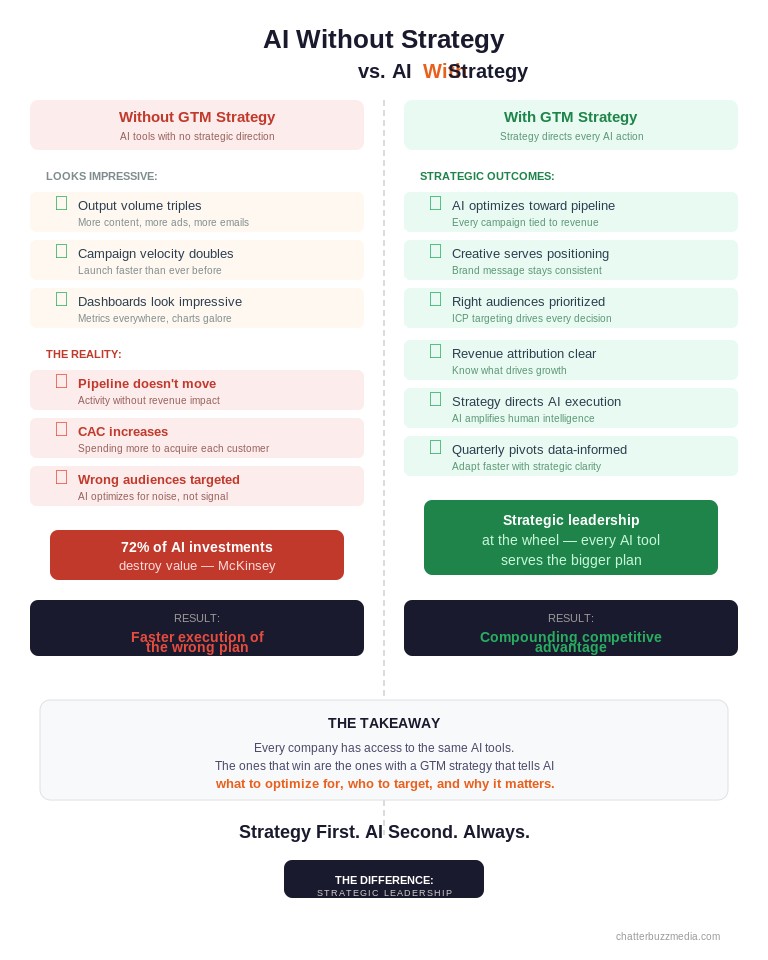
Here’s the pattern playing out across B2B marketing right now:
A company adopts AI tools for content production, ad management, and email automation. Output volume triples. Campaign velocity doubles. The dashboards look impressive.
But pipeline doesn’t move. Or worse, customer acquisition cost rises because the increased volume is reaching the wrong audiences with the wrong positioning at the wrong time.
Research shows 72% of AI investments destroy value rather than create it, largely because of tool sprawl and invisible spending. Companies buy 15 AI subscriptions without a clear marketing automation strategy connecting them to business outcomes.
The root cause isn’t the AI. It’s the absence of a go-to-market strategy that tells the AI what to optimize toward.
Consider the difference:
Without GTM strategy: AI optimizes for engagement metrics because those are measurable. Click-through rates improve. Cost per click drops. But the clicks don’t convert because the positioning doesn’t resonate with actual buyers.
With GTM strategy: AI optimizes toward specific pipeline outcomes for defined audience segments. Creative testing serves the positioning, not the algorithm. Conversion rate optimization focuses on the right visitors, not just more visitors.
The difference between these two scenarios isn’t technology. It’s leadership. One company has someone who can articulate why they’re running these campaigns. The other is running faster on a treadmill.
The GTM Strategy Framework for the AI Era
A go-to-market strategy for 2026 needs to account for what AI changes and what it doesn’t. The framework below separates the strategic layer (where humans must lead) from the execution layer (where AI excels).
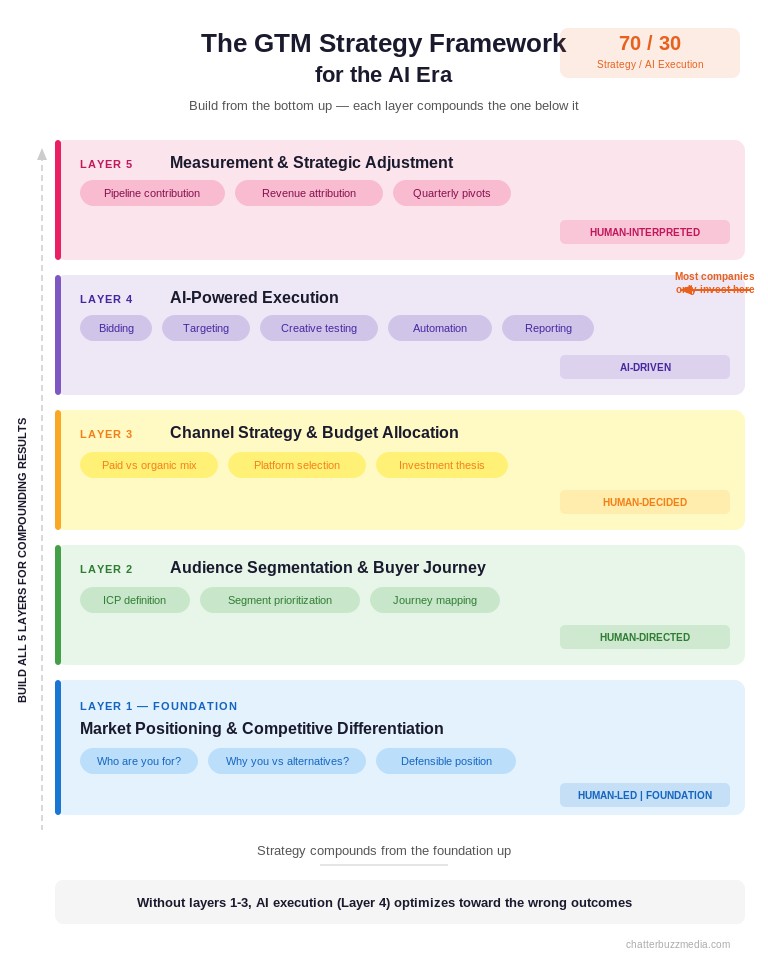
Layer 1: Market positioning and competitive differentiation. This is the foundation AI cannot build. Who are you for? Why should they choose you over alternatives? What’s your defensible position? Brand messaging that answers these questions drives every downstream decision — and it requires human judgment informed by market experience.
Layer 2: Audience segmentation and buyer journey mapping. AI can process audience data at scale, but the strategic decision about which segments to prioritize — and which to ignore — belongs to leadership. Account-based marketing works because humans identify high-value accounts based on strategic fit, not just data patterns.
Layer 3: Channel strategy and budget allocation. Which channels deserve investment? How much should go to paid media versus organic search? AI can recommend based on historical performance, but strategic allocation requires understanding where the market is heading, not just where it’s been.
Layer 4: AI-powered execution. This is where AI belongs — handling bidding, targeting, creative testing, marketing funnel automation, and performance reporting. When layers 1-3 are set correctly, AI execution becomes dramatically more effective because it’s optimizing toward the right objectives.
Layer 5: Measurement and strategic adjustment. Track pipeline contribution, not just efficiency metrics. Use AI for data visualization and reporting, but keep the strategic interpretation — and the decision to pivot — in human hands.
Most companies invest heavily in Layer 4 and skip Layers 1-3 entirely. That’s like buying a race car engine and bolting it to a bicycle frame. The engine performs beautifully. The vehicle doesn’t go anywhere useful.
What AI Advertising Success Actually Looks Like
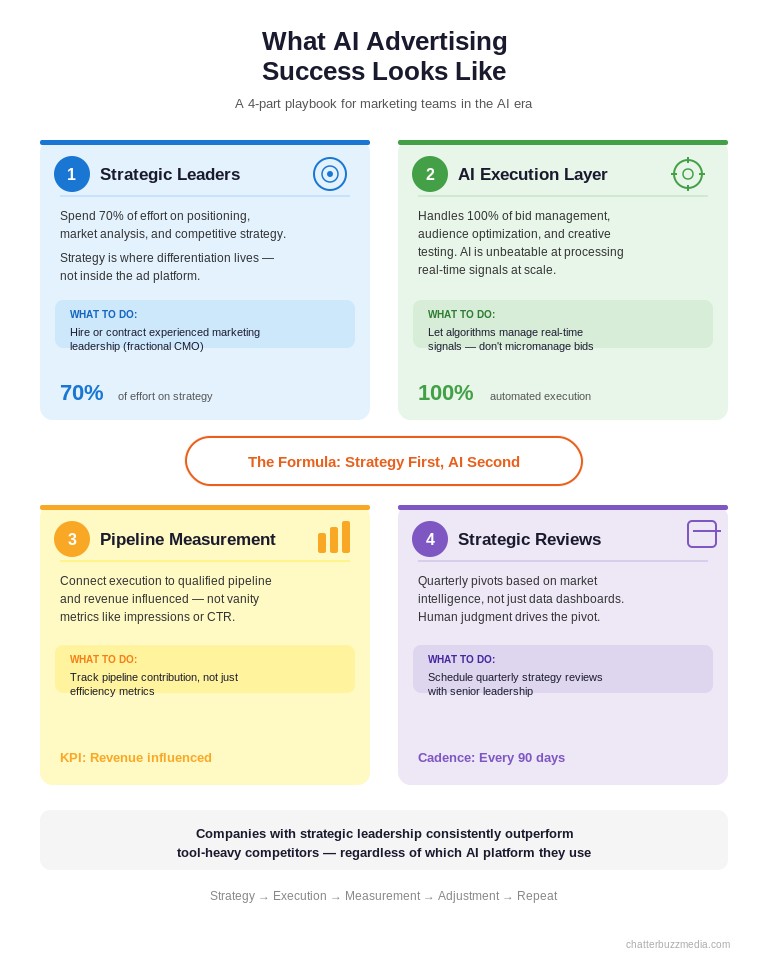
The companies winning with AI advertising in 2026 share a common structure: experienced strategic leadership directing AI-powered execution. The strategist sets the direction. The AI handles the velocity.
Here’s what that looks like in practice:
Strategic leaders spend 70% of their time on positioning, market analysis, and competitive strategy. They use AI tools to accelerate research and data analysis, but the synthesis — connecting data points to strategic insights — stays with them. The fractional CMO model works particularly well here because mid-market companies get executive-level strategic thinking without the cost of a full-time hire.
AI handles 100% of bid management, audience optimization, and creative testing. No human can process the volume of real-time signals that platforms like Meta and Google generate. Letting AI manage these tasks isn’t lazy — it’s smart resource allocation.
The measurement stack connects execution to pipeline. Tools track engagement and efficiency, but the strategic team measures what matters: qualified pipeline generated, marketing ROI, and customer acquisition cost by segment. AI provides the data. Humans interpret it against competitive context.
Quarterly strategy reviews adjust the direction. Market conditions shift. New competitors emerge. Marketing audits reveal what’s working and what isn’t. The AI execution layer adapts instantly, but the strategic direction changes only when leadership has the context and judgment to call the pivot.
This model works across industries. Financial services firms use it to navigate compliance-heavy markets where positioning matters more than volume. Home builders use it to target local buyers with precision while AI manages seasonal campaign adjustments. Technology companies use it to differentiate in crowded categories where every competitor has access to the same AI tools.
The common thread: strategy first, AI second. Never the reverse.
How to Audit Your AI Marketing Strategy
Most marketing teams believe they have a strategy when they actually have a collection of tactics. Use these four diagnostic questions to determine whether your organization has the strategic layer that AI advertising requires.
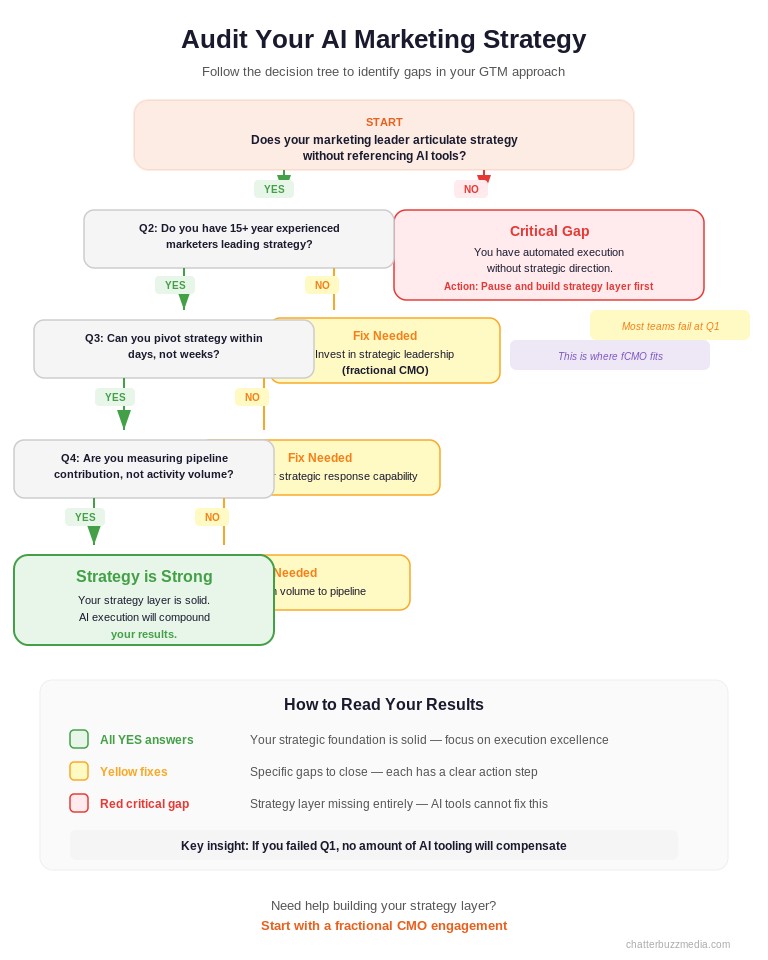
Question 1: Can your marketing leader articulate the strategic rationale for your current program without referencing AI tool recommendations? If your strategy is being validated against what the AI suggests — rather than formed by human judgment and then tested with AI — you don’t have genuine strategic direction. You have sophisticated automated execution without anyone at the wheel.
Question 2: Do you have marketers with 15+ years of experience who have navigated market downturns, competitive disruptions, and major industry shifts? If your team skews junior with strong AI tool proficiency, you’re optimized for execution in familiar conditions and vulnerable when conditions change. Fractional CMO services can fill this gap without the cost of a full-time executive.
Question 3: When market conditions shift, how quickly can your organization change strategy? If the answer involves waiting for data analysis to confirm the shift before acting, you’re operating behind the competitive frontier. The organizations winning their markets respond to strategic signals before they appear clearly in data because their leaders have the experience and intuition to recognize what’s coming.
Question 4: Are you measuring pipeline contribution or activity volume? If your marketing KPIs focus on content pieces published, emails sent, or ads running — rather than qualified leads generated and revenue influenced — AI is making your team more productive at things that don’t matter.
If any of these questions reveal a gap, the fix isn’t another AI tool. It’s investing in the strategic layer that makes every AI tool more effective.
FAQ
1. 🔍 How is AI changing advertising in 2026?
AI now handles bidding, targeting, creative assembly, and placement automatically across major platforms. The AI in advertising market reached $14.12 billion in 2026, growing 26.4% year over year. Platforms like Meta and Google no longer offer automation as optional — it’s the default operating layer. The shift means execution skill matters less while strategic direction matters more.
2. 📊 Can AI replace marketing strategy?
No. AI excels at pattern recognition, data processing, and optimizing toward measurable outcomes. But it cannot anticipate market shifts before they appear in data, position novel products, navigate competitive dynamics with game-theory thinking, or make judgment calls in ambiguous situations. These capabilities require lived experience across multiple market cycles — something AI won’t replicate for at least five more years.
3. ⚡ What is the biggest mistake companies make with AI advertising?
Investing in AI execution tools without a go-to-market strategy to direct them. Research shows 72% of AI investments destroy value rather than create it because companies optimize for measurable efficiency metrics rather than strategic pipeline outcomes. AI amplifies whatever strategy you feed it — including bad ones.
4. 🏦 How much should companies invest in AI marketing strategy vs. tools?
The 70/30 rule provides a practical guideline: invest roughly 70% of marketing resources in strategic direction and 30% in AI-powered execution. Most companies do the opposite, spending heavily on tools while underinvesting in the strategic thinking that makes those tools effective. The right marketing budget allocation prioritizes strategic leadership.
5. 🤝 What is a fractional CMO and how does it relate to AI strategy?
A fractional CMO is an experienced marketing executive who works with companies on a part-time or contract basis. In the AI era, fractional CMOs provide the strategic leadership layer that AI can’t replace — setting market positioning, directing competitive strategy, and making the judgment calls that determine whether AI execution drives real business results.
6. 💰 How do you measure AI advertising ROI?
Track three layers: efficiency gains (time and cost savings from automation), output quality (engagement and conversion rates), and pipeline contribution (qualified leads and revenue influenced). Make decisions based on pipeline contribution, not efficiency metrics. If AI saves time and produces decent content but pipeline isn’t growing, your strategy needs adjusting — not your tools.
7. 🚀 What does AI-first marketing mean?
AI-first marketing means designing operations so AI handles planning, execution, and coordination by default while humans focus on strategy, creativity, and judgment. It’s different from AI-assisted marketing, where humans still plan and coordinate with AI helping on individual tasks. The key shift is from human-as-coordinator to human-as-strategist.
8. 📈 How do I build a GTM strategy for the AI era?
Start with five layers: market positioning and competitive differentiation (human-led), audience segmentation and buyer journey mapping (human-directed with AI research), channel strategy and budget allocation (human-decided), AI-powered execution (fully automated), and measurement with strategic adjustment (human-interpreted). Most companies only invest in layer four. Build all five for results that compound.
Conclusion
AI advertising has eliminated execution as a competitive advantage. Every company now has access to the same automated bidding, the same machine-learning audiences, and the same AI-generated creative. The differentiator is — and always was — the quality of strategic thinking directing those tools.
The companies winning in 2026 aren’t the ones with the most AI subscriptions. They’re the ones with experienced strategic leaders who know which markets to enter, which audiences to prioritize, and when to pivot before the data confirms what they already sense.
Here’s your action plan:
1. Audit your strategy-to-execution ratio. Use the four diagnostic questions above to identify whether your team has genuine strategic direction or just sophisticated automated execution.
2. Invest in strategic leadership. Whether through a fractional CMO engagement, a senior hire, or developing existing talent — put experienced strategic thinking at the top of your marketing organization.
3. Restructure your AI investment around outcomes. Connect every AI tool to a specific pipeline objective. If you can’t draw a line from the tool to revenue, question whether you need it.
4. Measure what matters. Shift your KPIs from activity volume (content published, emails sent, ads running) to pipeline contribution (qualified leads generated, revenue influenced, customer acquisition cost by segment).
For a deeper look at building a go-to-market strategy by revenue stage, explore our resource guides — they break down what $5M, $20M, and $50M companies each need to get the strategy layer right before scaling execution.

Victoria Wallace
Victoria Wallace is a senior content strategist and marketing writer with 30+ years of experience helping more than 200 brands translate complex business goals into clear, conversion-focused content. Her background spans paid media, marketing strategy, go-to-market planning, brand positioning, and full-funnel campaign development, giving her a deep understanding of how SEO content connects to real business growth.