
 321-236-2899

Entity SEO: Build the Brand Entity Google & AI Trust
Google stopped ranking strings of text years ago. It ranks entities: the people, companies, products, and concepts it can identify, verify, and connect to each other.
We have watched brands with modest backlink profiles get pulled into AI Overviews and knowledge panels while competitors with bigger link counts stayed invisible. The difference was almost always entity clarity, not domain authority.
This guide walks through the exact seven-step process to make Google and AI engines recognize your brand as a distinct entity, from auditing what search engines already know about you to measuring whether your signals are working. Here is the full workflow.
Key Takeaways
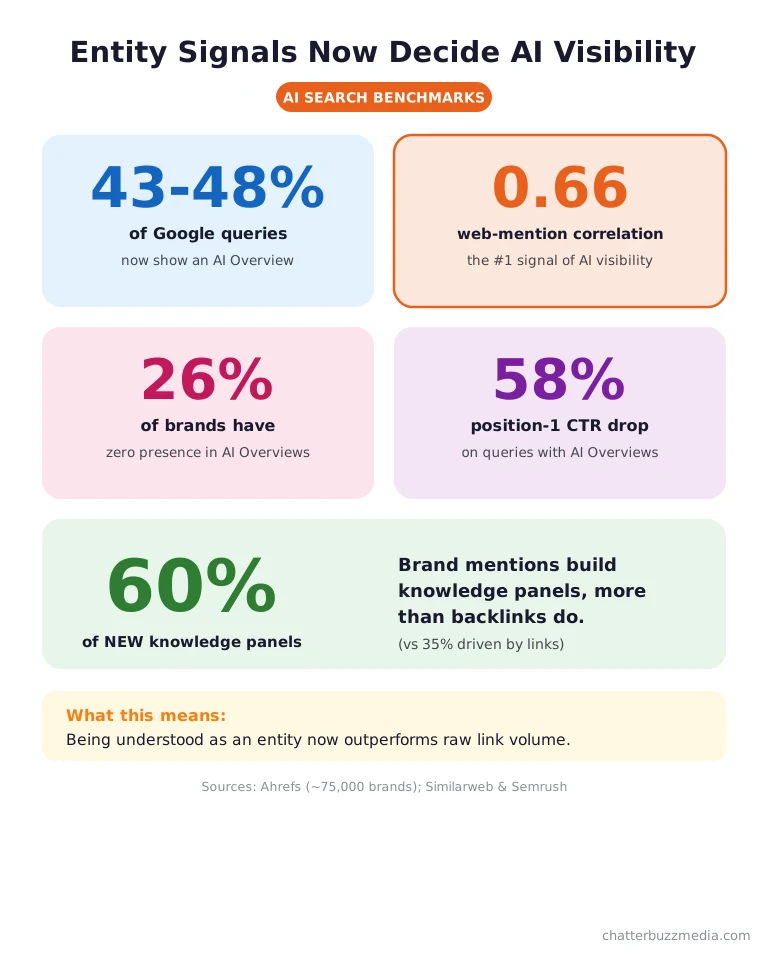
- Entities beat keywords in AI search. An Ahrefs analysis of roughly 75,000 brands found web mentions were the single strongest correlate of AI Overview visibility, ahead of backlinks and domain rating.
- Your entity needs one canonical home. A clear “About” page plus consistent naming across the web is what lets Google attach a node in its Knowledge Graph to your brand.
- Organization schema with sameAs is non-negotiable. It is the machine-readable statement that tells search engines who you are and which profiles belong to you.
- Unlinked brand mentions build knowledge panels. Industry analysis attributes roughly 60% of new knowledge panels to brand mentions, versus 35% to backlinks.
- Entity SEO is measurable. You can track knowledge panel presence, AI citations, and branded search volume to prove the work is paying off.
What Entity SEO Is (and Why It Wins in AI Search)
Entity SEO is the practice of building and clarifying the signals that let search engines and AI models recognize your brand as a specific, verified “thing” rather than a loose collection of keywords. An entity is any uniquely identifiable object or concept, and Google stores these in its Knowledge Graph as nodes connected by relationships.
The shift matters because search no longer works by matching the words on your page to the words in a query. It works by understanding which entities a query is about and which entities can authoritatively answer it.
Keyword SEO asks, “Does this page contain the phrase someone searched?” Entity SEO asks, “Is this brand a trusted source on this topic?”
That second question is the one AI engines ask before they cite a source. An Ahrefs study of around 75,000 brands found that web mentions correlated with AI Overview visibility at 0.66, far ahead of referring domains (0.30) or raw backlink counts (0.22).
In other words, being mentioned and understood now outperforms being linked to. That is the entire premise of entity SEO, and it is why the discipline sits at the center of modern answer engine optimization.
The timing is not academic. AI Overviews now appear on roughly 43% to 48% of Google queries according to Similarweb and Semrush data, and the brands that get pulled into those answers are the ones engines can identify with confidence.
This is also why entity SEO is the connective tissue between traditional search and AI-driven marketing: a clear entity is reusable across Google, ChatGPT, Perplexity, and whatever comes next. With the foundation set, the rest of this guide is the step-by-step build. Start with a diagnosis.
Step 1: Audit How Search Engines See Your Brand Today
Before you build anything, find out what Google already believes about your brand, because you cannot fix an entity you have not measured. The audit takes under an hour and tells you whether you are starting from a recognized entity, a partial one, or nothing at all.
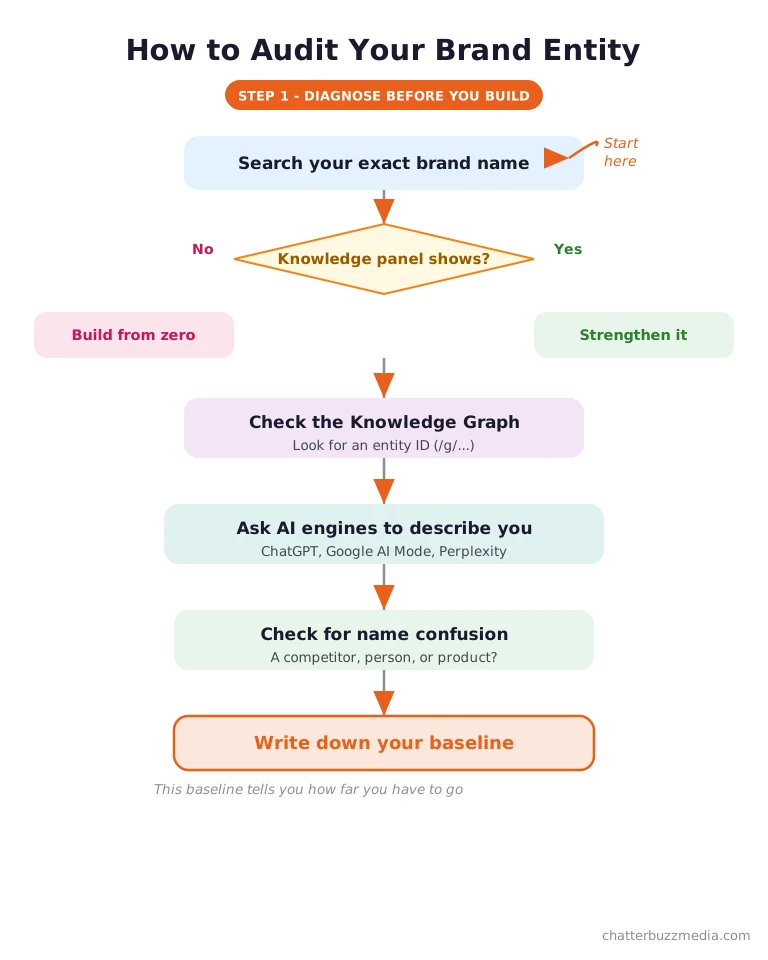
Start by searching your exact brand name in Google. If a knowledge panel appears on the right side of the results, you already have an entity Google trusts, and your job is to strengthen it.
If no panel appears, you are starting from scratch, which is common and completely fixable. Note what does appear, because those pages are the sources Google currently associates with your name.
Next, check the Google Knowledge Graph directly. Query the Knowledge Graph Search API or a free lookup tool with your brand name to see whether an entity ID (a code beginning with “/g/” or “/m/”) already exists for you.
Then run the same brand query through ChatGPT, Google AI Mode, and Perplexity. Ask each one, “What is [your brand]?” and note whether the answer is accurate, vague, or wrong.
Finally, audit for entity confusion. Search your brand name alongside your category and city, and check whether another company, a public figure, or a product shares your name and is muddying the signal.
Entity confusion is one of the most common reasons a brand never earns a panel, and knowing it exists now saves months of guessing later. It is the same diagnostic mindset behind a full SEO and AEO audit.
Document four things from this audit: whether a knowledge panel exists, whether an entity ID exists, how accurately AI engines describe you, and whether anything competes for your name. These become your baseline for the measurement step later.
With your gaps identified, the next move is to control the facts those systems read.
Step 2: Define Your Canonical Facts and Entity Home
Pick one exact brand name and one authoritative page that states your core facts, because entity recognition depends on consistency above everything else. Search engines build confidence when every source agrees, and they get confused when your name or details drift.
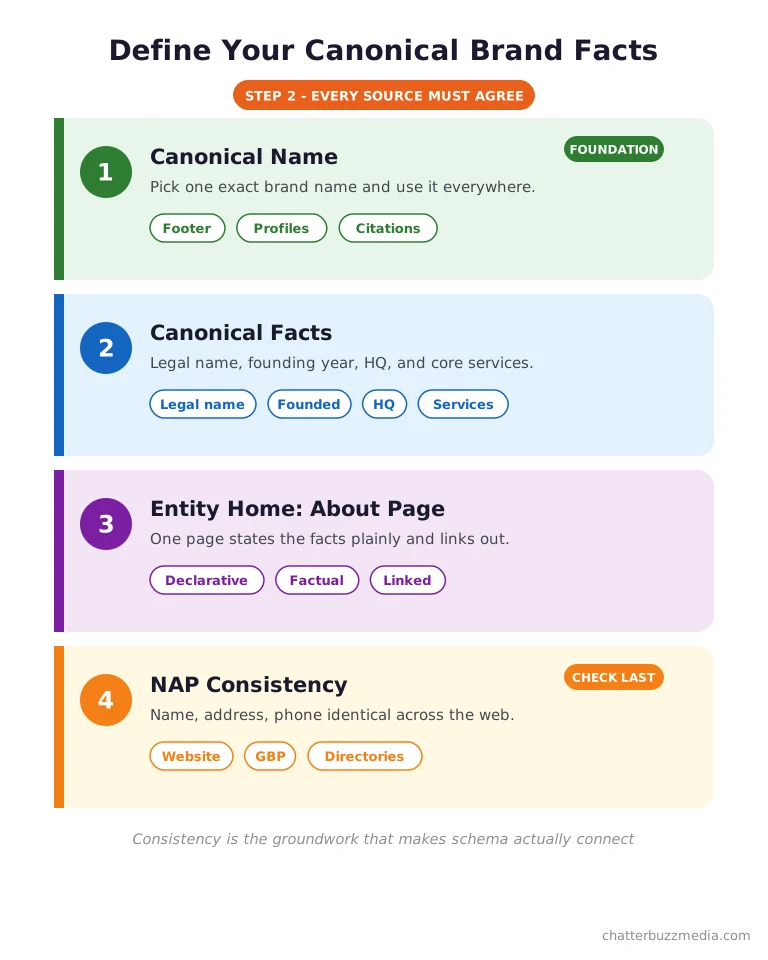
Decide your canonical name first. If you are “Acme Marketing Group, LLC” in one place and “Acme Marketing” in another, choose one and use it everywhere, including your footer, profiles, and citations.
Lock your canonical facts into a short, structured list: legal name, founding year, founders, headquarters, services, and the topics you are authoritative on. These are the facts you will repeat across every platform.
Your “About” page becomes your entity home, the single page that states these facts plainly and links out to the profiles that corroborate them. Write it as factual statements, not marketing copy, because AI engines extract declarative sentences.
A line like “Founded in 2009, [Brand] is a digital marketing agency specializing in SEO, paid media, and content marketing” is extractable. “We are passionate about growth” is not.
Keep your name, address, and phone number identical across your site, Google Business Profile, and every directory. This consistency is the groundwork that makes the next step, schema, actually connect.
If your brand language itself is inconsistent, fix that before you scale mentions, because you cannot corroborate facts you have not settled. Nailing down a single, repeatable description is exactly the work of brand messaging, and it pays off at every later step.
Step 3: Publish Organization Schema With sameAs
Organization schema is the machine-readable statement that tells search engines exactly who your entity is and which profiles belong to it. It is the most direct signal you fully control, and most brands either skip it or implement it incompletely.
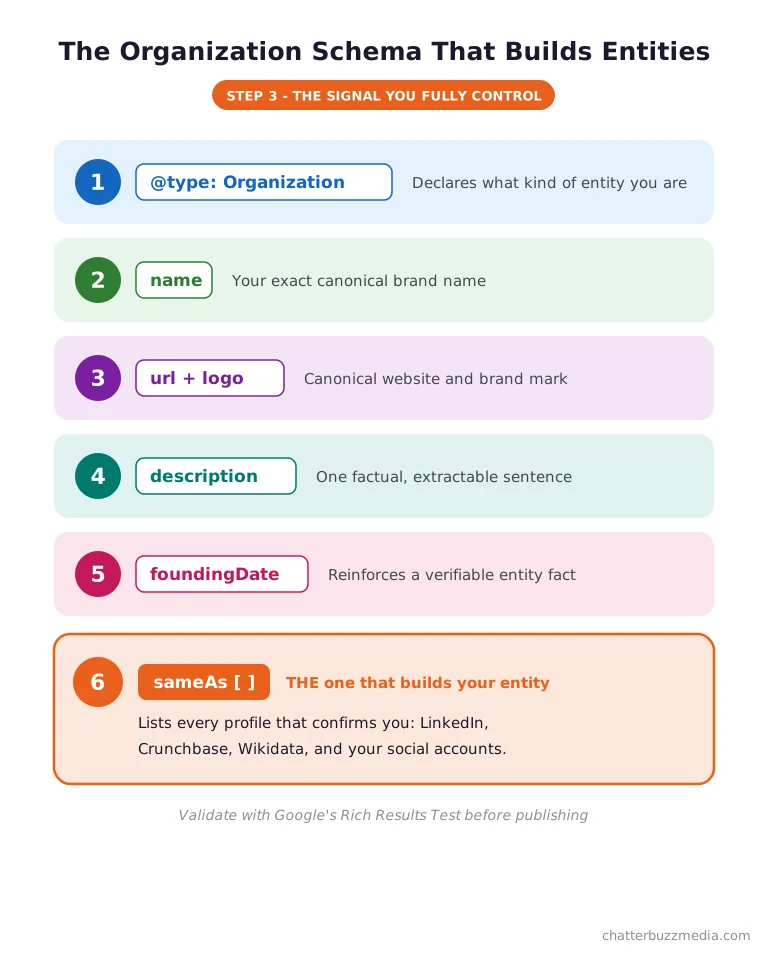
Add JSON-LD Organization markup to your homepage and keep it site-wide. The non-negotiable properties are name, url, logo, description, and the sameAs array.
The sameAs property is the one that builds your entity. It lists the authoritative profiles that confirm your identity, and it is how Google connects your website to your LinkedIn, Wikidata, Crunchbase, and social profiles as one entity.
A minimal but complete block looks like this:
{

 "@context": "https://schema.org",

 "@type": "Organization",

 "name": "Your Brand",

 "url": "https://yourbrand.com",

 "logo": "https://yourbrand.com/logo.png",

 "description": "What you do, in one factual sentence.",

 "foundingDate": "2009",

 "sameAs": [

  "https://www.linkedin.com/company/yourbrand",

  "https://www.crunchbase.com/organization/yourbrand",

  "https://www.wikidata.org/wiki/Qxxxxxx"

 ]
}
Validate every block with Google’s Rich Results Test and Schema Markup Validator before you publish. A single syntax error can void the entire entity signal.
Schema tells Google what you claim about yourself. The next step is getting the rest of the web to agree.
Step 4: Build Corroboration Across the Web
Corroboration is the process of getting independent, authoritative sources to describe your brand the same way you describe yourself, and it is what turns a claim into a verified entity. Google trusts what others say about you more than what you say about yourself.
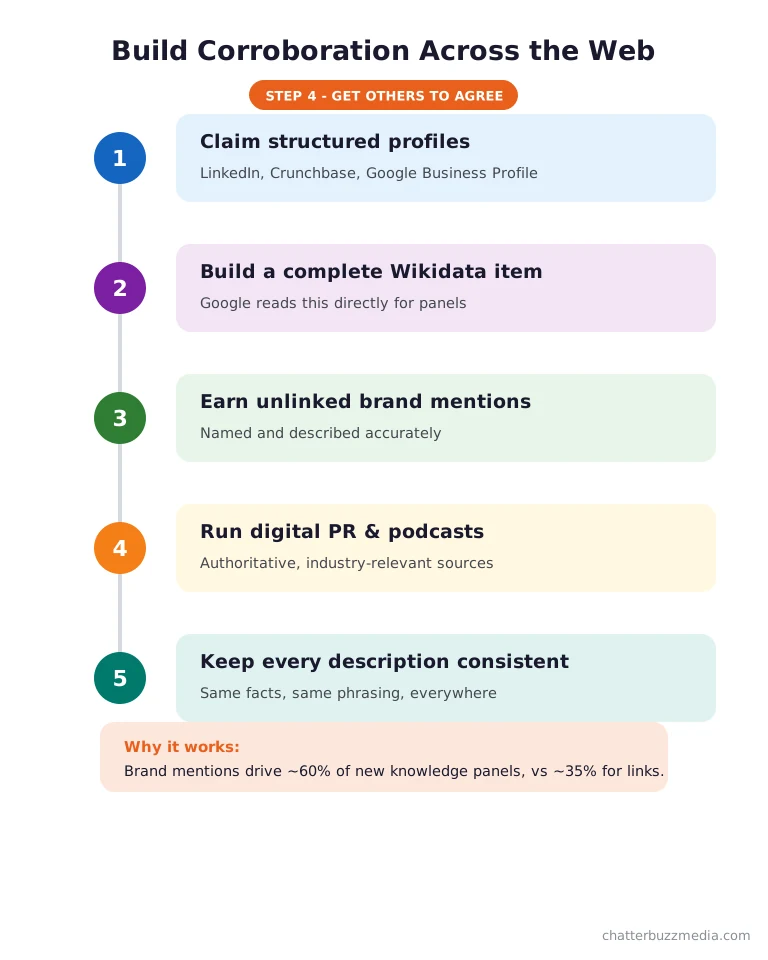
Start with the structured-data sources Google reads directly. Create or claim profiles on Wikidata, Crunchbase, LinkedIn, and your Google Business Profile, using your exact canonical facts on each.
Wikidata deserves special attention because Google pulls from it heavily when constructing knowledge panels. A complete, accurate Wikidata item with consistent statements is one of the fastest routes to entity recognition for a brand without a Wikipedia page.
Then pursue unlinked brand mentions, not just backlinks. Industry analysis from Search Atlas attributes roughly 60% of new knowledge panels to brand mentions, compared with about 35% to backlinks.
Earn these through digital PR, podcast appearances, guest contributions, and industry roundups where your brand is named and described accurately. The description matters as much as the mention, because consistent phrasing reinforces your entity facts.
Corroboration also scales by vertical. A credit union builds entity trust through state league listings and NCUA-adjacent sources, a manufacturer through industry directories and trade publications, and a home builder through local parade-of-homes and MLS-linked coverage, as we outline in our credit union and manufacturing SEO guides.
The principle is the same everywhere: find the sources your industry treats as authoritative, and get described accurately on each. A focused link building and digital PR program compounds here, because each consistent mention adds a corroborating data point, and volume of agreement is exactly what builds Google’s confidence. With external agreement growing, turn to the content that proves what you are about.
Step 5: Establish Topical Authority With Entity-Rich Content
Topical authority is how you prove your brand is an entity worth citing on a subject, and you build it by covering a topic comprehensively rather than chasing isolated keywords. Search engines map the entities your content covers and the relationships between them.
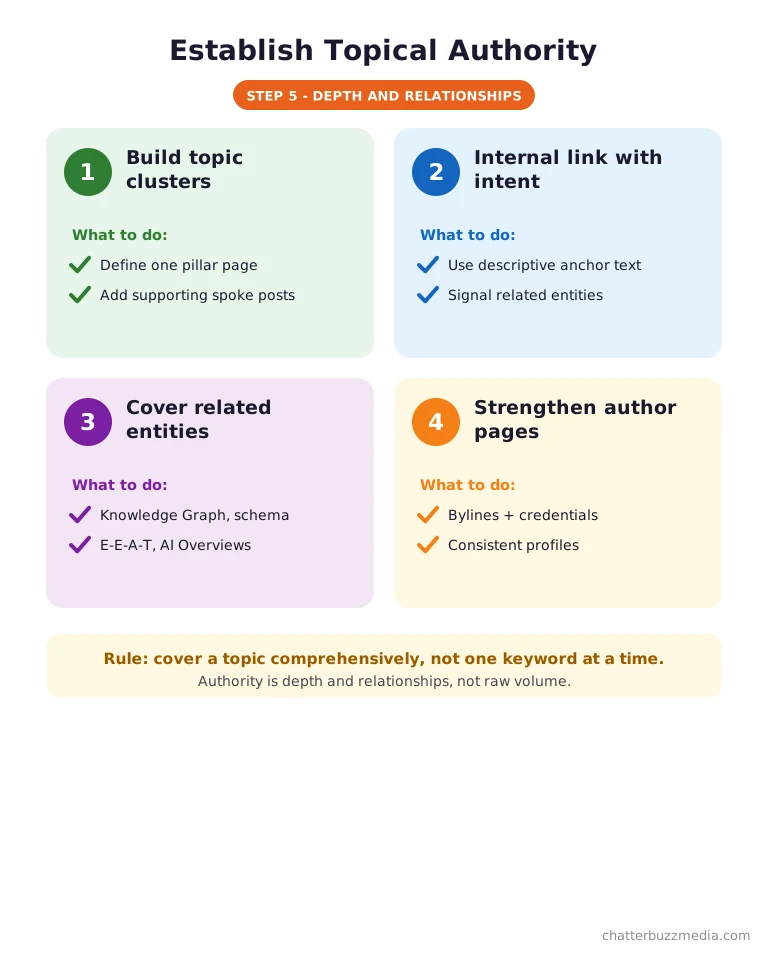
Organize your content into clusters around the entities you want to own. A pillar page defines the core topic, and supporting posts cover related subtopics and connect back with internal links.
Internal linking is doing entity work, not just navigation. When you link your entity SEO post to your SEO versus AEO post with descriptive anchor text, you are telling Google these entities are related and you cover both.
Write with semantic completeness. If your topic is entity SEO, the related entities Google expects, like Knowledge Graph, schema markup, E-E-A-T, and AI Overviews, should appear naturally because a true authority would mention them.
Strengthen your author and team entities too. Bylines with detailed author pages, credentials, and consistent profiles across the web signal expertise, which feeds the experience and authority that both Google and AI engines weigh.
Feed those same entity facts into your CRM and marketing automation so every touchpoint reinforces one consistent brand story, which is a core part of how we approach HubSpot implementation. Alignment between what your content says and what your systems record is another corroboration signal.
This is the same discipline behind a strong content marketing program and a well-mapped ideal customer profile: depth and relationships, not volume. Once your entity is defined, corroborated, and reinforced, the final step is proving it works.
Step 6: Measure Entity Strength and AI Citations
Entity SEO is measurable, and you should track it with the same rigor as any other channel so you can prove progress and spot drift. The metrics tie directly back to the baseline you captured in Step 1.
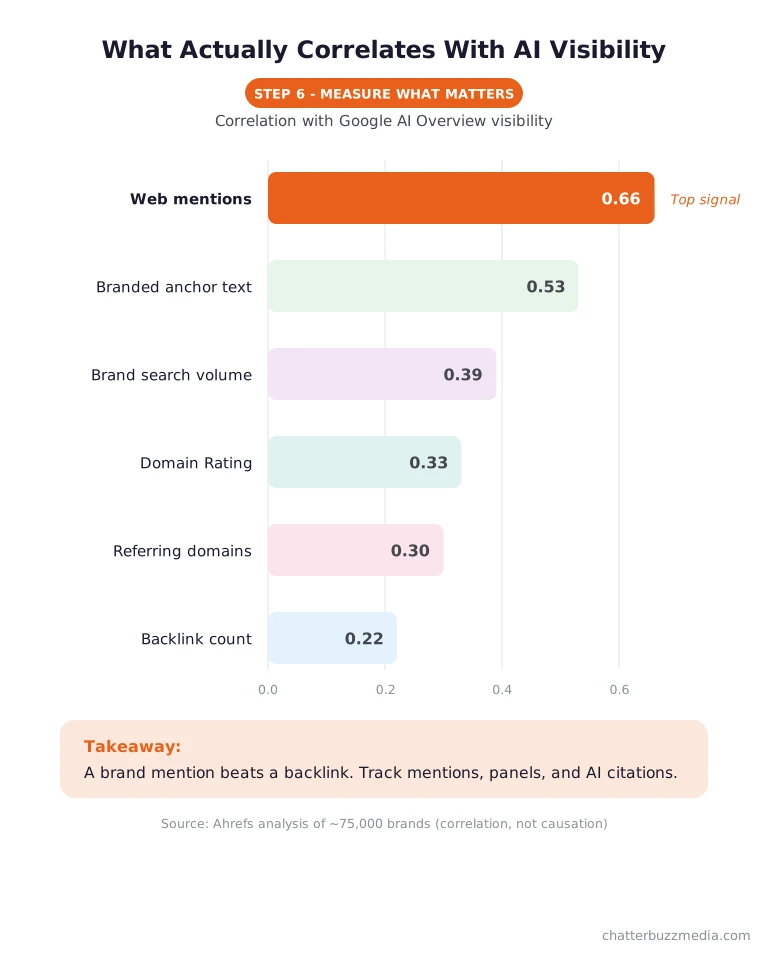
Track knowledge panel presence first. Re-run your brand search monthly and record whether a panel appears, what facts it shows, and whether those facts are accurate.
Monitor AI citations across engines. Query ChatGPT, Perplexity, Google AI Mode, and Gemini with questions in your topic area and log how often your brand is named or cited as a source.
Watch branded search volume in Google Search Console and your analytics. Rising branded queries signal that your entity is becoming known, and brand search volume itself correlates with AI visibility in the Ahrefs data.
Finally, track entity consistency. Periodically re-check that your name, facts, and sameAs profiles still agree across the web, because entities decay when details drift after a rebrand or an office move. These metrics turn entity SEO from a theory into a dashboard you can report on, which is exactly how we frame it inside a broader digital marketing strategy.
Frequently Asked Questions About Entity SEO
1. 🔍 What is entity SEO in simple terms?
Entity SEO is the practice of helping search engines and AI models recognize your brand as a specific, verified thing rather than just matching keywords on a page. It uses consistent facts, schema markup, and corroborating mentions so Google can connect your brand to a node in its Knowledge Graph and trust it as a source.
2. 📊 How is entity SEO different from keyword SEO?
Keyword SEO optimizes pages to match the words people search, while entity SEO builds your brand’s identity and authority so engines understand who you are and what you are credible on. Keyword work still matters for individual pages, but entity work is what gets you cited in AI answers and surfaced in knowledge panels.
3. ⚡ Do I need a Wikipedia page to become an entity?
No. A Wikipedia page helps, but a complete Wikidata item, Organization schema with sameAs, a clear About page, and consistent brand mentions can establish your entity without one. Wikidata in particular is an accessible, high-impact source that Google reads directly when building knowledge panels.
4. 🏦 Does schema markup alone create a knowledge panel?
No. Schema makes your entity machine-readable and is essential, but a knowledge panel also requires corroboration from independent sources that confirm the same facts. Think of schema as your claim and brand mentions across the web as the evidence that validates it.
5. 🤝 How long does entity SEO take to show results?
Most brands see early signals, such as more accurate AI descriptions or a first knowledge panel, within three to six months of consistent work. Full entity strength, where you are reliably cited across AI engines, typically builds over six to twelve months as corroboration accumulates.
6. 💰 Is entity SEO only for big brands?
No. Entity recognition is based on clarity and consistency, not size, so a small business with a clean About page, complete schema, accurate profiles, and a few authoritative mentions can earn an entity faster than a large brand with scattered, inconsistent information.
7. 🚀 Why does entity SEO matter for AI search specifically?
AI engines cite sources they can identify and trust, and entities are how they decide trust. In the Ahrefs analysis of about 75,000 brands, web mentions, a core entity signal, were the strongest correlate of AI Overview visibility, which is why entity clarity directly affects whether AI tools recommend you.
8. 📈 What is the first thing I should do to start?
Audit how search engines see you today by searching your brand name, checking for a knowledge panel and an entity ID, and asking AI engines to describe you. That baseline tells you whether you are strengthening an existing entity or building one from zero, which shapes everything that follows.
Your Entity SEO Action Plan
Entity SEO is no longer optional, because search has moved from matching words to understanding brands, and AI engines cite the entities they trust. The work is methodical, measurable, and well within reach for brands of any size that commit to clarity and consistency.
Here is the path from invisible to recognized:
- Audit first. Search your brand, check the Knowledge Graph, and ask AI engines to describe you, then write down your baseline.
- Define and declare. Lock your canonical facts into an entity-home About page and publish complete Organization schema with a thorough sameAs array.
- Corroborate. Build Wikidata, Crunchbase, and profile consistency, then earn accurate brand mentions through digital PR.
- Reinforce and measure. Build topical authority with entity-rich content clusters, then track knowledge panel presence, AI citations, and branded search monthly.
Work the steps in order, give the signals a few months to compound, and revisit the measurement step every month so you can see your entity strengthen. For a broader view of how entity work fits alongside SEO, content, and AI search, explore our marketing resource guides and our approach to SEO services.

Victoria Wallace
Victoria Wallace is a senior content strategist and marketing writer with 30+ years of experience helping more than 200 brands translate complex business goals into clear, conversion-focused content. Her background spans paid media, marketing strategy, go-to-market planning, brand positioning, and full-funnel campaign development, giving her a deep understanding of how SEO content connects to real business growth.