
 321-341-2327
Med Spa Facebook Ads: 7 Steps to Fill Every Location
Most guides on med spa Facebook ads are written for a single clinic running a single offer. That advice breaks the moment you add a second, third, or fifth location.
Multi-location aesthetic practices face problems solo med spas never see: overlapping ad audiences, budget cannibalization between sites, and medical advertising rules that get stricter every year. Get the structure wrong and your best location subsidizes your weakest one while your cost per lead quietly doubles.
This guide walks through the exact seven-step system for running compliant, profitable Meta and Google Ads across every location you operate. You will see how to architect ad accounts so locations do not compete, which targeting and creative actually convert aesthetic patients, and how to track leads without tripping HIPAA. Let’s start where every compliant campaign has to start.
Key Takeaways
- Compliance is the foundation, not an afterthought. Meta classifies most aesthetic ads under restricted rules, and before/after photos carry real legal risk without signed, channel-specific consent.
- Account structure decides whether locations compete or compound. A clean Business Manager hierarchy stops your sites from bidding against each other.
- Creative is the real targeting. Provider-led video and UGC outperform polished studio ads by a wide margin, and each treatment needs its own angle.
- Meta creates demand; Google captures it. Running both channels together beats either one alone for multi-location growth.
- Speed to lead wins the patient. The first clinic to respond books the consult most of the time, so follow-up automation is non-negotiable.
Step 1: Build a Compliant Foundation Before You Spend a Dollar
Medical advertising compliance is the single biggest difference between med spa ads and every other local business. Before you build a campaign, you need a foundation that keeps you inside platform policy, FTC rules, and HIPAA.
This matters because a policy strike can disable your ad account overnight, and a deceptive-claims complaint can trigger regulatory action. For a multi-location practice, one bad account setup puts every location at risk at once.
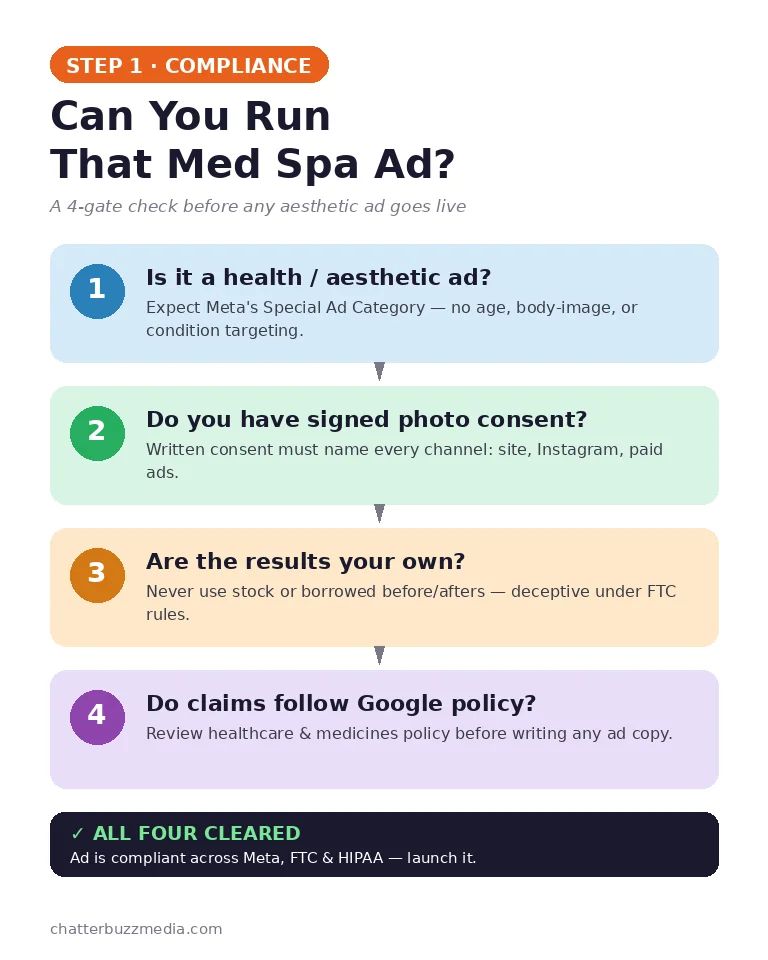
Start with these compliance guardrails:
- Expect the “special ad category” restriction. Meta routinely flags aesthetic and health-related ads, which removes detailed targeting by age insecurities, body image, and medical conditions. Plan your targeting around broad audiences from the start.
- Get channel-specific photo consent. Never post a patient’s before/after without written consent that names each channel, including website, Instagram, and paid ads. If a channel is not listed, do not use the photo there.
- Never borrow or buy before/after images. Using stock or another clinic’s results is deceptive under FTC endorsement rules and destroys patient trust.
- Follow Google’s healthcare policy. Certain treatments and claims are restricted under Google’s healthcare and medicines policy, so review it before writing ad copy.
The clinics that scale are the ones that treat compliance as a system, not a scramble. A shared consent workflow and an approved-claims library keep every location and every provider inside the lines.
What you just set up: a legal and platform-safe base that protects all of your locations. With that in place, the next job is structuring the ad accounts so those locations work together instead of against each other.
Step 2: Structure Ad Accounts So Locations Don’t Compete
The right account architecture is what separates multi-location paid media from just running more ads. The goal is a structure where each location gets clean data, protected budget, and no audience overlap with its sister sites.
This is the step most solo-clinic advice skips entirely. When two locations target overlapping ZIP codes inside one messy account, they bid against each other and inflate everyone’s cost per lead.
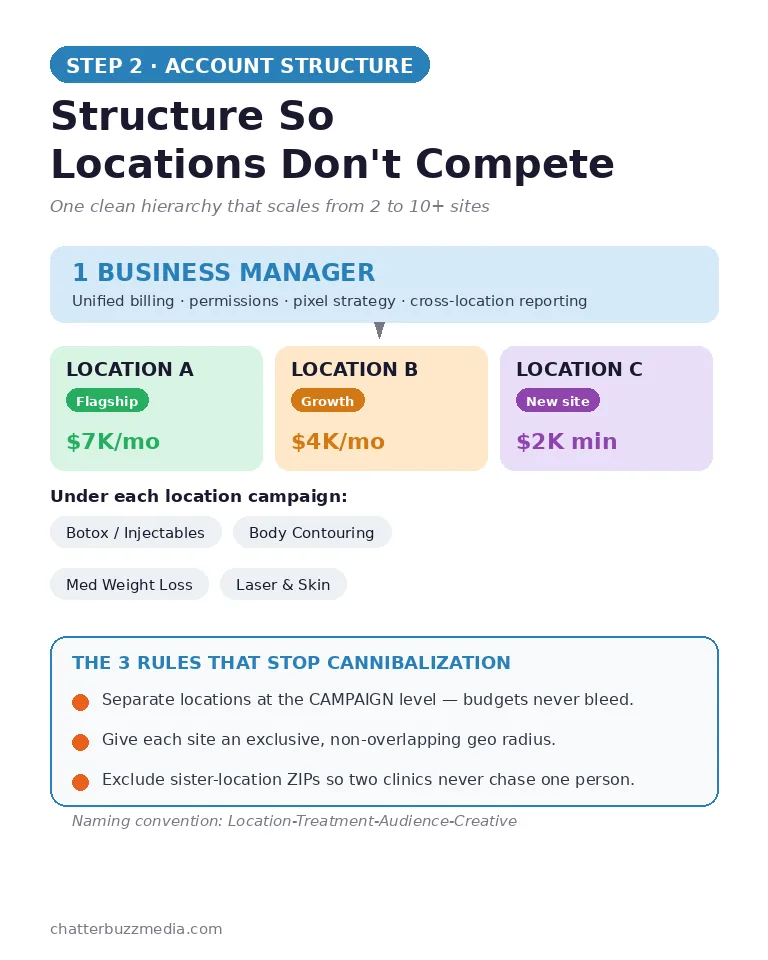
Use this multi-location structure on Meta:
- One Business Manager, one pixel strategy. Keep everything under a single Meta Business Manager for unified billing, permissions, and reporting across locations.
- One campaign per location, not per treatment first. Separate locations at the campaign level so budgets never bleed across markets, then split treatments into ad sets underneath.
- Carve out exclusive geographies. Give each location its own non-overlapping radius, and exclude sister-location ZIP codes so two clinics never chase the same person.
- Standardize naming conventions. A consistent naming system (Location-Treatment-Audience-Creative) makes reporting across five locations readable instead of chaotic.
For practices with a strong flagship and newer satellites, weight budget toward proven markets while giving new locations a protected minimum to escape the learning phase. This prevents your best location from starving your newest one, or vice versa.
Decide early how centralized you want to be. A single manager running all locations gives you consistency and easier budget shifting, while a per-location manager gives you local nuance at the cost of coordination. Most growing groups land in the middle: centralized structure and reporting, with local input on offers and creative. If you would rather hand the whole build to a partner, a specialized healthcare marketing team can stand this up across every location at once.
What you just built: an account that scales cleanly as you add locations. Now you can point precise targeting at each individual market.
Step 3: Target the Right Patients Around Each Location
For local aesthetic practices, geography and demographics do most of the targeting work. Because Meta strips detailed interest targeting from restricted health ads, your radius, age, and gender settings carry the load.
Precise local targeting keeps each location’s spend inside the trade area where those patients can actually book. Waste here compounds fast across multiple sites.
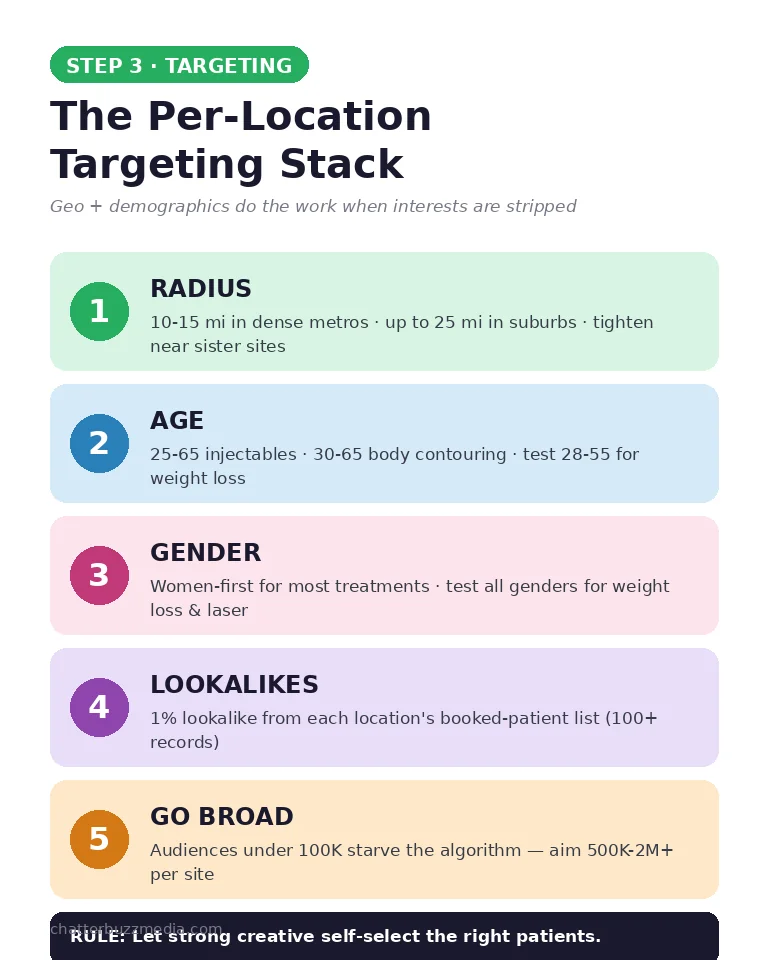
The targeting stack that works per location:
- Radius: 10-15 miles in dense metros, up to 25 miles in suburban markets. Tighten it where a sister location sits nearby.
- Age: 25-65 for injectables, 30-65 for body contouring, and test 28-55 for medical weight loss programs.
- Gender: women-first for most treatments, since the large majority of aesthetic patients are women. Test all genders for weight-loss and laser hair removal.
- Lookalikes: build a 1% lookalike from each location’s booked-patient list once you have enough records, and let it find similar local buyers.
Go broad, not narrow. Audiences under 100,000 people give Meta’s algorithm too little room to optimize, so aim for a large local audience and let strong creative self-select the right patients. This is the opposite of the old “stack ten interests” approach, and it wins in 2026.
What you just dialed in: clean, local audiences for every location. The lever that actually moves cost per lead, though, is the creative you put in front of them.
Step 4: Build Creative That Converts by Treatment
Creative is the single biggest driver of med spa ad performance. The same audience with different creative can produce a multiple-times difference in cost per lead, which makes this the highest-leverage step in the entire system.
Aesthetic treatments are visual, emotional, and often impulse-driven. People do not search for a treatment they have never heard of; they see a result, feel something, and reach out.
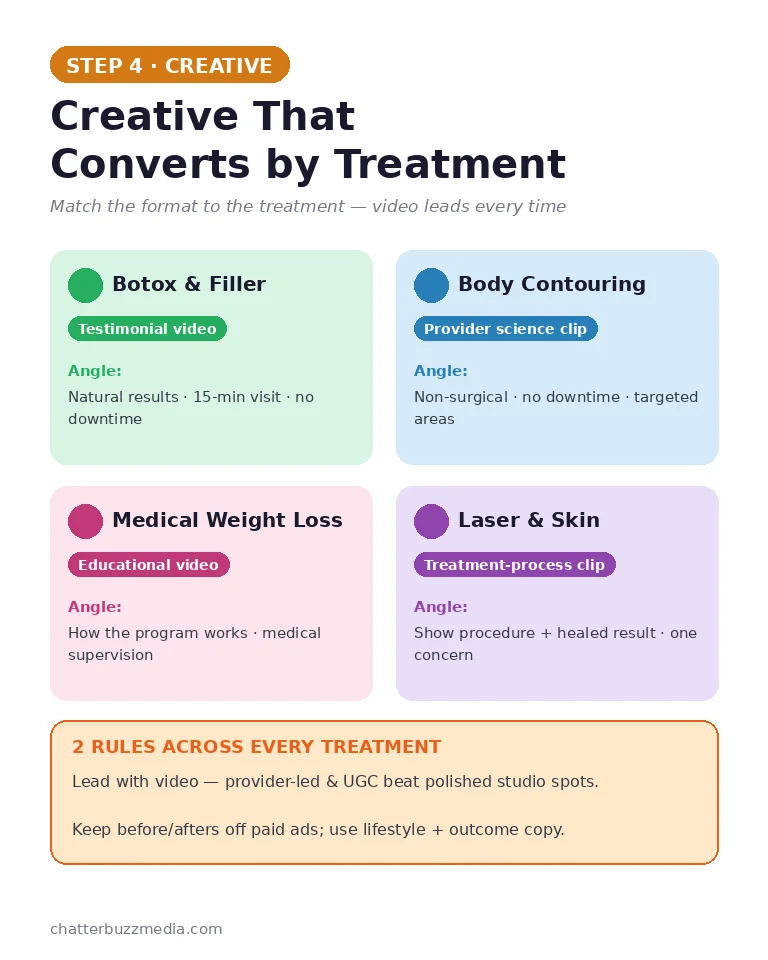
Match the format to the treatment:
- Injectables (Botox, filler): short provider or patient testimonial video emphasizing natural results, quick procedure, and no downtime.
- Body contouring: provider education video explaining the science, paired with non-surgical and no-downtime messaging.
- Medical weight loss: educational provider video on how the program works, stressing medical supervision over a quick fix.
- Laser and skin: treatment-process video showing the procedure and healed outcome, tied to a specific skin concern.
Two rules cut across every treatment. First, lead with video, because provider-led and UGC-style video consistently outperforms polished studio spots. Second, respect the policy line: keep before/after transformations to your website and organic content, and use lifestyle imagery and outcome-focused copy in paid ads.
Anchor every ad in a strong offer. A free consultation plus skin analysis, a first-time-client credit, or a limited demo of a signature device gives people a concrete reason to act now instead of later. The offer often matters more than the production quality, so nail the offer first and use video to scale what already converts. For multi-location groups, keep a shared library of approved offers so each site runs proven promotions instead of reinventing them.
Plan for fresh assets every month. Creative fatigue sets in after a few weeks, and our breakdown of Facebook ad fatigue shows why rising frequency quietly kills performance. A steady creative testing cadence is what keeps cost per lead flat as you scale.
What you just created: a treatment-specific creative library that does the real targeting. With demand generation handled on Meta, it’s time to capture the patients already searching.
Step 5: Add Google Ads to Capture High-Intent Searches
Meta creates demand, and Google captures it. A patient who sees your Botox result on Instagram often heads to Google to search “Botox near me” before booking, and you want to own that moment too.
Running both channels together is what makes a multi-location paid media strategy compound. Meta fills the top of the funnel while Google intercepts high-intent, ready-to-book searches in each market.
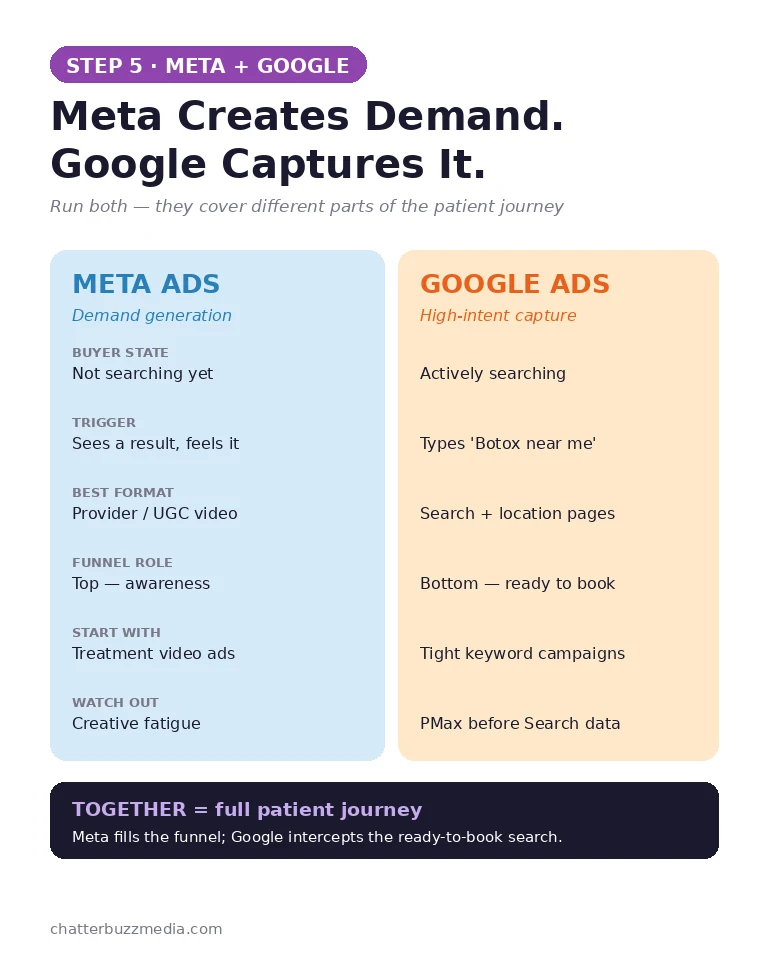
How to layer Google Ads onto each location:
- Start with Search, not Performance Max. Tight, treatment-plus-location keyword campaigns (“lip filler Orlando”) give you control and clean intent before you hand budget to automation.
- Use location-specific landing pages. Each location needs its own page with its address, providers, and reviews, which lifts both Quality Score and conversion rate. Our guide to PPC landing pages covers what those pages need.
- Add call and location extensions. Most aesthetic searches happen on mobile, so click-to-call and directions turn searches into booked consults.
- Layer in local SEO underneath. Paid captures demand now, while optimized Google Business Profiles compound your visibility for free over time.
Graduate to Performance Max only once Search is working. PMax can extend reach across YouTube, Discover, and Maps, but it hands targeting to Google’s automation, so give it clean conversion data and location signals from your Search campaigns first. Launching PMax cold, before Google understands what a booked patient looks like, usually burns budget on low-intent clicks.
Keep Google’s healthcare restrictions in mind here too, and set realistic expectations on ramp time, because paid search needs a few weeks of data before it stabilizes. If you are weighing where to put the next dollar, our comparison of SEO versus PPC helps frame the tradeoff, and a well-run PPC management process keeps both channels accountable.
What you just added: a high-intent capture layer that complements Meta’s demand generation. Now you need budgets and benchmarks you can actually defend to an owner or board.
Step 6: Set Budgets and Benchmarks You Can Defend
The right budget depends on your market, treatment mix, and how many locations you run. The mistake is spreading a thin budget across many locations, which starves every campaign of the data it needs to optimize.
Meta needs enough weekly conversions per campaign to exit its learning phase, so each location needs a real minimum rather than a token amount. Underfunding is why so many multi-location practices see inconsistent results.
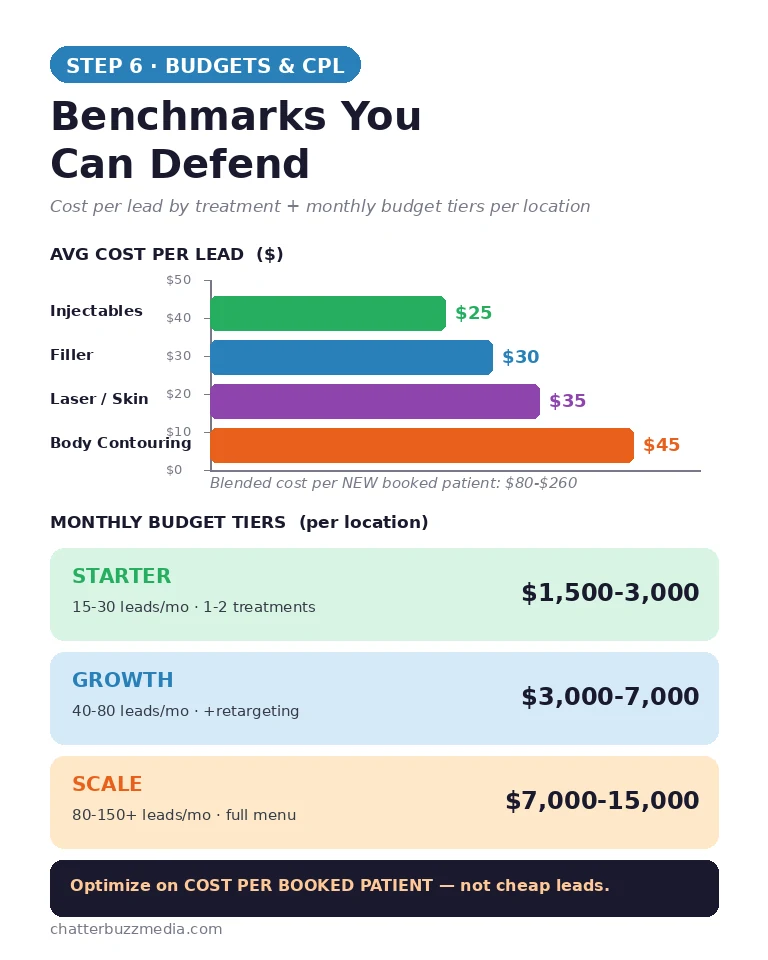
Practical budget tiers per location:
- Starter ($1,500-3,000/mo): one or two treatment campaigns, roughly 15-30 leads per month, good for testing a single location.
- Growth ($3,000-7,000/mo): three or four treatments plus retargeting, roughly 40-80 leads per month.
- Scale ($7,000-15,000/mo): full treatment menu plus retargeting and re-engagement, 80-150+ leads per month.
Know your benchmarks so you can judge performance. Cost per lead typically runs $15-25 for injectables, $18-30 for filler, and $25-45 for body contouring, while blended cost per new patient often lands between $80 and $260. Track cost per booked patient, not just cost per lead, because a cheap lead that never shows is worth less than a pricier lead who books a package.
For multi-location owners, the number that matters most is cost per booked patient by location. That single metric tells you where to shift budget, and clear reporting and data visualization makes those decisions obvious.
What you just set: defensible budgets and the benchmarks to hold campaigns accountable. None of it matters, though, without the tracking and follow-up to convert those leads.
Step 7: Track Leads and Follow Up Fast
If you can’t track it, you can’t improve it, and if you don’t follow up fast, you lose the patient. This final step is where multi-location practices win or leak the most revenue.
Tracking for a med spa also has to respect patient privacy, which changes how you set up your pixels compared to a normal local business. Get this right and every location’s data feeds cleaner optimization.
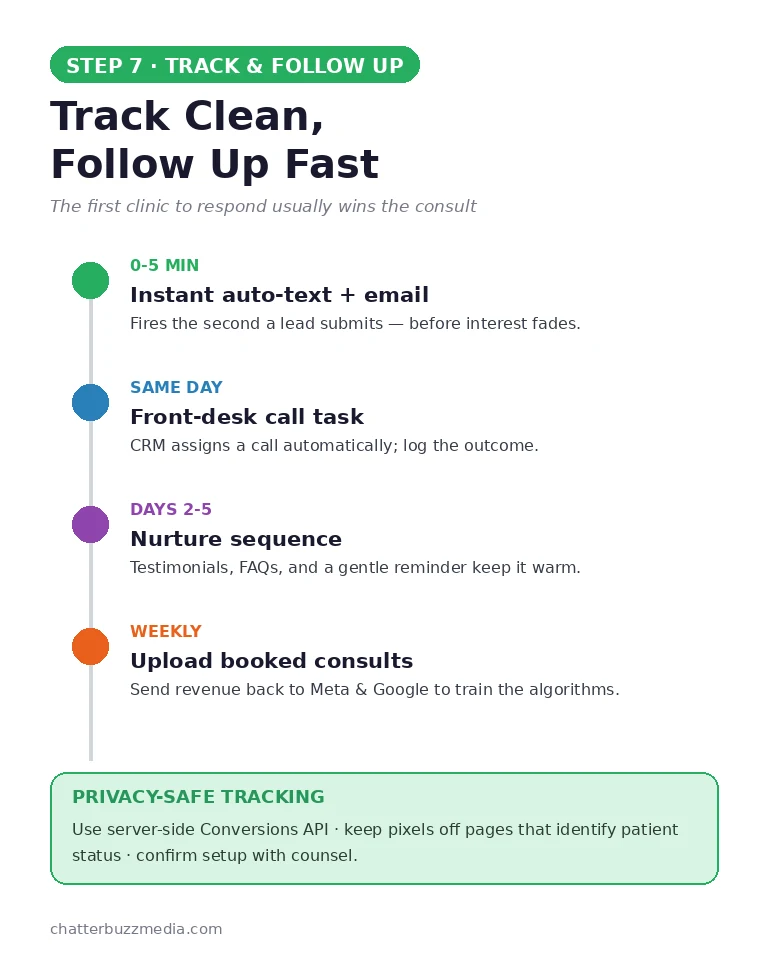
Build this tracking and follow-up stack:
- Use server-side tracking. The Meta Conversions API recovers conversions the browser pixel misses and gives you more control over what data leaves your site.
- Keep pixels off protected pages. Per American Med Spa Association guidance, avoid firing ad pixels on pages that could tie a person to patient status, and confirm your setup with counsel.
- Retarget site visitors. A simple Facebook pixel retargeting audience brings back visitors who did not book the first time.
- Automate speed to lead. Trigger an instant text and email the moment a lead comes in, because the first clinic to respond usually wins the consult.
Then close the loop. Upload booked consults and revenue back to Meta and Google so the algorithms learn which leads become paying patients, and track the full funnel from click to booked patient in your CRM. Without that loop, you optimize for cheap leads instead of real revenue.
What you just completed: a measurement and follow-up engine that turns leads into booked patients across every location. That’s the full seven-step system, so let’s answer the questions owners ask most.
Frequently Asked Questions
1. 🔍 How much do med spa Facebook ads cost per month?
Most single locations spend $1,500-5,000 per month on Meta ad spend, with $2,000-3,000 being the common sweet spot. Multi-location practices should budget a real minimum per location rather than splitting one small budget across sites, because each campaign needs enough weekly conversions to optimize.
2. 📊 What’s a good cost per lead for a med spa?
Cost per lead usually runs $15-25 for injectables, $18-30 for filler, and $25-45 for body contouring. Blended cost per new booked patient typically lands between $80 and $260, so always judge campaigns on cost per booked patient, not just cost per lead.
3. ⚡ Should I run Facebook ads, Google Ads, or both?
Run both. Meta generates demand by putting results in front of people who were not searching yet, while Google captures high-intent patients actively searching for a treatment near them. Together they cover the full patient journey, which is exactly what multi-location growth needs.
4. 🏦 Can med spas use before-and-after photos in paid ads?
Generally not in paid ads, since Meta restricts before/after and body-image framing, and using them requires signed, channel-specific consent. Keep transformations on your website and organic content, and use lifestyle imagery with outcome-focused copy in ads.
5. 🤝 How do I structure ad accounts for multiple locations?
Keep everything under one Business Manager, separate locations at the campaign level so budgets don’t bleed, and give each location an exclusive, non-overlapping geographic radius. This stops sister locations from bidding against each other and keeps reporting clean.
6. 💰 How fast should we follow up with new leads?
Within minutes, not hours. Interest fades quickly and the first practice to respond books the consultation most of the time, so automate an instant text and email on every lead and assign a call task to your front desk immediately.
7. 🚀 Are med spa ad pixels HIPAA compliant?
Standard ad pixels are not automatically HIPAA compliant, because they can send data ad platforms should not receive. Use server-side tracking, keep pixels off pages that could identify patient status, and confirm your configuration with legal counsel before launching.
8. 📈 How long before med spa ads start working?
Expect a two-to-four week learning phase while the algorithms test audiences and placements. Cutting campaigns too early is a common and costly mistake, so evaluate trends over weeks rather than reacting to daily swings.
Conclusion: Your Multi-Location Paid Media Action Plan
Running paid media across multiple med spa locations is not about spending more; it’s about structure, compliance, and follow-through. The practices that win build a compliant foundation, keep locations from competing, and pair Meta’s demand generation with Google’s high-intent capture.
Here’s your action plan to get started:
- Lock down compliance. Set up channel-specific photo consent, an approved-claims library, and privacy-safe tracking before you launch a single ad.
- Architect your accounts. One Business Manager, one campaign per location, and exclusive geographies so no two sites compete.
- Launch Meta plus Google together. Lead with treatment-specific video on Meta and capture “near me” searches with location-specific Google Search campaigns.
- Measure and follow up. Track cost per booked patient by location and automate instant lead follow-up to convert what you generate.
For the bigger picture beyond paid media, our med spa marketing guide ties advertising together with SEO, website, and reputation, and our med spa SEO guide shows how organic search compounds the demand your ads create. Used together, they turn a collection of locations into a growth system.

Victoria Wallace
Victoria Wallace is a senior content strategist and marketing writer with 30+ years of experience helping more than 200 brands translate complex business goals into clear, conversion-focused content. Her background spans paid media, marketing strategy, go-to-market planning, brand positioning, and full-funnel campaign development, giving her a deep understanding of how SEO content connects to real business growth.