
 321-236-2899

How to Measure AI Search ROI: From Citations to Revenue
AI assistants now sit between your buyers and your website, and most of the revenue they drive never shows up in a last-click report. AI search ROI is the return you earn from being cited, mentioned, and recommended inside AI answers, measured against what you spend to earn that visibility.
If you can’t put a number on it, you can’t defend the budget. Finance will treat the channel as a hobby until you show the math.
The stakes are no longer theoretical. ChatGPT crossed 800 million weekly active users in late 2025, and Euromonitor projects AI-powered search will influence more than $595 billion in retail e-commerce by 2028.
Buyers are asking machines first and clicking second. That single shift is why the old dashboards undercount the channel so badly.
This guide walks the full measurement chain, step by step: from AI visibility metrics, to the traffic those answers send, to pipeline, to a defensible ROI number. You’ll leave with the one formula that ties citations to revenue and realistic benchmarks for how long each layer takes to move.
Key Takeaways
- AI search ROI = (AI-assisted revenue − AI search investment) ÷ AI search investment × 100. Everything else in this guide exists to fill in those two inputs honestly.
- Last-click hides several times the real contribution because a large share of AI-influenced visits arrive with no referrer and get bucketed as direct traffic.
- Measure in three layers — visibility, engagement, and revenue — and expect them to mature in that order across your first two quarters.
- Self-reported attribution (a “How did you hear about us?” field) is the single most reliable way to recover the dark funnel AI search creates.
- Report leading indicators early and lagging revenue later so leadership sees momentum before pipeline fully catches up.
What AI Search ROI Means — and Why Last-Click Hides It
AI search ROI measures the revenue you can trace back to AI answers against the cost of earning a place in them. The hard part isn’t the math; it’s that the two numbers live in systems that were never built to see each other.
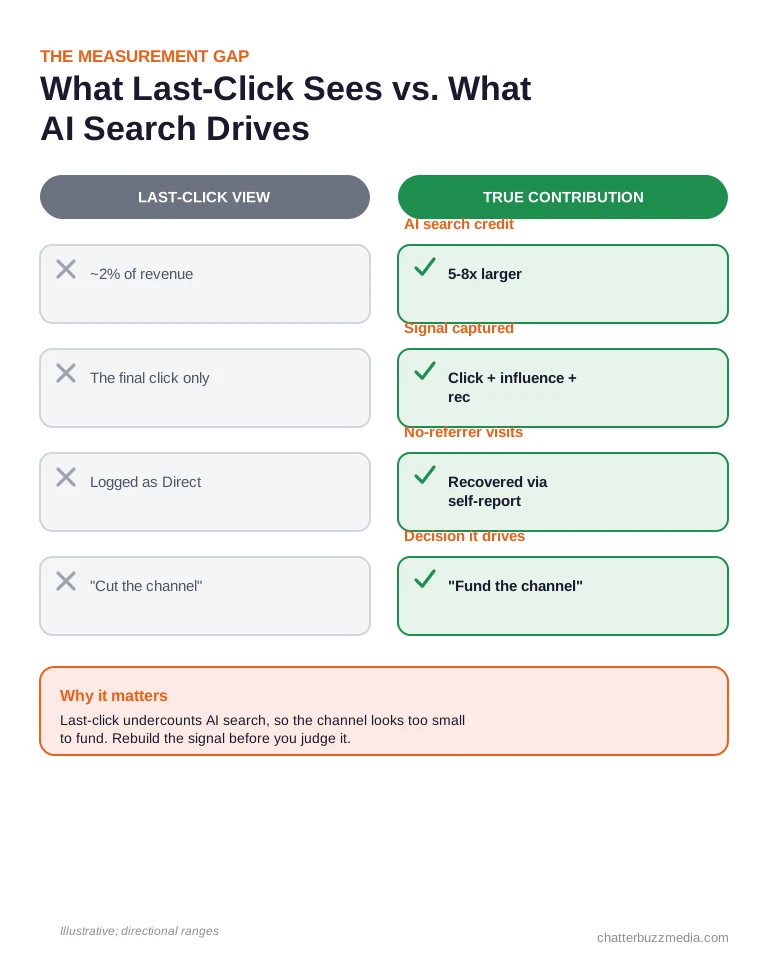
Traditional analytics assume a click. Someone searches, clicks a blue link, lands on your page, and the source gets recorded cleanly.
AI search breaks that chain in three places. The answer often resolves the question with no click, the eventual visit arrives days later from a different device, and when it does arrive it usually carries no referrer at all.
That last point is why the channel looks tiny in GA4. Studies of AI-influenced journeys find a large share land as direct traffic rather than a labeled source.
A last-click report then credits the brand term or the retargeting ad that closed the visit, not the AI answer that started it. The channel that did the convincing gets none of the credit.
The practical consequence is a systematic undercount. Teams that stitch the journey back together routinely find AI search contributes several times more than last-click shows.
So the first job of measurement is simple: stop losing the signal. The sections below rebuild that signal one layer at a time, starting with whether AI engines mention you at all.
Step 1: Baseline Your AI Visibility Metrics
Start by measuring whether AI engines mention you, because visibility is the leading indicator that moves first and predicts everything downstream. Four metrics form the baseline, and each has a simple formula you can run weekly.
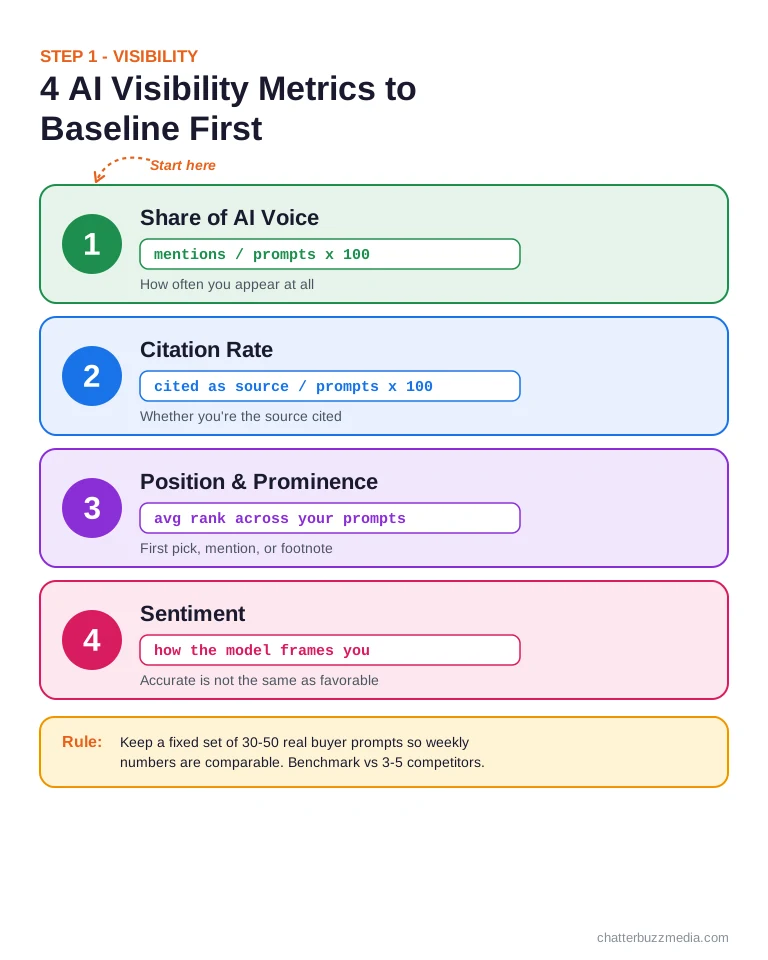
Share of AI voice is the percentage of your tracked prompts where your brand appears: brand mentions ÷ total prompts tracked × 100. It answers the blunt question of how often you show up.
Citation rate narrows that to authority: prompts where you’re cited as a source ÷ total prompts × 100. Being named in the answer is good; being the link the model leans on is better.
Position and prominence captures where you land — first recommendation, a supporting mention, or a footnote. Sentiment captures how the model describes you, because a model can mention you accurately and still frame you poorly.
The input that makes all four trustworthy is your prompt set. Build 30 to 50 real buyer questions across the funnel — problem-aware, solution-aware, and vendor-comparison — and keep the set fixed so week-over-week numbers mean something.
Run that same set against ChatGPT, Google AI Overviews, Perplexity, and Gemini on a schedule. A tracked prompt set built by vertical is what turns scattered spot-checks into a trend line you can act on.
Benchmark the whole set against three to five named competitors, not just yourself. Visibility is relative, and the gap to a rival is a more useful target than an absolute percentage.
With a baseline in hand, move to the traffic those answers actually send.
Step 2: Track AI-Driven Traffic in Google Analytics
Capture AI traffic by building a dedicated channel in GA4, because the default reports fold it into direct or organic and make it invisible. The fix is a custom channel group plus a referral filter for the AI domains.
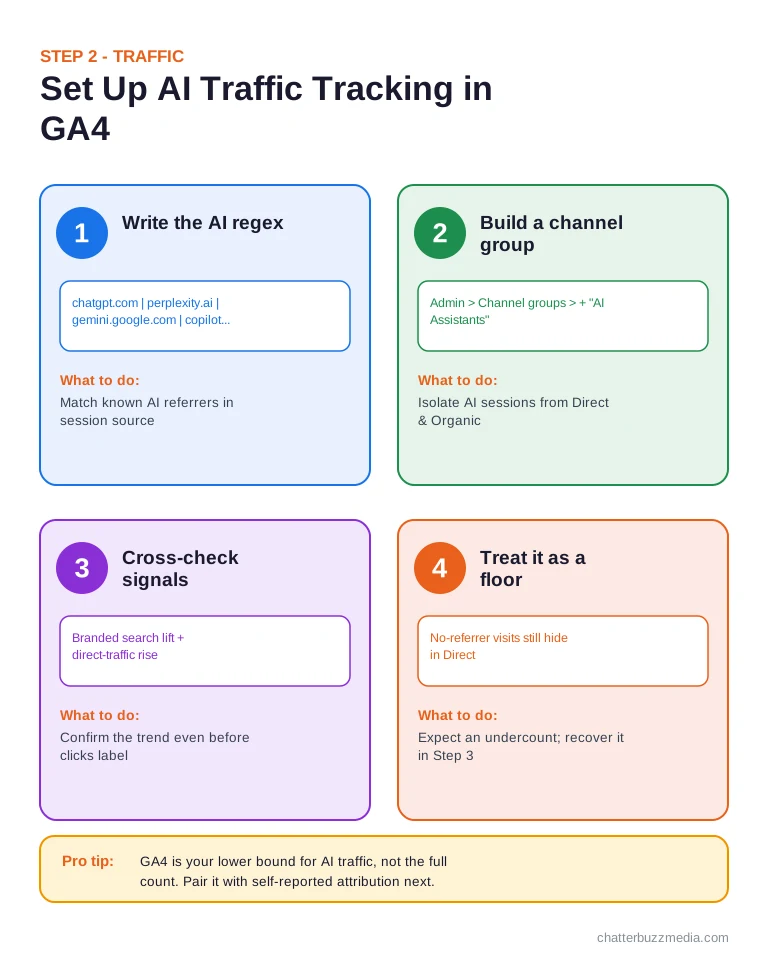
First, write a regex that catches the known AI sources in the session source: chatgpt.com|openai.com|perplexity.ai|gemini.google.com|copilot.microsoft.com|claude.ai. Add new engines to the pattern as they emerge.
Second, build a custom channel group in GA4 Admin and add an “AI Assistants” channel that matches that regex. Google’s Analytics Help explains how channels classify your traffic and where custom groups fit.
Third, cross-check the trend against branded-search volume and direct-traffic lift. When AI mentions rise and branded searches follow a few weeks later, that correlation is real evidence even before a single click is labeled.
Finally, accept that referrer-based tracking will always miss the no-referrer visits. Treat GA4 as your floor for AI traffic, not the whole picture — it proves the channel exists and trends, but it undercounts volume.
That gap is exactly why the next step matters. To recover the visits GA4 can’t label, you ask the buyer directly.
Step 3: Link Visits to Pipeline With Self-Reported Attribution
Add a “How did you hear about us?” question to your highest-intent conversion points, because self-reported attribution is the most reliable way to recover the dark funnel that AI search creates. It captures influence that no pixel can see.
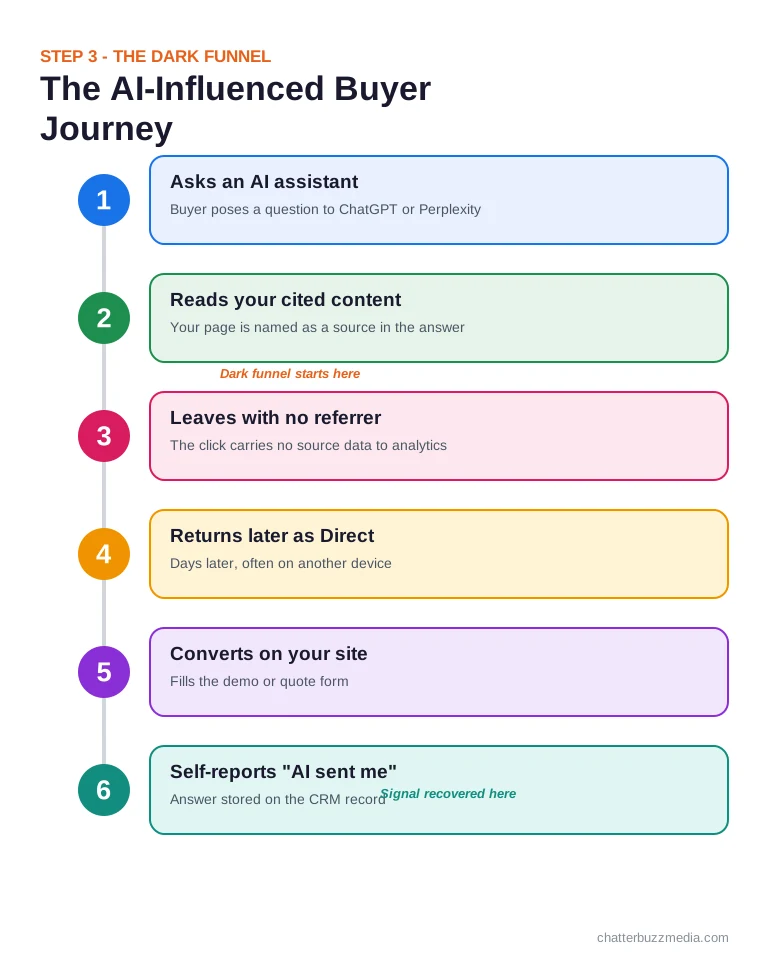
Place the question where commitment is highest — the demo request, the quote form, the account signup — not on a low-intent newsletter box. Make it an open field or a short list that includes options like “ChatGPT or another AI assistant.”
Then connect the answer to money. Store the response as a field on the lead record in your CRM so it travels with the opportunity all the way to closed-won.
Volume will look small at first, and that’s expected. Even a 5 to 10% self-report rate is enough to establish a directional pattern you can weight up using the undercount from your GA4 floor.
Watch for confirmation in the wording, too. When buyers write “an AI tool recommended you,” you are seeing the recommendation layer of AI search working, not just a referral.
This is the bridge from marketing metric to revenue. Once AI influence is a field on the opportunity, you can decide how much credit it deserves.
Step 4: Choose an Attribution Model for AI Revenue
Pick the simplest attribution model your data can support today, then upgrade as your tracking matures — starting too complex is how teams stall out. Three models cover almost every mid-market situation.
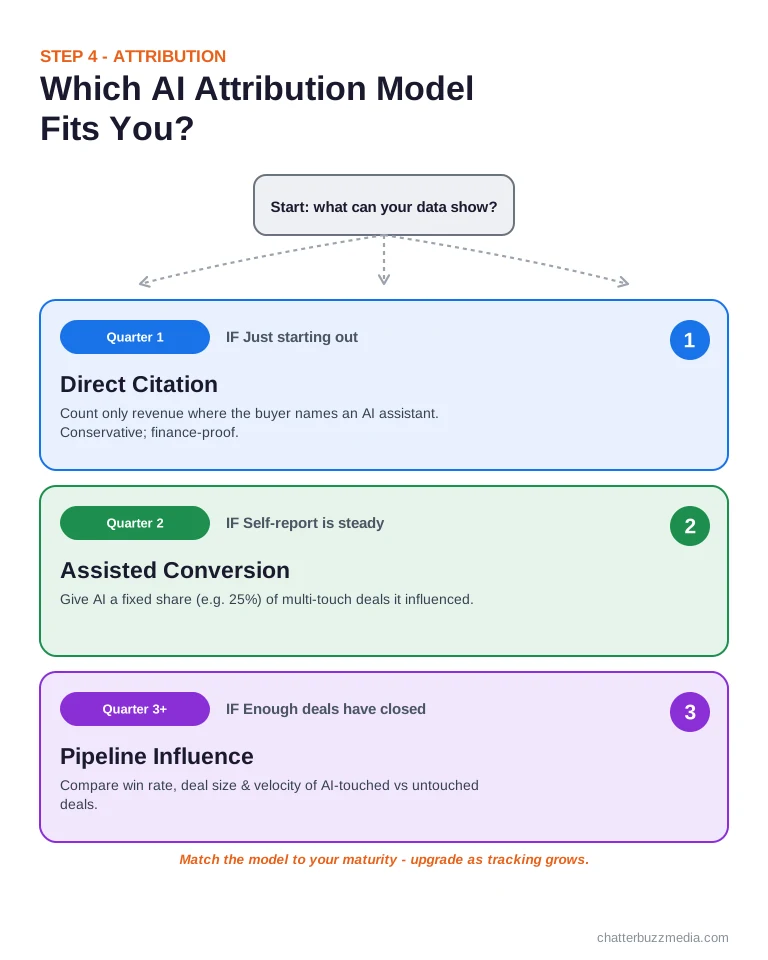
Direct citation attribution counts only revenue where the buyer explicitly said an AI assistant sent them. It is conservative and nearly impossible to overstate, which makes it the right starting point and the number most defensible with finance.
Assisted conversion attribution gives AI search partial credit when it appears anywhere in a multi-touch journey. A common approach assigns a fixed weight — say 25% — to the AI-influenced touch, so a $40,000 deal it assisted contributes $10,000 of AI-attributed revenue.
Pipeline influence attribution is the executive view. Tag every opportunity AI search touched, then compare that cohort’s win rate, deal size, and velocity against deals it never touched.
Pipeline influence reframes the question from “how many clicks” to “how much pipeline,” which is the language revenue leaders actually use. It also survives the no-referrer problem because it rides on CRM data, not analytics sessions.
For a deeper treatment of connecting touchpoints to revenue, our marketing attribution approach applies the same logic across channels.
Match the model to your maturity. Use direct citation in quarter one, layer in assisted conversion once self-report volume is steady, and graduate to pipeline influence when enough tagged deals have closed to compare cohorts.
Step 5: Calculate and Report AI Search ROI
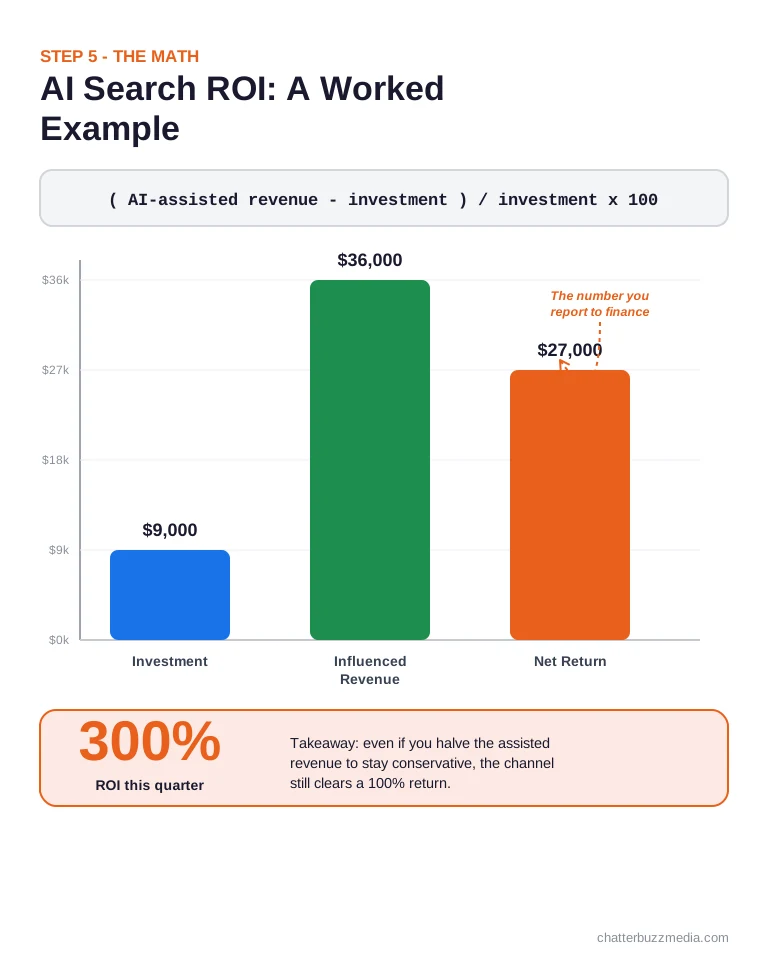
Calculate AI search ROI with one formula: (AI-assisted revenue − AI search investment) ÷ AI search investment × 100. The revenue input comes from Step 4; the honest part is counting the investment.
Count every real cost on the investment side. That means AEO and schema and structured-data work, content created or refreshed for AI citations, visibility-tracking tools, and the staff or agency hours spent on the channel.
Here is a worked example a mid-market team can recognize. Suppose a quarter of AEO content, tooling, and tracking costs $9,000, and self-reported plus assisted attribution credits AI search with $36,000 in influenced pipeline that closed.
Run the math: ($36,000 − $9,000) ÷ $9,000 × 100 = 300% ROI. Even if you discount the assisted revenue by half to stay conservative, the channel still clears a 100% return.
Pair the ROI number with a payback period and a cost-per-influenced-opportunity. Those two figures translate the result into terms a CFO uses to compare channels side by side.
Then report it in each stakeholder’s language. Show finance payback and cost per opportunity, and show your CMO share of AI voice climbing next to pipeline, so the reporting dashboard tells a cause-and-effect story rather than a pile of metrics.
AI Search ROI Benchmarks and Timelines by Vertical
Expect visibility to move in weeks, traffic in a quarter, and revenue across two quarters — and expect the pace to shift with how considered your buyer’s decision is. There is no universal benchmark yet, so anchor on your own baseline and these directional ranges.
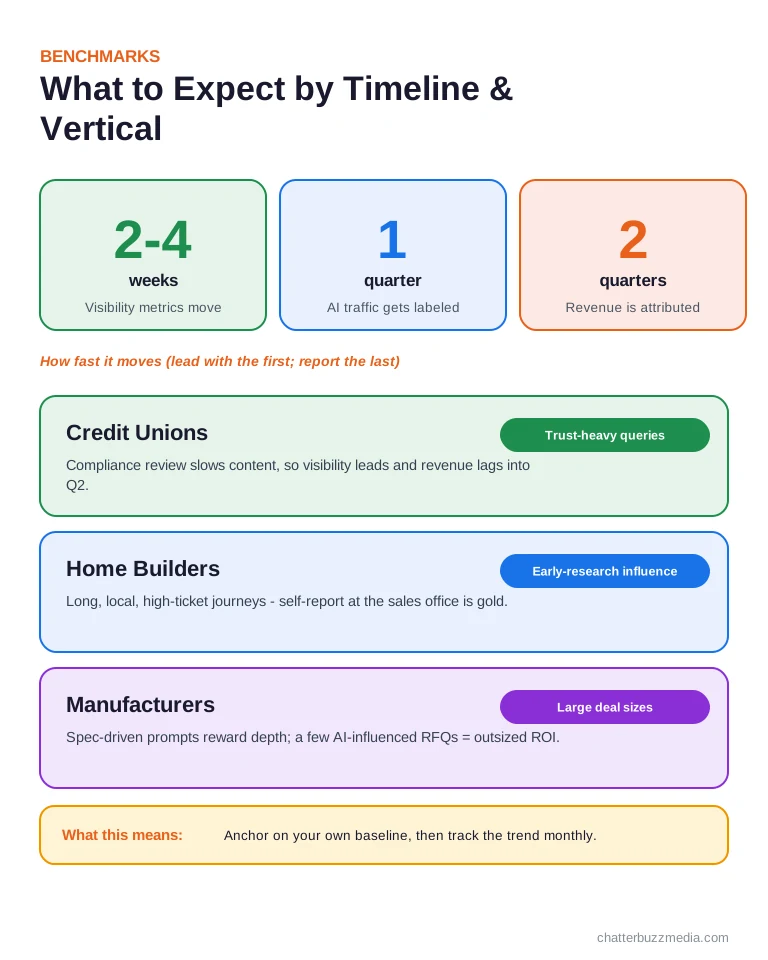
For credit unions and financial institutions, trust-heavy queries and compliance review slow content velocity. Visibility gains show first, while revenue attribution lags into the second quarter as longer consideration cycles play out.
For home builders, buyers run long, local, high-ticket journeys. AI influence often appears early in research, so self-reported attribution captured at the sales office becomes the most valuable signal you have.
For manufacturers, technical, specification-driven prompts reward depth of content. Because deal sizes are large, even a handful of AI-influenced RFQs can produce an outsized ROI number.
Across all three verticals the discipline is identical: baseline, track, attribute, and recompute every month. Let the trend drive the decision, never a single reading — and if you want the broader AI-search context, our breakdown of why SEO alone won’t cut it frames where this measurement work fits.
Frequently Asked Questions
1. 🔍 How do I track ChatGPT and AI traffic in Google Analytics?
Create a custom channel group in GA4 and add an “AI Assistants” channel with a regex that matches AI referrers such as chatgpt.com, perplexity.ai, gemini.google.com, and copilot.microsoft.com. Treat it as a floor rather than a full count, because many AI-influenced visits arrive with no referrer and still land in direct traffic.
2. 📊 Why does AI search traffic show up as direct traffic?
Most AI assistants strip or omit referrer data when a user follows a link, so the browser reaches your site with no source attached. GA4 defaults any session with no identifiable source to direct, which is why AI’s real contribution stays buried there until you add self-reported attribution to recover it.
3. ⚡ What is a good AI search share of voice?
There is no universal number, because share of AI voice depends entirely on the prompt set you track. The useful target is directional: measure your baseline against three to five named competitors on the same prompts, then work to close the gap and grow the trend month over month.
4. 🏦 How long does it take to see ROI from AI search?
Visibility metrics typically move within a few weeks of focused AEO work, AI-labeled traffic within a quarter, and attributed revenue across roughly two quarters. Longer-consideration verticals like financial services and home building sit at the slower end, while a single large manufacturing RFQ can show ROI quickly once it closes.
5. 🤝 Can you really attribute revenue to AI search?
Yes, but not with click data alone. The reliable path combines self-reported “how did you hear about us” responses stored in your CRM with an assisted or pipeline-influence model, which together recover the influence that referrer tracking misses.
6. 💰 What counts as investment when calculating AI search ROI?
Count everything you spend to earn AI visibility: AEO and structured-data work, content created or refreshed for citations, visibility-tracking tools, and the staff or agency hours on the channel. A clean investment figure is what keeps your ROI number credible when finance pressure-tests it.
7. 🚀 Which AI search ROI metric should I report to executives?
Lead with pipeline influence and cost-per-influenced-opportunity for revenue leaders, then pair it with share of AI voice as the leading indicator. The combination shows both the outcome finance cares about and the early signal that predicts where the outcome is heading.
Conclusion: Turn AI Visibility Into a Defensible Number
AI search is already shaping how buyers find you; the only question is whether you can prove its return before the budget conversation forces the issue. The teams that win this channel measure it like any other — honestly, repeatedly, and in the language finance understands.
Here is the action plan to start this quarter:
- Baseline visibility. Build a 30-to-50 prompt set and record your share of AI voice, citation rate, and sentiment against your top competitors.
- Capture the signal. Stand up an “AI Assistants” channel in GA4 and add a “How did you hear about us?” field to your highest-intent forms.
- Attribute and calculate. Store AI influence on the CRM opportunity, choose the simplest attribution model your data supports, and run the ROI formula.
- Report and repeat. Show leaders leading indicators now and lagging revenue later, and recompute every month so the trend drives decisions.
If you want a head start on the visibility half of the equation, our guide to answer engine optimization walks through how to earn the citations this framework is built to track. Our AI search optimization page shows what a full program looks like when visibility and revenue are measured together.

Victoria Wallace
Victoria Wallace is a senior content strategist and marketing writer with 30+ years of experience helping more than 200 brands translate complex business goals into clear, conversion-focused content. Her background spans paid media, marketing strategy, go-to-market planning, brand positioning, and full-funnel campaign development, giving her a deep understanding of how SEO content connects to real business growth.