
 321-236-2899
What Does a Fractional CMO Actually Do? (Week by Week)

Most articles about fractional CMOs describe the role in the abstract: “strategic leadership,” “part-time executive,” “growth expertise.” Useful, but it tells you almost nothing about what the person actually does with their week.
This post takes the opposite approach. Over hundreds of engagements, a clear operating rhythm shows up in how effective fractional CMOs spend their time, and mapping it week by week is the fastest way to understand the role. You will see the real monthly cadence, the core responsibilities that land on the desk, how the role compares to a consultant or full-time hire, what it costs, and how to know within 90 days whether it is working.
By the end, you will be able to picture exactly what a fractional CMO does on a Tuesday afternoon, not just what the job description says.
Key Takeaways
- A fractional CMO owns marketing strategy and outcomes on a part-time basis, sitting between an advisor who only recommends and a full-time executive who costs three to four times as much.
- The role runs on a predictable monthly rhythm: strategy and planning early, execution and enablement mid-month, and analysis and reporting at the end.
- Typical retainers run $5,000 to $15,000 per month, versus $300,000 to $450,000 all-in for a full-time CMO, a 40% to 70% saving at the same experience level.
- A fractional CMO is not a doer-of-everything; they lead strategy, build systems, and direct a team rather than personally executing every campaign.
- You should see structural progress within 90 days, from a clear strategy in month one to functioning systems and early pipeline signals by month three.
What a Fractional CMO Actually Does (Beyond the Job Title)
A fractional CMO is a senior marketing executive who owns your marketing strategy and its results on a part-time, ongoing basis. The word “fractional” refers to the time commitment, not the seniority: you get full CMO-level judgment for a fraction of the hours and cost.
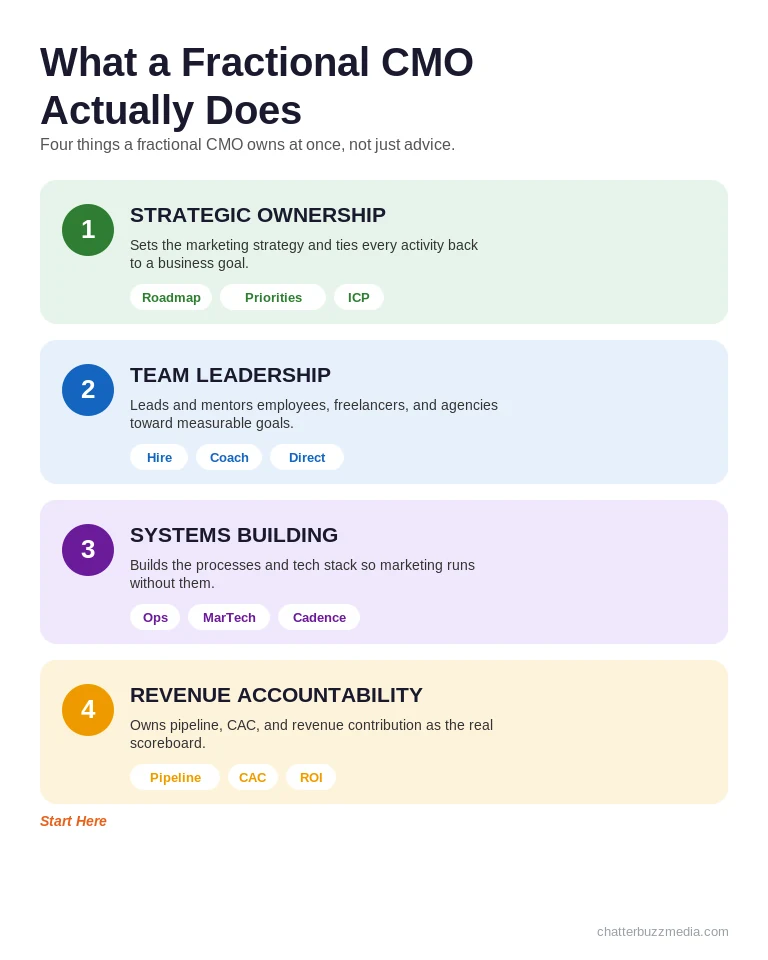
The distinction that matters most is ownership. A consultant hands you a slide deck and leaves; a fractional CMO stays, integrates with your team, and is accountable for whether the plan actually moves revenue.
In practice, the role covers four things at once. They set the marketing strategy and tie every activity back to business goals, they lead the team of employees, freelancers, and agencies, they build the systems that let marketing run without them, and they own the numbers that leadership cares about.
What separates a great fractional CMO from an expensive advisor is that last point. They treat pipeline, customer acquisition cost, and revenue contribution as their scoreboard, which is why the best engagements start with defining your ideal customer profile before touching a single campaign.
That ownership mindset only works if the time is structured deliberately, which is where the weekly rhythm comes in.
The Week-by-Week Reality: A Fractional CMO’s Monthly Rhythm
The best way to understand a fractional CMO is to watch a month unfold. Effective engagements follow a repeating four-week operating rhythm that balances high-level strategy with hands-on execution and hard measurement.
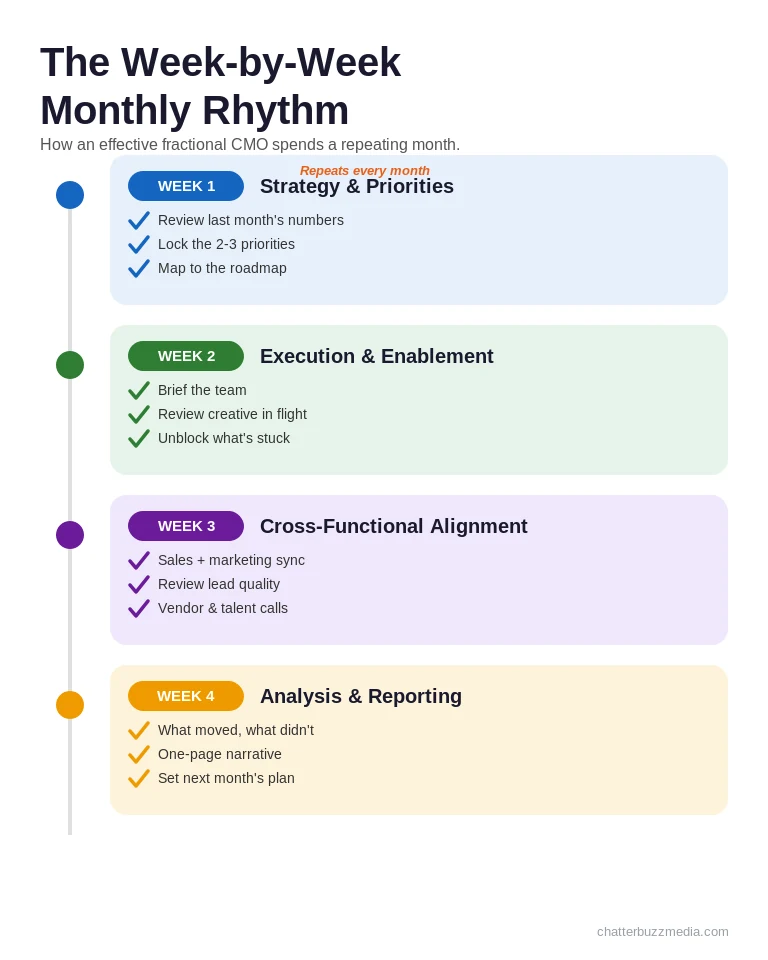
Week 1 is for strategy and priorities. The month opens with a review of last month’s numbers and a working session with leadership to lock the two or three priorities that matter most.
This is where the fractional CMO protects focus. Instead of letting the team chase ten half-finished ideas, they force a decision about what actually gets resourced, mapping it against the marketing roadmap and the company’s revenue stage.
Week 2 is for execution and enablement. With priorities set, the focus shifts to briefing the team, reviewing creative and campaigns in flight, and unblocking whatever is stuck.
A fractional CMO spends this week in the work, not above it. They are editing messaging, sitting in on a go-to-market planning call, and making sure the demand-generation engine is actually shipping, not just planned.
Week 3 is for cross-functional alignment. Marketing rarely fails on its own; it fails at the handoffs. This week is dedicated to keeping marketing and sales aligned, reviewing lead quality with the sales team, and coordinating with product or operations.
It is also when talent and vendor decisions happen. The fractional CMO evaluates whether the current team, agencies, and tools are pulling their weight, and makes the calls to add, coach, or replace.
Week 4 is for analysis and reporting. The month closes with a hard look at performance: what moved, what didn’t, and what it means for next month’s priorities.
This is the accountability loop that advisors skip. A strong fractional CMO turns the numbers into a one-page narrative leadership can act on, tracking the marketing KPIs that connect to revenue rather than vanity metrics.
The rhythm is not rigid, and a good fractional CMO flexes it to the moment. During a product launch, execution weeks expand; during a strategic reset, week one stretches into a deeper diagnosis.
What stays constant is the discipline of separating strategy time from execution time. That separation is precisely what most in-house teams lack, because the person setting direction is usually too buried in daily tasks to think two quarters ahead.
This rhythm repeats every month, tightening as the systems mature, which is what turns a set of activities into a real marketing function.
Core Responsibilities: What Lands on a Fractional CMO’s Desk
Across that monthly rhythm, the same core responsibilities recur. A fractional CMO’s job description spans six areas, and a capable one moves fluidly between all of them.
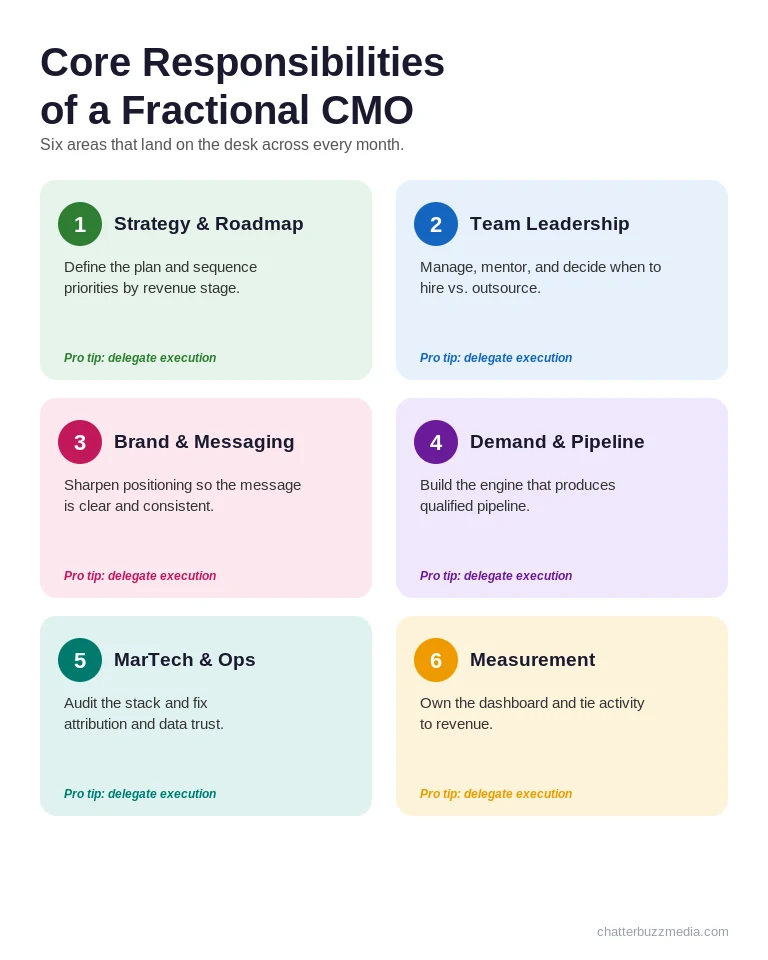
- Marketing strategy and roadmap. They define the plan, sequence the priorities by revenue stage, and make sure every dollar and hour ties back to a business objective.
- Team leadership and hiring. They manage and mentor internal staff, decide when to hire versus outsource, and hold agencies and freelancers to measurable standards.
- Brand positioning and messaging. They sharpen how the company talks about itself so the message is clear, differentiated, and consistent across every channel.
- Demand generation and pipeline. They build the engine that produces qualified pipeline, balancing demand generation against lead generation based on the buyer’s journey.
- Marketing operations and technology. They audit and streamline the tech stack, fix attribution, and make sure the data feeding decisions is trustworthy.
- Performance measurement and reporting. They own the dashboard, connect marketing activity to revenue, and translate results into decisions through clear reporting and data visualization.
Notice what is not on this list: personally running every ad, writing every email, or posting to social all day. A fractional CMO directs those functions and builds the team that executes them, which is exactly what separates the role from a marketing agency or an individual contributor.
The balance between these areas shifts with your situation. A company with a strong team but no direction will lean on the strategy and reporting responsibilities, while one with a clear plan but weak execution will need the CMO to spend more time on team leadership and operations.
Understanding those boundaries is easier when you compare the role side by side with the alternatives.
Fractional CMO vs. Consultant, Full-Time CMO, and Agency
The fastest way to understand a fractional CMO is to see what they are not. The role occupies a specific middle ground between advice and full-time employment, and each alternative solves a different problem.
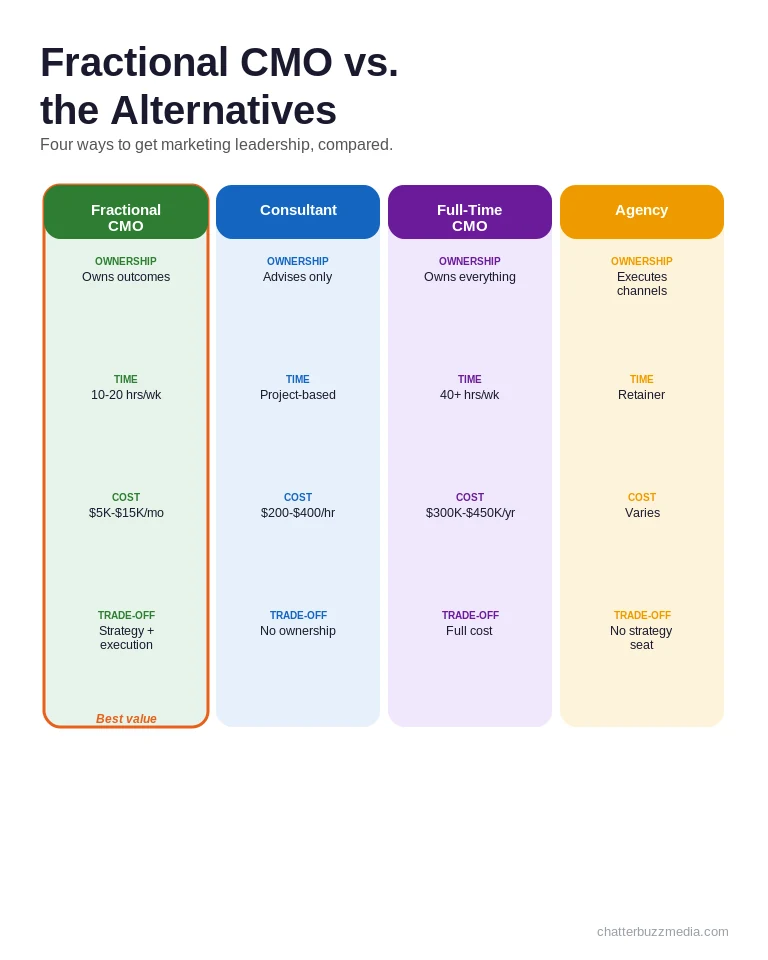
A marketing consultant advises but does not own outcomes. They diagnose the problem and recommend a fix, then it is on you to execute, which works well when you already have a strong team that just needs direction.
A full-time CMO owns everything but comes at full cost, typically $300,000 to $450,000 all-in. That level of investment makes sense once marketing is complex enough to demand 40-plus hours of executive attention every week.
A marketing agency executes specific channels well, but rarely owns your overall strategy or sits inside your leadership decisions. Many companies pair a fractional CMO with an agency, letting the CMO set direction while the agency runs execution, a structure worth weighing in any agency versus in-house decision.
A fractional CMO gives you the ownership of a full-time executive at a fraction of the hours and cost. It is the right fit when you need senior strategy and accountability but do not yet have the scale, or the budget, to justify a permanent hire, a tradeoff we break down further in this guide on hiring an agency versus in-house staff.
Which brings up the question every leader asks next: what does this actually cost, and does the math work?
What a Fractional CMO Costs and the ROI Math
A fractional CMO costs dramatically less than a full-time equivalent while delivering the same caliber of leadership. Most engagements run on a monthly retainer between $5,000 and $15,000, with the sweet spot for growth-stage companies landing around $8,000 to $12,000.
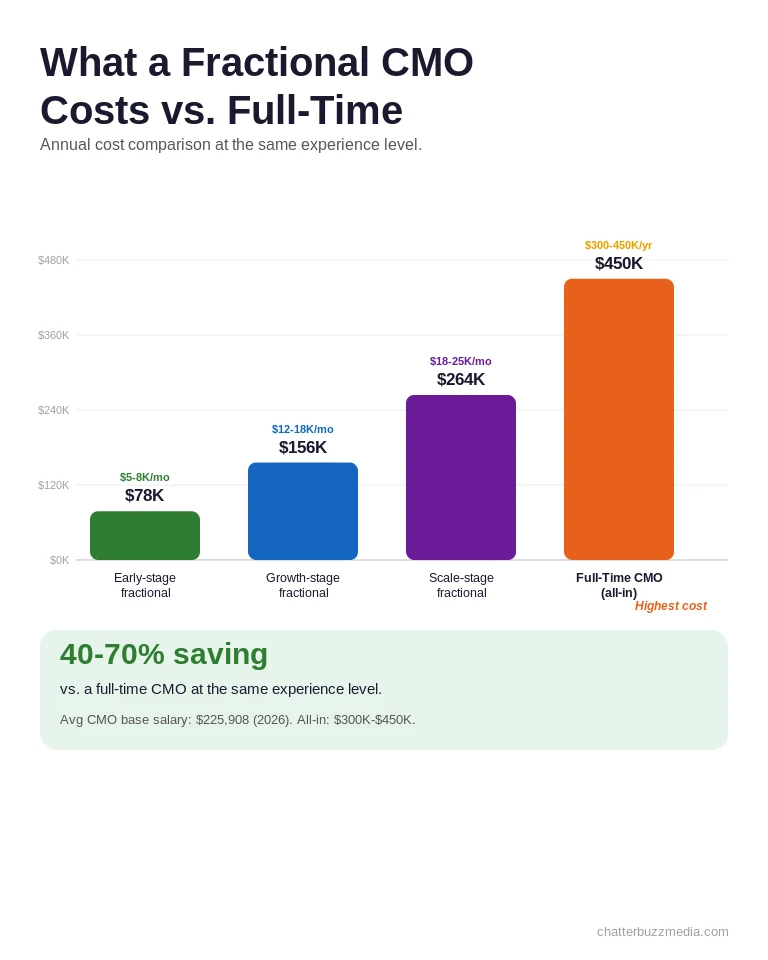
Compare that to a full-time CMO. According to 2026 compensation analysis, the average CMO base salary sits around $225,908, and once benefits, bonus, and payroll taxes are added, the all-in cost reaches $300,000 to $450,000 per year.
The pricing scales with your stage. Industry rate data shows early-stage startups commonly pay $5,000 to $8,000 per month, growth-stage companies $12,000 to $18,000, and scale-stage firms $18,000 to $25,000 or more, with hourly rates from $200 to $400.
The net effect is a 40% to 70% saving versus a full-time hire at the same experience level, according to 2026 rate benchmarks. The real ROI, though, is not just the salary you avoid; it is the wasted spend a senior operator prevents by killing bad campaigns early and reallocating budget to what works.
For a deeper breakdown of pricing models and what drives the number up or down, see our full guide on how much a fractional CMO costs and this framework for how much to invest in marketing.
It also helps to think about cost per outcome, not just cost per month. A fractional CMO who redirects even a modest ad budget away from underperforming channels can pay for the entire engagement in reclaimed spend.
Cost only matters if the engagement produces results, so here is how to judge that in the first 90 days.
The First 90 Days and How to Know It’s Working
A strong fractional CMO engagement follows a visible arc, and by day 90 you should see structural change, not just activity. The first three months move from understanding to systems to early results.
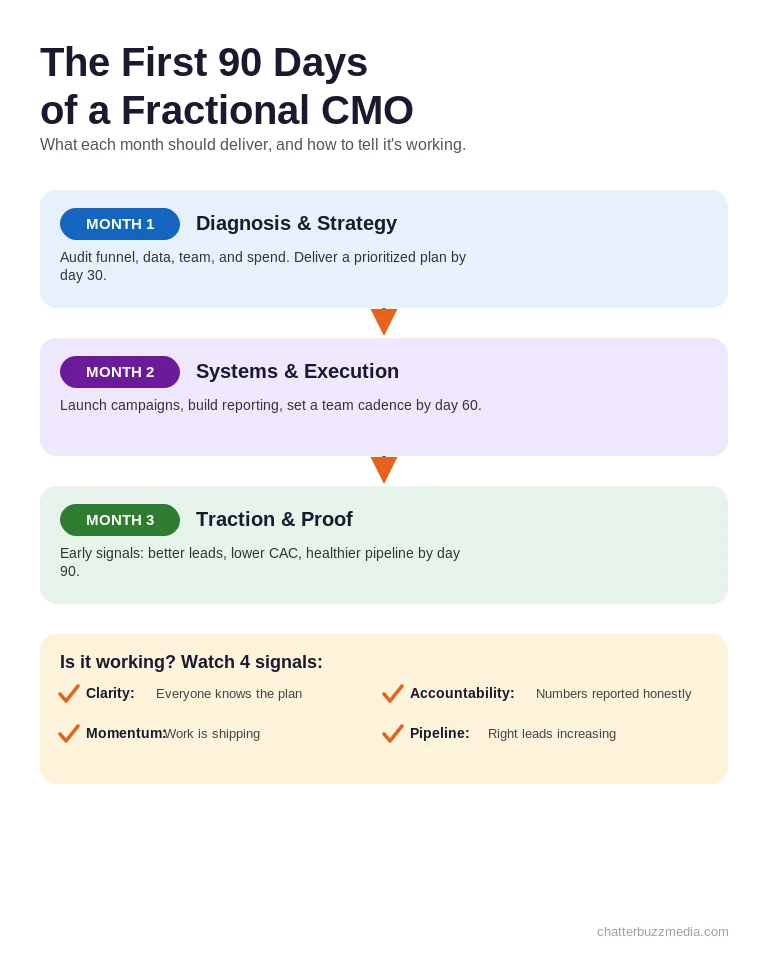
Month one is diagnosis and strategy. The CMO audits your funnel, data, team, and spend, then delivers a prioritized plan. By day 30, you should have a clear strategy and know exactly what the next 60 days will focus on.
Month two is systems and execution. Priorities turn into working processes: campaigns launch, reporting gets built, and the team starts operating on a defined cadence. By day 60, marketing should feel more organized and measurable than it did before.
Month three is traction and proof. Early signals appear, whether that is improved lead quality, lower acquisition cost, or a healthier pipeline. This maps closely to the playbook for how B2B CMOs succeed in their first 90 days.
To judge whether it is working, watch for four signals: clarity (does everyone know the plan?), accountability (are numbers reported honestly?), momentum (are things shipping?), and pipeline movement (are the right leads increasing?). If you see all four, the engagement is on track; if you see none by day 90, something is wrong.
This same arc applies whether you operate broadly or in a specialized vertical like a credit union, where the strategy adapts but the rhythm stays the same.
Frequently Asked Questions
1. 🔍 What does a fractional CMO do day to day?
Day to day, a fractional CMO reviews performance data, leads team and campaign meetings, sharpens messaging, and unblocks stalled work. Their time skews toward strategy and leadership rather than hands-on execution, which they delegate to the team, agencies, and freelancers they direct.
2. 📊 How many hours per week does a fractional CMO work?
Most fractional CMOs commit roughly 10 to 20 hours per week per client, though it varies with the engagement. The hours are structured around a monthly rhythm of strategy, execution oversight, alignment, and reporting rather than spread evenly across every day.
3. ⚡ How is a fractional CMO different from a marketing consultant?
A consultant advises and hands off; a fractional CMO owns outcomes and stays embedded in the team. The fractional CMO is accountable for whether the strategy actually moves revenue, not just for delivering recommendations.
4. 💰 How much does a fractional CMO cost?
Monthly retainers typically range from $5,000 to $15,000, with growth-stage companies often paying $8,000 to $12,000. That represents a 40% to 70% saving compared with the $300,000-plus all-in cost of a full-time CMO.
5. 🏦 Can a fractional CMO work with my existing marketing team?
Yes, and that is usually the point. A fractional CMO leads and mentors your current team, fills capability gaps with vendors when needed, and builds the systems that let the team keep performing after the engagement.
6. 🚀 How quickly should a fractional CMO produce results?
Expect strategy and clarity within 30 days, functioning systems by 60 days, and early pipeline or efficiency signals by 90 days. Structural results come first; compounding revenue results build over the following quarters.
7. 🤝 Is a fractional CMO right for a small or growth-stage company?
A fractional CMO fits best when you need senior marketing leadership but cannot yet justify a full-time executive salary. Early-stage startups and growth-stage companies are the most common clients precisely because they need strategy without the six-figure commitment.
8. 📈 What is the difference between a fractional CMO and a marketing director?
A marketing director executes and manages within a set strategy, while a fractional CMO sets the strategy and owns the business outcome. The CMO operates at the leadership table; the director operates inside the plan the CMO defines.
Conclusion: Putting the Role to Work
A fractional CMO is not a mystery once you see the rhythm behind it: strategy early in the month, execution and alignment mid-month, and honest measurement at the end, repeated until marketing becomes a real function. The role gives growing companies executive ownership without executive overhead.
If you are weighing whether the model fits your business, here is a simple action plan.
- Define the outcome first. Write down the one or two revenue goals you need marketing to drive over the next two quarters.
- Audit your current gap. Decide whether you lack strategy, execution, leadership, or all three, since that determines whether a consultant, agency, or fractional CMO fits best.
- Map the first 90 days. Agree up front on what diagnosis, systems, and early results should look like at day 30, 60, and 90.
- Set the scoreboard. Choose the handful of metrics that will tell you honestly whether the engagement is working before you sign.
When you are ready to go deeper on the model, explore our complete fractional chief marketing officer guide and browse more marketing strategy resources to plan your next move.

Victoria Wallace
Victoria Wallace is a senior content strategist and marketing writer with 30+ years of experience helping more than 200 brands translate complex business goals into clear, conversion-focused content. Her background spans paid media, marketing strategy, go-to-market planning, brand positioning, and full-funnel campaign development, giving her a deep understanding of how SEO content connects to real business growth.