
 321-236-2899

Home Builder Reviews: How to Earn and Use Them Right
Buyers decide whether to trust your model home before they ever walk through it. They read your reviews first, and what they find there either opens the door or quietly sends them to the builder down the road.
We have watched a single run of recent, specific reviews pull a community out of a slow quarter, and we have watched four unanswered one-star ratings stall traffic on an otherwise strong floor plan. The difference was never the homes. It was whether the builder treated reviews as a system instead of an afterthought.
This guide walks through exactly how to earn home builder reviews that buyers believe, respond to the good and the bad without losing sleep, and turn that feedback into marketing that moves people from browsing to signing. You will leave knowing the one moment in the build when a review request almost always gets a yes.
Key Takeaways
- Reputation is the filter. 76% of new-construction buyers say a builder’s reputation is very or extremely important, so reviews decide who even gets a showing.
- Volume and recency beat a perfect score. 47% of consumers avoid businesses with fewer than 20 reviews, and 74% only care about reviews from the last three months.
- Ask at the final walkthrough. The completion rate collapses once a happy buyer leaves the finished home, so request the review while you are standing in it.
- Respond to everything, fast. 89% of buyers expect owners to reply, and a calm answer to a bad review can reassure more people than the complaint scared off.
- Reviews are marketing assets. The same five-star quote belongs on your community pages, your ads, and your sales follow-ups, not just on Google.
Why Home Builder Reviews Decide Who Buyers Trust
Reviews decide trust because a new home is the largest, most irreversible purchase most buyers will ever make, and they have no way to test it in advance. So they borrow the confidence of the people who bought before them.
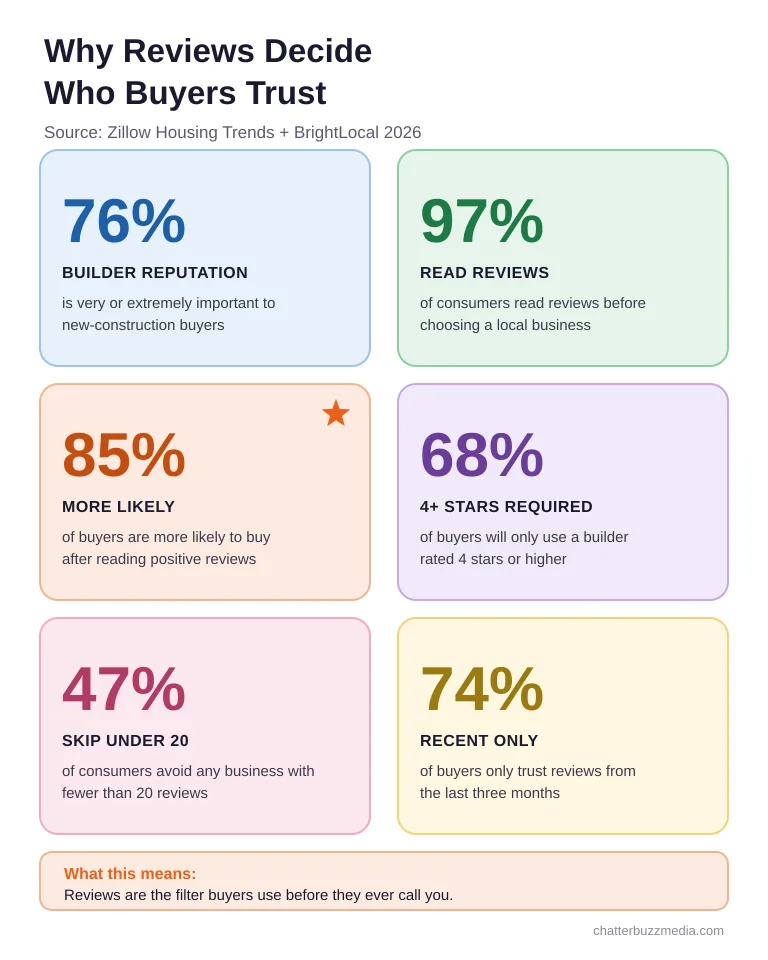
The data is blunt about how much weight that carries. Zillow’s Consumer Housing Trends Report found that 76% of new-construction buyers consider a builder’s reputation very or extremely important, and BrightLocal’s 2026 Local Consumer Review Survey found 97% of consumers read reviews for local businesses before choosing one.
It gets more demanding from there. 68% of buyers will only use a business rated 4 stars or higher, and 47% skip any business with fewer than 20 reviews outright.
This is why reputation acts as a filter rather than a tiebreaker. A buyer narrowing a list of three builders rarely rewards the one with the best homes; they reward the one whose past buyers sound the most relieved and the most specific, which is why reviews belong at the center of your digital marketing, not off to the side.
The builders who understand this stop treating reviews as something that happens to them. They build a process to earn reviews on purpose, and that starts with knowing where those reviews need to appear.
Where Your Reviews Need to Live: The Platforms That Matter
Your reviews need to live where buyers are already looking, which for home builders means a short, specific list rather than every directory on the internet. Concentrate your effort on the platforms that influence search visibility and purchase decisions, and ignore the rest.
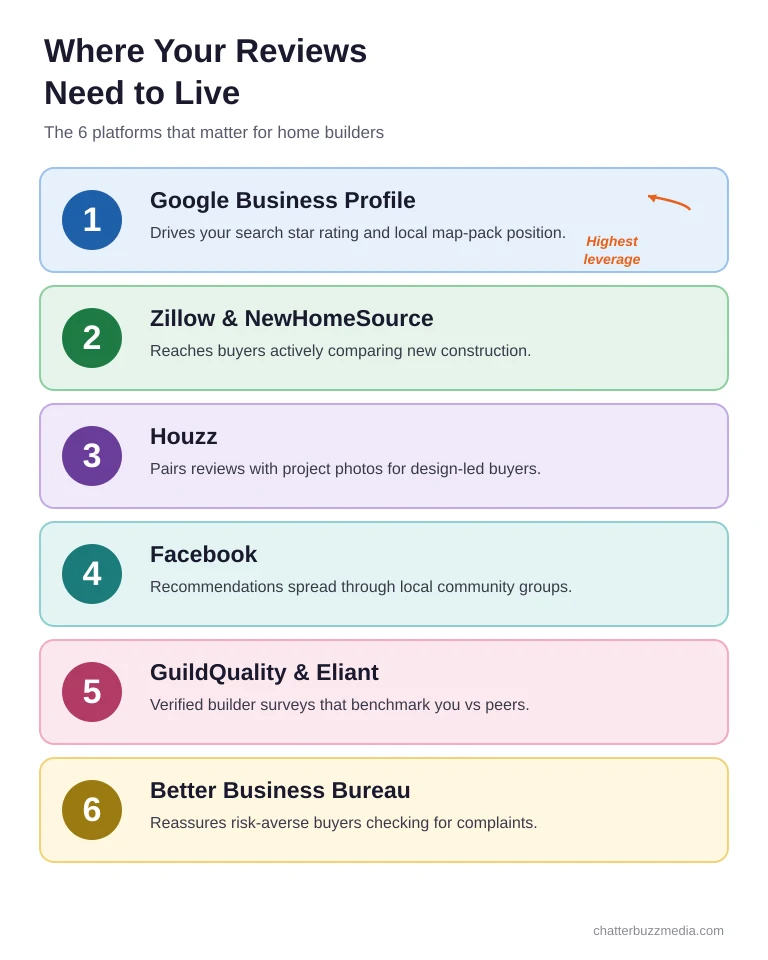
Here is the priority order that works for most builders:
- Google Business Profile. This is the single highest-leverage platform because its reviews feed both your star rating in search and your position in the local map pack.
- Zillow and NewHomeSource. Buyers shopping new construction live on these sites, and a builder profile with verified buyer reviews reaches people at the moment of active comparison.
- Houzz. For custom and semi-custom builders, Houzz pairs reviews with project photos, which is exactly the proof a design-conscious buyer wants.
- Facebook. Recommendations here travel through local community groups, where a single tagged recommendation can reach hundreds of nearby prospects.
- GuildQuality and Eliant. These builder-specific survey platforms generate structured, verified feedback and benchmark you against peers.
- Better Business Bureau. A clean BBB profile reassures the risk-averse buyer who is specifically checking whether you have unresolved complaints.
You do not need a flood of reviews on all six. You need a steady, recent stream on Google first, a credible presence on the two new-construction portals, and a monitored profile everywhere else.
One warning on spreading yourself thin: a profile you never monitor is worse than one you never created. An unanswered complaint on a platform you forgot about still shows up when a buyer searches your name, so claim only what you can realistically watch.
Once you know where reviews need to land, the real work begins: getting enough happy buyers to actually write them. A strong home builder SEO foundation ensures those profiles surface the moment a buyer searches your name.
How to Ask for Reviews Without Making It Awkward
The most reliable way to ask for a review is to do it in person, at the emotional peak of the build, before money or paperwork cools the moment. For a home builder, that peak is the final walkthrough.
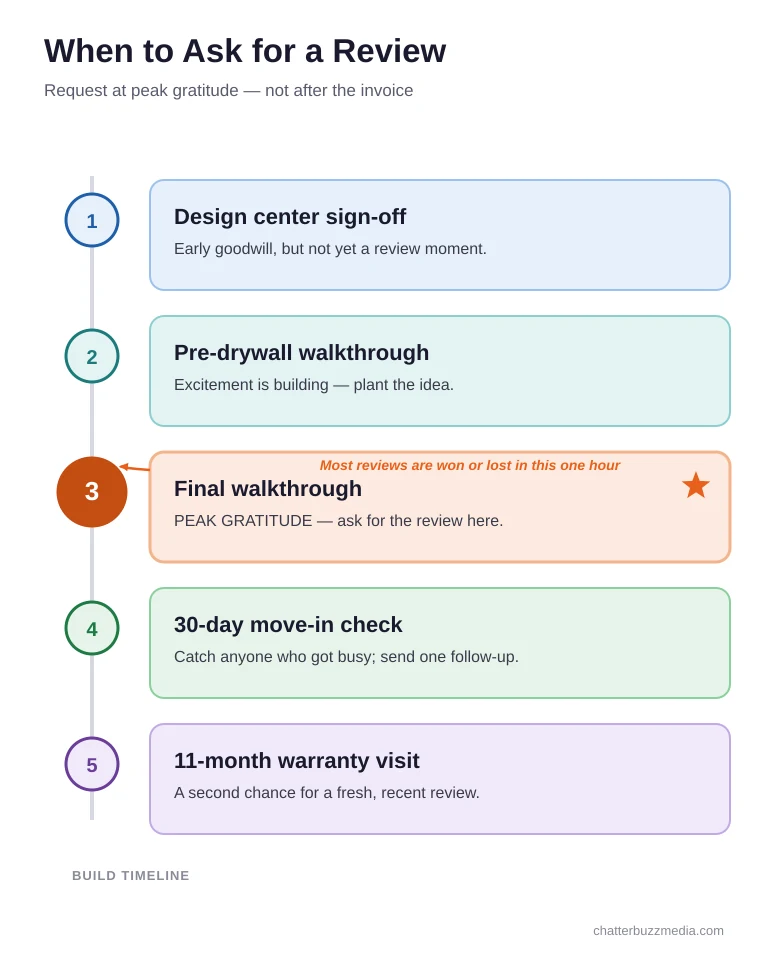
Timing is the whole game. A buyer standing in their finished home, keys in hand, is as grateful as they will ever be, and the request feels natural rather than transactional.
Wait until after closing, and the completion rate falls off a cliff. Once the relationship shifts to invoices and warranty tickets, the window where a review feels like a thank-you has already closed.
Keep the ask short and human. Something as simple as, “It’s been a pleasure building this with you. If you have a minute, a quick Google review would mean a lot to our team,” is enough.
Then remove every ounce of friction:
- Text the link on the spot. Pull up your Google review link and send it by text while you are still standing together, rather than promising to email it later.
- Save a one-tap link. Keep the shortened review URL saved on your phone so sending it never takes more than a few seconds.
- Prompt what to mention. Suggest they name their floor plan, their community, and anyone on your team who helped, which makes the review specific and far more persuasive.
- Follow up once. If they loved the idea but got busy, a single friendly text a few days later recovers a surprising number of reviews.
Build this into your closing checklist so it happens on every home, not just the ones where someone remembers. A consistent ask is what turns a handful of reviews a year into the volume buyers actually trust, and it supports the broader marketing strategy your community needs.
How to Respond to Reviews, the Good and the Bad
You should respond to every review you receive, and you should respond to negative ones within 24 hours. Buyers are not only reading the review; they are reading how you handled it, and 89% of them expect to see an owner reply.
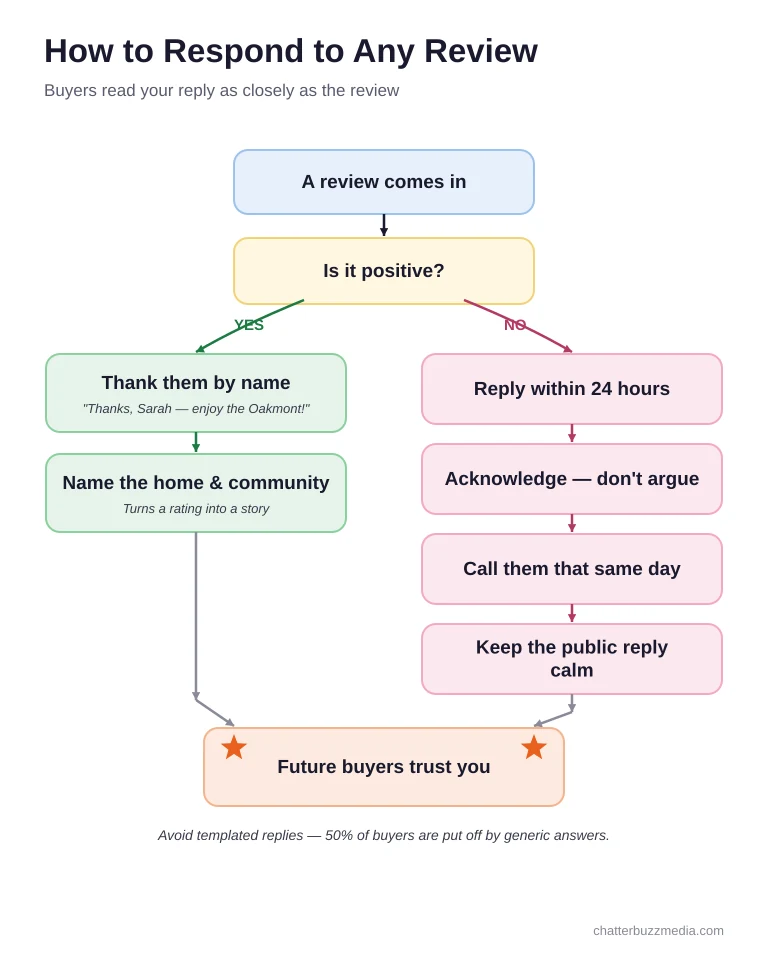
A response to a positive review is not a formality. Thank the buyer by name, mention the specific home or community they bought, and you turn a nice rating into a vivid story the next prospect can picture themselves in.
Negative reviews are where builders panic, and the panic costs them. The instinct to argue, to go silent, or to post a defensive wall of text all read the same way to a prospect: as a warning.
Handle a hard review in four moves. Acknowledge the frustration without litigating the facts, take the specifics offline with a direct phone call that same day, resolve what you reasonably can, and keep the public reply calm and brief.
A thoughtful answer to a one-star review can reassure more future buyers than the complaint ever scared away. It shows the exact thing a new-home buyer is terrified of not finding: a builder who stays engaged when something goes wrong.
Avoid the two patterns that undo good intentions. 50% of buyers are put off by generic, templated replies, so a copy-pasted “Thank you for your feedback” can do nearly as much damage as silence.
There is a hidden upside here that most builders miss. A backlog of well-handled reviews becomes a quiet record that you stand behind your homes, and that record does as much for your construction marketing as any brochure you could print.
Consistent, human responses do more than protect your reputation. As the next section shows, they also feed directly into how high you rank when a buyer searches.
How Reviews Lift Your Local Search Rankings
Reviews are one of the strongest levers you have in local search, because Google reads your review volume, ratings, recency, and responses as signals of a prominent, active, trustworthy business. For a builder competing to appear in the local map pack, that makes your review profile a ranking asset, not just a reputation one.
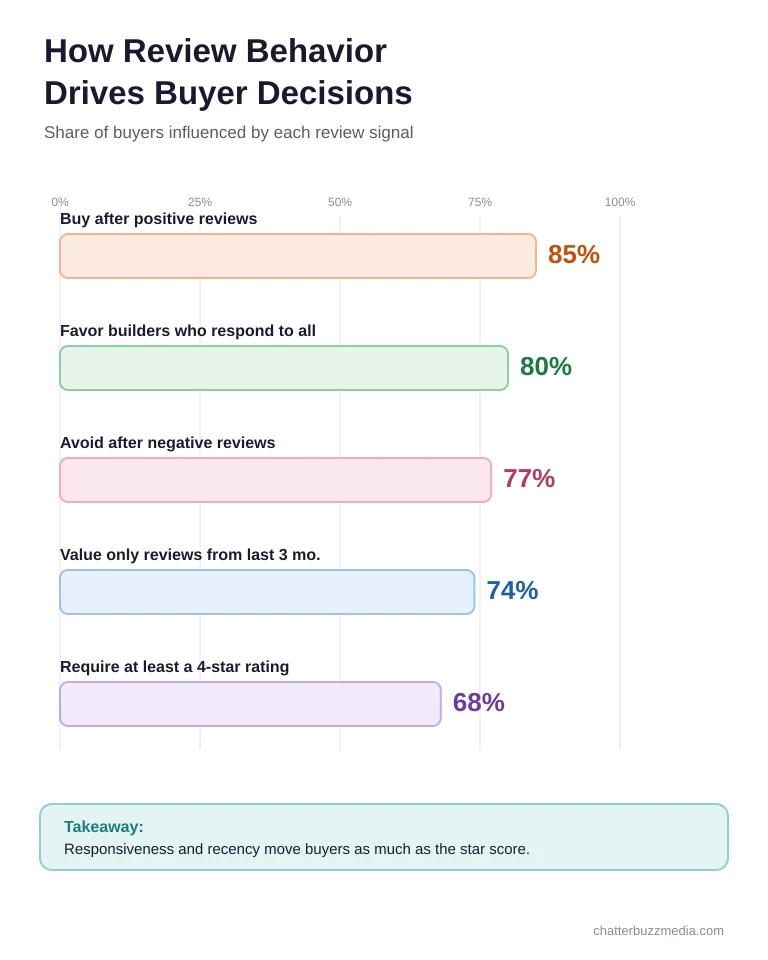
The buyer behavior behind those signals is dramatic. BrightLocal found that buyers are 85% more likely to use a business after reading positive reviews and 77% less likely after negative ones, and 80% favor a business that responds to all of its reviews.
Recency compounds the effect. With 74% of consumers only valuing reviews from the last three months, a burst of great reviews from two years ago does almost nothing for you today.
That is why a steady cadence beats an occasional push. Ten fresh reviews a quarter will carry you further in both rankings and buyer trust than fifty reviews that all arrived in a single old campaign.
Responses matter to the algorithm too. Replying to reviews, naturally including your community and city names where it fits, signals ongoing engagement and reinforces the local relevance Google is trying to measure.
Treat your review stream as part of your local SEO engine, right alongside your multi-location marketing and community landing pages. The builders who win the map pack are rarely the biggest; they are the most consistently reviewed and the most responsive.
How to Turn Reviews Into Marketing That Moves Buyers
A review stops working the moment you let it sit on one platform. To actually move buyers, you take your best reviews and put them everywhere a prospect makes a decision, turning passive feedback into active proof.
Start by treating every strong review as reusable content. A buyer’s words about your build quality or your crew are more persuasive than anything your own marketing can claim about itself.
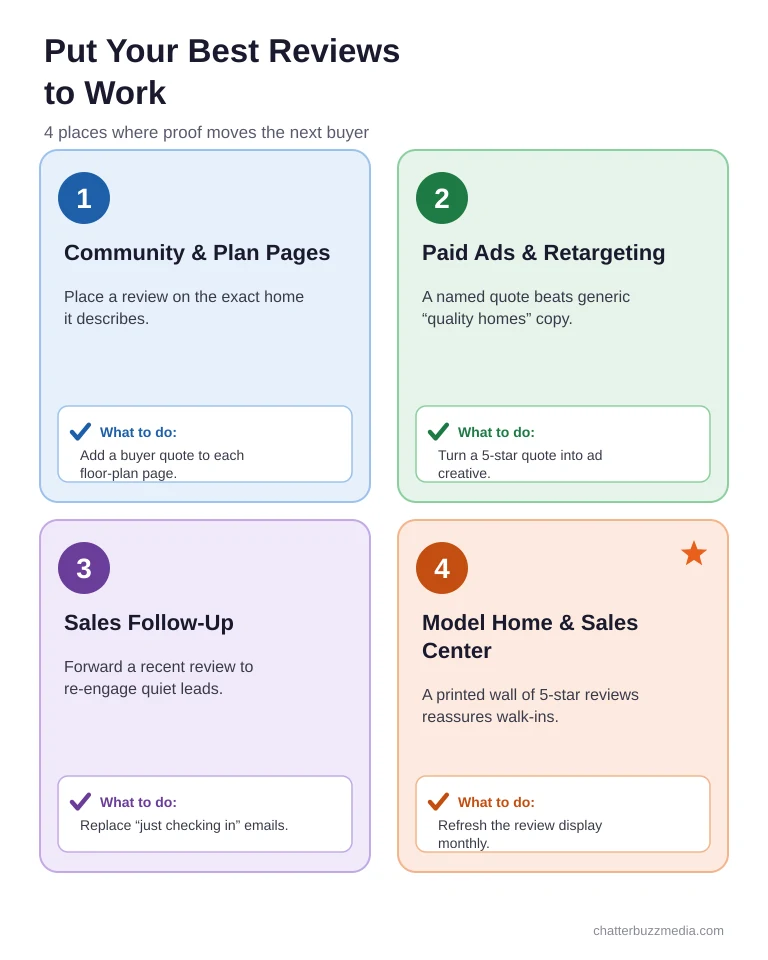
Put that proof to work in four places:
- Community and floor-plan pages. Place a relevant review directly on the page for the community or plan it describes, so the proof sits exactly where the buyer is weighing that specific home.
- Paid ads and retargeting. A short, specific quote as ad copy or a review-screenshot creative outperforms generic “quality homes” messaging because it carries a real name behind it.
- Sales follow-up. When a prospect goes quiet, a one-line forward of a recent buyer’s review is a softer, more credible nudge than another “just checking in” email, and it pairs naturally with your lead nurturing process.
- Model home and sales center. A printed wall of recent five-star reviews gives walk-in traffic the same reassurance online buyers get from your profile.
The goal is simple. Every buyer, on every channel, should run into the voices of the people you have already made happy, which is where strong home builder advertising and community-focused social campaigns amplify what your reviews already prove.
Do this consistently and your reviews stop being a scoreboard you check nervously. They become the most trusted salesperson you have, working across your website and every ad long after the buyer has moved in.
Frequently Asked Questions About Home Builder Reviews
1. 🔍 How many reviews does a home builder need to be credible?
Aim for at least 20 reviews on your Google Business Profile, since 47% of consumers avoid businesses below that threshold. Beyond the count, prioritize recency, because 74% of buyers only trust reviews from the last three months.
2. 📊 What is a good star rating for a home builder?
Target 4.5 stars or higher, as 31% of buyers will only consider businesses at that level and 68% require at least 4 stars. A rating slightly below a perfect 5 with many reviews is often more believable than a flawless score with only a handful.
3. ⚡ When is the best time to ask a buyer for a review?
Ask at the final walkthrough, when the buyer is standing in their finished home and feels the most gratitude. Requesting it later, after closing paperwork and invoices, causes completion rates to drop sharply.
4. 🏦 Which review platforms matter most for home builders?
Google Business Profile matters most because it drives both your search rating and your local map pack position. Follow it with Zillow and NewHomeSource for new-construction shoppers, then Houzz, Facebook, and builder-specific platforms like GuildQuality.
5. 🤝 How should I respond to a negative home builder review?
Respond within 24 hours, acknowledge the frustration without arguing the facts, and move the specifics to a direct phone call that same day. A calm, non-defensive public reply reassures future buyers far more than silence or a rebuttal.
6. 💰 Can I offer incentives for reviews?
You can encourage reviews, but you should never pay for or condition them on a positive rating, which violates the policies of Google and most platforms. Offer a great building experience and a frictionless ask instead, which is both compliant and more effective.
7. 🚀 How do reviews affect my local SEO?
Review volume, ratings, recency, and your responses all feed Google’s local ranking signals, directly influencing whether you appear in the map pack. A steady stream of fresh, responded-to reviews signals the prominence and engagement Google rewards.
8. 📈 What should I do about fake or unfair reviews?
Flag clearly fake or policy-violating reviews for removal through the platform, but respond publicly and professionally in the meantime. Never ignore them, because an unanswered unfair review looks the same to a prospect as an unanswered true one.
Conclusion: Make Reviews a System, Not a Hope
Home builder reviews are not a vanity metric you glance at once a quarter. They are the first conversation every buyer has about you, and you can either shape that conversation or leave it to chance.
The builders who win treat reviews as an engine with a clear operating plan:
- Claim and optimize your platforms. Start with Google Business Profile, then build a credible presence on Zillow, NewHomeSource, and the platforms your buyers actually check.
- Ask every buyer at the walkthrough. Make a frictionless, texted review request a permanent line on your closing checklist so it happens on every home.
- Respond to all of it within a day. Thank the happy buyers specifically and handle the hard reviews calmly, publicly, and fast.
- Put your best reviews to work. Move your strongest proof onto community pages, ads, and sales follow-ups where it influences the next decision.
Do this for two quarters and your reputation stops being something that happens to you. If you want the local search foundation that makes those reviews easy to find, start with our home builder SEO guide, explore how a construction marketing approach ties it together, and browse the full set of marketing resources built for growth-focused builders.

Victoria Wallace
Victoria Wallace is a senior content strategist and marketing writer with 30+ years of experience helping more than 200 brands translate complex business goals into clear, conversion-focused content. Her background spans paid media, marketing strategy, go-to-market planning, brand positioning, and full-funnel campaign development, giving her a deep understanding of how SEO content connects to real business growth.