
 321-236-2899

Home Builder Lead Qualification: Score & Route Leads
Most home builders don’t have a lead problem — they have a qualification problem. Strong home builder lead qualification is what separates a steady stream of inquiries from a pipeline of buyers who will actually sign a contract.
The gap is costly and well documented. In a 2025 mystery shop of 50 U.S. homebuilders, not a single builder answered an online inquiry with a personalized email inside the five-minute window buyers expect, and nearly a quarter never sent a personalized reply at all. The leads were there; the system to sort them and act on them was not.
This guide walks through an eight-step system to score incoming leads, route them to the right salesperson, and turn the qualified ones into booked appointments — with the exact questions, point values, and response times to put in place. Start by defining what a qualified lead actually looks like for your communities.
Key Takeaways
- Qualification is a filter, not a funnel stage. You are separating buyers who can and will build from browsers before a salesperson spends real time on them.
- Score fit and behavior on separate scales. That keeps a motivated dreamer with no financing from outranking a pre-approved buyer quietly comparing floorplans.
- Speed is the highest-leverage variable. Responding in five minutes can make a lead up to 22 times more likely to enter your pipeline.
- Routing rules decide who calls. Community-based or round-robin assignment with a clear response deadline keeps leads from dying in a shared inbox.
- The finish line is a booked appointment. Every qualified lead should exit the process with a specific date on a salesperson’s calendar.
- Disqualifying well is a feature. A polite “not yet” plus a nurture track protects sales-team time without burning the relationship.
Step 1: Define What a Qualified Home Builder Lead Looks Like
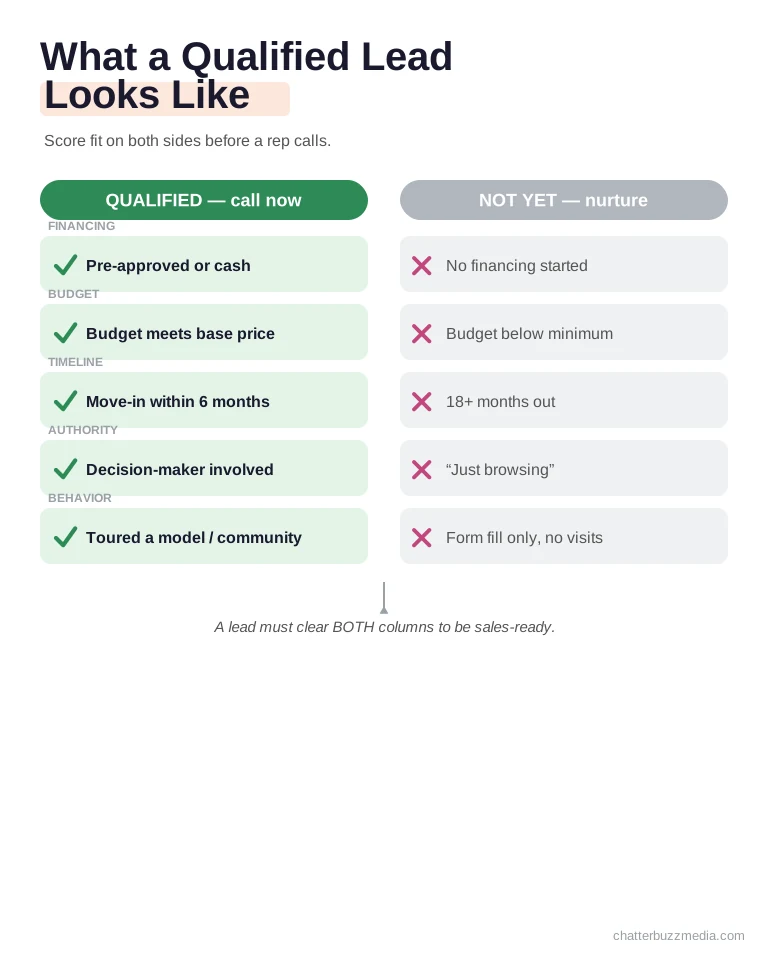
A qualified home builder lead is someone whose budget, buying timeline, and community or floorplan fit all point toward a signable contract — not just anyone who filled out a form. Define that profile first, or you will optimize for inquiry volume instead of revenue.
Your sales team’s calendar is the scarcest resource you have, and most of it leaks. Sales strategist Marc Wayshak estimates that at least half of any company’s prospects are not a good fit for what it sells.
Write down the ideal buyer for each community before you touch a scoring sheet. The same clarity that drives a sharp ideal customer profile turns a vague “interested” lead into a yes-or-no decision.
Separate two ideas that builders often blur: fit (can this person buy from me) and intent (are they ready to move now). A buyer can be a perfect fit and still be eighteen months out — that changes how you treat them, not whether you keep them.
For each community, capture the criteria that actually predict a contract:
- Price band and financing path: Does their budget reach your base price, and is there a realistic route to a mortgage?
- Product match: Spec home, semi-custom, or full custom — and do you have inventory or lots that fit?
- Timeline: A move-in window inside your build schedule signals a real buyer, not a someday browser.
- Location and decision authority: They are inside your service area and are one of the people who will actually sign.
Once the profile is on paper, the first conversation stops being small talk and starts being qualification. The questions you ask on contact one are where that happens.
Step 2: Ask the Right Qualifying Questions on First Contact
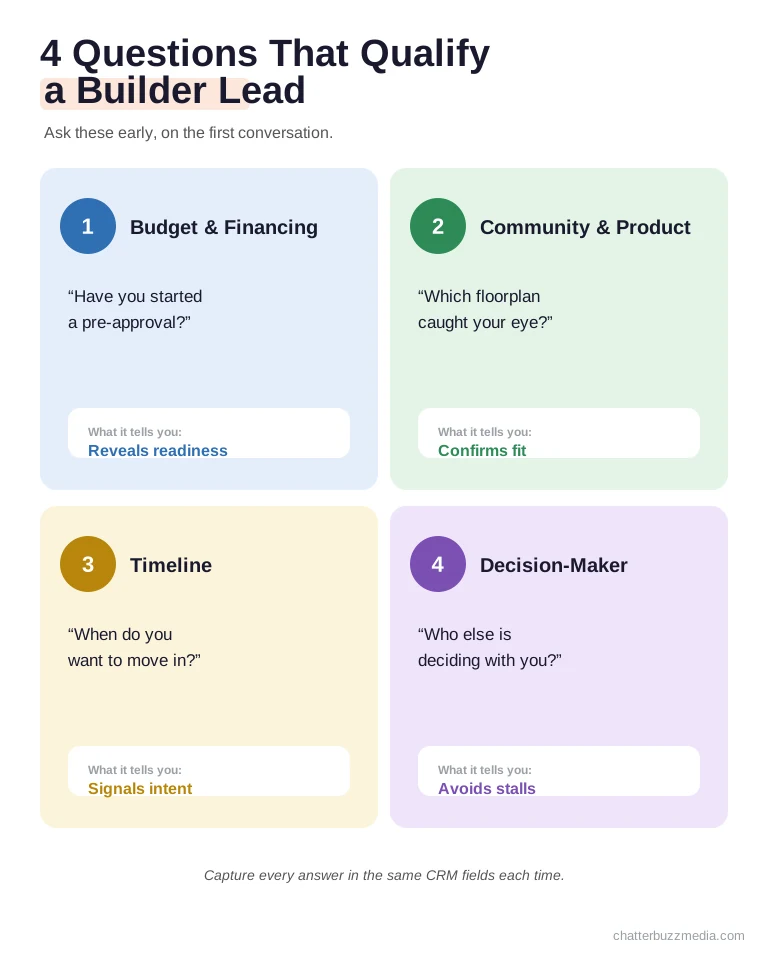
The fastest way to qualify a home builder lead is to learn four things early: their budget and financing status, the community or floorplan they want, their move-in timeline, and whether they are the decision-maker. These map to the classic BANT framework — Budget, Authority, Need, Timeline — adapted for new-home sales.
Ask with a light touch, not an interrogation. Builders are often warned not to disqualify a prospect just because they won’t name a budget on the first call — buyers hold that detail until they trust you, so build rapport while you gather the facts.
Group your questions around the four signals so nothing gets missed:
- Budget & financing: “Have you spoken with a lender or started a pre-approval?” A buyer with a pre-approval letter is a different lead than one who hasn’t thought about financing.
- Community & product fit: “Which community or floorplan caught your eye, and what drew you to it?” The answer tells you whether you have something to sell them.
- Timeline: “When are you hoping to be in your new home?” A date inside your build window is a strong intent signal.
- Authority: “Will anyone else be part of this decision with you?” Single-threaded deals stall when the unseen decision-maker says no.
Capture every answer in the same fields every time, so the data is consistent enough to score. Treat the right discovery questions as a repeatable script, not improvisation. Those structured answers are the raw material for the next step: a scoring model.
Step 3: Build a Lead Scoring Model (Fit + Behavior)
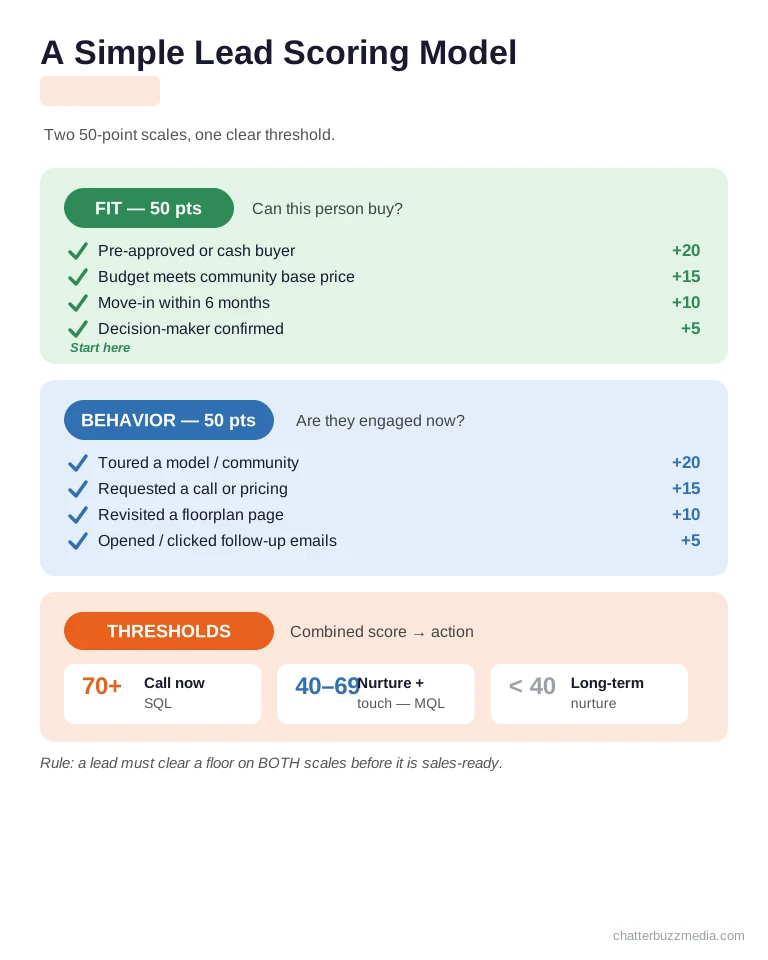
A home builder lead scoring model assigns points for how well a lead fits your buyer profile and how engaged they are, then sets thresholds that tell sales who to call first. Score fit and behavior on two separate scales so one can never hide the other.
Fit points come from the demographic answers you gathered in Step 2. Behavior points come from what the lead does — the actions that reveal intent even when they haven’t said it out loud.
A simple, builder-ready model uses two 50-point scales. Here is a starting framework you can adjust to your communities:
- Fit (0–50): Pre-approved or cash buyer (+20), budget meets community base price (+15), move-in inside 6 months (+10), decision-maker confirmed (+5).
- Behavior (0–50): Toured a model or visited a community (+20), requested a call or pricing (+15), returned to a floorplan or pricing page (+10), opened or clicked follow-up emails (+5).
Then set thresholds that turn the combined score into an action. The point is a clear handoff, not a precise number:
- 70+ — Sales-ready (SQL): Call now. This lead fits and is actively engaged.
- 40–69 — Marketing-qualified (MQL): Light-touch sales outreach plus nurture. Close but not hot.
- Under 40 — Long-term nurture: Keep warm with automated content until a trigger raises the score.
Rule: require both scales to clear a floor before a lead becomes sales-ready. A buyer with 50 behavior points and 10 fit points is excited but can’t afford you — that is a nurture lead, not a call-now lead.
Scoring like this is far easier when inquiry and engagement data flow into one system. The same logic underpins most marketing automation workflows and is a core reason a modern CRM is essential for builders. A strong score, though, is worthless if nobody acts on it fast — which brings us to speed.
Step 4: Set Speed-to-Lead SLAs So Hot Leads Get a Fast Response
Set a hard rule that every high-scoring lead gets a human response within five minutes, because response speed moves qualification odds more than almost any other variable. A service-level agreement (SLA) makes that speed a standard, not a hope.
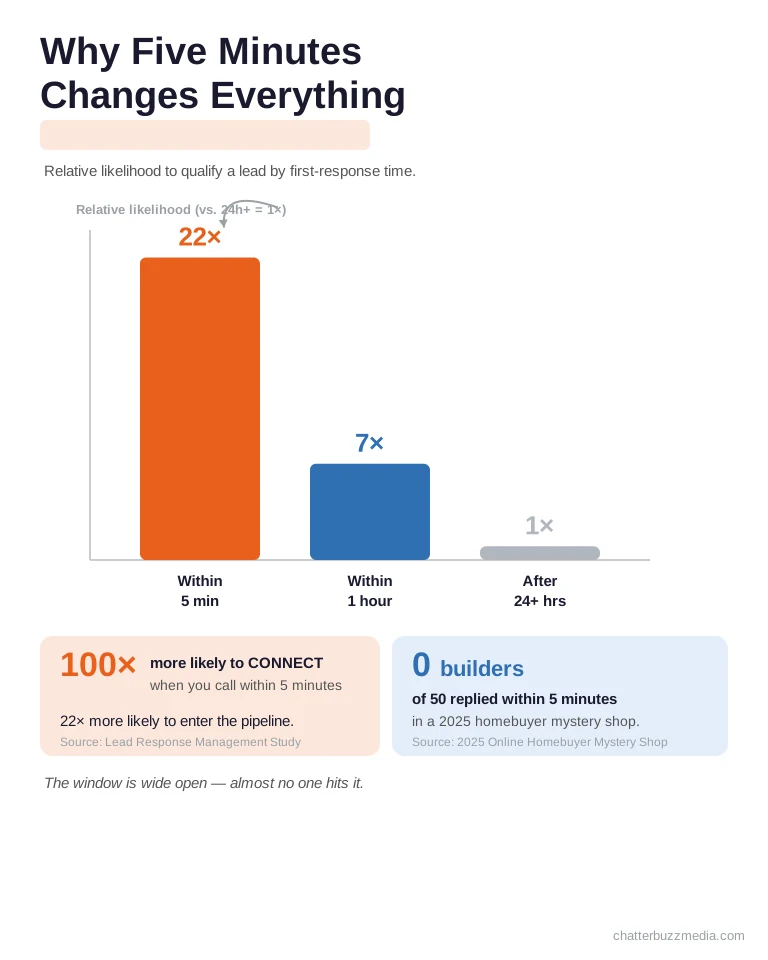
The data on fast follow-up is overwhelming. The Lead Response Management Study found that calling a lead within five minutes made reps up to 100 times more likely to connect and 22 times more likely to move that lead into the pipeline.
Harvard Business Review’s study of 1.25 million leads reached the same conclusion from another angle. Firms that contacted a lead within an hour were seven times likelier to qualify it than those who waited just one hour longer — and sixty times likelier than those who waited a day or more.
Translate that into SLAs tied to the score tiers from Step 3:
- Sales-ready (SQL): A live call or text within five minutes, during and after business hours.
- Marketing-qualified (MQL): A personal response the same business day.
- Nurture: An automated, personalized acknowledgment within minutes, with human follow-up as the score climbs.
Make the speed automatic: instant alerts to the assigned rep, and after-hours coverage through text or a chatbot so no inquiry waits until morning. Speed only pays off, though, when the alert reaches the right person — and that is a routing decision.
Step 5: Route Leads to the Right Salesperson
Route every qualified lead to a specific salesperson by a defined rule — usually the community they asked about, or round-robin within that community — so no lead sits in a shared inbox waiting for someone to claim it. Ownership is what turns a fast alert into a fast call.
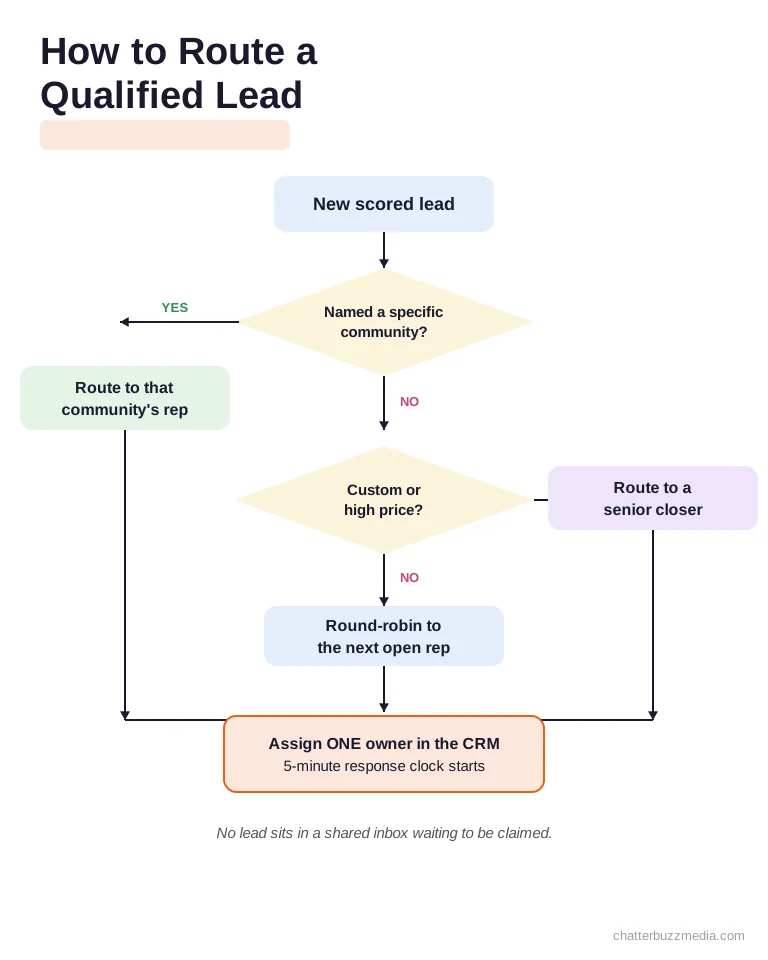
Most builders choose among three routing logics, and many combine them:
- Community or territory based: The lead goes to the rep who owns the community or region they named. This is the default for multi-community builders.
- Round-robin: Within a community, leads cycle evenly across available reps so response speed and workload stay balanced.
- Price or product based: Custom and higher-price inquiries route to your most experienced closers.
Build a few guardrails into the handoff so leads don’t fall through. Preserve the lead’s original source and the community they asked about, assign a single owner in the CRM, and make sure two systems don’t start competing follow-up sequences for the same person.
Clear routing is also where marketing and sales stop pointing fingers, because every lead has a name attached to it. Getting that alignment between marketing and sales right is half the battle. Once the right rep owns the lead, their first conversation has one job: book the appointment.
Step 6: Convert Qualified Leads Into Booked Appointments
The goal of qualification is not a “hot lead” label — it is a confirmed appointment on a salesperson’s calendar. Make booking the explicit next step of every qualified-lead conversation, not a vague “let’s stay in touch.”
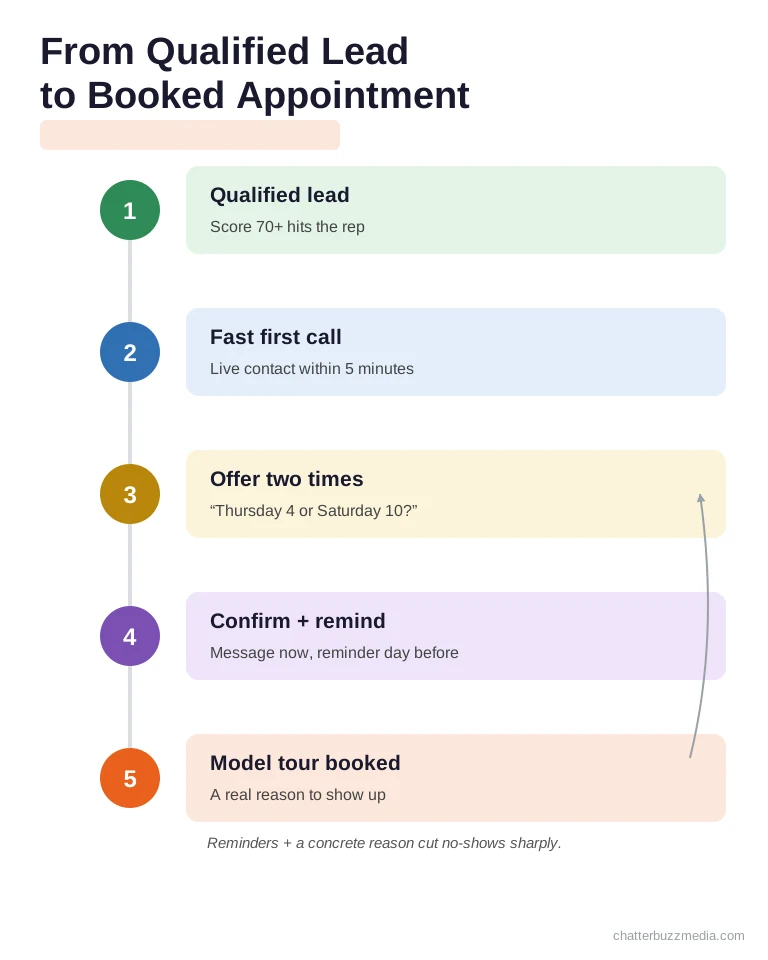
Offer specific times instead of open-ended availability. “Does Thursday at 4 or Saturday at 10 work better for a model tour?” converts far better than “when are you free?”
Give buyers more than one way to lock it in. An online scheduling link, a text-to-book option, and a rep who can set it live on the phone all remove friction at the moment intent is highest.
Clear messaging helps here too, since a confused buyer rarely books. A simple StoryBrand-style landing page that makes the next step obvious does a lot of the convincing before the call.
Protect the appointments you set. A confirmation message plus a reminder the day before cuts no-shows, and tying the meeting to something concrete — a model home tour, a lot walk, a financing conversation — gives the buyer a reason to show up.
A strong first appointment is also a conversion event, so the landing pages and tour experiences around it matter as much as the call. Treating the model visit like a conversion-rate problem keeps booked appointments from quietly leaking into no-shows. Not every lead, though, earns an appointment today — and the rest need a deliberate path, too.
Step 7: Disqualify and Nurture the Rest
Disqualifying is not rejecting — it is moving leads who aren’t ready, or aren’t a fit, into a nurture track so sales stops chasing them and you stop losing them. A clear “not yet” is a sign of a healthy system, not a failure.
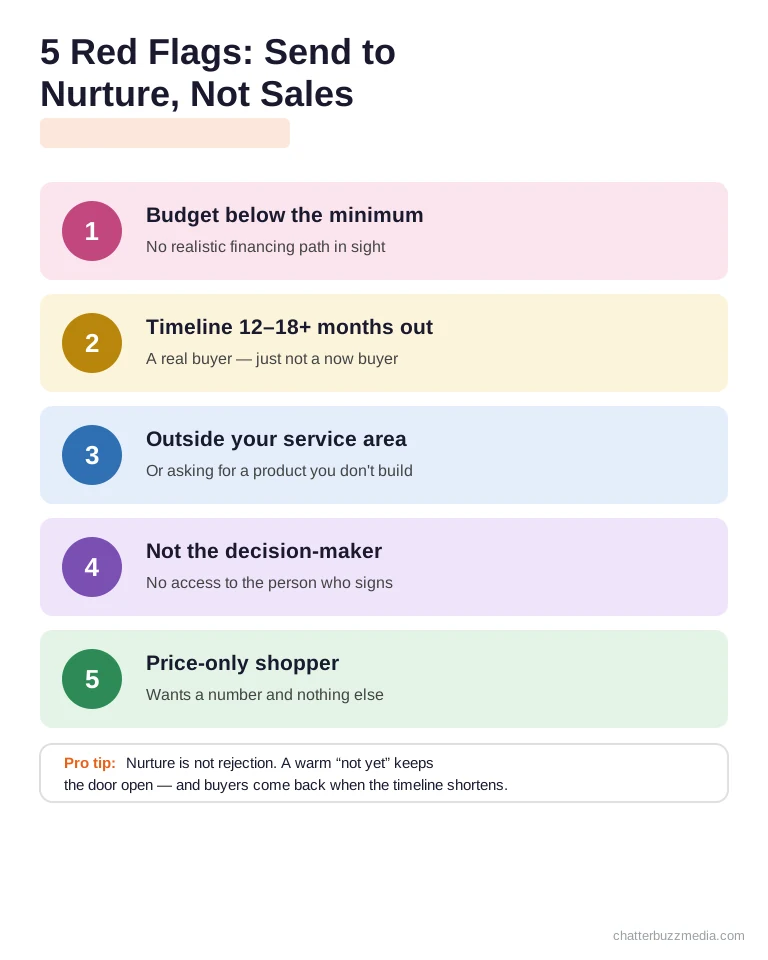
Watch for the signals that a lead belongs in nurture rather than on a rep’s call list:
- Budget well below the community minimum with no financing path in sight.
- A timeline beyond 12 to 18 months — a real buyer, just not a now buyer.
- Outside your service area or asking for a product you don’t build.
- Not the decision-maker, with no access to the person who is.
- Price-only shoppers who want a number and nothing else.
Redirect them with respect. A warm note that points a far-off buyer to helpful resources keeps the door open, and buyers who feel helped rather than dismissed come back when their timeline shortens.
Keep nurtured leads warm with content that matches their stage: community updates, new floorplan alerts, financing and first-time-buyer guidance, and the occasional check-in. A drip sequence built in your marketing automation platform handles this at scale, and it is the long game that demand generation is built for. The only way to know whether your thresholds are sorting leads correctly is to measure what happens next.
Step 8: Measure and Refine Your Qualification System
Track how leads move from inquiry to qualified to appointment to contract, then recalibrate your scores and thresholds against what actually closes. A scoring model is a hypothesis you tune over time, not a rule you set once and forget.
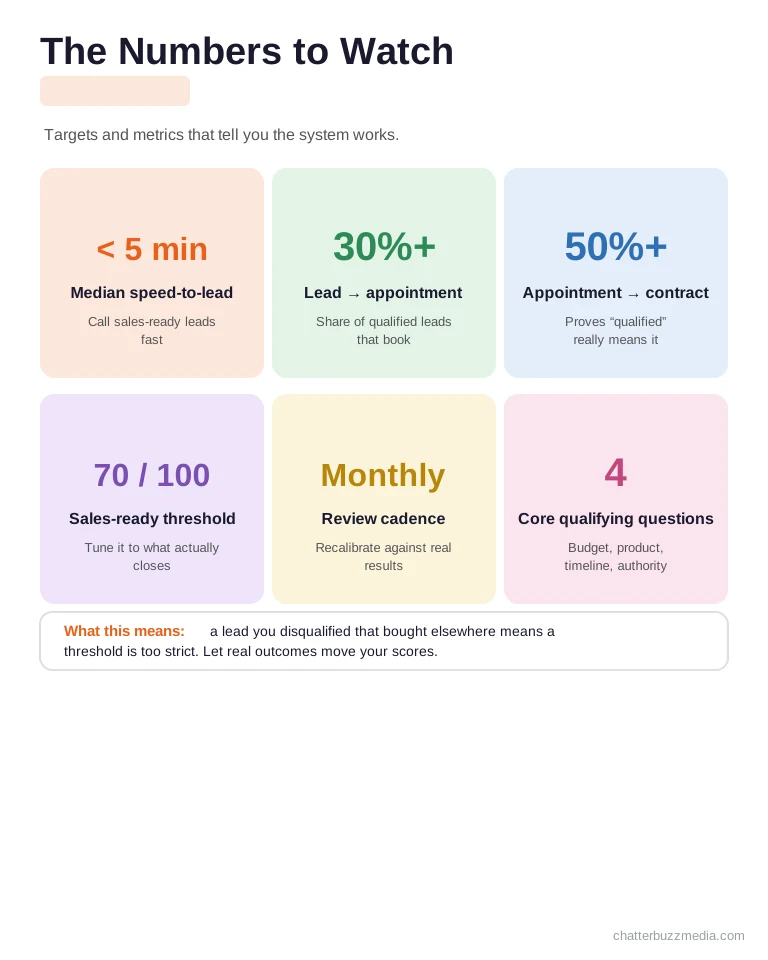
A handful of metrics tell you whether the system is working:
- Lead-to-appointment rate: The share of qualified leads that book. Low numbers point to weak scoring or slow follow-up.
- Appointment-to-contract rate: How many booked appointments become buyers. This validates whether “qualified” really means qualified.
- Actual speed-to-lead: Your real median response time, not your target.
- MQL-to-SQL conversion: How often nurtured leads graduate to sales-ready, which tells you if your thresholds are set right.
Review the numbers monthly and interview your sales team quarterly, since reps know which “qualified” leads were a waste of time. Watch especially for leads you disqualified that bought elsewhere — that is your scoring model telling you a threshold is too strict.
Tracking the right numbers is its own discipline; a short list of marketing KPIs worth watching beats a dashboard no one reads. Tune the model, and your cost per booked appointment — and ultimately your customer acquisition cost — falls quarter over quarter.
Frequently Asked Questions
1. 🔍 What is home builder lead qualification?
Home builder lead qualification is the process of scoring and sorting incoming inquiries by how likely they are to become buyers, based on budget, financing, timeline, product fit, and engagement. It lets sales teams spend their time on leads that can actually sign a contract instead of every form fill.
2. 📊 What questions should I ask to qualify a home builder lead?
Ask about financing status (pre-approval or cash), the community or floorplan they want, their target move-in timeline, and whether anyone else is part of the decision. These four signals map to the BANT framework and tell you fit and intent quickly.
3. ⚡ How fast should home builders respond to a new lead?
Aim for a human response within five minutes for sales-ready leads. Studies show responding inside five minutes can make a lead up to 22 times more likely to enter the pipeline, yet most builders miss that window entirely.
4. 🏦 Should I disqualify a buyer who won’t share their budget?
No — buyers often withhold budget until they trust you, so build rapport before pushing for a number. Instead of asking for a dollar figure on contact one, ask whether they’ve started financing, which reveals readiness without feeling intrusive.
5. 🤝 What’s the difference between an MQL and an SQL for home builders?
A marketing-qualified lead (MQL) fits your buyer profile and shows interest but isn’t ready for a hard sales push, so they get nurture plus light outreach. A sales-qualified lead (SQL) clears both your fit and behavior thresholds and warrants an immediate call.
6. 💰 How do I score leads without a CRM?
Start with a simple spreadsheet that lists your fit and behavior criteria with point values, and score each lead by hand. It is less efficient than automation, but it forces you to define your criteria — the hardest part — before you invest in software.
7. 🚀 How many points should make a lead sales-ready?
A common starting point is a combined score of 70 out of 100, with a minimum floor on both the fit and behavior scales. Treat it as a hypothesis and adjust the threshold up or down based on how your appointments and contracts actually convert.
8. 📈 How do I reduce appointment no-shows?
Confirm the appointment immediately, send a reminder the day before, and tie the meeting to something concrete like a model tour or lot walk. Giving the buyer a specific reason and time to show up matters more than any clever reminder copy.
Putting It All Together
A home builder lead qualification system turns a noisy inbox into a prioritized call list, and it rests on a few moving parts working together. Define your qualified lead, ask the right questions, score fit and behavior, respond fast, route to the right rep, book the appointment, and nurture everyone else.
Here is a four-step action plan to put it in motion:
- Write your qualified-lead profile this week. Document budget, financing, timeline, product, and location criteria for each community.
- Build a simple scoring sheet. Start with the two 50-point fit and behavior scales and a 70-point sales-ready threshold.
- Set and enforce a five-minute SLA for sales-ready leads, with routing rules and alerts that make it automatic.
- Review the numbers monthly and tune your thresholds against what actually books and closes.
Qualification is where lead generation finally turns into sales, so it deserves the same rigor you give your ad campaigns. The leads you qualify have to come from somewhere first, whether that is Facebook ads for home builders or organic search driven by home builder SEO.
For the bigger picture on filling the top of that funnel, see our guide to home builder marketing strategies, the companion home builder advertising guide, and our full library of marketing resources.

Victoria Wallace
Victoria Wallace is a senior content strategist and marketing writer with 30+ years of experience helping more than 200 brands translate complex business goals into clear, conversion-focused content. Her background spans paid media, marketing strategy, go-to-market planning, brand positioning, and full-funnel campaign development, giving her a deep understanding of how SEO content connects to real business growth.