
 321-236-2899
B2B Content Marketing: The Mid-Market Growth Playbook
Every enterprise brand in your market has a bigger content budget than you do. This guide shows how mid-market companies win B2B content marketing anyway, by trading spend for focus.
We have helped mid-market teams in manufacturing, financial services, and professional services build content programs that outrank far larger competitors on the topics that matter to their buyers. The pattern is always the same: go deep on a narrow cluster, map content to the real buying journey, and measure what actually drives pipeline.
Inside, you will get a step-by-step strategy, a content-to-journey map, the formats that generate the most leads, and how to get your content cited in the new era of AI search. Let’s get into it.
Key Takeaways
- Focus beats budget. Mid-market teams win by owning a narrow topic cluster completely, not by out-publishing enterprise brands.
- A documented strategy is the multiplier. Marketers who write down goals, audience, and clusters report meaningfully higher ROI.
- Map content to every buying stage. The middle of the funnel is where most B2B programs leak, so fill it with proof and comparison content.
- Lead with proof and depth. Case studies, original research, and pillar guides drive more pipeline than a high volume of thin posts.
- Measure pipeline, not pageviews. Track content-influenced revenue and structure every piece to be cited by Google and AI assistants.
What Is B2B Content Marketing?
B2B content marketing is the practice of creating and distributing educational content to earn the trust of business buyers before they ever talk to sales. It turns your expertise into blog posts, guides, case studies, and videos that answer the questions a buying committee asks on the way to a decision.
The distinction matters because B2B purchases are rarely impulsive. A single deal can involve six to ten stakeholders, months of research, and a procurement process that scrutinizes every claim.
Content is what keeps your brand in the conversation across that entire timeline. It educates the champion, reassures the skeptic, and gives the economic buyer the proof they need to sign off internally.
That is the real job of B2B content: it does the selling that happens when no salesperson is in the room. By the time a prospect books a call, they have often consumed a dozen of your assets and already decided you are a credible option.
The buying committee is what makes this so different from consumer marketing. A technical evaluator, a budget holder, and an end user each read your content looking for different answers, and strong programs speak to all three.
That is why B2B content skews toward education and evidence rather than persuasion. Your goal is to make every member of the committee smarter and more confident, so the group can reach a decision without friction.
It helps to separate content marketing from the things people confuse it with. It is not advertising, which rents attention, and it is not one-off blogging, which produces disconnected posts with no strategy behind them.
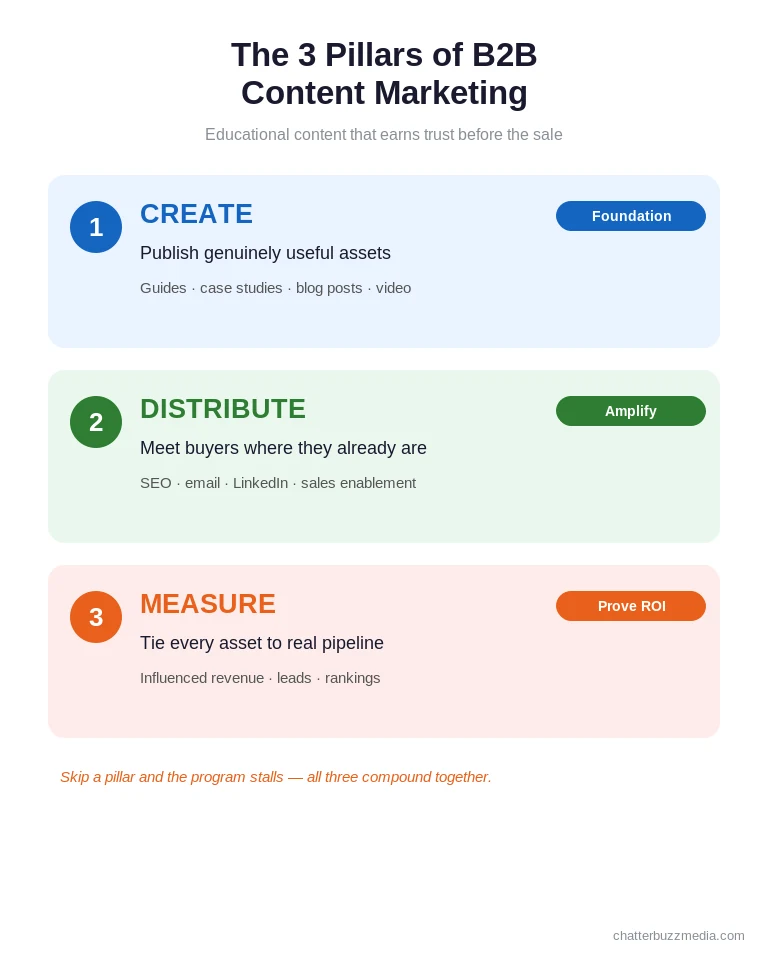
True content marketing rests on three pillars that work together. You create genuinely useful assets, you distribute them where your buyers already spend time, and you measure their impact on pipeline so the program earns its budget.
The formats are familiar even if the strategy is not. Blog posts, pillar guides, case studies, white papers, webinars, email newsletters, and short videos are all vehicles for the same underlying goal.
What ties them together is intent, not format. Every asset should either capture demand your buyers are already expressing or create demand by reframing a problem they have not fully named yet.
Keep that intent test handy as you plan. If a proposed piece does not clearly capture existing demand or create new demand, it probably belongs in the backlog rather than the calendar.
Done well, B2B content marketing compounds. Every asset you publish keeps working long after it goes live, pulling in organic traffic, feeding your sales team, and building the topical authority that makes the next piece rank faster.
Paid media stops the instant you stop paying, but a strong guide can generate leads for years. That compounding effect is exactly why resource-constrained teams can use content to punch above their weight, which is where the rest of this guide focuses.
Why B2B Content Marketing Pays Off for Mid-Market Companies
B2B content marketing pays off because it generates demand at a fraction of the cost of paid channels and keeps producing returns for years. For a mid-market company weighing where to spend a finite budget, content is one of the few investments that lowers your cost per lead over time instead of raising it.
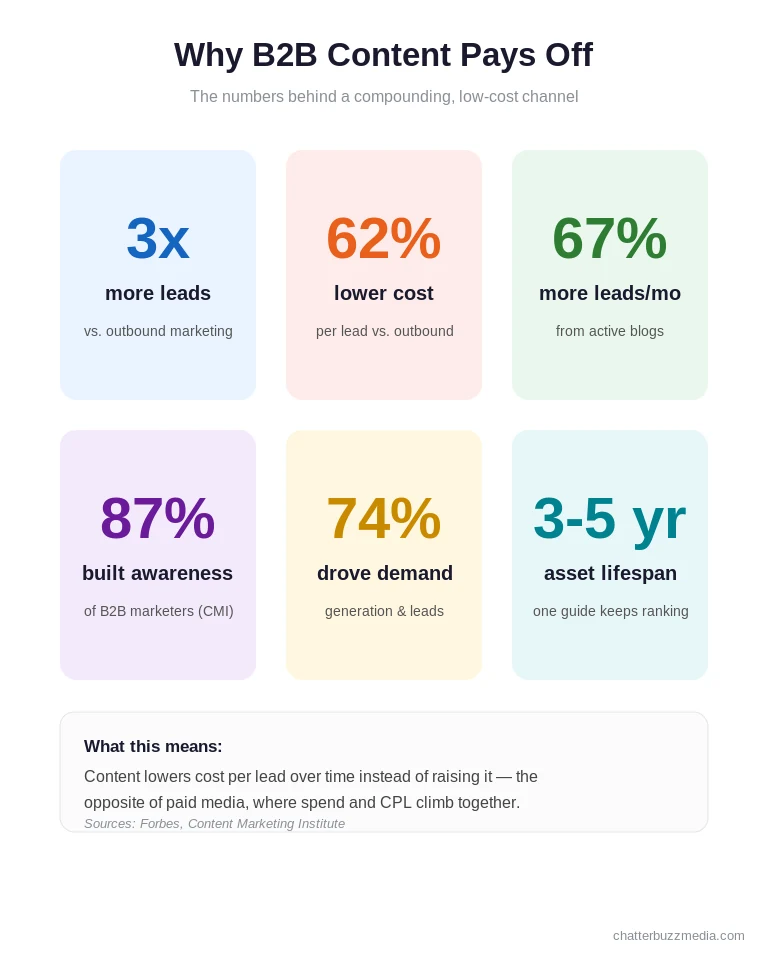
The numbers are hard to argue with. Content marketing generates roughly three times as many leads as outbound while costing about 62% less per lead, and companies with active blogs pull in 67% more monthly leads than those without.
Those gains come from owned assets you never have to rent. Unlike a paid campaign that disappears the moment the budget runs out, a ranking guide keeps generating pipeline on autopilot.
There is also a durability advantage that rarely gets discussed. A well-optimized page can hold its ranking and keep converting for three to five years, which means the true ROI of content only becomes visible over a longer horizon than most quarterly reports capture.
Strategy is the multiplier. According to the Content Marketing Institute, 87% of B2B marketers say content built brand awareness and 74% say it generated demand and leads over the past year.
The catch is that a documented strategy separates the winners from the rest. Marketers who write their strategy down consistently report higher ROI than those who wing it, which is why the next section starts with strategy, not tactics.
For mid-market companies specifically, content also levels a playing field that paid media tilts toward whoever has the biggest budget. You cannot always outbid an enterprise competitor on Google Ads, but you can absolutely out-teach them on the topics your shared buyers care about.
Content marketing rewards insight over budget, which is precisely the trade a smaller company wants to make. It converts your team’s hard-won expertise into an asset that keeps appreciating.
There is a trust dividend on top of the lead numbers. When a prospect finds three of your articles answering their exact questions, you stop being a vendor and start being the expert they already rely on.
That perceived authority shortens sales cycles and reduces price sensitivity. Buyers pay more, and argue less, when they believe they are hiring the category expert rather than a commodity provider.
For a deeper look at turning content into measurable pipeline, our guide to content marketing ROI breaks down the math. It pairs well with the measurement framework later in this post.
Mid-Market vs. Enterprise: Where You Actually Have the Advantage
Mid-market companies beat enterprise content teams by being faster, more specific, and closer to the customer, not by outspending them. The instinct to copy enterprise playbooks is the single biggest mistake mid-market marketers make, because those playbooks are built for scale you do not have and slowness you cannot afford.

Enterprise brands publish constantly, but most of it is generic. They serve a broad audience, route every asset through legal and brand review, and optimize for reach over relevance.
That creates an opening. When a $50M manufacturer writes for a specific buyer in a specific industry, it can be more useful on that narrow topic than a Fortune 500 competitor ever will be.
It is worth being honest about where enterprise teams genuinely lead. Research on enterprise content marketing shows they are further along on thought leadership, data governance, and first-party data than the average B2B team.
But that maturity comes with weight. Every one of those strengths is wrapped in process, and process is the tax that slows enterprise content to a crawl.
The lesson is not to envy enterprise scale but to exploit enterprise slowness. While a large brand debates a topic in committee, you can research, write, and publish the definitive piece and start ranking before they finish their first draft.
Your real advantages are structural, and they are worth naming:
- Speed to publish. You can spot a trend and ship a post in days, while enterprise teams need weeks of approvals and legal sign-off.
- Niche depth. You can own a narrow topic cluster completely instead of covering everything shallowly.
- Founder and expert access. Your subject-matter experts are a hallway away, which makes genuine first-hand content easy to produce.
- Customer proximity. You talk to buyers directly, so your content reflects real objections rather than committee guesses.
- Authentic voice. You can write with a point of view instead of the risk-averse, sanded-down tone big brands default to.
The winning move is to go deep, not wide. Pick a handful of topics your ideal customer genuinely cares about and become the most useful resource on the internet for them.
This is where the topic-cluster model earns its keep. Instead of chasing hundreds of unrelated keywords, you dominate one subject so thoroughly that search engines and buyers treat you as the authority on it.
A concrete example makes it real. A regional logistics firm will never outrank a global carrier on the word “shipping,” but it can absolutely own “cold-chain shipping for Florida produce distributors” and win every buyer who searches variations of it.
That specificity is a feature, not a limitation. The narrower your focus, the less competition you face and the more qualified every visitor becomes.
Depth also builds a moat that is hard to copy. An enterprise team can outspend you tomorrow, but it cannot easily replicate a decade of niche expertise expressed across an interconnected library of content.
Every focused piece you publish makes the next one stronger. Internal links, accumulated authority, and reader familiarity all compound, so the gap between you and a late-arriving competitor widens over time.
That focus is how a lean team earns authority, and it maps directly to your B2B buyer persona. If you are still torn between broad and narrow, our breakdown of B2B vs. B2C marketing explains why B2B rewards depth over volume.
How to Build a B2B Content Marketing Strategy Step by Step
A B2B content marketing strategy is a documented plan that connects specific content to specific business goals, audiences, and stages of the buying journey. The word documented is doing real work here, because an undocumented strategy is just a wish list that shifts every time priorities change.
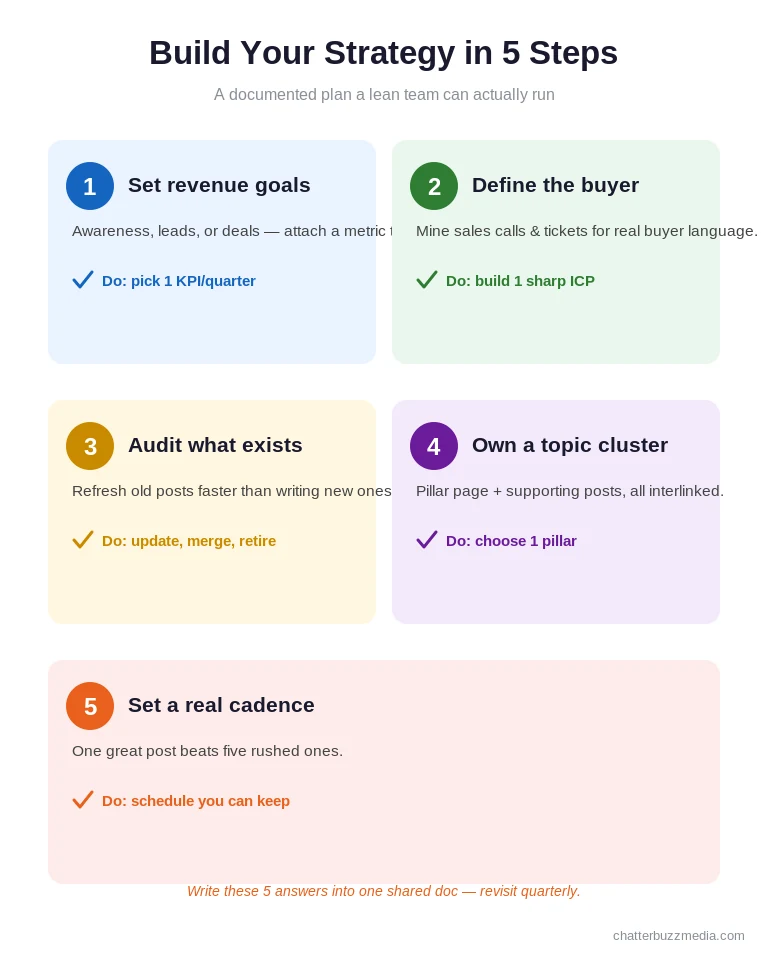
You do not need a 40-page playbook. You need a clear, written answer to five questions that keeps your small team pointed in the same direction week after week.
1. Set goals tied to revenue. Decide whether this content exists to build awareness, generate leads, or accelerate deals, then attach a metric to each goal.
Vague goals produce vague content, so get specific about what success looks like this quarter. “Publish more” is not a goal, but “rank on page one for our five priority terms and source 20 qualified leads a month” is.
2. Define your audience and their pain. Build a sharp profile of the buying committee you serve, grounded in real conversations rather than assumptions.
The fastest way to do this is to mine your own sales calls and support tickets for the exact language buyers use. Our guide to ICP marketing and content personalization shows how to translate that profile into topics, and the tighter your buyer personas, the easier every other step becomes.
3. Audit what you already have. Most companies are sitting on old posts that can be refreshed faster than new ones can be written.
A quick content audit tells you what to update, what to consolidate, and what to retire. Refreshing a post that already has some authority often produces faster ranking gains than starting from a blank page, which is exactly the play behind this very guide.
4. Choose a topic cluster to own. Instead of one-off posts, pick a pillar theme and plan a cluster of supporting articles that all link back to a central page.
This is the mechanic that builds topical authority and helps a smaller site outrank bigger ones. Our B2B demand generation guide shows how clusters feed the funnel from first click to closed deal.
5. Commit to a realistic cadence. One excellent post a week beats five rushed ones, especially for a lean team.
Consistency signals reliability to both readers and search engines. Pick a schedule you can sustain through a busy quarter, because the program that survives contact with real deadlines is the one that compounds.
Picture how this looks for a lean team. A single strategist might publish one pillar guide and two supporting posts a month, then repurpose each into email and social, and that modest output builds a commanding cluster within a year.
The strategy also tells you what to say no to. When a stray idea does not serve your goals, audience, or chosen cluster, the document gives you permission to skip it and stay focused.
Write these five answers into a single shared document and revisit it quarterly. That living plan is the difference between a content program and a pile of random posts, and it sets up the mapping work that comes next.
Map Content to the B2B Buying Journey
You map content to the buying journey by matching each asset to the question a buyer is asking at that moment, from first awareness to final decision. Skipping stages is why so much B2B content underperforms: teams publish awareness posts and then wonder why no one converts, because nothing exists to carry the buyer from curious to convinced.
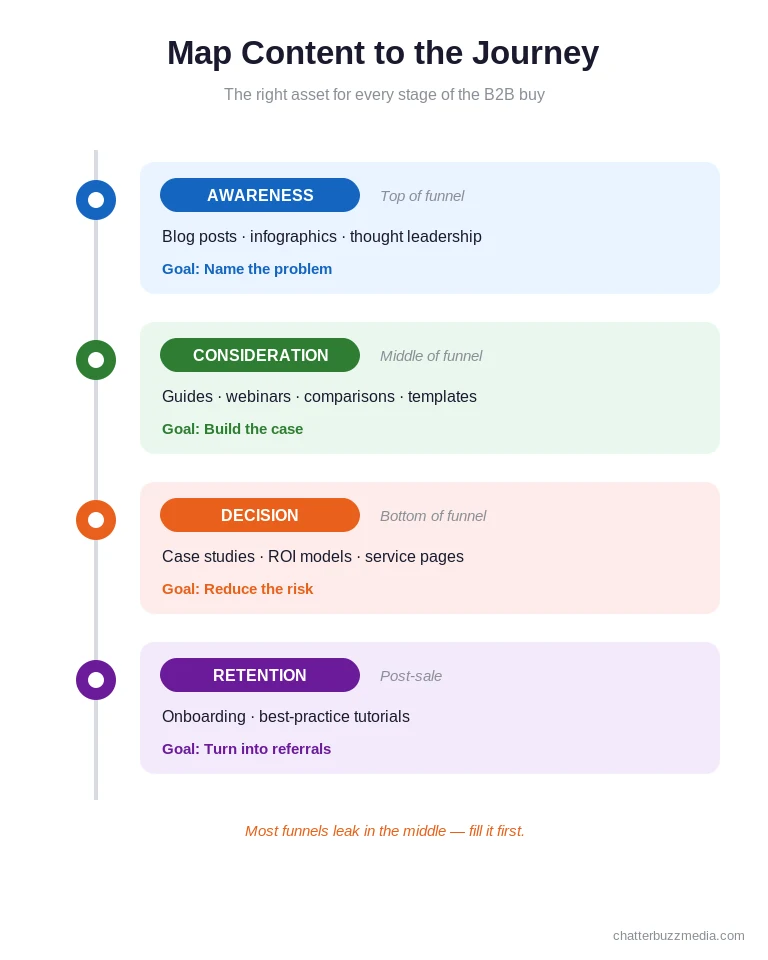
The B2B journey is long and rarely linear. Buyers loop back, bring in new stakeholders, and do the majority of their research before they ever fill out a form, according to consistent findings from Gartner’s B2B buying research.
That behavior has a clear implication. If most of the decision happens before a sales conversation, your content has to do the heavy lifting while you are not in the room.
Your job is to have the right content waiting at each stage. Here is how the stages break down:
- Top of funnel (Awareness). Educational blog posts, infographics, and thought-leadership pieces that name the problem your buyer feels but may not have words for yet.
- Middle of funnel (Consideration). Guides, webinars, comparison pieces, and templates that position your approach as the smart path forward.
- Bottom of funnel (Decision). Case studies, ROI calculators, and detailed service pages that give the buying committee proof and reduce perceived risk.
- Post-sale (Retention). Onboarding tutorials and best-practice content that turn customers into repeat buyers and referral sources.
The most common gap is the middle. Plenty of companies have blog posts and a pricing page but nothing that nurtures the months in between, which is exactly where deals stall.
Fill that gap with content that helps your champion sell internally. Remember that your buyer often has to convince a boss, a finance lead, and a skeptical peer, so give them the comparison sheet, the ROI model, and the objection-handling FAQ they can forward.
The best middle-funnel content answers the quiet question every stakeholder asks: what happens if we choose wrong? Reduce that perceived risk with proof, specifics, and honesty, and you remove the biggest reason B2B deals stall.
A simple way to audit your coverage is to list every stage and honestly mark what content exists for each. Empty rows are your priority backlog, and they usually explain any leak in your funnel faster than any tool will.
Watch the transitions between stages, not just the stages themselves. The most valuable assets are the ones that hand a buyer off cleanly, like an awareness post that links to a guide, which links to a case study, which links to a demo.
Our walkthrough on mapping content to the customer journey details what belongs at each stage. Pair it with lead nurturing through email to keep those assets in front of buyers between visits, and the journey starts to close itself.
The B2B Content Types That Actually Drive Pipeline
The B2B content types that drive the most pipeline are the ones that combine proof with utility: case studies, original research, in-depth guides, and comparison content. Chasing every format at once is a trap for lean teams, so it pays to know which formats do the heaviest lifting before you spread yourself thin.
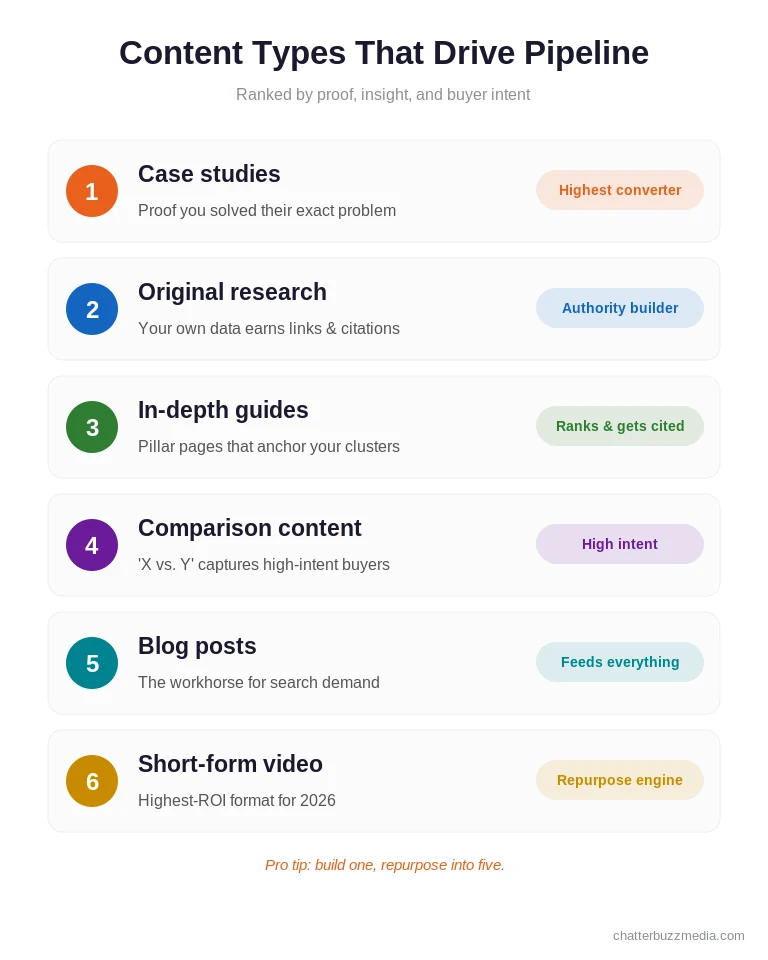
Not all content is created equal. A single well-researched pillar guide can outperform a month of thin posts, and one strong case study can close deals a hundred blog posts never touch.
Prioritize these formats in roughly this order:
- Case studies. Nothing converts a skeptical buying committee like proof that you solved their exact problem for someone like them.
- Original research and data. Publishing your own numbers earns backlinks, citations, and authority no borrowed stat can match.
- In-depth guides and pillar pages. Comprehensive resources rank, get cited, and become the backbone of your topic clusters.
- Comparison and alternative content. Buyers actively search for “X vs. Y,” and being the honest broker in that comparison builds trust while capturing high-intent traffic.
- Blog posts. Still the workhorse for capturing search demand and feeding every other format.
- Short-form video. Repeatedly cited as the highest-ROI format heading into 2026, ideal for turning written content into social-native clips.
Notice what these top formats have in common. Each one either supplies proof, supplies original insight, or captures a buyer at a high-intent moment, which is why they outperform generic listicles.
Match the format to the stage rather than chasing whatever is trendy. Awareness rewards approachable blog posts and short video, consideration rewards guides and webinars, and decision rewards case studies and detailed comparisons.
The smartest move for a small team is repurposing rather than constant net-new production. One pillar guide can become a case study angle, a research snippet, five social posts, an email sequence, and a short video without starting from scratch.
Think of every major asset as a source file, not a finished product. This “create once, publish everywhere” discipline is how a two-person team produces the output of a much larger one.
Distribution deserves as much attention as creation. A brilliant guide nobody sees is worthless, so plan to promote each asset through email, LinkedIn, your sales team, and relevant communities the moment it goes live.
A useful rule of thumb is to spend as much time distributing a piece as you spent creating it. The best mid-market teams treat publishing as the start of the work, not the finish line.
One more principle separates content that drives pipeline from content that just fills a calendar. Every piece should demonstrate real experience, expertise, authority, and trust, because both Google and cautious B2B buyers reward first-hand knowledge over recycled summaries.
Write what only you can write: the lesson from a client engagement, the number from your own data, the counterintuitive take from your team’s experience. Our roundup of content marketing strategies that boosted brand awareness shows this in action, and our B2B sales content strategy covers the bottom-funnel assets sales actually uses.
How to Measure ROI and Win the AI Search Era
You measure B2B content ROI by tracking content-influenced pipeline and revenue, not just traffic, and you future-proof it by optimizing to be cited by AI search. Vanity metrics like pageviews feel good but tell a mid-market CFO nothing, so the goal is to connect content to money and to the new way buyers discover answers.
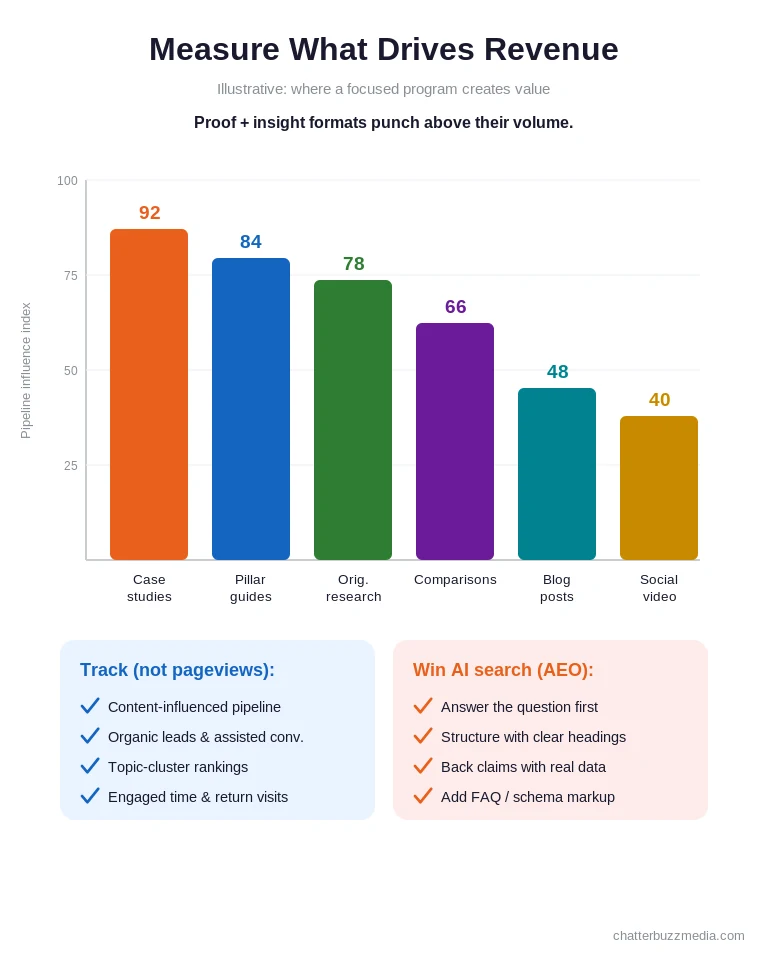
Start by tracking the metrics that map to revenue. The ones that matter most are the ones a leadership team will actually act on:
- Content-influenced pipeline. The dollar value of opportunities that touched your content before converting.
- Organic leads and assisted conversions. How many qualified leads content sourced or helped along the way.
- Keyword and topic-cluster rankings. Whether you are gaining ground on the terms your buyers actually search.
- Engaged time and return visits. Signals that your content is genuinely useful, not just clicked and abandoned.
A simple attribution model inside your CRM connects these dots without a data-science team. Even a first-touch and last-touch view of which content precedes closed deals will tell you where to double down.
Resist the pull of pure traffic reporting. A page that brings 200 visitors and three sales-ready leads is worth more than one that brings 5,000 visitors and none, and only revenue-linked measurement makes that visible. Our reporting and data visualization approach turns that data into a dashboard leadership trusts.
Set a review rhythm you will actually keep. A monthly look at rankings and leads plus a quarterly look at influenced pipeline is enough to steer the program without drowning in reports.
Use those reviews to prune as well as to plan. Content that has not moved after a fair trial should be updated, merged, or retired, because a lean library of winners beats a sprawling archive of forgotten posts.
Then optimize for AI search. Buyers increasingly get answers from AI Overviews and chat assistants that summarize the web, and being the source those tools cite is the new front page of Google.
This shift is often called answer engine optimization, and it changes what “ranking” means. The goal is no longer just a blue link; it is being the quoted, credited source inside an AI-generated answer.
To earn those citations, a few practices consistently help:
- Answer the question first. Open each section with a direct, quotable answer before you add context.
- Structure for machines. Use clear headings, short paragraphs, lists, and tables that are easy to parse.
- Back every claim with proof. Cite data and add first-hand expertise that a generic model cannot fabricate.
- Add schema markup. Structured data and FAQ markup help search and AI systems understand your content.
The reassuring part is that this rewards exactly the kind of specific, authoritative content mid-market teams do best. The same depth that earns a buyer’s trust is what earns an AI citation.
There is a strategic upside hiding in this shift. As generic content floods the web, the premium on original, expert, hard-to-fake insight only rises, and that is the exact terrain where a focused mid-market team can beat a bloated content mill.
Treat AEO as an extension of good content, not a separate project. If you are already answering real questions with real proof, you are most of the way there, and a few structural habits close the rest of the gap.
For the fundamentals that still matter underneath it all, our explainer on how long SEO takes to work sets realistic expectations. Combine revenue-linked measurement, solid SEO, and AEO, and your content program becomes a compounding engine instead of a cost center.
Frequently Asked Questions
1. 🔍 What is B2B content marketing in simple terms?
B2B content marketing is creating helpful content like guides, case studies, and articles that educate business buyers and build trust before a sale. Instead of pitching, you answer the questions your buyers are already asking so your brand becomes their go-to resource.
2. 📊 How is B2B content marketing different from B2C?
B2B targets a buying committee through a long, research-heavy purchase, so the content is deeper, more educational, and focused on ROI and risk reduction. B2C usually speaks to one person making a faster, more emotional decision, so the content is shorter and more entertaining.
3. ⚡ How long does B2B content marketing take to show results?
Most B2B content programs start showing meaningful organic traffic and leads in four to six months, with compounding gains after that. The exact timeline depends on your site’s authority, publishing consistency, and how competitive your keywords are.
4. 🏦 How much should a mid-market company budget for content marketing?
Most mid-market companies invest a meaningful share of their marketing budget in content because it lowers cost per lead over time. The smarter question is depth over volume: fund one excellent pillar cluster and consistent publishing before spreading budget across formats you cannot sustain.
5. 🤝 Can a small team compete with enterprise content teams?
Yes, and focus is how they win. A small team that owns a narrow topic cluster with genuinely expert content will outperform a Fortune 500 team publishing broad, generic articles on the same subject.
6. 💰 What content types generate the most B2B leads?
Case studies, in-depth guides, original research, and comparison content typically drive the most qualified leads. These formats combine proof and utility, which is exactly what a cautious buying committee needs to move forward.
7. 🚀 How do I get my content cited by AI tools like ChatGPT and Google AI Overviews?
Answer questions directly at the top of each section, use clear headings, and support claims with data and first-hand expertise. AI systems favor content that is well-structured, authoritative, and genuinely useful, which is the same content that earns trust with human buyers.
8. 📈 Is blogging still worth it for B2B in 2026?
Blogging is still one of the most reliable ways to capture search demand and feed every other content format you produce. The bar is simply higher now, so thin, generic posts fail while deep, expert content that answers real buyer questions wins.
Conclusion: Your B2B Content Marketing Action Plan
B2B content marketing is the highest-leverage channel a mid-market company has, precisely because it rewards focus over budget. You do not need to outspend the enterprise brands in your space; you need to be more useful to a narrower audience than they will ever bother to be.
The teams that win treat content as a compounding asset, not a campaign. Here is how to put this guide to work:
1. Document your strategy. Write down your goals, audience, and the one topic cluster you will own this quarter.
2. Map content to the journey. Fill the middle-funnel gap so buyers can move from aware to convinced without hitting a dead end.
3. Lead with proof and depth. Prioritize case studies, original research, and pillar guides over a high volume of thin posts.
4. Measure and optimize for AI. Track content-influenced pipeline and structure every piece to be cited by search and AI assistants.
Pick one cluster and start there rather than trying to fix everything at once. Momentum from a single well-executed topic will teach you more than a sprawling plan you never finish.
Give the program room to compound before you judge it. Content marketing rarely delivers in a single quarter, but the teams that stay consistent for a year almost always look back on it as their best marketing investment.
When you are ready to turn this plan into a system, our inbound marketing guide and library of marketing resources give you the frameworks to go deeper. Start with one cluster, publish consistently, and let the compounding begin.

Victoria Wallace
Victoria Wallace is a senior content strategist and marketing writer with 30+ years of experience helping more than 200 brands translate complex business goals into clear, conversion-focused content. Her background spans paid media, marketing strategy, go-to-market planning, brand positioning, and full-funnel campaign development, giving her a deep understanding of how SEO content connects to real business growth.