
 321-236-2899
Customer Acquisition Strategy: How Mid-Market Companies Scale Without Burning Cash
Most companies do not have a customer acquisition problem. They have an acquisition math problem.
They can buy growth by pouring more money into ads, but the moment spend flattens, so does the pipeline. That is not a strategy — it is a treadmill, and it burns cash fast.
A real customer acquisition strategy is the system that connects paid media, organic search, content, and conversion optimization into one engine where every new customer costs less than the last. This guide breaks down how mid-market companies build that engine: the funnel, the metrics that separate scaling from burning, the channel mix, and the exact framework a fractional CMO uses to grow without lighting money on fire.
By the end, you will know how to calculate whether your acquisition is actually profitable — and which lever to pull first when it is not.
Key Takeaways
- A customer acquisition strategy is a system, not a channel. The companies that scale profitably connect paid, organic, and CRO into one framework instead of treating each as a separate budget line.
- Your LTV:CAC ratio is the number that matters most. A healthy business targets at least 3:1 — earning three dollars in lifetime value for every dollar spent to acquire a customer.
- CAC payback period tells you if you can afford to grow. Recovering acquisition cost in under 12 months keeps cash flowing; longer than that quietly starves the business.
- Conversion rate optimization multiplies every channel. Fixing a leaky funnel lowers CAC across paid and organic at the same time, which is why CRO is the highest-leverage move in acquisition.
- Diversified channels beat a single dependency. Over-reliance on one paid platform is the fastest way to watch CAC spike overnight when auction prices rise.
What Is a Customer Acquisition Strategy?
A customer acquisition strategy is the coordinated plan a business uses to attract, convert, and onboard new paying customers at a predictable, profitable cost. It defines which channels you use, how they work together, and what a “good” customer is worth relative to what you spend to win one.
The word that matters there is coordinated. Running ads is a tactic. Publishing blog posts is a tactic. A strategy is the framework that decides how those tactics reinforce each other and how you measure whether the whole system is paying off.
Acquisition is not the same as lead generation
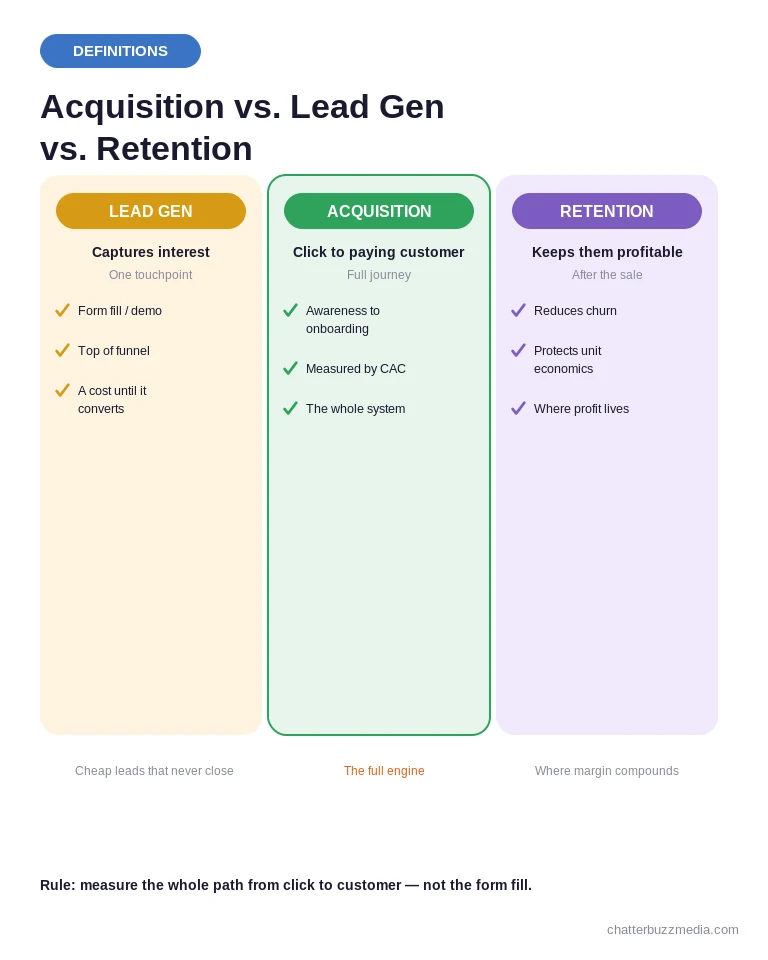
Lead generation captures interest — a form fill, a demo request, a downloaded guide. Acquisition is the full journey from that first touch all the way to a closed, paying, onboarded customer.
Treating them as the same thing is how teams celebrate “record lead volume” while revenue stays flat. A pile of unqualified leads is a cost, not a result, which is why smart teams measure the whole path from click to customer. If you want to see how the top of that funnel feeds the rest, our breakdown of demand generation vs. lead generation maps the distinction in detail.
Acquisition and retention are two halves of the same engine
Acquisition brings customers in. Retention keeps them long enough to become profitable — and the two are inseparable, because a customer who churns before you recover their acquisition cost is a net loss no matter how cheaply you won them.
This is why the strongest strategies start with the economics of the whole relationship, not just the cost of the first sale. Experience matters here too — Zendesk research found that 62% of B2B customers bought more after a good service experience, which means the same quality that retains customers also lowers the cost of winning the next one.
That lens is what separates a durable acquisition engine from an expensive spike, and it sets up the funnel we will walk through next.
The 5 Stages of the Customer Acquisition Funnel
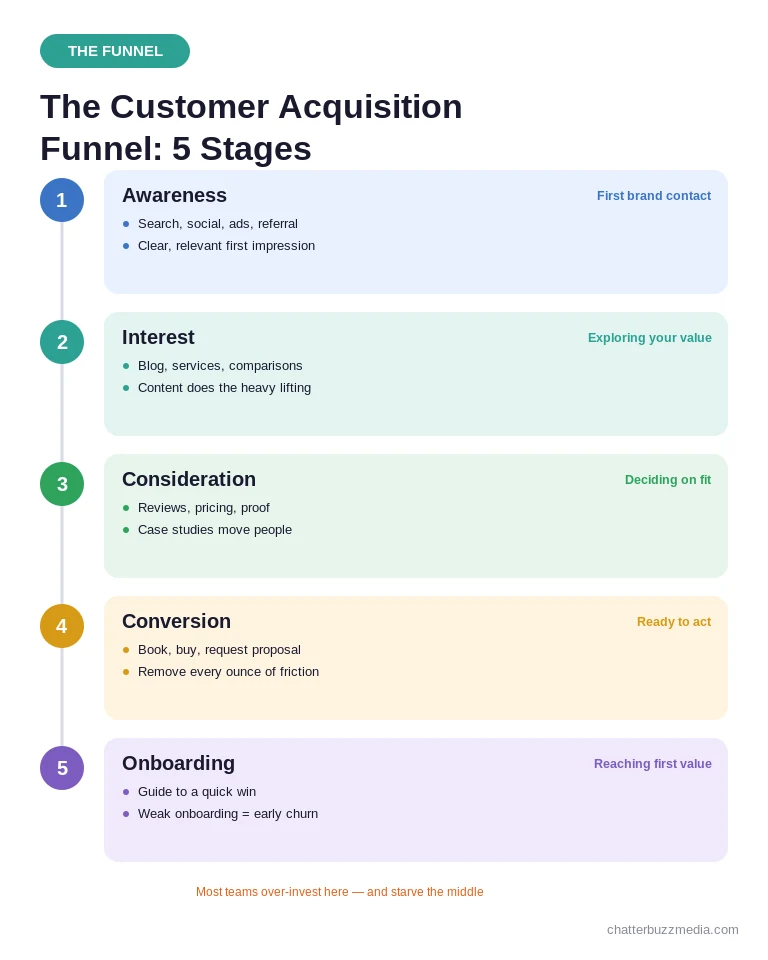
The customer acquisition funnel is the path a prospect travels from first hearing about you to becoming an onboarded customer, broken into five stages: awareness, interest, consideration, conversion, and onboarding. Mapping your strategy to these stages is what lets you see exactly where prospects stall — and where your money is leaking.
Most teams over-invest at the top and under-invest in the middle. That imbalance is expensive, so let’s look at what each stage actually needs.
Stage 1: Awareness
This is the first time a prospect encounters your brand — through search, social, an ad, or a referral. Your only job here is a clear, relevant first impression that earns the next click.
Awareness is cheap to buy and expensive to waste, so the content a prospect meets first should speak to a problem they already feel.
Stage 2: Interest
Now the prospect is exploring — reading your blog, browsing your services, comparing you to the mental shortlist in their head. The goal shifts from grabbing attention to holding it with genuinely useful information.
This is where content marketing earns its keep, and where a strong demand generation program quietly does the heavy lifting.
Stage 3: Consideration
Here the prospect is deciding whether you are the right fit. They read reviews, weigh pricing, and look for proof that you can solve their specific problem.
Case studies, comparison content, and clear answers to common objections move people forward at this stage. Getting your ideal customer profile right is what makes this messaging land instead of falling flat.
Stage 4: Conversion
The prospect is ready to act — book a call, request a proposal, or buy. Your job is to remove every ounce of friction between intent and action.
A confusing form or a slow page costs you customers you already paid to attract. This is precisely where conversion rate optimization turns existing traffic into revenue without raising your ad budget a dollar.
Stage 5: Onboarding
The sale closes, but acquisition is not finished until the customer reaches first value. A shaky onboarding experience produces early churn, which destroys the unit economics we are about to measure.
Treating onboarding as the final acquisition stage — not the first retention stage — keeps the whole team focused on customers who actually stick. With the funnel mapped, the next question is how to tell whether it is making money.
The Metrics That Decide Whether You’re Scaling or Burning Cash
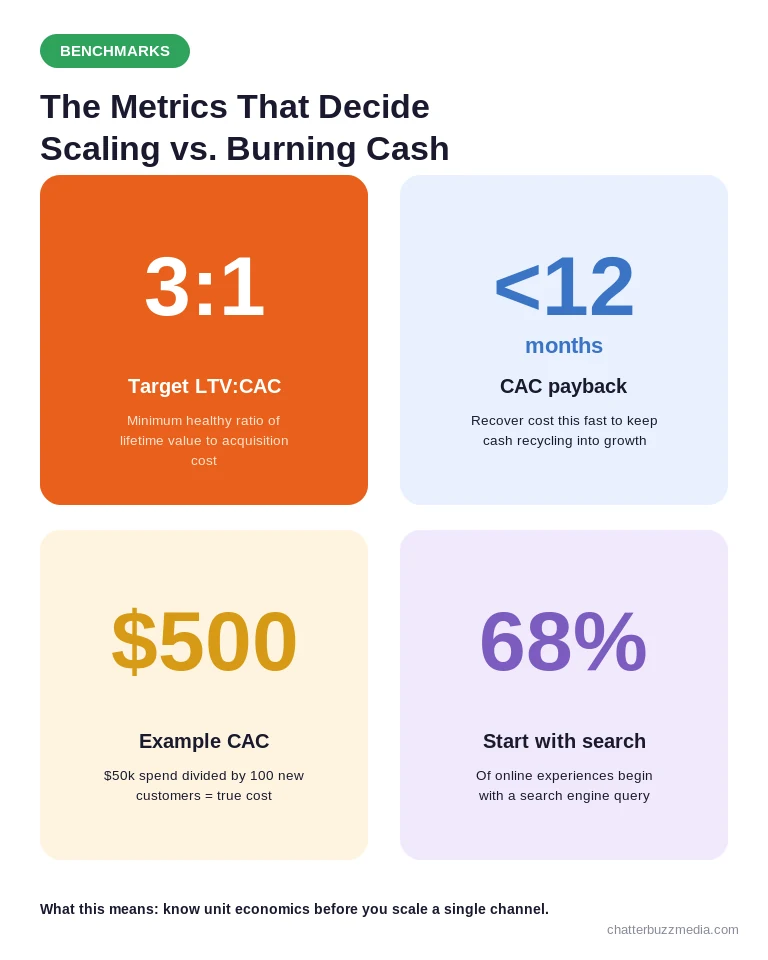
The single most important truth in acquisition is this: you cannot scale a channel until you know its unit economics. Four numbers tell you whether growth is building the business or draining it — CAC, LTV, the LTV:CAC ratio, and payback period.
Get these right and every budget decision becomes obvious. Ignore them and you will scale your losses faster than your revenue.
Customer acquisition cost (CAC)
CAC is the total sales and marketing spend required to win one new customer. Divide everything you spent — ad dollars, salaries, tools, agency fees — by the number of customers acquired in the same period.
If you spent $50,000 and gained 100 customers, your CAC is $500. The trap most teams fall into is measuring only ad spend, which hides the real cost. For a full walkthrough of the math, our guide to calculating customer acquisition cost shows exactly what to include.
Customer lifetime value (LTV)
LTV is the total profit you expect from a customer across the entire relationship. It is the ceiling on what you can afford to spend to acquire them.
Multiply average purchase value by purchase frequency by average lifespan, then adjust for margin. A customer worth $6,000 over three years gives you far more room to invest than one worth $600.
The LTV:CAC ratio
This ratio is the health check for your entire acquisition strategy. The widely cited benchmark is at least 3:1 — three dollars of lifetime value for every dollar of acquisition cost.
Below 3:1 and you are spending too much or keeping customers too briefly. Far above 3:1, oddly, can mean you are under-investing and leaving growth on the table.
CAC payback period
Payback period is how many months it takes to recover the cost of acquiring a customer. It is the metric that governs your cash flow, and mid-market companies ignore it at their peril.
A payback under 12 months keeps cash recycling into more growth. Stretch it to 18 or 24 months and you need deep reserves — or outside funding — just to keep the lights on while you wait.
This is the number that decides whether “scaling” is safe or reckless. It also explains why two companies with identical revenue can have wildly different cash positions — the one with faster payback simply gets to reinvest sooner.
Blended CAC vs. channel CAC
Blended CAC averages your acquisition cost across every channel; channel CAC isolates the cost of each one individually. You need both, because the blended number tells you if the business is healthy while the per-channel number tells you where to move budget.
Relying on blended CAC alone is a classic mistake — a cheap organic channel can mask an unprofitable paid channel hiding inside the average. Break it apart, and the channel quietly losing money becomes impossible to ignore. According to Salesforce’s customer acquisition research, tracking channel-level ROI is what lets teams double down on what works and cut what does not.
Customer Acquisition Channels: Building a Cross-Channel Mix
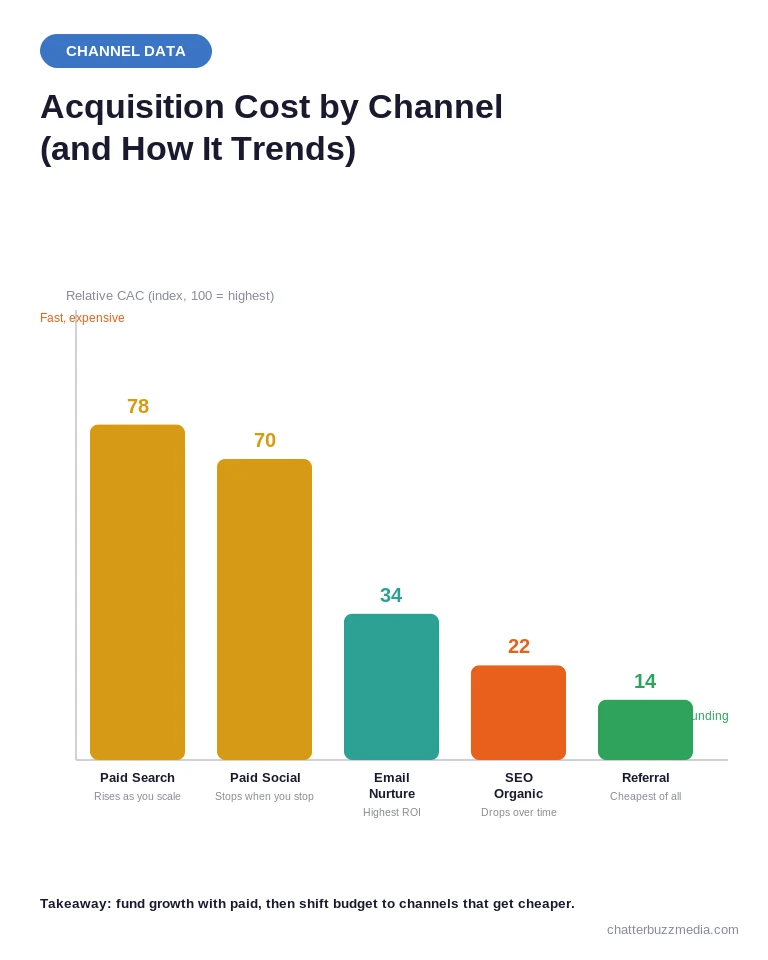
The right acquisition channels are the ones where your ideal customers already spend attention and where the economics work at your target CAC. No single channel wins on its own — the goal is a mix where fast channels fund slow ones and slow ones lower your blended cost over time.
Here is how the primary channels compare and where each fits in a mid-market strategy.
Search deserves special weight in the mix, because it captures buyers at the moment of intent. Roughly 68% of online experiences begin with a search engine, which is why organic and paid search anchor most acquisition strategies. As buyers shift toward AI-assisted research, that intent is starting to surface inside answer engines too.
- Paid search and paid social. The fastest way to test demand and buy predictable volume, but CAC rises as you scale and stops the moment you stop paying. Ideal for validating offers and capturing high-intent buyers through disciplined PPC management.
- SEO and organic search. Slow to compound but the lowest long-run CAC of any channel, since traffic keeps arriving after the work is done. This is the channel that quietly drops your blended acquisition cost year over year.
- Content marketing. The fuel for organic and the trust-builder for every other channel, turning strangers into informed buyers. Explore how a content marketing program supports the full funnel rather than just the top.
- Email and lead nurture. The highest-ROI channel for converting interest you already earned, especially for longer B2B cycles. A structured lead nurturing strategy recovers prospects who were not ready on the first visit.
- Referral and word of mouth. The cheapest customers you will ever acquire, because trust does the selling for you. Built well, referrals compound as your customer base grows.
- Answer engine optimization (AEO). The emerging 2026 channel — optimizing to be cited inside AI-generated answers as buyers increasingly start research inside chat interfaces instead of a search bar.
The discipline that ties this together is sequencing: start with one or two channels you can measure, prove the economics, then reinvest into channels that lower your blended CAC. If you are weighing where to start, our comparison of SEO vs. PPC is a useful starting point before you commit budget.
How to Build a Customer Acquisition Strategy
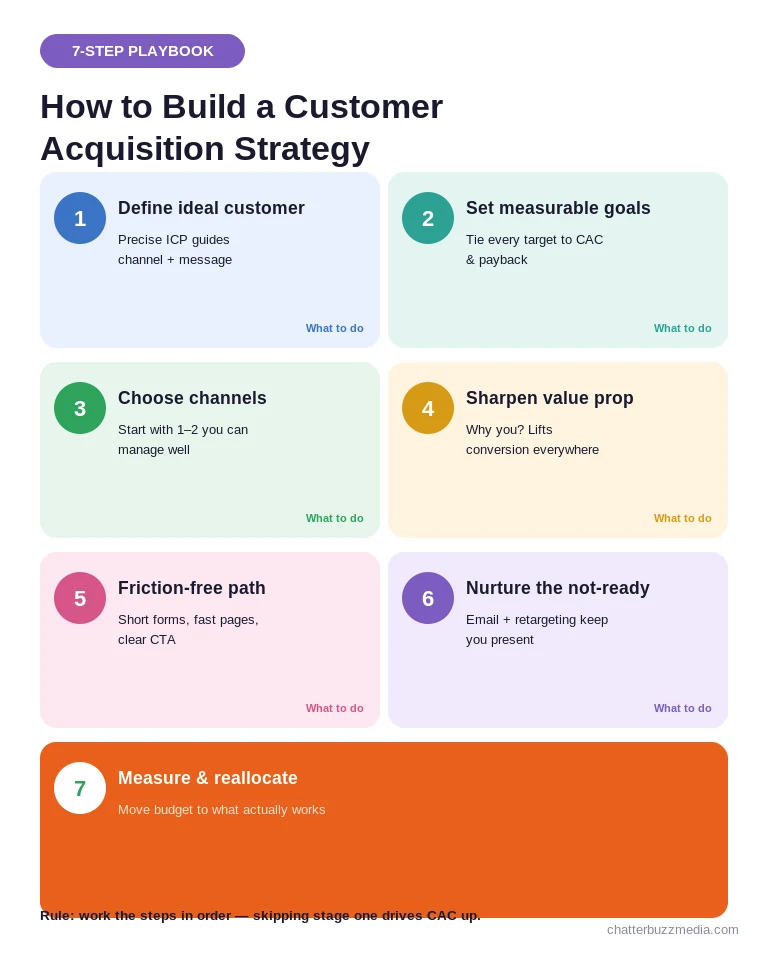
Building a customer acquisition strategy means moving through seven steps in order: define your ideal customer, set measurable goals, choose channels, sharpen your value proposition, build a friction-free conversion path, nurture the not-yet-ready, and measure relentlessly. Skipping steps is how companies end up spending on channels that were never going to work.
Here is the framework a fractional CMO uses to stand up acquisition that scales.
Step 1: Define your ideal customer
Everything downstream depends on knowing exactly who you are trying to reach and what problem they are solving. A precise ideal customer profile tells you which channels to use and what message will resonate.
Vague targeting is the root cause of high CAC. When you talk to everyone, you convert almost no one.
Step 2: Set clear, measurable goals
Decide what the strategy must produce — booked demos, qualified pipeline, revenue — and attach a number and a date. Goals you cannot measure are wishes, not targets.
Tie every goal back to CAC and payback so you never celebrate volume that does not pay for itself.
Step 3: Choose channels that fit your economics
Match channels to your buyer, your budget, and your target CAC — then start with one or two you can actually manage well. Spreading thin across six channels guarantees you will do none of them well enough to work.
Step 4: Sharpen your value proposition
Your message has to answer one question instantly: why you instead of every alternative? A clear brand message raises conversion on every channel at once, which lowers CAC everywhere.
Step 5: Build a friction-free conversion path
Map the exact route from first click to closed deal and strip out every unnecessary step. Short forms, fast pages, and obvious calls to action turn traffic you already paid for into customers.
Step 6: Nurture the prospects who aren’t ready yet
Most prospects will not buy on the first visit, and that is normal. Automated email sequences, retargeting, and helpful follow-up keep you present until the timing is right.
Step 7: Measure, then reallocate
Track CAC, conversion rate, and payback by channel, then move budget toward what works and away from what does not. This loop — measure, reallocate, repeat — is what compounds acquisition efficiency over time. If you want this framework tied to your growth stage, our marketing plan template maps it to revenue milestones.
How to Reduce Customer Acquisition Cost Without Slowing Growth
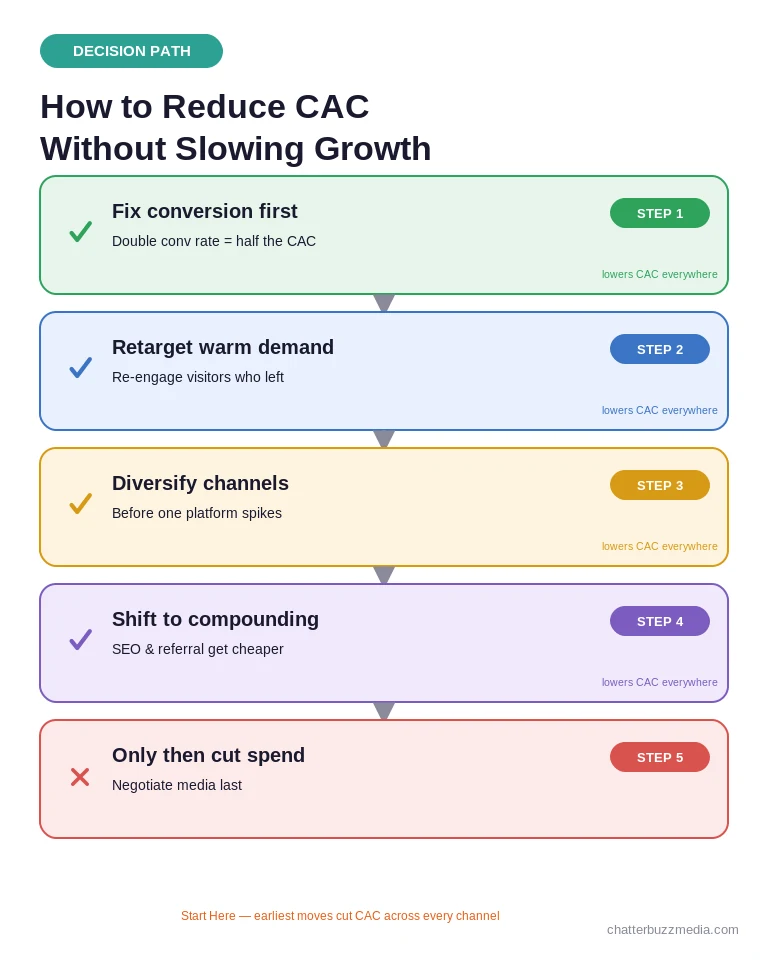
The fastest way to lower CAC is not to cut spend — it is to convert more of the traffic you already have. Before you touch your budget, work down a simple decision path: fix conversion first, then retarget warm demand, then diversify channels, and only then negotiate media costs.
This order matters because the earliest moves lower CAC across every channel at once.
Fix conversion before you spend more
Doubling your landing page conversion rate cuts your effective CAC in half — no additional ad dollars required. This is why CRO consistently beats spending more on ads as the first lever to pull.
Audit your highest-traffic conversion points, test one variable at a time, and compound the wins. A single headline change or a shorter form can move conversion by a few points, and a few points at scale is the difference between a channel that pays and one that does not.
The leverage here is what makes CRO the first move rather than the last: every improvement you lock in keeps working for free on every visitor who arrives afterward, from paid, organic, or referral alike.
Retarget the demand you already created
Most visitors leave without converting, and re-engaging them is far cheaper than finding new prospects from scratch. Retargeting and email nurture recover intent you already paid to generate.
The economics here are hard to beat: you are not buying new awareness, only nudging people who already raised their hand. A modest retargeting budget aimed at recent visitors and cart abandoners routinely converts at a fraction of cold-traffic cost, which pulls your blended CAC down without adding a single new prospect to the top of the funnel.
Diversify before a single channel spikes
Over-dependence on one paid platform means one auction-price increase can wreck your CAC overnight. Building organic and referral alongside paid protects your blended cost when any single channel gets expensive.
Invest in the channels that compound
Organic search and referral get cheaper as they grow, unlike paid, which gets more expensive. Shifting budget toward compounding channels is how mid-market companies drop blended CAC year over year while still growing.
The catch is patience: compounding channels take months to pay off, so most teams need paid media to fund growth while organic matures underneath it. Doing this sequencing well is where a fractional CMO earns their keep — balancing fast, expensive channels against slow, cheap ones so the business never runs out of runway.
Customer Acquisition Mistakes That Burn Cash
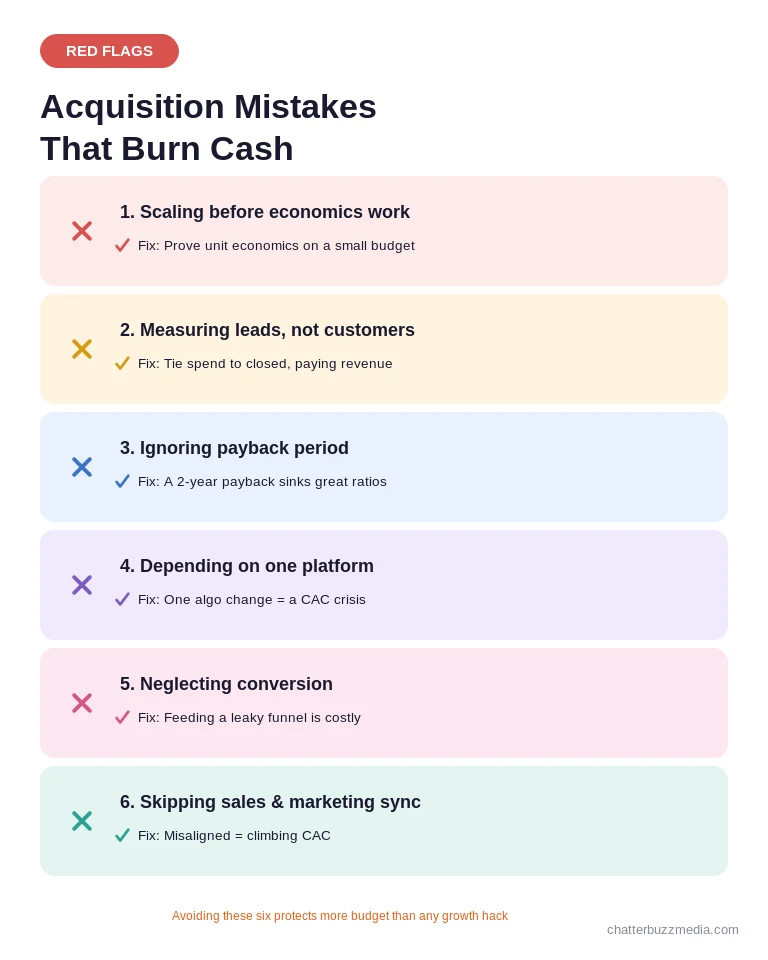
Most wasted acquisition budget traces back to a handful of predictable mistakes. Spotting them early is the difference between a strategy that compounds and one that quietly bleeds cash every month.
Here are the errors that do the most damage to mid-market acquisition.
- Scaling a channel before the economics work. Pouring budget into a channel with an unprofitable CAC just loses money faster. Prove the unit economics on a small budget first.
- Measuring leads instead of customers. Optimizing for cheap leads produces volume that never converts. Always tie spend back to closed, paying customers.
- Ignoring payback period. A great LTV:CAC ratio can still sink you if it takes two years to get your cash back. Watch payback as closely as the ratio.
- Depending on one platform. Single-channel businesses are one algorithm change away from a CAC crisis. Diversify before you are forced to.
- Neglecting conversion optimization. Buying more traffic to feed a leaky funnel is the most expensive habit in marketing. Fix the funnel first.
- Skipping sales and marketing alignment. When the two teams chase different definitions of a good lead, acquisition cost climbs. Our take on aligning marketing and sales shows how to close that gap.
Avoiding these six mistakes protects more budget than most “growth hacks” ever generate. With the pitfalls clear, let’s answer the questions teams ask most.
Frequently Asked Questions
1. 🔍 What is a customer acquisition strategy?
A customer acquisition strategy is a coordinated plan for attracting, converting, and onboarding new paying customers at a predictable, profitable cost. It connects channels like paid media, SEO, content, and conversion optimization into one system rather than treating each as a separate effort.
2. 📊 How do you calculate customer acquisition cost?
Divide your total sales and marketing spend by the number of new customers acquired in the same period. Include everything — ad spend, salaries, tools, and agency fees — not just media cost, or your CAC will look artificially low.
3. ⚡ What is a good LTV:CAC ratio?
The widely accepted benchmark is at least 3:1, meaning a customer’s lifetime value is three times what it cost to acquire them. A ratio far above 3:1 can signal you are under-investing in growth, while below 3:1 usually means CAC is too high or retention is too low.
4. 🏦 What is a healthy CAC payback period?
For most mid-market companies, recovering acquisition cost within 12 months keeps cash flowing back into growth. Payback periods stretching past 18 to 24 months require significant reserves or outside funding to sustain.
5. 🤝 What is the difference between customer acquisition and lead generation?
Lead generation captures initial interest, such as a form fill or demo request. Customer acquisition covers the entire journey from that first touch through to a closed, paying, onboarded customer — lead generation is just one stage inside it.
6. 💰 How can I reduce my customer acquisition cost?
Start by improving conversion rate so you win more customers from existing traffic, then retarget warm demand, diversify channels, and shift budget toward compounding channels like SEO and referral. Fixing conversion first lowers CAC across every channel at once.
7. 🚀 Which acquisition channel is best for mid-market companies?
There is no single best channel — the strongest approach blends fast channels like paid search with compounding channels like SEO and referral. Start with one or two you can measure well, prove the economics, then reinvest into the channels that lower your blended CAC.
Turning Acquisition Into Predictable Growth
Scaling without burning cash is not about spending less — it is about building a system where every new customer costs less than the last. That happens when paid, organic, and conversion optimization work as one engine instead of competing for budget.
Here is where to start:
- Measure your real CAC and payback period by channel, including all costs, so you know which channels actually pay off.
- Fix your highest-traffic conversion points first to lower CAC across every channel without spending more.
- Diversify beyond any single platform so one price spike cannot break your economics.
- Reinvest into compounding channels like SEO, content, and referral to drop your blended cost over time.
Acquisition becomes predictable the moment you treat it as a system with clear economics rather than a series of disconnected campaigns. The companies that scale without burning cash are rarely the ones spending the most — they are the ones who know their numbers, fix conversion before buying more traffic, and let compounding channels quietly lower cost over time. If you want a deeper foundation, explore our inbound marketing guide or browse the full resource library to build the framework that fits your growth stage.
Need help with SEO? Explore our SEO agency services.

Victoria Wallace
Victoria Wallace is a senior content strategist and marketing writer with 30+ years of experience helping more than 200 brands translate complex business goals into clear, conversion-focused content. Her background spans paid media, marketing strategy, go-to-market planning, brand positioning, and full-funnel campaign development, giving her a deep understanding of how SEO content connects to real business growth.