
 321-341-2327
What Is Ad Fatigue? Why Your Facebook Ads Stop Working
Key Takeaways
- Ad fatigue happens when your audience sees the same creative too many times — and stops responding. It shows up as a slow CPA creep, not a sudden crash.
- Three variables control how fast it hits: your spend level, creative differentiation, and audience size.
- Most brands don’t measure ad fatigue proactively. By the time they feel it, they’ve already lost weeks of spend.
- There are three levers to fix it: produce more true creative concepts, build a proper testing structure, and raise your creative hit rate.
- Facebook ad fatigue is a supply chain problem, not a creative quality problem. Treat it like one.
I’ve audited a lot of Facebook ad accounts. And one of the most common things I hear from CEOs and marketing directors sounds like this:
“Our ads just stopped working. We don’t know what happened.”
They think they have a creative quality problem. Or a targeting problem. Some blame the algorithm. A few think Meta is punishing them for no reason.
Most of the time, none of that is true.
When I get into the account, the story is almost always the same: their top-spending ads are 45, 60, sometimes 90 days old. Their “testing” is two or three new ads a month dropped into a $50K account. The ads that are spending were great — eight weeks ago. They just got old, nobody replaced them fast enough, and now the account is slowly bleeding efficiency while everyone wonders what went wrong.
That slow bleed has a name: Facebook ad fatigue. And it’s probably the most expensive problem in paid media that most companies aren’t actively measuring.
Here’s what I want to give you in this post: a real framework for what ad fatigue is, how to catch it before it costs you, and exactly what to do about it.
What Is Ad Fatigue — And Why Most People Misdiagnose It
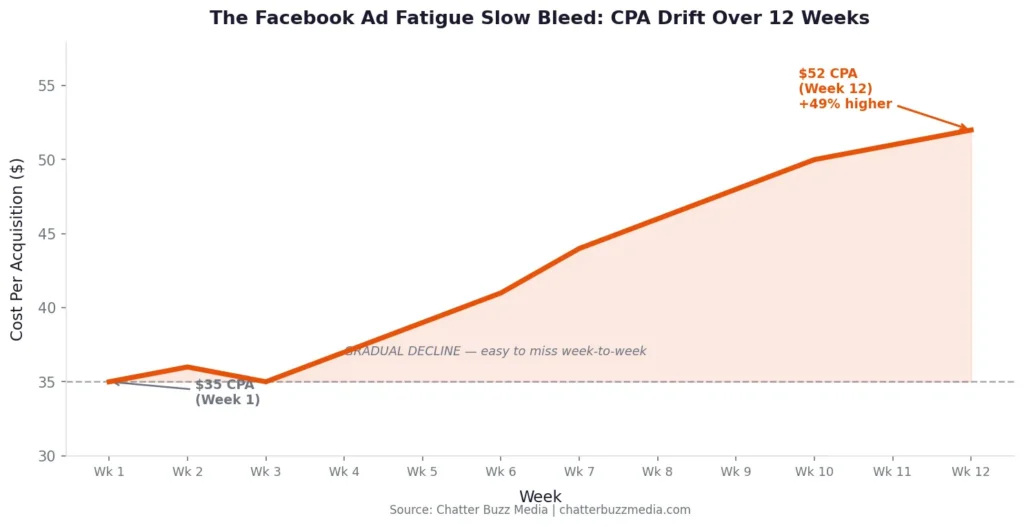
Ad fatigue is what happens when the same audience sees the same creative too many times and stops responding to it. Click-through rate drops. Conversion rate falls. Your cost per acquisition starts climbing — not dramatically, not all at once, just enough that no single week looks like a disaster.
That’s what makes it so dangerous. Ad fatigue doesn’t look like a crisis. It looks like a slow Tuesday.
Your CPA is up 5% one week. Another 3% the next. Then 7%. You don’t panic because no individual week looks catastrophic. But zoom out over two months and you’ve gone from a $35 CPA to a $52 CPA — and you’re sitting there asking what broke.
Nothing broke. Your ads just got old. And nobody replaced them in time.
I want to be direct about something: ad fatigue is not a creative quality problem. It’s a supply chain problem. The ad didn’t get worse. The audience just ran out of patience for seeing it. The fix isn’t about making better ads — it’s about building the system to replace ads before they die.
That’s the mindset shift most teams need before anything else.
The 3 Variables That Control How Fast Facebook Ad Fatigue Hits
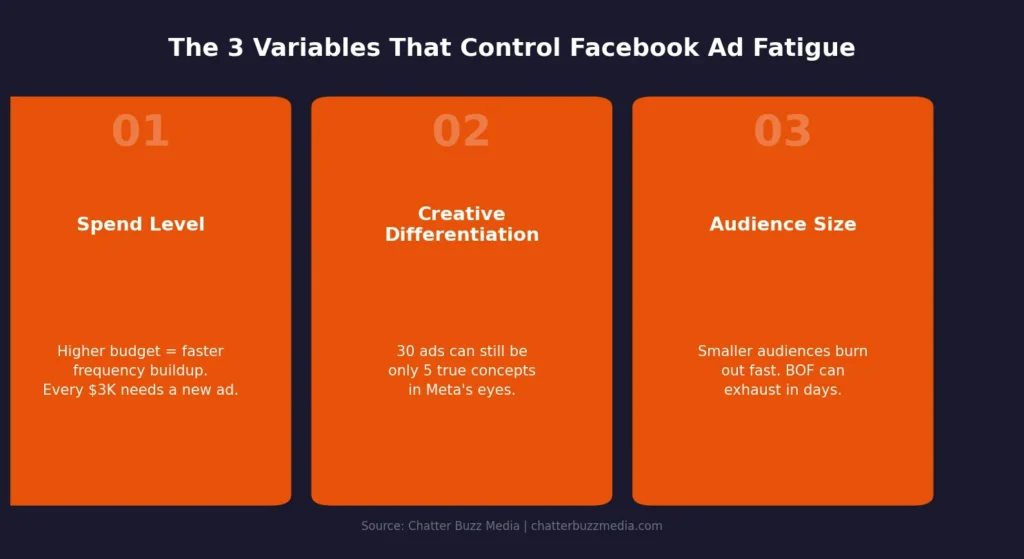
Facebook ad fatigue is not random and it’s not unpredictable. It’s a function of three variables. Once you understand them, you can start managing your creative pipeline the way you’d manage any operational function in the business.
Variable 1: Spend Level
This is the most intuitive variable — and the most underestimated. Most people think their ads run out of steam over time. That’s not exactly right.
Creative doesn’t fatigue over time. It fatigues under spend pressure.
The same ad can run for two years at $500 a month and hold steady. Put $50,000 behind it in a single week and it’ll be dead by Friday. The mechanism is simple: more spend means more impressions, more impressions means higher frequency, and higher frequency means the same people see your ad over and over until they stop responding.
The algorithm notices the declining engagement, deprioritizes your ad in the auction, CPMs rise, and the whole thing spirals. This is why scaling is so hard for most businesses. They find a winning ad, increase the budget, and watch performance fall apart within two weeks.
Here’s the rule I use:
- for every $3,000 you spend in a month, you should be producing one new ad.
- For every $10,000, you need one genuinely new concept — not a variation on the same idea.
- So if you’re spending $100,000 a month, that’s roughly 10 concepts with 3 to 4 variations each. About 30 to 35 ads total.
Most companies are producing creative at the rate that worked when they were spending $20K.
Then they scaled spend to $80K and never adjusted production. That’s the gap where fatigue lives.
Variable 2: Creative Differentiation
This is the one people think they understand but almost always get wrong.
I’ll ask a team how many ads they’re running. They’ll say 30. Then I look at the account and almost every single one of them is a variation of the same creative concept — same creator, same setting, slightly different hook. Same product shot, different headline that speaks to the same audience pain point.
From Meta’s perspective, those are the same ad. From the audience’s perspective, they’re all the same ad. Your “30 ads” might actually be 4 or 5 true concepts in the algorithm’s eyes.
Creative differentiation isn’t just about avoiding fatigue. It’s a targeting play. This is what “creative is the new targeting” actually means.
When you run genuinely diverse creative — different visual styles, different creators, different emotional angles, different formats — Meta uses each distinct creative to find different pockets of your audience. A polished product demo reaches a different person than raw UGC from a customer. A pain-point ad reaches a different person than a lifestyle aspiration ad.
Diverse creative simultaneously reduces fatigue and expands your total addressable reach. Producing 40 variations of the same concept is almost worthless. Producing 10 genuinely different concepts with 4 variations each is a completely different game — and a much better investment.
If you want to see what strong creative strategy looks like in practice, our Facebook ad strategy blog post walks through how we approach ad concepts for different audience segments.
Variable 3: Audience Size
This is the variable most people never think about — and the one that explains why conventional wisdom about funnel position and fatigue is backwards.
Fatigue is a function of frequency. Frequency is a function of how many impressions you’re pushing into a given audience pool. If your audience is 2 million people and you’re spending $50,000 a month, frequency builds fast. If your audience is 100 million people at the same spend, frequency stays low and your creative lasts significantly longer.
This has two important implications:
First: it explains why niche verticals burn through creative so much faster. If you’re in a regulated category — telehealth, financial services, legal — your targetable audience might be a fraction of what a mass-market brand can access. Same spend, smaller pool, faster fatigue. These businesses need dramatically more creative volume per dollar than a brand with broad appeal.
Second: it explains why bottom-of-funnel fatigues faster than top-of-funnel at scale — and this is where I disagree with a lot of conventional thinking.
Bottom-of-funnel audiences are tiny. At any meaningful spend level, you can burn through that entire retargeting pool in days.
Your retargeting lists, past purchasers, warm traffic — these are small groups. Even if a BOF ad technically “works” on a per-person basis, it can’t scale because the audience caps out. There simply aren’t more people to show it to.
Top-of-funnel is the opposite. Cold audiences are larger. Yes, each cold prospect is harder to convert. But there are always more of them. You can always expand. The pool doesn’t cap out the way bottom-of-funnel does.
The practical rule: your creative volume needs are proportional to the inverse of your audience size. Smaller audience = more creative needed. And if your BOF campaigns are getting more expensive every month without explanation — this is very likely why. The audience ran dry. Move up the funnel.
How to Actually Measure Facebook Ad Fatigue (Before It’s Too Late)
Most companies don’t measure ad fatigue at all. They feel it. Performance starts declining, questions start getting asked, and then a scramble begins to figure out what happened.
By the time you feel it, you’ve already wasted weeks of spend on creative that’s well past its prime. The goal is to catch it proactively — before it eats your efficiency. Here are the three methods I use.
Method 1: Track Your Creative Churn Rate by Cohort
The most useful way to visualize creative fatigue is by cohort. Every month, you launch a batch of new creatives. That batch is your cohort — January creatives, February creatives, March creatives. Each cohort enters the account, competes for spend, and eventually fades as newer cohorts emerge.
Plot your total ad spend as a stacked chart colored by the month each creative was launched. What you get is a layered view of your entire creative lifecycle.
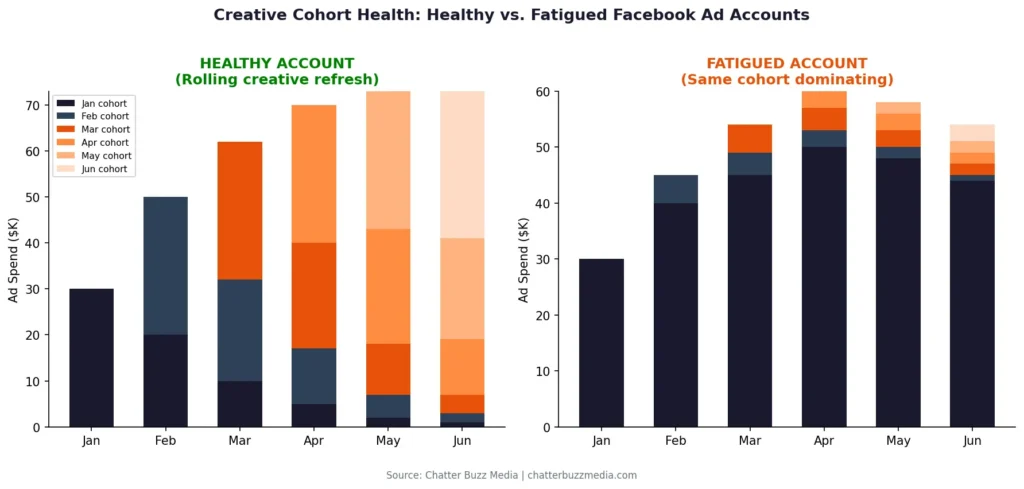
In a healthy account, this chart looks like a rolling wave. Each cohort rises, peaks, and gives way to the next. There’s always a fresh layer absorbing the majority of spend.
In a fatigued account, the same cohort dominates for months. You’ll see one color stretching across the entire chart with nothing layering on top. That’s your creative pipeline falling behind.
This view tells you three things at a glance:
How fast your creatives churn. If a cohort is still carrying 30%+ of spend two months after launch, either you found a unicorn creative or you’re not producing enough to replace it. Both are worth knowing.
How much you need to replace each month. If your January cohort spent $750K out of a $1M total in February, that’s 25% churn. Track this each month and you’ll know your average replacement rate. Churn above 30% usually means high competition or creatives that are too similar. Below 20% typically signals a low-competition category or a genuinely strong creative system.
Whether production is keeping pace with spend. As total spend scales up, the layers should multiply — not just get thicker. If you’re spending more but launching the same number of concepts, each cohort is absorbing more pressure and burning out faster.
Method 2: Spend Concentration and Winner Turnover
Pull your top 10 ads by spend for the current month. Ask two questions:
What percentage of total spend do they represent?
How many of them were also in last month’s top 10?
If the same 5 or 6 ads have been your top spenders for 3+ months in a row, that’s a fatigue risk whether the numbers have declined yet or not. Those ads are carrying the account, and when they fatigue — and they will — you’ll have nothing ready to replace them.
When I see an account where the top 5 ads are all 60+ days old and represent 70%+ of total spend, I know exactly what’s coming. Even if the numbers look fine today.
A healthy account has regular turnover in its top performers. Not because winners are failing faster, but because new winners are emerging and earning their place. That means the creative pipeline is actually working.
Method 3: Spend-Weighted Average Age of Creative
This is one of my favorites. Take every active ad in your account. Look at how many days it’s been running. Weight each ad’s age by its share of total spend. The result is a single number:
The spend-weighted average age of your creative portfolio — on average, how old is the creative your money is being spent on?
This is different from just looking at the age of your oldest running ad. It tells you whether the bulk of your spend is flowing through fresh creative or stale creative. And that distinction matters enormously.
A spend-weighted average age of 15 days? Your account is in healthy rotation. An average age of 60 days? Most of your money is being spent on creative that’s well past its prime — even if you launched a few new ads recently. Those new ads aren’t getting spend, which means they either aren’t winning or your account structure isn’t giving them a real shot to compete.
If this number is trending upward month over month, you’re falling behind on production and fatigue is building — even if your CPA doesn’t look alarming yet.
What to Do When Facebook Ad Fatigue Hits
Your creative is fatiguing. Your spend-weighted age is climbing. Your CPA is drifting upward. Here are the three levers that actually fix it.
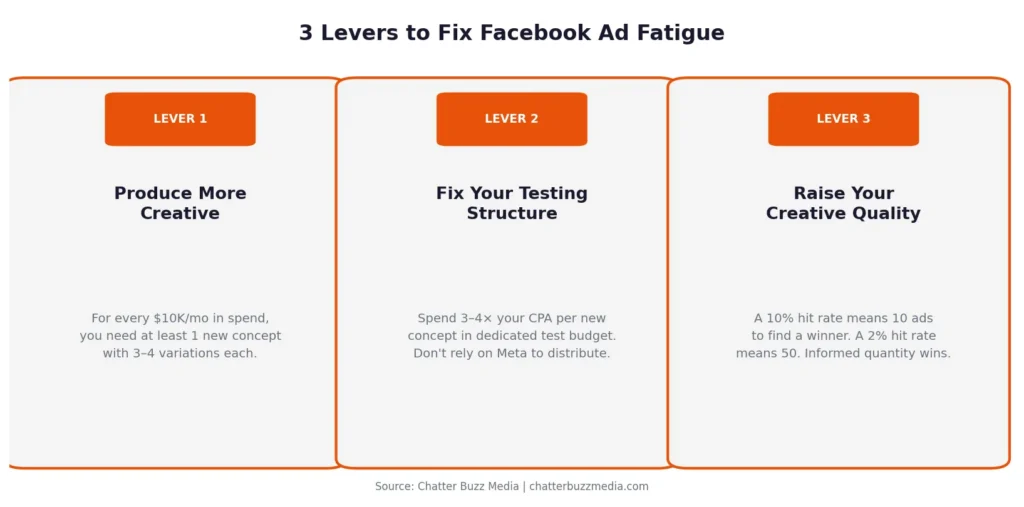
Lever 1: Produce More Creative — The Right Way
This is the obvious lever. If your ads are old and fatiguing, you need new ones. But here’s where most companies make a mistake: they produce more volume of the same ideas.
The production increase needs to come with genuine concept diversity. New formats. New angles. Different creators. Different visual styles. Different emotional entry points. You want to give Meta something it hasn’t seen from your account before — so each new concept gets its own learning phase, its own audience pathway, its own opportunity to scale independently.
I think about two goals when planning new creative:
Replacement creative: Built on learnings from your current top performers. What made the winner work — the hook type, the visual style, the emotional angle? Take those winning elements and build genuinely new concepts around them.
Expansion creative: Completely new angles designed to open audience segments your current creative hasn’t reached. These carry more risk but are the only path to real scale.
Split your production budget between both. The replacement work keeps your account from falling off a cliff. The expansion work is where you find your next unicorn.
Lever 2: Fix Your Testing Structure
Producing more creative doesn’t help if your account structure isn’t set up to actually test it. I see this constantly — a brand produces 20 new ads, launches them into the account, and two weeks later, 90% of spend is still going to the same 3 old winners.
The new ads never got a real chance.
This is a testing structure problem, not a creative problem. Your account needs a dedicated testing mechanism that gives new creative enough spend to generate statistically meaningful data before the algorithm decides to kill it.
That means allocating real budget to testing — not just throwing new ads into existing campaigns and hoping Meta distributes spend fairly. It won’t.
The budget math I use: spend 3 to 4 times your CPA per new concept in dedicated testing budget. If your CPA is $40, each new concept needs $120+ to evaluate properly. If you’re launching 10 new concepts, that’s $1,200+ in committed test spend before you can draw any real conclusions.
If that feels like a lot, compare it to what you’re currently wasting on fatigued creative that’s spending $500 a day at a CPA 40% above your target. The math usually becomes very clear.
Our social media advertising services include creative strategy and testing frameworks built around exactly this kind of structure — designed to find winners faster without burning budget on dead creatives.
Lever 3: Test at Higher Quality, Not Just Higher Volume
Volume and structure aren’t enough if what you’re testing is low quality. A low hit rate makes the whole creative system exponentially more expensive to maintain.
Here’s the math that makes this real:
At a 2% creative hit rate, you need 50 ads to find one winner.
At a 10% creative hit rate, you need 10 ads to find one winner.
That’s a 5× difference in production cost to achieve the exact same outcome. And the gap compounds over time.
How do you improve hit rate? Start with the data you already have. Break down your current winners by hook type, visual style, creator, angle, and format. Understand why they worked — not just that they worked. Then brief new creative that takes those winning elements and applies them to genuinely new concepts and angles.
The brands that treat creative production as an analytical, data-informed process — where every new concept is built on learnings from previous tests — will always outperform brands that are producing based on gut instinct and trend chasing.
Quantity matters. But informed quantity is what actually moves the needle. The goal is a creative system that gets smarter with every ad you run.
FAQ: Facebook Ad Fatigue
How do I know if my Facebook ads have ad fatigue?
Look for a gradual CPA increase over 4 to 8 weeks with no corresponding change in targeting or budget. Check whether your top-spending ads are more than 45 days old. Calculate the spend-weighted average age of your active creative — anything above 30 days in a high-spend account warrants attention.
How long should a Facebook ad run before it fatigues?
There’s no universal answer — it depends on your spend level, audience size, and creative differentiation. An ad spending $500/month might last a year. The same ad spending $50,000/month might be dead in two weeks. Focus on tracking churn rate and spend-weighted creative age rather than watching a calendar.
What’s the difference between ad fatigue and a bad ad?
A bad ad underperforms from the start. Ad fatigue shows up as a gradual decline in an ad that previously worked well. If your CPA was strong for 6 weeks and then started climbing without any changes to targeting or offer, you’re almost certainly looking at fatigue, not creative quality.
How many Facebook ads should I be running to avoid fatigue?
Use the $3K/$10K rule: one new ad per $3,000 of monthly spend, one new concept per $10,000. At $50K/month, you should be producing approximately 5 new concepts with 3 to 4 variations each month — roughly 15 to 20 ads — with a clear testing structure to evaluate each one.
Does ad fatigue affect Google Ads too?
Yes, though the mechanism is slightly different. On Google, creative fatigue shows up more in display and YouTube campaigns where frequency is a factor. Search campaigns are more keyword-intent driven, so fatigue manifests more as quality score erosion and increasing CPCs over time rather than frequency-based burnout. The principles of creative diversification and cohort tracking still apply.
The Bottom Line on Facebook Ad Fatigue
Ad fatigue is not a mystery. It’s not the algorithm turning against you. It’s not a sign that Facebook ads don’t work anymore.
It’s a supply chain problem. You’re not replacing creative fast enough relative to how quickly your spend is burning through your audience’s patience.
The companies that win at paid social over time are the ones that treat creative production as an operational function — not a nice-to-have, not something the marketing coordinator handles between other projects, but a core business system directly tied to whether you can scale profitably or not.
Here’s the reality I always tell my clients: your ads are going to stop working. That’s not a problem you solve. It’s a problem you build a system around.
Measure your churn rate. Watch your spend-weighted creative age. Give new concepts a real testing budget. Build on what your data tells you. And produce creative at a rate that actually matches your spend level.
Do that, and ad fatigue becomes a manageable, predictable part of your paid media operation instead of the thing that quietly drains your budget while everyone wonders what went wrong.

Shalyn Dever
Shalyn is the Founder & Chief Growth Consultant at Chatter Buzz. An engineer recruited by Google, she loves solving the most complex business growth problems and utilizing technology as solutions. She loves amazing UI/UX, out of the box SEO tactics and forward thinking paid campaigns.