
 321-341-2327
20 Best Marketing Strategies for Bank & Credit Union Success
Bank marketing plays a critical role in how financial institutions attract new customers, build community trust, and strengthen long-term relationships. About 77% of banking customers prefer to manage their accounts through a mobile app or computer, making it increasingly important to make banking experiences easily accessible and user-friendly.
Banks and credit unions are expected to provide stability and clarity, while also keeping pace with digital trends and evolving customer expectations. The most successful institutions combine modern digital strategies with community engagement, financial education, and strong, trust-centered communication. Many financial institutions, such as Trustco Bank, turn to digital marketing experts, like ChatterBuzz Media, for marketing strategies.
Below are 20 of the most effective bank marketing strategies that help financial institutions compete, connect, and grow.
1. Develop Customer and Member Segmentation Strategies
Effective marketing for banks and credit unions starts with a clear Ideal Customer Profile (ICP). Defining who you’re targeting should be the first step because your website, content, offers, and campaigns should all be built around the needs of those specific audiences. The best marketing services use data to deliver relevant experiences at the right moment.
Why this matters
Personalized communication increases engagement, improves response rates, and supports deeper financial relationships. AI-driven personalization and CRM-integrated segmentation are emerging trends that help refine audience targeting and improve relevance. It’s important to look at specific communities nearby, too. For example, creating tailored promotions for Spanish-speaking communities, veterans, or new local business owners allows you to address their unique financial goals and challenges.
How to implement
- Group audiences by life stage, native language, behavior, or product type
- Create targeted campaigns and education tracks
- Utilize AI to enhance segmentation and personalization strategies
- Align messaging with needs such as homebuying, savings, or retirement
Once you’ve established these groups, segment your messaging and ads based on these demographics and goals.
2. Build a Clear, User-Friendly Website and Mobile Experience
Your website and mobile app function as your digital branch. Your platforms should make it easy for visitors to find product details, rates, and key actions such as opening an account or applying for a loan. Mobile devices account for more than 50% of annual web traffic, making it incredibly important to have a clean, easy-to-navigate mobile view. This experience increases confidence and reduces friction during decision-making.
Why this matters
A professional website and mobile app reinforce trust and credibility, and improve conversions by guiding visitors toward clear next steps. Customers expect intuitive digital experiences from financial institutions.
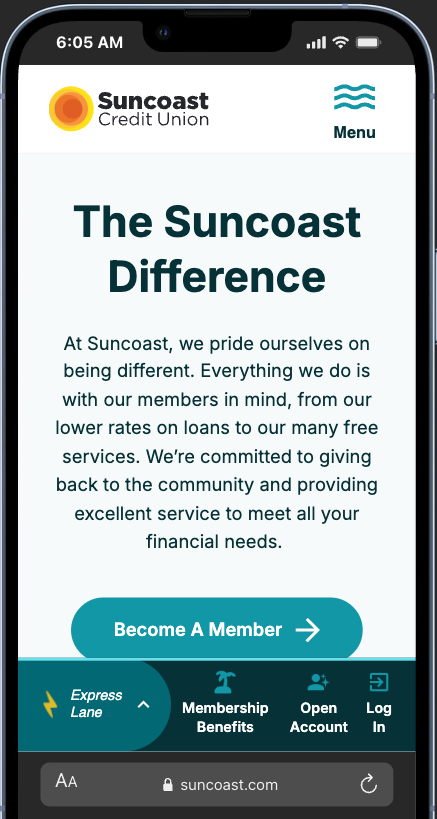
Example of a clean banking mobile interface
Roughly 67% of marketers prioritize tracking conversion rates, making optimized web experiences essential for performance improvement. These findings were analyzed from 1,200 surveyed marketers.
How to implement
- Use straightforward navigation and clear calls to action
- Ensure accessibility and strong mobile performance
- Provide transparent product details and helpful resource pages
3. Leverage AI to Enhance Your Strategy
AI tools help banks and credit unions improve personalization, automate routine marketing tasks, and uncover insights from member behavior and campaign data. For example, your bank or credit union can use AI to analyze transaction data, digital behavior, and life-stage signals to automatically group customers by needs such as first-time homebuyers, small business owners, or retirees, enabling highly targeted campaigns. This helps deliver more relevant digital experiences across channels. Several popular AI platforms include Bard, Google AI, OpenAI, and ChatGPT.
Why this matters
AI supports smarter targeting, stronger personalization, and faster decision-making, helping financial institutions improve marketing effectiveness. More than half of marketers plan to increase investment in AI-powered tools to improve efficiency and campaign performance.
How to implement
- Use AI-driven analytics to identify audience segments and product interest patterns
- Personalize email, website content, and campaigns based on behavior signals
- Automate routine reporting and performance analysis to free up team capacity
- Test AI-assisted content ideation for educational resources and product messaging
- Apply AI insights to refine onboarding, cross-sell journeys, and retention programs
4. Invest in Local SEO and Online Listings
Local SEO is one of the best marketing services for regional banks and credit unions because customers often search for “banks near me” or “credit unions near me.” Accurate and optimized listings strengthen your local presence and increase branch discovery. Mobile devices account for over half of annual web traffic, and a strong local presence helps financial brands appear where users are actively searching.
The image below shows search results for the keyword “banks near me” with Google Business Profile (GMB) results.
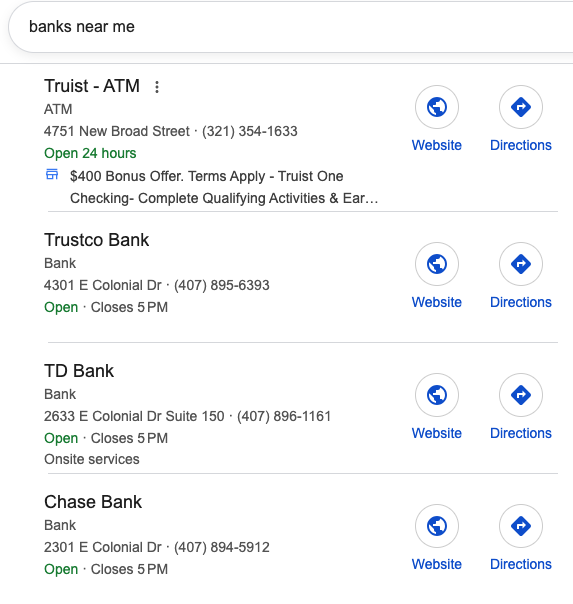
GMB optimization opportunities
Why this matters
Most banking decisions are location-driven, and appearing prominently in local search results helps capture high-intent prospects while reinforcing your credibility in the community.
How to implement
- Optimize Google Business Profiles for each branch, trying to get the profile strength to 100%
- Keep address and contact details consistent across directories
- Encourage satisfied customers and members to leave reviews
You can view the strength of your GMB profile in the top-right corner of your dashboard. Make sure to read through reviews regularly and respond when needed. This requires regular upkeep of your profile.

GMB optimized profile example
5. Create Educational Financial Content Marketing
Educational content supports customers through major financial decisions and positions your institution as a trusted resource. This type of bank marketing builds relationships rather than relying only on promotional messaging.
Why this matters
Financial education increases confidence and loyalty while also improving search visibility and long-term engagement with your institution. Over 50% of marketers plan to increase their investment in content marketing, showing how valuable long-form, educational resources remain in bank marketing strategies.
How to implement
- Publish guides on mortgages, budgeting, and credit
- Create content for specific life stages and financial goals
- Share resources across your website, email, and social channels
You can publish both evergreen content, which is generally timeless and universally relevant, and more news-related content. For example, Chase Bank regularly publishes economic outlook posts with time-sensitive content.
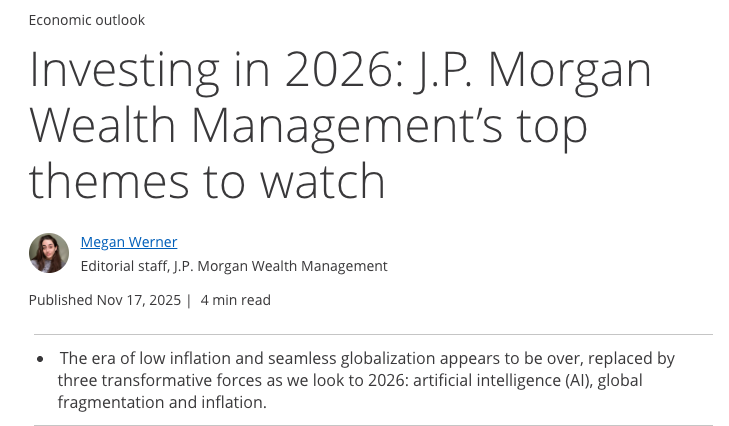
J.P Morgan (Chase) Wealth Management Article
6. Use Targeted Paid Search and Display Advertising
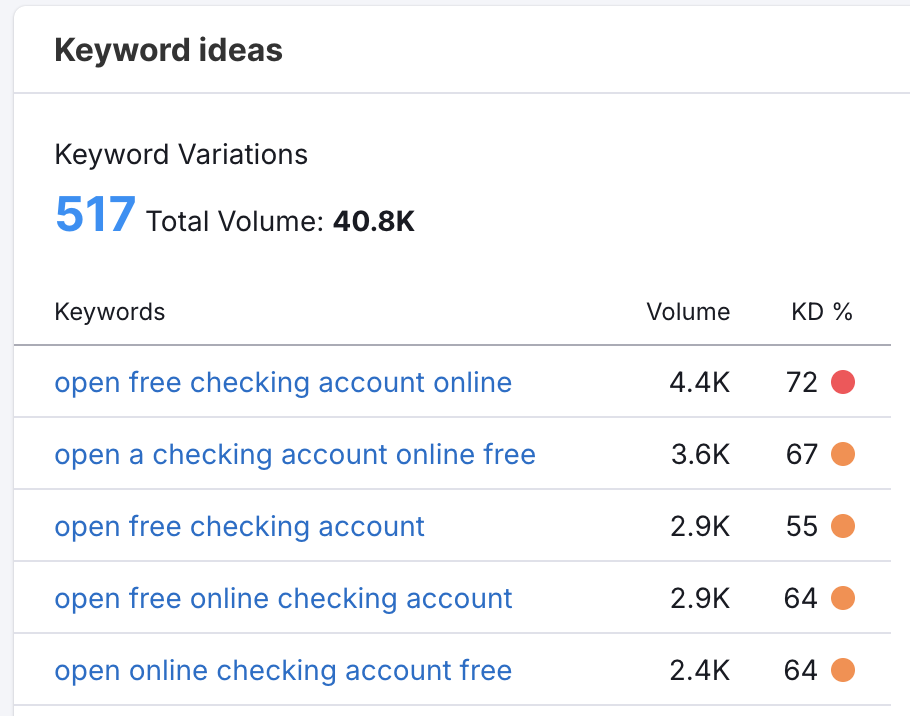
Paid campaigns help banks and credit unions reach people who are actively researching financial products. Product-specific ads paired with strong landing pages improve relevance and lead quality. Global digital ad spend is expected to hit $734.6 billion by the end of 2025. Running Google Ads is an effective intent-based strategy because prospects are actively searching for financial products and are closer to making a decision. Focus on bottom-of-the-funnel (BOFU) keywords such as “open free checking account” (2.9k monthly searches), which signals strong purchase intent.
Why this matters
Paid search reaches users at key decision moments and allows your institution to connect with audiences who are already comparing financial options.
How to implement
- Run campaigns for priority products and locations
- Use focused landing pages for each service
- Track applications, form fills, and appointment requests
7. Launch Email Marketing Programs for Education and Retention
Email remains one of the most effective channels for customer and member communication. It supports onboarding, product awareness, and financial education in a direct and relationship-driven way. Several popular email marketing programs include HubSpot, GetResponse, Constant Contact, and AWeber.
Why this matters
Email strengthens retention and builds trust by delivering helpful, relevant guidance throughout the customer lifecycle. Mobile email opens represent over half of all email engagement.
How to implement
- Send onboarding and welcome sequences
- Share helpful financial resources and guidance
- Use behavior-based segments for relevant follow-ups
8. Leverage Social Media for Visibility and Community Engagement
Social media helps banks and credit unions reinforce their local identity and humanize their brand. Sharing community involvement, education, and culture-driven content builds familiarity and approachability. The primary popular social media platforms are currently Instagram, Facebook, YouTube, TikTok, Pinterest, and LinkedIn. Determine your posting cadence for each platform and how often to review your strategy based on interactions. It’s important to use each platform for a specific goal, tailored to your unique audience. For example, TikTok videos are best suited for educational content for younger generations.
Why this matters
A strong social presence increases brand awareness and helps customers feel connected to your institution beyond transactions. Facebook continues to be one of the most widely used channels for marketing, often yielding strong ROI for brands, and social platforms play a key role in discovery and engagement.
How to implement
-
Use LinkedIn to focus on commercial banking by sharing thought leadership, business insights, and success stories to build credibility and generate business leads.
-
Facebook can help to promote consumer products like savings, checking, and mortgage accounts while engaging the local community through Reels and Live content.
-
Instagram engagement builds brand awareness and emotional connection using Reels to highlight lifestyle banking moments, financial tips, and product education.
-
TikTok videos educate Gen Z and younger millennials with short, trend-driven videos that simplify banking and financial basics.
9. Host or Sponsor Community Events
Community events demonstrate your institution’s commitment to supporting people and businesses where they live and work. In-person engagement remains a powerful trust-building channel in bank marketing.

Chatter Buzz Media at the Trustco Bank Veteran & Active Duty Run For Freedom 5K
Why this matters
Events create meaningful personal connections, strengthen local reputation, and reinforce your role as a community partner.
How to implement
- Host financial literacy workshops or webinars
- Support school and nonprofit programs
- Partner with local businesses or real estate organizations
10. Use Branch Signage and In-Location Marketing
This strategy is only relevant for banks or credit unions with traditional branches. Branches remain a valuable customer touchpoint and should reinforce your broader marketing strategy. Messaging inside the branch can highlight education, featured services, and digital banking tools.
Why this matters
In-branch communication increases awareness of available services and creates a consistent, informative experience during visits.
How to implement
- Use signage for seasonal campaigns and financial themes
- Provide brochures and resource materials
- Align in-branch messages with digital campaigns
11. Implement Referral and Word-of-Mouth Programs
Referrals are highly influential in financial decision-making. Encouraging customers and members to recommend your institution supports warm, trust-based growth. This can be done online and in person.
Why this matters
Personal recommendations carry strong credibility and often result in higher-quality, more loyal new relationships. It also offers an opportunity to give back to new and current bank customers.
How to implement
- Offer referral rewards or recognition programs
- Promote referral opportunities across channels
- Encourage employee and member advocacy
12. Build Partnerships with Local Businesses and Organizations
Partnership marketing expands your presence and reinforces your role as a financial resource in the community. These relationships create meaningful outreach opportunities.
Why this matters
Partnerships extend brand reach, support business banking growth, and strengthen community alignment.
How to implement
- Co-host educational workshops or events
- Offer employee banking benefits
- Partner with schools, nonprofits, and chambers of commerce
13. Run Social Advertising
Social advertising allows banks and credit unions to reach targeted audiences more efficiently than traditional TV commercials, with significantly lower CPMs and measurable performance. Platforms like Facebook, Instagram, LinkedIn, and TikTok enable precise targeting based on demographics, interests, and behaviors.
Why this matters
Social ads are more cost-effective, easier to optimize, and provide better visibility into ROI compared to broadcast advertising. Advanced targeting ensures your message reaches the right audience at the right stage of the customer journey.
How to implement
- Allocate budget across at least three campaigns: awareness, lead generation, and retargeting
- Use interest- and behavior-based targeting to reach high-intent and relevant audiences
- Continuously optimize creative and messaging to improve performance and reduce cost per result
14. Use Data and Analytics to Guide Marketing Strategy
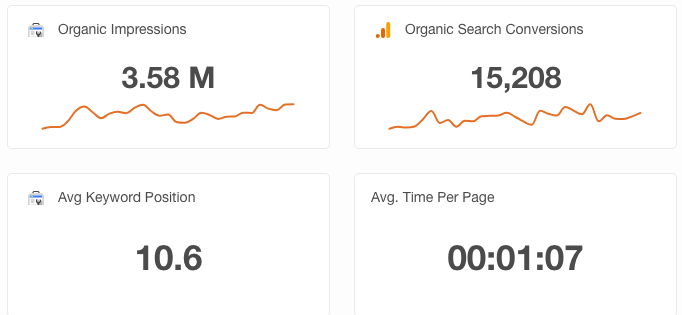
Analytics help banks and credit unions invest in the best marketing services with clarity and accountability. Performance insights improve targeting and campaign planning.
Why this matters
Data-driven decisions improve efficiency, strengthen ROI, and help marketing teams prioritize the most effective channels.
How to implement
- Monitor website engagement and conversions
- Track campaign outcomes across channels
- Align marketing data with customer research
15. Run Local Geo-Fencing Programmatic Campaigns
Geo-fencing programmatic advertising allows banks and credit unions to show digital ads to people when they enter specific physical locations. In simple terms, a virtual boundary is placed around an area, and when someone with a mobile device enters that area, they can be served your promotion across apps, websites, or streaming platforms.
Why this matters
Geo-fencing delivers highly relevant, local messaging at a lower cost than traditional sponsorships or event advertising. It allows financial institutions to reach people in real time, reduce wasted ad spend, and stay visible during high-intent moments.
How to implement
- Target specific ZIP codes, neighborhoods, or trade areas around branches
- Place geo-fences around stadiums, arenas, or large events to promote offers during high-traffic moments
- Use geo-fencing as a cost-effective alternative to sponsoring sports events while still reaching the same audience with measurable results
16. Use SEO-Driven Blogs and Resource Hubs to Capture Organic Traffic
Content marketing continues to be a core driver of organic discovery and engagement. More than half of marketers say they plan to increase content creation efforts. For banks and credit unions, producing articles that answer real questions — like “How to improve your credit score” or “What to know before a home loan” — boosts SEO while helping customers make informed decisions.
Why this matters
SEO-optimized content captures organic search traffic and positions your institution as a trusted educational resource.
How to implement
- Conduct keyword research to find high-intent search queries relevant to financial services
- Produce high-quality articles and resources that answer common questions
- Link to other educational assets to increase time on site and visibility
- Use internal linking and clear calls-to-action to drive conversions
- Update evergreen content regularly to maintain rankings
17. Utilize Video Content to Educate and Convert Online Audiences
Video has become one of the most impactful formats in digital marketing. 85% of businesses use video as a marketing tool, and many plan to increase investment in video content to improve engagement and conversions.
For financial institutions, educational video helps demystify complex topics like loans, savings strategies, digital tools, and financial planning in a way that text alone cannot.

Why this matters
Video increases engagement, helps explain complex financial topics clearly, and drives higher retention of information when compared to text-only content.
How to implement
- Create short explainer videos for products such as checking accounts, mortgages, and digital banking tools
- Publish video tutorials for mobile app navigation, fraud avoidance, or loan application steps
- Share success stories or member testimonials through video on your website and social channels
- Host live Q&A sessions on platforms like Facebook or LinkedIn to answer common financial questions
- Add captions and optimized descriptions to improve accessibility and SEO
18. Run Product-Focused Campaigns
Product-focused campaigns perform best when paired with dedicated landing pages built specifically for conversion. Unlike full websites that contain multiple navigation paths and distractions, landing pages keep users focused on one product and action.
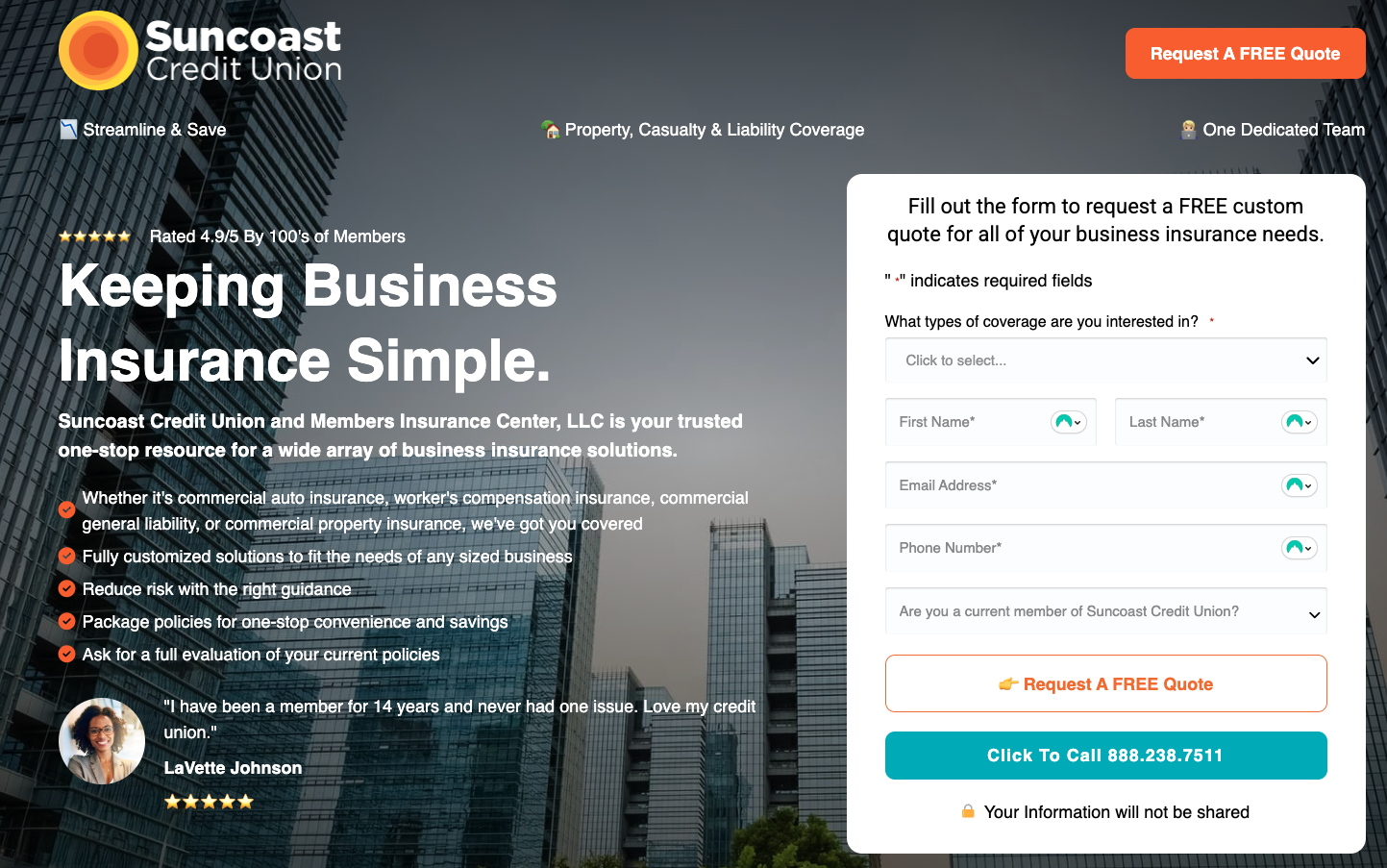
Chatter Buzz Media’s Landing Page for Suncoast Credit Union
Why this matters
Landing pages can drive conversion rates of 8–10%, compared to the typical 2–3% seen on general bank websites. A focused experience improves clarity, reduces friction, and increases the likelihood of account openings or loan applications.
How to implement
- Create a unique landing page for each promotional product or campaign
- Remove unnecessary navigation and limit the page to one primary call to action
- Align ad messaging, headlines, and offers directly with the landing page content to maximize conversions
19. Build Location-Optimized Pages by Branch
Location-optimized branch pages help banks and credit unions connect with customers searching for financial services in their local area while supporting visibility in both traditional search and AI-driven discovery. These pages should clearly communicate branch-specific details in a structured, easy-to-understand format.
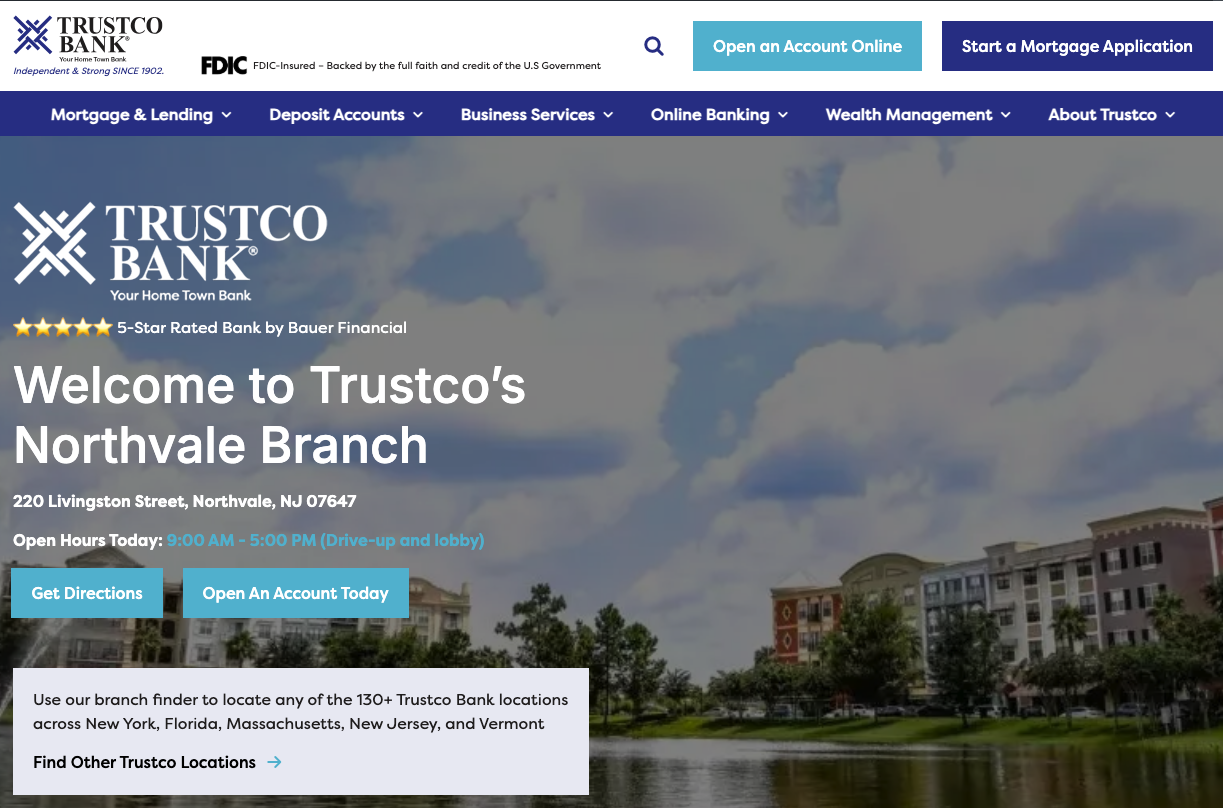
Trustco Bank’s Location-Optimized Page by Chatter Buzz Media
Why this matters
Branch pages improve local SEO performance and increase the likelihood of appearing in “near me,” city-based, and AI-powered search results. Well-structured pages help search engines and AI systems accurately understand your locations, services, and relevance, driving more qualified traffic and in-branch visits.
How to implement
- Create a dedicated page for each branch with unique content, address, hours, and service details
- Use clear headings, FAQs, and schema-friendly sections so AI and search engines can easily interpret the page
- Include maps, reviews, localized keywords, and branch-specific offers to improve visibility, trust, and conversions
20. Conversation Rate Optimization
Conversion rate optimization focuses on improving how effectively your website turns visitors into leads, account openings, and loan applications. With many banks and credit unions receiving 50K+ website visits per month, even minor improvements to messaging and user experience can drive significant growth.
Why this matters
CRO allows institutions to increase results without increasing traffic or ad spend. Data-driven testing ensures decisions are based on real user behavior, not assumptions.
How to implement
- Identify high-traffic, high-impact pages such as checking, savings, and loan product pages
- Run A/B tests on headlines, calls to action, form length, and UI/UX elements
- Use performance data to continuously refine messaging and page design to improve conversions
Conclusion
There is no single marketing strategy that guarantees success for banks and credit unions. Financial institutions can make the biggest impact through a thoughtful blend of digital innovation, educational content, community connection, trust-building communication, and data-informed decision-making.
By combining these strategies in a cohesive and consistent way, financial institutions can strengthen relationships, improve visibility, and support meaningful, long-term growth.